Species · Birds
Moustached Wren Pheugopedius genibarbis
The scientific name of the Moustached Wren is Pheugopedius genibarbis. It is a species of bird in the family Troglodytidae (wren), order Passeriformes. The name dates from 1838.
- Scientific name
- Pheugopedius genibarbis (Swainson, 1838)
- Common name
- Moustached Wren
- Genus
- Pheugopedius
- Family
- Troglodytidae (Wren)
- Order
- Passeriformes
- Class
- Aves
- Red List category
- LC Least Concern
- Recorded in
- 6 countries
- Name status
- accepted in the Catalogue of Life

Overview
The Moustached Wren (Pheugopedius genibarbis) is a bird in the family Troglodytidae, order Passeriformes, and class Aves. It occurs in Bolivia, Brazil, and Peru, throughout the central and southern Amazon Basin. It is distinguished by a white moustachial stripe, a black malar stripe, and a bright chestnut back and rump.
Written 27 November 2026 from the sources listed below. Each statement was checked against the passage it cites; statements that could not be supported were removed.
Appearance
Adult nominate Moustached Wrens have an olivaceous gray-brown crown and nape, a bright chestnut back and rump, and a dull brown tail with narrow blackish bars. Their faces have a white supercilium and eyering, a black stripe through the eye, and gray-black cheeks streaked with white.[1][2]
The nominate form has a white moustachial stripe, a black malar stripe, a white throat and upper chest, a buffy lower chest, and deeper brown flanks and belly.[3][4]
Juveniles have a browner crown, a duller and less deeply chestnut back, less defined facial markings, and more diffuse tail bars than adults.[5]
The subspecies juruanus has paler underparts and is larger than the nominate subspecies. Intercedens has a less sooty crown and duller underparts, while bolivianus has deeper ochre underparts and more gray on its face than the nominate form.[6][7][8]
The Moustached Wren measures approximately 15.5 cm in length and weighs between 16.2 and 22.8 grams.[9][10]
Habitat
The Moustached Wren inhabits forest edges, including those along rivers, and favors dense stands of Bambusa bamboo.[11][12]
Across most of its range, the species inhabits elevations from sea level to middle elevations. In Bolivia, it occurs at elevations reaching 1,500 meters.[13][14]
Diet
The Moustached Wren's diet has not been documented, but it is considered probably mostly or entirely invertebrate-based.[15]
Behaviour
The Moustached Wren forages low in vegetation.[16]
Both sexes sing a series of fast, rollicking phrases. The species also has a whining call described as jeeyr.[17][18]
Reproduction and life cycle
Four documented Moustached Wren nests in Peru's Manu National Park were domed or ball-shaped and had side entrances. Each nest contained four eggs.[19][20]
The four nests containing eggs were found in September and October. One adult incubated the eggs in each documented nest, and researchers assumed that this bird was female.[21][22]
Conservation
The Moustached Wren was assessed as Least Concern by the IUCN and was most recently assessed for the IUCN Red List in 2018.[23][24]
The species is fairly common throughout its large geographic range. Its habitat is widespread and is not excessively threatened, and the species occurs in several protected areas.[25][26][27]
Similar species
The Moustached Wren was formerly treated as conspecific with the Whiskered Wren (Pheugopedius mystacalis).[28]
Classification of the Moustached Wren
| Kingdom | Animalia |
|---|---|
| Phylum | Chordata |
| Subphylum | Vertebrata |
| Infraphylum | Gnathostomata |
| Parvphylum | Osteichthyes |
| Megaclass | Tetrapoda |
| Class | Aves (Bird) |
| Order | Passeriformes (Passerine) |
| Family | Troglodytidae (Wren) |
| Genus | Pheugopedius (Wren) |
| Species | Pheugopedius genibarbis (Swainson, 1838) |
Where the Moustached Wren is found
Checklists and occurrence records place Pheugopedius genibarbis in 6 countries. GBIF holds 35,370 georeferenced records of it.
Countries
Regions and cities with the most records
- Madre de Dios, Peru 4,947
- Mato Grosso, Brazil 4,290
- Bahia, Brazil 2,770
- Cuzco Department, Peru 1,815
- Rio de Janeiro, Brazil 1,666
- Pará, Brazil 1,664
- Goiás, Brazil 1,571
- Tocantins, Brazil 1,501
- Pernambuco, Brazil 1,346
- Santa Cruz Department, Bolivia 1,333
- Espírito Santo, Brazil 1,256
- Rondônia, Brazil 1,254
- Ceará, Brazil 1,170
- Minas Gerais, Brazil 1,084
- La Paz Department, Bolivia 1,016
- Chapada dos Guimarães, Brazil 809
- Amazonas, Brazil 785
- Puerto Maldonado, Peru 726
- Marituba, Brazil 673
- Catende, Brazil 649
- Maranhão, Brazil 641
- Cupira, Brazil 632
- Panelas, Brazil 627
- Alagoas, Brazil 623
- Acre, Brazil 613
- Tambopata, Peru 573
- Loreto, Peru 551
- Baturité, Brazil 535
- Benevides, Brazil 525
- Ananindeua, Brazil 520
- Cachoeiras de Macacu, Brazil 472
- Santa Bárbara do Pará, Brazil 435
- Santa Isabel do Pará, Brazil 433
- Beni Department, Bolivia 430
- São Lourenço da Mata, Brazil 391
- Abreu e Lima, Brazil 387
A number beside a place is its count of GBIF occurrence records. A place without a number comes from a checklist alone. Records show where a species has been observed or collected, which can include escapes and vagrants.
Common names
English
- Moustached Wren
Names in 23 other languages
- Catalan
- cargolet mostatxut meridional
- Chinese
- 须苇鹪鹩, 鬚葦鷦鷯
- Croatian
- prugastolici palčić
- Czech
- střízlík vousatý
- Danish
- Skægsmutte
- Dutch
- Knevelwinterkoning
- Esperanto
- liphara troglodito
- Finnish
- viiksipeukaloinen
- French
- Troglodyte à moustaches
- German
- Wangenstreif-Zaunkönig, Wangenstreifzaunkönig
- Italian
- Scricciolo dai mustacchi
- Japanese
- シロヒゲマユミソサザイ
- Lithuanian
- mažoji ūsuotoji krūmyninė karietaitė
- Norwegian
- skjeggsmett
- Polish
- strzyżal wąsaty
- Portuguese
- Garrincha-de-bigode, carriça-de-bigodes-brasileira, garrinchão-pai-avô
- Russian
- Усатый крапивник, Усатый кустарниковый крапивник
- Serbian
- Brkati carić
- Slovak
- oriešok pruholíci
- Spanish
- Cucarachero bigotudo brasileño, cucarachero bigotudo
- Swedish
- mustaschgärdsmyg
- Turkish
- Amazon Bıyıklı Çıtkuşu
- Ukrainian
- поплітник вусатий
Synonyms
2 other scientific names have been used for this species and are now treated as synonyms of Pheugopedius genibarbis.
- Thryothorus genibarbis Swainson, 1838
- Thryothorus genibarbis genibarbis Swainson, WJ, 1838
Subspecies and varieties
- Pheugopedius genibarbis bolivianus subspecies
- Pheugopedius genibarbis genibarbis subspecies
- Pheugopedius genibarbis intercedens subspecies
- Pheugopedius genibarbis juruanus subspecies
Related species
-
 Happy WrenPheugopedius felix
-
 Rufous-breasted WrenPheugopedius rutilus
-
 Coraya WrenPheugopedius coraya
-
 Spot-breasted WrenPheugopedius maculipectus
-
 Black-bellied WrenPheugopedius fasciatoventris
-
 Black-throated WrenPheugopedius atrogularis
-
 Whiskered WrenPheugopedius mystacalis
-
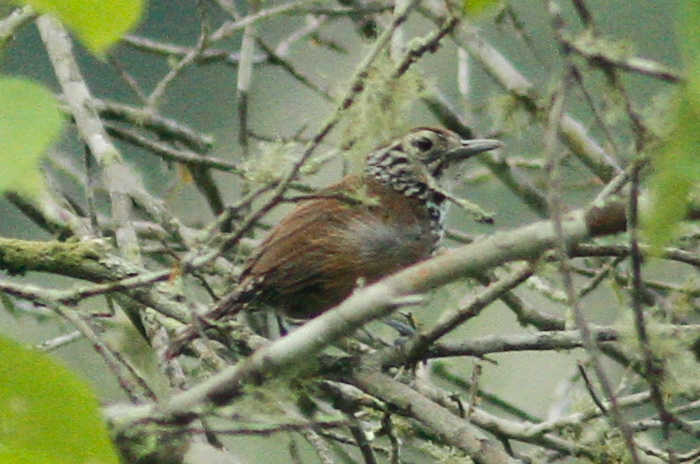 Speckle-breasted WrenPheugopedius sclateri
Compare
Questions and answers
What is the scientific name of the Moustached Wren?
The scientific name of the Moustached Wren is Pheugopedius genibarbis. Written with its author, the full name is Pheugopedius genibarbis (Swainson, 1838).
Which family does the Moustached Wren belong to?
Pheugopedius genibarbis belongs to the family Troglodytidae, in the order Passeriformes and the class Aves.
Where is the Moustached Wren found?
Checklists and occurrence records place Pheugopedius genibarbis in 6 countries: Brazil, Peru, Bolivia, Colombia, Venezuela and Ecuador.
What is the conservation status of the Moustached Wren?
The IUCN Red List category recorded for Pheugopedius genibarbis is Least Concern (LC).
What does the bird wren eat?
The Moustached Wren's diet is considered probably mostly or entirely invertebrate-based, although it has not been documented.[15]
Sources
Passages the profile rests on
- Adult nominate Moustached Wrens have an olivaceous gray-brown crown and nape, a bright chestnut back and rump, and a dull brown tail with narrow blackish bars. Source passage: “The nominate adult has an olivaceous gray-brown crown and nape, bright chestnut back and rump, and a dull brown tail with narrow blackish bars.” — English Wikipedia
- The adult nominate form has a white supercilium and eyering, a black stripe through the eye, and gray-black cheeks streaked with white. Source passage: “It has a white supercilium and eyering, a black stripe through the eye, gray-black cheeks streaked with white” — English Wikipedia
- The nominate form has a white moustachial stripe and a black malar stripe. Source passage: “a white moustachial stripe, and a black malar stripe.” — English Wikipedia
- The nominate adult has a white throat and upper chest, a buffy lower chest, and deeper brown flanks and belly. Source passage: “Its throat and upper chest are white, its lower chest buffy, and its flanks and belly deeper brown.” — English Wikipedia
- Juveniles have a browner crown, a duller and less deeply chestnut back, less defined facial markings, and more diffuse tail bars than adults. Source passage: “the juvenile's crown is browner, its back duller and less deeply chestnut, and it has less well defined facial markings and more diffuse bars on the tail.” — English Wikipedia
- The subspecies juruanus has paler underparts and is larger than the nominate subspecies. Source passage: “P. g. juruanus is larger than the nominate and its underparts are paler.” — English Wikipedia
- The subspecies intercedens has a less sooty crown and duller underparts than the nominate form. Source passage: “P. g. intercedens' crown is less sooty and its underparts are duller than the nominate's.” — English Wikipedia
- The subspecies bolivianus has deeper ochre underparts and more gray on its face than the nominate form. Source passage: “P. g. bolivianus is similar to intercedens but its underparts are a deeper ochre compared to the nominate's buff and it has more gray on the face.” — English Wikipedia
- The Moustached Wren measures approximately 15.5 cm in length. Source passage: “The moustached wren is 15.5 cm (6.1 in) long” — English Wikipedia
- The Moustached Wren weighs between 16.2 and 22.8 grams. Source passage: “weighs 16.2 to 22.8 g (0.57 to 0.80 oz).” — English Wikipedia
- The Moustached Wren inhabits forest edges, including those along rivers. Source passage: “It inhabits forest edge, including along rivers” — English Wikipedia
- The species favors dense stands of Bambusa bamboo. Source passage: “and favors dense stands of Bambusa bamboo.” — English Wikipedia
- In Bolivia, the species occurs at elevations reaching 1,500 meters. Source passage: “In elevation it ranges as high as 1,500 m (4,900 ft) in Bolivia” — English Wikipedia
- Across most of its range, the species inhabits elevations from sea level to middle elevations. Source passage: “but generally only from sea level to middle elevations.” — English Wikipedia
- The Moustached Wren's diet has not been documented, but it is considered probably mostly or entirely invertebrate-based. Source passage: “Though its diet has not been documented, it is probably mostly or entirely invertebrates.” — English Wikipedia
- The Moustached Wren forages low in vegetation. Source passage: “The moustached wren forages low in vegetation” — English Wikipedia
- Both sexes of the Moustached Wren sing a series of fast, rollicking phrases. Source passage: “Both sexes of moustached wren sing "a series of fast rollicking phrases"” — English Wikipedia
- The species has a whining call described as jeeyr. Source passage: “Their call is "a whining 'jeeyr'"” — English Wikipedia
- Four documented Moustached Wren nests in Peru's Manu National Park were domed or ball-shaped and had side entrances. Source passage: “Four nests of the moustached wren found in Peru's Manu National Park were domed or ball-like with a side entrance.” — English Wikipedia
- Each of the four documented nests contained four eggs. Source passage: “They were all found with four eggs, in September and October.” — English Wikipedia
- The four documented nests containing eggs were found in September and October. Source passage: “They were all found with four eggs, in September and October.” — English Wikipedia
- One adult incubated the eggs in the documented nests, and researchers assumed that this bird was female. Source passage: “One adult incubated the eggs; it was assumed to be the female.” — English Wikipedia
- The Moustached Wren was assessed as Least Concern by the IUCN. Source passage: “The IUCN has assessed the moustached wren as being of Least Concern.” — English Wikipedia
- The Moustached Wren was most recently assessed for the IUCN Red List in 2018. Source passage: “Moustached Wren Pheugopedius genibarbis has most recently been assessed for The IUCN Red List of Threatened Species in 2018.” — iucnredlist.org
- The species is fairly common throughout its large geographic range. Source passage: “It is fairly common over its large range” — English Wikipedia
- The species' habitat is widespread and is not excessively threatened. Source passage: “its habitat is widespread and not excessively threatened” — English Wikipedia
- The Moustached Wren occurs in several protected areas. Source passage: “and it occurs in several protected areas.” — English Wikipedia
- The Moustached Wren was formerly treated as conspecific with the Whiskered Wren (Pheugopedius mystacalis). Source passage: “The moustached wren was at one time treated as conspecific with the whiskered wren (Pheugopedius mystaclais).” — English Wikipedia
Data
- Catalogue of Life, 2026-10-16 XR cc by
- Global Biodiversity Information Facility CC BY 4.0
- Wikidata CC0
- GeoNames CC BY 4.0
- Wikimedia Commons per image; credit shown with each image
- Within the Catalogue of Life, this name comes from The Integrated Taxonomic Information System cc0
This species in other databases
Page built on 29 November 2026. See how the catalog is made and all sources and licences.
Cite this page
ScientificNames.org. (2026). Pheugopedius genibarbis (Moustached Wren). Retrieved November 29, 2026, from https://scientificnames.org/species/pheugopedius-genibarbis
“Pheugopedius genibarbis (Moustached Wren).” ScientificNames.org, 2026, scientificnames.org/species/pheugopedius-genibarbis. Accessed 29 Nov. 2026.
ScientificNames.org. “Pheugopedius genibarbis (Moustached Wren).” Accessed November 29, 2026. https://scientificnames.org/species/pheugopedius-genibarbis.
@misc{scientificnames_pheugopedius_genibarbis_moustached_wren,
  author = {{ScientificNames.org}},
  title = {Pheugopedius genibarbis (Moustached Wren)},
  year = {2026},
  url = {https://scientificnames.org/species/pheugopedius-genibarbis},
  note = {Accessed 2026-11-29}
}