Species · Birds
Whiskered Wren Pheugopedius mystacalis
The scientific name of the Whiskered Wren is Pheugopedius mystacalis. It is a species of bird in the family Troglodytidae (wren), order Passeriformes. The name dates from 1860.
- Scientific name
- Pheugopedius mystacalis (P. L. Sclater, 1860)
- Common name
- Whiskered Wren
- Genus
- Pheugopedius
- Family
- Troglodytidae (Wren)
- Order
- Passeriformes
- Class
- Aves
- Red List category
- LC Least Concern
- Recorded in
- 3 countries
- Name status
- accepted in the Catalogue of Life

Overview
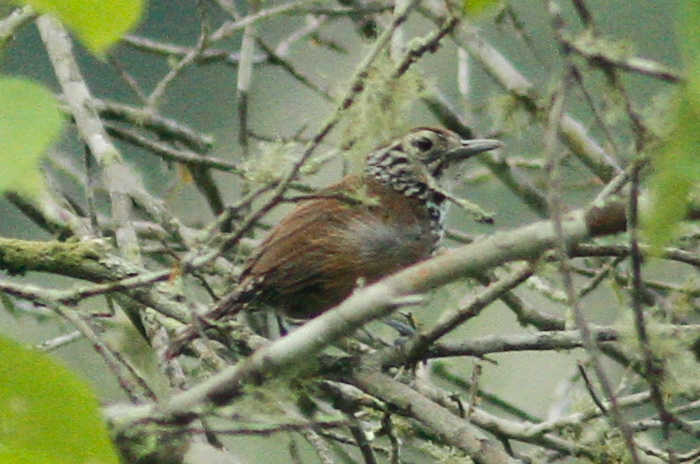
Pheugopedius mystacalis occurs in Colombia, Ecuador, and Venezuela. The adult nominate subspecies has bright chestnut shoulders, back, and rump, a reddish-brown tail with dull black bars, and distinctive black and white facial markings.
Written 27 November 2026 from the sources listed below. Each statement was checked against the passage it cites; statements that could not be supported were removed.
Similar species
The Whiskered Wren was formerly treated as the same species as the Moustached Wren (Pheugopedius genibarbis).[1]
Appearance
The Whiskered Wren measures approximately 16 cm in length. A Venezuelan specimen weighed 29 g.[2][3]
The adult nominate subspecies has a grayish-black crown and an olivaceous-gray nape. Its shoulders, back, and rump are bright chestnut, and its reddish-brown tail has dull black bars.[4][5][6]
The adult nominate subspecies has a grayish-white supercilium and a black line passing through the eye. Its blackish cheeks have a white line below them and a black malar stripe beneath that.[7][8]
The adult nominate subspecies has an off-white chin and throat, a gray chest that becomes olivaceous gray on the belly, and reddish-gray flanks.[9][10][11]
Juveniles are duller than adults, with less prominent facial markings and a buffy throat.[12]
The subspecies P. m. saltuensis has a grayer chest and less distinct tail bars than the nominate subspecies. P. m. yanachae has a slate-gray crown, while P. m. macrurus has a dingy-brown tail.[13][14][15]
The subspecies P. m. amaurogaster has a sooty-brown crown and ochraceous-tawny underparts. P. m. consobrinus has a buffy-tinged supercilium and buffy neck and chest.[16][17]
The subspecies P. m. tachirensis has a dusky-olive crown and white throat and is darker than P. m. consobrinus. P. m. ruficaudatus has additional buff coloration on its face and lacks tail bars.[18][19]
The species comprises eight recognized subspecies.[20]
Habitat
The Whiskered Wren inhabits dense undergrowth at the edges of humid forests and in regenerating clearings. It avoids the interior of forests.[21][22]
It generally occurs at elevations between 1,200 and 2,400 m and has been recorded as high as 2,800 m. In Ecuador, it occurs at elevations almost reaching sea level.[23][24][25]
The nominate subspecies P. m. mystacalis occurs in southern Colombia and western Ecuador. P. m. saltuensis occurs in the West and Central Andes of Colombia, while P. m. yanachae occurs in the Nariño Department of southwestern Colombia.[26][27][28]
The subspecies P. m. macrurus occurs on the eastern slope of the Central Andes and western slope of the Eastern Andes in Colombia. P. m. amaurogaster occurs on the eastern slope of Colombia's Eastern Andes.[29][30]
The subspecies P. m. consobrinus occurs in the Serranía del Perijá and the Venezuelan Andes from southern Lara south to Mérida. P. m. tachirensis occurs in southern Táchira in southwestern Venezuela.[31][32]
The subspecies P. m. ruficaudatus occurs in northern Venezuela from central Falcón and Yaracuy east to Miranda.[33]
Behaviour
The Whiskered Wren forages in pairs at heights of up to 10–12 m above the ground.[34]
Both male and female Whiskered Wrens sing together in duets consisting of loud, gurgling whistles. The species also produces a deep, throaty call described as a repeated bong sound.[35][36][37]
Reproduction and life cycle
The Whiskered Wren appears to have a long breeding season. Nest building has been observed between December and May.[38][39]
It builds a large spherical nest from roots and grass, with an entrance on the side. The nest is usually placed in the fork of a small tree or among ferns.[40][41]
Conservation
The Whiskered Wren is classified as Least Concern by the IUCN. It was most recently assessed for the IUCN Red List in 2018.[42][43]
It is quite common across much of its geographical range and occurs in several protected areas.[44][45]
Classification of the Whiskered Wren
| Kingdom | Animalia |
|---|---|
| Phylum | Chordata |
| Subphylum | Vertebrata |
| Infraphylum | Gnathostomata |
| Parvphylum | Osteichthyes |
| Megaclass | Tetrapoda |
| Class | Aves (Bird) |
| Order | Passeriformes (Passerine) |
| Family | Troglodytidae (Wren) |
| Genus | Pheugopedius (Wren) |
| Species | Pheugopedius mystacalis (P. L. Sclater, 1860) |
Where the Whiskered Wren is found
Checklists and occurrence records place Pheugopedius mystacalis in 3 countries. GBIF holds 46,021 georeferenced records of it.
Countries
Regions and cities with the most records
- Caldas Department, Colombia 7,542
- Villamaría, Colombia 5,870
- Manizales, Colombia 5,830
- Chinchiná, Colombia 5,646
- Antioquia, Colombia 5,124
- Neira, Colombia 5,110
- Valle del Cauca Department, Colombia 4,846
- Tolima Department, Colombia 4,830
- Cali, Colombia 3,228
- Santa Rosa de Cabal, Colombia 3,171
- Manzanares, Colombia 3,076
- Circasia, Colombia 3,028
- Risaralda Department, Colombia 2,998
- Dosquebradas, Colombia 2,749
- Padua, Colombia 2,743
- Fresno, Colombia 2,703
- Pereira, Colombia 2,639
- Yumbo, Colombia 2,468
- Pichincha, Ecuador 2,437
- San Antonio de Los Altos, Venezuela 2,420
- Quindío Department, Colombia 2,408
- Baruta, Venezuela 2,307
- Caracas, Venezuela 2,296
- El Hatillo, Venezuela 2,294
- Cundinamarca, Colombia 2,283
- Itagüí, Colombia 2,162
- Envigado, Colombia 2,143
- La Estrella, Colombia 2,131
- Miranda, Venezuela 2,087
- Huila Department, Colombia 2,063
- Carrizal, Venezuela 1,949
- Medellín, Colombia 1,922
- Caldas, Colombia 1,881
- Los Teques, Venezuela 1,787
- Chacao, Venezuela 1,747
- Calarcá, Colombia 1,597
A number beside a place is its count of GBIF occurrence records. A place without a number comes from a checklist alone. Records show where a species has been observed or collected, which can include escapes and vagrants.
Common names
English
- Whiskered Wren
Names in 22 other languages
- Catalan
- cargolet mostatxut septentrional
- Chinese
- 髭鷦鷯, 髯苇鹪鹩
- Croatian
- sivokapi palčić
- Czech
- střízlík andský
- Danish
- Hvidskægget Smutte
- Dutch
- Andeswinterkoning
- Esperanto
- anda troglodito
- Finnish
- kolumbianviiksipeukaloinen, pulisonkipeukaloinen
- French
- Troglodyte à favoris
- German
- Bartstreif-Zaunkönig, Bartstreifzaunkönig
- Italian
- Scricciolo baffuto
- Japanese
- ハイガシラマユミソサザイ
- Lithuanian
- didžioji ūsuotoji krūmyninė karietaitė
- Norwegian
- fjellskjeggsmett
- Polish
- strzyżal białobrewy
- Portuguese
- carriça-de-bigodes-andina, garrinchão-de-suíças
- Russian
- Бородатый крапивник, Бородатый кустарниковый крапивник
- Slovak
- oriešok fúzatý
- Spanish
- Cucarachero bigotudo montano
- Swedish
- andinsk gärdsmyg
- Turkish
- And Bıyıklı Çıtkuşu
- Ukrainian
- поплітник смугастощокий
Synonyms
3 other scientific names have been used for this species and are now treated as synonyms of Pheugopedius mystacalis.
- Thryothorus genibarbis mystacalis Sclater, PL, 1860
- Thryothorus mystacalis P. L. Sclater, 1860
- Thryothorus mystacalis mystacalis Sclater, PL, 1860
Subspecies and varieties
- Pheugopedius mystacalis amaurogaster subspecies
- Pheugopedius mystacalis consobrinus subspecies
- Pheugopedius mystacalis macrurus subspecies
- Pheugopedius mystacalis mystacalis subspecies
- Pheugopedius mystacalis ruficaudatus subspecies
- Pheugopedius mystacalis saltuensis subspecies
- Pheugopedius mystacalis tachirensis subspecies
- Pheugopedius mystacalis yananchae subspecies
Related species
-
 Happy WrenPheugopedius felix
-
 Rufous-breasted WrenPheugopedius rutilus
-
 Coraya WrenPheugopedius coraya
-
 Spot-breasted WrenPheugopedius maculipectus
-
 Black-bellied WrenPheugopedius fasciatoventris
-
 Black-throated WrenPheugopedius atrogularis
-
 Moustached WrenPheugopedius genibarbis
-
 Speckle-breasted WrenPheugopedius sclateri
Compare
Questions and answers
What is the scientific name of the Whiskered Wren?
The scientific name of the Whiskered Wren is Pheugopedius mystacalis. Written with its author, the full name is Pheugopedius mystacalis (P. L. Sclater, 1860).
Which family does the Whiskered Wren belong to?
Pheugopedius mystacalis belongs to the family Troglodytidae, in the order Passeriformes and the class Aves.
Where is the Whiskered Wren found?
Checklists and occurrence records place Pheugopedius mystacalis in 3 countries: Colombia, Venezuela and Ecuador.
What is the conservation status of the Whiskered Wren?
The IUCN Red List category recorded for Pheugopedius mystacalis is Least Concern (LC).
Sources
Passages the profile rests on
- The Whiskered Wren was formerly treated as the same species as the Moustached Wren (Pheugopedius genibarbis). Source passage: “The whiskered wren was at one time treated as conspecific with the moustached wren (Pheugopedius genibarbis).” — English Wikipedia
- The Whiskered Wren measures approximately 16 cm in length. Source passage: “The whiskered wren is 16 cm (6.3 in) long;” — English Wikipedia
- A Venezuelan specimen of the Whiskered Wren weighed 29 g. Source passage: “a specimen from Venezuela weighed 29 g (1.0 oz).” — English Wikipedia
- The adult nominate subspecies has a grayish-black crown and an olivaceous-gray nape. Source passage: “The nominate adult has a grayish-black crown, olivaceous gray nape,” — English Wikipedia
- The adult nominate subspecies has bright chestnut shoulders, back, and rump. Source passage: “bright chestnut shoulders, back, and rump,” — English Wikipedia
- The adult nominate subspecies has a reddish-brown tail marked with dull black bars. Source passage: “and a reddish brown tail with dull black bars.” — English Wikipedia
- The adult nominate subspecies has a grayish-white supercilium and a black line passing through the eye. Source passage: “It has a grayish white supercilium, a black line through the eye,” — English Wikipedia
- The adult nominate subspecies has blackish cheeks with a white line below them and a black malar stripe beneath that. Source passage: “blackish cheeks with a white line below and a black malar stripe below that.” — English Wikipedia
- The adult nominate subspecies has an off-white chin and throat. Source passage: “The chin and throat are off-white,” — English Wikipedia
- The adult nominate subspecies has a gray chest that becomes olivaceous gray on the belly. Source passage: “the chest gray darkening to olivaceous gray on the belly,” — English Wikipedia
- The adult nominate subspecies has reddish-gray flanks. Source passage: “and the flanks reddish gray.” — English Wikipedia
- Juvenile Whiskered Wrens are duller than adults, with less prominent facial markings and a buffy throat. Source passage: “The juvenile is duller than the adult with less prominent facial markings and a buffy throat.” — English Wikipedia
- The subspecies P. m. saltuensis has a grayer chest and less distinct tail bars than the nominate subspecies. Source passage: “P. m. saltuensis has a grayer chest and less distinct bars on the tail.” — English Wikipedia
- The subspecies P. m. yanachae has a slate-gray crown. Source passage: “P. m. yanachae has a slate-gray crown.” — English Wikipedia
- The subspecies P. m. macrurus has a dingy-brown tail. Source passage: “P. m. macrurus' tail is dingy brown.” — English Wikipedia
- The subspecies P. m. amaurogaster has a sooty-brown crown and ochraceous-tawny underparts. Source passage: “P. m. amaurogaster is much darker with a sooty brown crown and ochraceous tawny underparts.” — English Wikipedia
- The subspecies P. m. consobrinus has a buffy-tinged supercilium and buffy neck and chest. Source passage: “P. m. consobrinus has a buffy tinge to the supercilium and a buffy neck and chest.” — English Wikipedia
- The subspecies P. m. tachirensis has a dusky-olive crown and white throat and is darker than P. m. consobrinus. Source passage: “P. m. tachirensis is darker than consobrinus with a dusky olive crown and white throat.” — English Wikipedia
- The subspecies P. m. ruficaudatus has additional buff coloration on its face and lacks tail bars. Source passage: “P. m. ruficaudatus has more buff on its face and no bars on the tail.” — English Wikipedia
- The species comprises eight recognized subspecies. Source passage: “It has eight subspecies:” — English Wikipedia
- The Whiskered Wren inhabits dense undergrowth at the edges of humid forests and in regenerating clearings. Source passage: “The whiskered wren inhabits dense undergrowth such as is found at the edge of humid forest and in regrowing clearings.” — English Wikipedia
- The Whiskered Wren avoids the interior of forests. Source passage: “It shuns the forest interior.” — English Wikipedia
- The Whiskered Wren generally occurs at elevations between 1,200 and 2,400 m. Source passage: “In elevation it generally ranges between 1,200 and 2,400 m (3,900 and 7,900 ft)” — English Wikipedia
- The Whiskered Wren has been recorded at elevations as high as 2,800 m. Source passage: “but can be found as high as 2,800 m (9,200 ft)” — English Wikipedia
- In Ecuador, the Whiskered Wren occurs at elevations almost reaching sea level. Source passage: “and in Ecuador almost down to sea level.” — English Wikipedia
- The subspecies P. m. saltuensis occurs in the West and Central Andes of Colombia. Source passage: “P. m. saltuensis, the West and Central Andes of Colombia” — English Wikipedia
- The subspecies P. m. yanachae occurs in the Nariño Department of southwestern Colombia. Source passage: “P. m. yanachae, southwestern Colombia's Nariño Department” — English Wikipedia
- The nominate subspecies P. m. mystacalis occurs in southern Colombia and western Ecuador. Source passage: “P. m. mystacalis, southern Colombia and western Ecuador” — English Wikipedia
- The subspecies P. m. macrurus occurs on the eastern slope of the Central Andes and western slope of the Eastern Andes in Colombia. Source passage: “P. m. macrurus, Colombia, the eastern slope of the Central Andes and western slope of the Eastern Andes” — English Wikipedia
- The subspecies P. m. amaurogaster occurs on the eastern slope of Colombia's Eastern Andes. Source passage: “P. m. amaurogaster eastern slope of Colombia's eastern Andes” — English Wikipedia
- The subspecies P. m. consobrinus occurs in the Serranía del Perijá and the Venezuelan Andes from southern Lara south to Mérida. Source passage: “P. m. consobrinus, the Serranía del Perijá and Andes of western Venezuela from southern Lara south to Mérida” — English Wikipedia
- The subspecies P. m. tachirensis occurs in southern Táchira in southwestern Venezuela. Source passage: “P. m. tachirensis, southern Táchira in southwestern Venezuela” — English Wikipedia
- The subspecies P. m. ruficaudatus occurs in northern Venezuela from central Falcón and Yaracuy east to Miranda. Source passage: “P. m. ruficaudatus, northern Venezuela from central Falcón and Yaracuy east to Miranda” — English Wikipedia
- The Whiskered Wren forages in pairs at heights of up to 10–12 m above the ground. Source passage: “The whiskered wren forages in pairs as high as 10 to 12 m (33 to 39 ft) above ground.” — English Wikipedia
- Both male and female Whiskered Wrens sing together in duets. Source passage: “Both sexes of whiskered wren sing in duet,” — English Wikipedia
- The Whiskered Wren's duet consists of loud, gurgling whistles. Source passage: “a splendid series of loud gurgling whistles” — English Wikipedia
- The Whiskered Wren produces a deep, throaty call described as a repeated bong sound. Source passage: “a deep throaty 'bong bong'” — English Wikipedia
- The Whiskered Wren appears to have a long breeding season. Source passage: “The whiskered wren appears to have a long breeding season;” — English Wikipedia
- Nest building in the Whiskered Wren has been observed between December and May. Source passage: “nest building has been observed from December to May.” — English Wikipedia
- The Whiskered Wren builds a large spherical nest from roots and grass, with an entrance on the side. Source passage: “The nest is a large ball of roots and grass with a side entrance,” — English Wikipedia
- The Whiskered Wren usually places its nest in the fork of a small tree or among ferns. Source passage: “usually placed in the fork of a small tree or in ferns.” — English Wikipedia
- The Whiskered Wren is classified as Least Concern by the IUCN. Source passage: “The IUCN has assessed the whiskered wren as being of Least Concern.” — English Wikipedia
- The Whiskered Wren was most recently assessed for the IUCN Red List in 2018. Source passage: “Whiskered Wren Pheugopedius mystacalis has most recently been assessed for The IUCN Red List of Threatened Species in 2018.” — iucnredlist.org
- The Whiskered Wren is quite common across much of its geographical range. Source passage: “In much of its range it is quite common” — English Wikipedia
- The Whiskered Wren occurs in several protected areas. Source passage: “and it is found in several protected areas.” — English Wikipedia
Data
- Catalogue of Life, 2026-10-16 XR cc by
- Global Biodiversity Information Facility CC BY 4.0
- Wikidata CC0
- GeoNames CC BY 4.0
- Wikimedia Commons per image; credit shown with each image
- Within the Catalogue of Life, this name comes from The Integrated Taxonomic Information System cc0
This species in other databases
Page built on 29 November 2026. See how the catalog is made and all sources and licences.
Cite this page
ScientificNames.org. (2026). Pheugopedius mystacalis (Whiskered Wren). Retrieved November 29, 2026, from https://scientificnames.org/species/pheugopedius-mystacalis
“Pheugopedius mystacalis (Whiskered Wren).” ScientificNames.org, 2026, scientificnames.org/species/pheugopedius-mystacalis. Accessed 29 Nov. 2026.
ScientificNames.org. “Pheugopedius mystacalis (Whiskered Wren).” Accessed November 29, 2026. https://scientificnames.org/species/pheugopedius-mystacalis.
@misc{scientificnames_pheugopedius_mystacalis_whiskered_wren,
  author = {{ScientificNames.org}},
  title = {Pheugopedius mystacalis (Whiskered Wren)},
  year = {2026},
  url = {https://scientificnames.org/species/pheugopedius-mystacalis},
  note = {Accessed 2026-11-29}
}