Species · Birds
Reddish-winged Bare-eye Phlegopsis erythroptera
The scientific name of the Reddish-winged Bare-eye is Phlegopsis erythroptera. It is a species of bird in the family Thamnophilidae (antbird), order Passeriformes. The name dates from 1855.
- Scientific name
- Phlegopsis erythroptera (Gould, 1855)
- Common name
- Reddish-winged Bare-eye
- Genus
- Phlegopsis
- Family
- Thamnophilidae (Antbird)
- Order
- Passeriformes
- Class
- Aves
- Red List category
- LC Least Concern
- Recorded in
- 6 countries
- Name status
- accepted in the Catalogue of Life

Overview
The Reddish-winged Bare-eye is a large antbird. It primarily inhabits the understorey of humid terra firme evergreen forest and also occurs in subtropical or tropical moist lowland forests. Both sexes have a large ring of bare red skin surrounding each eye.
Written 27 November 2026 from the sources listed below. Each statement was checked against the passage it cites; statements that could not be supported were removed.
Appearance
The Reddish-winged Bare-eye is a large antbird with a bare red eye-ring. Both sexes have a large ring of bare red skin surrounding each eye.[1][2]
Adult males of the nominate subspecies are predominantly black, with white feather edges on their upperparts and lesser wing coverts. Subadult males resemble adults but are grayer and have a rufous tinge.[3][4]
Adult females have dark reddish-brown crowns, upperparts and wing coverts, with white tips on the coverts. Their flight feathers are blackish-brown, with white tips on the tertials, and their blackish-brown tails are crossed by a pale band.[5][6]
Adult females have a tawny-tinged white central throat and rufous coloration extending from the face to the center of the belly. Their flanks and vent are rufous-brown.[7][8]
Males of the subspecies P. e. ustulata have entirely black uppertail coverts. Females of this subspecies have pale buff tips on their wing coverts.[9][10]
The species measures between 17 and 18.5 cm in length and weighs between 50 and 58 g.[11][12]
Habitat
The Reddish-winged Bare-eye primarily inhabits the understorey of humid terra firme evergreen forest. It also occurs in subtropical or tropical moist lowland forests.[13][14]
Along the upper Rio Negro, it also occurs in stunted woodlands growing on white sand soils.[15]
Diet
The Reddish-winged Bare-eye feeds on arthropods fleeing from foraging army ant swarms, primarily those of Eciton burchelli.[16]
Behaviour
The Reddish-winged Bare-eye is an obligate follower of army ants. It typically forages alone, in pairs or in family groups.[17][18]
While foraging, individuals usually perch within approximately one metre of the ground but sometimes perch as high as three metres. They capture prey by sallying or pouncing onto the ground and occasionally make short aerial sallies.[19][20][21]
The species also searches for prey by flipping leaves on the ground. Several pairs or family groups may attend the same army ant swarm.[22][23]
Members of a pair sometimes follow different army ant swarms. The Reddish-winged Bare-eye is dominant over most other ant-following bird species.[24][25]
The species is believed to remain resident throughout its geographical range year-round.[26]
Conservation
The Reddish-winged Bare-eye is classified as Least Concern by the IUCN and has a very large geographical range. It was most recently assessed for the IUCN Red List in 2018.[27][28][29]
The population size is unknown and is believed to be decreasing. No immediate threats to the species have been identified.[30][31]
The species is generally uncommon, scarce in Ecuador and rare to uncommon in Peru. It occurs in some large protected areas and extensive areas of intact habitat without formal protection.[32][33]
The Reddish-winged Bare-eye is considered highly sensitive to human disturbance.[34]
Classification of the Reddish-winged Bare-eye
| Kingdom | Animalia |
|---|---|
| Phylum | Chordata |
| Subphylum | Vertebrata |
| Infraphylum | Gnathostomata |
| Parvphylum | Osteichthyes |
| Megaclass | Tetrapoda |
| Class | Aves (Bird) |
| Order | Passeriformes (Passerine) |
| Family | Thamnophilidae (Antbird) |
| Genus | Phlegopsis (Bare-eyes) |
| Species | Phlegopsis erythroptera (Gould, 1855) |
Where the Reddish-winged Bare-eye is found
Checklists and occurrence records place Phlegopsis erythroptera in 6 countries across South America. GBIF holds 971 georeferenced records of it.
Countries
Regions and cities with the most records
- Amazonas, Brazil 228
- Loreto, Peru 147
- Orellana Province, Ecuador 132
- Sucumbíos, Ecuador 93
- Napo, Ecuador 87
- Vaupés, Colombia 45
- Mitú, Colombia 39
- Novo Airão, Brazil 35
- Amazonas Department, Colombia 27
- Manacapuru, Brazil 22
- Boca Suno, Ecuador 20
- Acre, Brazil 18
- Guaviare Department, Colombia 15
- Caquetá, Colombia 14
- Pastaza Province, Ecuador 14
- San José del Guaviare, Colombia 14
- Amazonas, Venezuela 11
- Rondônia, Brazil 11
- Meta Department, Colombia 10
- Atalaia do Norte, Brazil 9
- Nueva Loja, Ecuador 8
- Pando, Bolivia 7
- Iquitos, Peru 5
- San Juan, Peru 5
- Cobija, Bolivia 4
- Iranduba, Brazil 4
- Manaquiri, Brazil 4
- Putumayo Department, Colombia 4
- São Gabriel da Cachoeira, Brazil 4
- Tena, Ecuador 4
- Careiro, Brazil 3
- Ucayali, Peru 3
Range as the checklists state it
South America
A number beside a place is its count of GBIF occurrence records. A place without a number comes from a checklist alone. Records show where a species has been observed or collected, which can include escapes and vagrants.
Common names
English
- Reddish-winged Bare-eye
Names in 24 other languages
- Catalan
- formiguera ala-rogenca
- Chinese
- 紅翅裸眼雀, 红翅裸眼蚁鸟
- Croatian
- crvenolica mravarica
- Czech
- mravenčík rudočerný
- Danish
- Rødvinget Nøgenøje
- Dutch
- Roodvleugelmiertimalia
- Esperanto
- ruĝflugila formikulo
- Finnish
- pensaskaljusilmä
- French
- Batara à miroir roux, Fourmilier à miroir roux
- German
- Rotspiegel-Ameisenvogel
- Italian
- Occhionudo alirossicce
- Japanese
- アカバネホノオアリドリ
- Lithuanian
- rusvasparnė plikaakė skruzdėpaukštė
- Norwegian
- rødvingemaurvokter
- Polish
- gołook czarny
- Portuguese
- formigueiro-d'asa-ruiva, mãe-de-taoca-avermelhada
- Russian
- Рыжекрылая гологлазка, Рыжекрылая очковая муравьянка
- Serbian
- Golooka sa crvenim krilima
- Slovak
- mravcosled hrdzavokrídly
- Spanish
- Hormiguero alirrojo
- Swedish
- rödvingad myrfågel
- Turkish
- Kırmızı Kanatlı Gözüçıplak Karıncakuşu
- Ukrainian
- рудоок чорний
- Welsh
- llygadfoel adeingoch
Synonyms
One other scientific name has been used for this species and is now treated as a synonym of Phlegopsis erythroptera.
- Formicarius erythropterus Gould, 1855
Subspecies and varieties
- Phlegopsis erythroptera erythroptera subspecies
- Phlegopsis erythroptera ustulata subspecies
Related species
-
 Black-spotted Bare-eyePhlegopsis nigromaculata
- Pale-faced Bare-eyePhlegopsis borbae
-
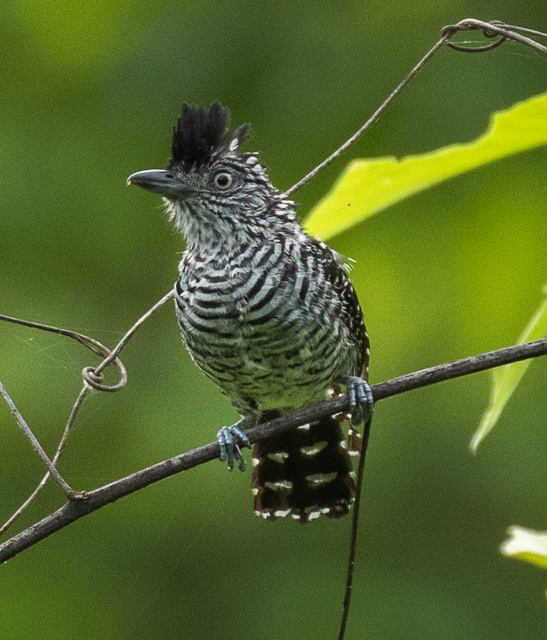 Barred AntshrikeThamnophilus doliatus
-
 Great AntshrikeTaraba major
-
 Black-crowned AntshrikeThamnophilus atrinucha
-
 Ocellated AntbirdPhaenostictus mcleannani
-
 Bicolored AntbirdGymnopithys bicolor
-
 Fasciated AntshrikeCymbilaimus lineatus
Compare
Questions and answers
What is the scientific name of the Reddish-winged Bare-eye?
The scientific name of the Reddish-winged Bare-eye is Phlegopsis erythroptera. Written with its author, the full name is Phlegopsis erythroptera (Gould, 1855).
Which family does the Reddish-winged Bare-eye belong to?
Phlegopsis erythroptera belongs to the family Thamnophilidae, in the order Passeriformes and the class Aves.
Where is the Reddish-winged Bare-eye found?
Checklists and occurrence records place Phlegopsis erythroptera in 6 countries: Brazil, Ecuador, Peru, Colombia, Venezuela and Bolivia.
What is the conservation status of the Reddish-winged Bare-eye?
The IUCN Red List category recorded for Phlegopsis erythroptera is Least Concern (LC).
Are there any birds that have red eyes?
The Reddish-winged Bare-eye has a large ring of bare red skin surrounding each eye.[1]
Sources
Passages the profile rests on
- Both sexes have a large ring of bare red skin surrounding each eye. Source passage: “Both sexes have a large ring of bare red skin around the eye.” — English Wikipedia
- The species is described as a large antbird with a bare red eye-ring. Source passage: “Large, handsome antbird with a bare red eye-ring.” — ebird.org
- Adult males of the nominate subspecies are predominantly black with white feather edges on their upperparts and lesser wing coverts. Source passage: “Adult males of the nominate subspecies are mostly black. They have white edges on the feathers of their upperparts and lesser wing coverts.” — English Wikipedia
- Subadult males resemble adult males but are grayer and have a rufous tinge. Source passage: “Subadult males have the same pattern as adults but are grayer and have a rufous tinge.” — English Wikipedia
- Adult females have dark reddish-brown crowns, upperparts and wing coverts with white tips on the coverts. Source passage: “Adult females have a very dark reddish brown crown, upperparts, and wing coverts with white tips on the coverts.” — English Wikipedia
- Adult females have blackish-brown flight feathers with white tips on the tertials and a blackish-brown tail crossed by a pale band. Source passage: “Their flight feathers are blackish brown with white tips on the tertials; their tail is blackish brown with a pale band across it.” — English Wikipedia
- Adult females have a tawny-tinged white central throat. Source passage: “The center of their throat is tawny-tinged white.” — English Wikipedia
- Adult females have rufous coloration from the face to the center of the belly and rufous-brown flanks and vent. Source passage: “Their face to the center of their belly are rufous and their flanks and vent area are rufous-brown.” — English Wikipedia
- Males of the subspecies P. e. ustulata have entirely black uppertail coverts. Source passage: “Males of subspecies P. e. ustulata have completely black uppertail coverts” — English Wikipedia
- Females of the subspecies P. e. ustulata have pale buff tips on their wing coverts. Source passage: “Females have pale buff tips on their wing coverts.” — English Wikipedia
- The reddish-winged bare-eye measures between 17 and 18.5 cm in length. Source passage: “The reddish-winged bare-eye is 17 to 18.5 cm (6.7 to 7.3 in) long” — English Wikipedia
- The reddish-winged bare-eye weighs between 50 and 58 g. Source passage: “weighs 50 to 58 g (1.8 to 2.0 oz).” — English Wikipedia
- The species primarily inhabits the understorey of humid terra firme evergreen forest. Source passage: “The species primarily inhabits the understorey of humid terra firme evergreen forest.” — English Wikipedia
- The species occurs in subtropical or tropical moist lowland forests. Source passage: “Its natural habitat is subtropical or tropical moist lowland forests.” — inaturalist.org
- Along the upper Rio Negro, the species also occurs in stunted woodlands growing on white sand soils. Source passage: “Along the upper Rio Negro it also occurs in stunted woodlands growing on white sand soils.” — English Wikipedia
- The reddish-winged bare-eye feeds on arthropods fleeing from foraging army ant swarms, primarily those of Eciton burchelli. Source passage: “feeds on a variety of arthropods that flee foraging army ant swarms, primarily those of Eciton burchelli.” — English Wikipedia
- The reddish-winged bare-eye is an obligate follower of army ants. Source passage: “The reddish-winged bare-eye is an obligate ant follower” — English Wikipedia
- The species typically forages alone, in pairs or in family groups. Source passage: “It typically forages individually, in pairs, and in family groups” — English Wikipedia
- While foraging, individuals usually perch within approximately one metre of the ground but sometimes perch as high as three metres. Source passage: “perching within about 1 m (3 ft) of the ground (though sometimes as high as 3 m (10 ft))” — English Wikipedia
- The species captures prey by sallying or pouncing onto the ground. Source passage: “and sallying or pouncing to the ground after prey.” — English Wikipedia
- The reddish-winged bare-eye occasionally makes short aerial sallies while foraging. Source passage: “It occasionally makes short aerial sallies” — English Wikipedia
- The species also searches for prey by flipping leaves on the ground. Source passage: “and also flips leaves on the ground to find prey.” — English Wikipedia
- Several pairs or family groups may attend the same army ant swarm. Source passage: “Several pairs or family groups may attend an ant swarm” — English Wikipedia
- Members of a pair sometimes follow different army ant swarms. Source passage: “but sometimes members of a pair follow different swarms.” — English Wikipedia
- The reddish-winged bare-eye is dominant over most other ant-following bird species. Source passage: “It is dominant over most other ant followers.” — English Wikipedia
- The species is believed to remain resident throughout its geographical range year-round. Source passage: “The reddish-winged bare-eye is believed to be a year-round resident throughout its range.” — English Wikipedia
- The reddish-winged bare-eye is classified as Least Concern by the IUCN. Source passage: “The IUCN has assessed the reddish-winged bare-eye as being of Least Concern.” — English Wikipedia
- The species has a very large geographical range. Source passage: “It has a very large range;” — English Wikipedia
- The species was most recently assessed for the IUCN Red List in 2018. Source passage: “Reddish-winged Bare-eye Phlegopsis erythroptera has most recently been assessed for The IUCN Red List of Threatened Species in 2018.” — iucnredlist.org
- The population size of the reddish-winged bare-eye is unknown and is believed to be decreasing. Source passage: “its population size is not known and is believed to be decreasing.” — English Wikipedia
- No immediate threats to the species have been identified. Source passage: “No immediate threats have been identified.” — English Wikipedia
- The species is generally uncommon, scarce in Ecuador and rare to uncommon in Peru. Source passage: “It is considered generally uncommon, "scarce" in Ecuador, and "rare to uncommon" in Peru.” — English Wikipedia
- The reddish-winged bare-eye occurs in some large protected areas and extensive areas of intact habitat without formal protection. Source passage: “It occurs in a few large protected areas and also in "extensive areas of intact habitat that are not formally protected” — English Wikipedia
- The species is considered highly sensitive to human disturbance. Source passage: “It is thought to be highly sensitive to human disturbance.” — English Wikipedia
Data
- Catalogue of Life, 2026-10-16 XR cc by
- Global Biodiversity Information Facility CC BY 4.0
- Wikidata CC0
- GeoNames CC BY 4.0
- Wikimedia Commons per image; credit shown with each image
- Within the Catalogue of Life, this name comes from The Integrated Taxonomic Information System cc0
References
- Gill, Frank, & and Minturn Wright. (2006). Birds of the World: Recommended English Names.
This species in other databases
Page built on 29 November 2026. See how the catalog is made and all sources and licences.
Cite this page
ScientificNames.org. (2026). Phlegopsis erythroptera (Reddish-winged Bare-eye). Retrieved November 29, 2026, from https://scientificnames.org/species/phlegopsis-erythroptera
“Phlegopsis erythroptera (Reddish-winged Bare-eye).” ScientificNames.org, 2026, scientificnames.org/species/phlegopsis-erythroptera. Accessed 29 Nov. 2026.
ScientificNames.org. “Phlegopsis erythroptera (Reddish-winged Bare-eye).” Accessed November 29, 2026. https://scientificnames.org/species/phlegopsis-erythroptera.
@misc{scientificnames_phlegopsis_erythroptera_reddish_winged_bare_eye,
  author = {{ScientificNames.org}},
  title = {Phlegopsis erythroptera (Reddish-winged Bare-eye)},
  year = {2026},
  url = {https://scientificnames.org/species/phlegopsis-erythroptera},
  note = {Accessed 2026-11-29}
}