Species · Birds
Black-footed Albatross Phoebastria nigripes
The scientific name of the Black-footed Albatross is Phoebastria nigripes. It is a species of bird in the family Diomedeidae (albatross), order Procellariiformes. The name dates from 1839.
- Scientific name
- Phoebastria nigripes (Audubon, 1839)
- Common name
- Black-footed Albatross
- Genus
- Phoebastria
- Family
- Diomedeidae (Albatross)
- Order
- Procellariiformes
- Class
- Aves
- Red List category
- NT Near Threatened
- Environment
- marine, terrestrial
- Recorded in
- 8 countries
- Name status
- accepted in the Catalogue of Life

Overview
Phoebastria nigripes occurs throughout the North Pacific, from Japan to the western coast of the United States. Adults have predominantly dark brown to black plumage, white markings beneath the eyes and around the base of the bill and tail, and dark legs, feet, and bill.
Written 26 November 2026 from the sources listed below. Each statement was checked against the passage it cites; statements that could not be supported were removed.
Appearance
The adult has predominantly dark brown to black plumage, with white markings beneath the eyes and around the base of the bill and tail. Its legs, feet, and bill are dark.[1][2]
Some adults have white undertail coverts. Young birds are uniformly dark when they hatch and develop the adult white markings as they age.[3][4]
Habitat
Outside the breeding season, the species inhabits open ocean waters. It commonly occurs over continental shelf breaks and along boundaries between water masses.[5][6]
Its nesting habitat includes sandy, wind-swept beaches. During incubation and chick-rearing, individuals travel to cooler and more productive marine waters, while during brooding they are restricted to relatively low-productivity waters near their breeding colonies.[7][8][9]
The species selects cooler sea surface temperatures during long-ranging movements.[10]
Diet
The species consumes squid, fish, other invertebrates, flying fish eggs, fish offal, and smaller quantities of crustaceans. Flying fish eggs and adult flying fish are important components of its diet.[11][12][13]
It also consumes floating debris, including plastic. It obtains food through surface-seizing, contact dipping, and scavenging.[14][15]
Behaviour
Individuals use ritualized dance displays to establish pair bonds. The species produces shrieks and squeals during food-related fights and bill-clapping, whistles, groans, and quacks during courtship.[16][17]
Individuals migrate thousands of kilometres between breeding colonies and summer foraging grounds. They spend a greater proportion of their foraging time in flight than other albatross species during the brooding period.[18][19]
Individuals range farther and forage for longer during incubation and chick-rearing than during brooding.[20]
Reproduction and life cycle
The species reaches sexual maturity at an average age of seven years. It is monogamous, and pair bonds generally persist until one partner disappears or dies.[21][22]
Breeding pairs generally reproduce once every two years. Females lay a single egg per clutch during November and December.[23][24][25]
The egg is dull white with reddish-brown spots and measures approximately 10.8 cm long and 7 cm wide. Its average incubation period is approximately 66 days.[26][27][28]
Both parents participate in incubating the egg, with males generally incubating for longer. Chicks hatch during January and February.[29][30]
Parents brood their chicks for several days and guard them for up to one month. They feed their chicks by regurgitating food into their bills.[31][32]
Chicks generally fledge after approximately 140 days, during June and July.[33][34]
Conservation
The species is classified as Near Threatened by the IUCN. Its population is currently experiencing a slight decline.[35][36]
Longline fishing causes substantial incidental mortality. An estimated 6,150 individuals are killed annually through fisheries bycatch according to more recent estimates.[37][38]
The species is vulnerable to oil pollution and ingestion of floating plastic. Its population experienced severe historical declines due to feather hunting, introduced rabbits, and military culling.[39][40]
The species is listed as threatened by the state of Hawaii. It is protected under the Migratory Bird Treaty Act.[41][42]
Similar species
The species overlaps geographically with the Laysan albatross and short-tailed albatross.[43]
Classification of the Black-footed Albatross
| Kingdom | Animalia |
|---|---|
| Phylum | Chordata |
| Subphylum | Vertebrata |
| Infraphylum | Gnathostomata |
| Parvphylum | Osteichthyes |
| Megaclass | Tetrapoda |
| Class | Aves (Bird) |
| Order | Procellariiformes (Petrels) |
| Family | Diomedeidae (Albatross) |
| Genus | Phoebastria (North Pacific Albatross) |
| Species | Phoebastria nigripes (Audubon, 1839) |
Where the Black-footed Albatross is found
Checklists and occurrence records place Phoebastria nigripes in 8 countries across Asia, North America and Oceania. GBIF holds 45,615 georeferenced records of it.
Countries
- Canada 2,828
- China 6
- Japan 2,170
- Mexico 778
- Northern Mariana Islands 8
- Taiwan 1,096
- United States 36,563
- United States Minor Outlying Islands 2,166
Regions and cities with the most records
- Pacific Grove, United States 3,238
- Monterey, United States 3,021
- Marina, United States 1,711
- Seaside, United States 1,686
- California, United States 1,409
- Santa Cruz, United States 624
- Hawaii, United States 500
- Live Oak, United States 418
- Alaska, United States 245
- Koolauloa, United States 146
- Watsonville, United States 138
- Eureka, United States 110
- British Columbia, Canada 107
- Prunedale, United States 104
- Pacifica, United States 84
- Tokyo, Japan 83
- Oregon, United States 63
- Miura, Japan 61
- Kurihama, Japan 59
- Arcata, United States 54
- Baja California, Mexico 54
- Bayside, United States 51
- Millbrae, United States 45
- Yokosuka, Japan 44
- Hayama, Japan 43
- Zushi, Japan 42
- Kanagawa, Japan 40
- Burlingame, United States 39
- San Bruno, United States 37
- Washington, United States 37
- Salinas, United States 35
- Makiki / Lower Punchbowl / Tantalus, United States 32
- Diamond Head / Kapahulu / Saint Louis Heights, United States 31
- Hokkaido, Japan 31
- Manoa, United States 31
- Waikīkī, United States 31
1 more country has a few records outside this range
These countries hold a few records of Phoebastria nigripes but lie outside the range the checklists give for it. Such records are often zoo or garden specimens, museum material or vagrants, so the species is not counted as occurring there.
Range as the checklists state it
North America
Southern Asia
Oceania
A number beside a place is its count of GBIF occurrence records. A place without a number comes from a checklist alone. Records show where a species has been observed or collected, which can include escapes and vagrants.
Common names
English
- Black-footed Albatross
- Black Gooney
- Brown Gooney
Names in 35 other languages
- Arabic
- قطرس أسود الرجلين
- Breton
- Albatroz pavioù du
- Bulgarian
- Чернокрак албатрос
- Catalan
- albatros camanegre
- Chinese
- 黑脚信天翁, 黑腳信天翁
- Czech
- albatros černonohý
- Danish
- Sortfodet Albatros
- Dutch
- zwartvoetalbatros
- Esperanto
- nigrapieda albatroso
- Estonian
- tõmmualbatross
- Finnish
- mustajalka-albatrossi
- French
- Albatros à pieds noirs
- German
- Schwarzfußalbatros
- Hawaiian
- Ka'upu
- Hungarian
- feketelábú albatrosz
- Icelandic
- Húmtrosi
- Irish
- Alabatras cosdubh
- Italian
- Albatros piedineri, albatro piedineri
- Japanese
- クロアシアホウドリ
- Korean
- 검은발알바트로스
- Latvian
- melnkāju albatross
- Lithuanian
- juodakojis albatrosas
- Northern Sami
- Čáhppesjuolalbatrossa
- Norwegian
- svartfotalbatross
- Polish
- albatros czarnonogi
- Portuguese
- Albatroz-de-patas-negras, albatroz-de-patas-pretas
- Russian
- Черноногий альбатрос
- Serbian
- Crnonogi albatros
- Slovak
- albatros čiernonohý
- Slovenian
- črnonogi albatros
- Spanish
- Albatros Patas Negras, Albatros pata negra, Albatros patinegro
- Swedish
- svartfotad albatross
- Turkish
- Kara Ayaklı Albatros
- Ukrainian
- альбатрос чорноногий
- chm
- Шим ялан альбатрос
Synonyms
8 other scientific names have been used for this species and are now treated as synonyms of Phoebastria nigripes.
- Campephilus nigripes (Audubon, 1839)
- Diomedea nigripes Audubon, 1839
- Diomedea nigripes nigripes Cramp & Simmons, 1977
- Diomedea nigripes nigripes Sibley & Monroe, 1990 [1993]
- Diomedea nigripes nigripes Stotz et al., 1996
- Diomedea nigripes nigripes Turbott, 1990
- Phoebastria nigripes nigripes Audubon, JJ, 1839
- Phoebastria nigripes reischekia Mathews, GM, 1930
Related species
-
 Laysan AlbatrossPhoebastria immutabilis
-
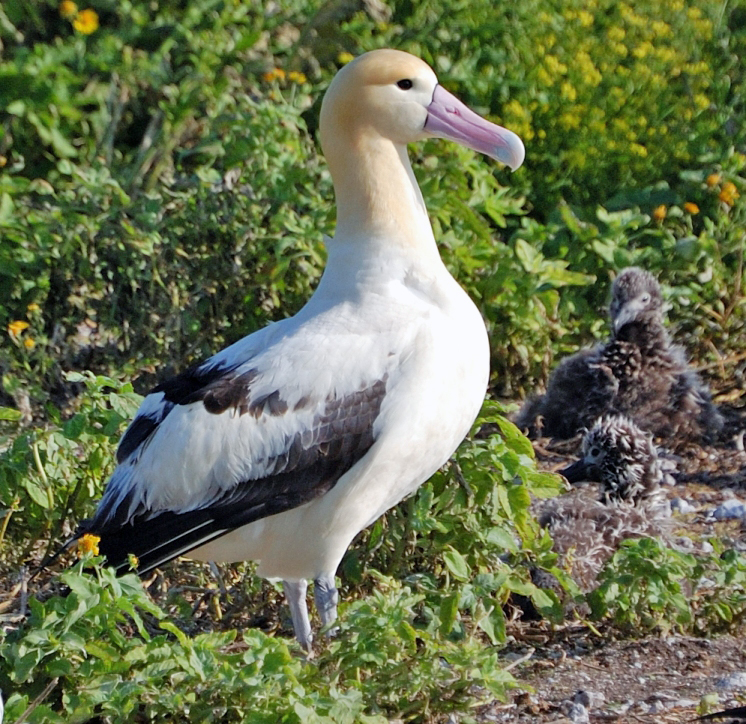 Short-tailed AlbatrossPhoebastria albatrus
-
 Waved AlbatrossPhoebastria irrorata
-
 Snowy AlbatrossDiomedea exulans
-
 Southern Royal AlbatrossDiomedea epomophora
-
 Black-browed AlbatrossThalassarche melanophris
-
 Shy AlbatrossThalassarche cauta
-
 Tristan AlbatrossDiomedea dabbenena
Compare
Questions and answers
What is the scientific name of the Black-footed Albatross?
The scientific name of the Black-footed Albatross is Phoebastria nigripes. Written with its author, the full name is Phoebastria nigripes (Audubon, 1839).
Which family does the Black-footed Albatross belong to?
Phoebastria nigripes belongs to the family Diomedeidae, in the order Procellariiformes and the class Aves.
Where is the Black-footed Albatross found?
Checklists and occurrence records place Phoebastria nigripes in 8 countries, including United States, Canada, Japan, United States Minor Outlying Islands, Taiwan and Mexico.
What is the conservation status of the Black-footed Albatross?
The IUCN Red List category recorded for Phoebastria nigripes is Near Threatened (NT).
What other names does the Black-footed Albatross have?
Phoebastria nigripes is also known in English as Black Gooney and Brown Gooney.
How rare is a black-footed albatross?
The species is classified as Near Threatened by the IUCN, and its population is currently experiencing a slight decline. Approximately 97.5% of the population occurs in the Northwestern Hawaiian Islands.[44][35][36]
What describes the habitat of an albatross?
The Black-footed Albatross inhabits open ocean waters outside the breeding season and commonly occurs over continental shelf breaks and along boundaries between water masses. Its nesting habitat includes sandy, wind-swept beaches.[5][6][7]
Sources
Passages the profile rests on
- The adult has predominantly dark brown to black plumage, with white markings beneath the eyes and around the base of the bill and tail. Source passage: “It is dark brown to black in color with black legs, bill, and feet. Adults have white under the eyes, at the base of the bill, and base of the tail.” — adfg.alaska.gov
- The species has dark legs, feet, and bill. Source passage: “Its beak and feet are also all dark.” — English Wikipedia
- Some adult individuals have white undertail coverts. Source passage: “Some adults show white undertail coverts” — English Wikipedia
- Young birds are uniformly dark when they hatch and develop the adult white markings as they age. Source passage: “When the chicks are born, they are uniformly dark colored. They will gain the white coloration pattern of adults as they age.” — adfg.alaska.gov
- Outside the breeding season, the species inhabits open ocean waters. Source passage: “Outside the breeding season, the black-footed albatross is an open ocean species.” — adfg.alaska.gov
- The species commonly occurs over continental shelf breaks and along boundaries between water masses. Source passage: “They are most commonly seen over shelf breaks and along boundaries between water masses.” — adfg.alaska.gov
- Its nesting habitat includes sandy, wind-swept beaches. Source passage: “They utilize sandy, wind-swept beaches for their nesting sites.” — adfg.alaska.gov
- During incubation and chick-rearing, individuals travel to cooler and more productive marine waters. Source passage: “During incubation and chick-rearing, they travel to cooler, more productive waters” — pmc.ncbi.nlm.nih.gov
- During brooding, individuals are restricted to relatively low-productivity waters near their breeding colonies. Source passage: “During brooding, however, they are restricted to the oligotrophic waters close to their breeding colonies, where prey abundance is likely lower” — pmc.ncbi.nlm.nih.gov
- The species selects cooler sea surface temperatures during long-ranging movements. Source passage: “Habitat selection during long-ranging movements was most strongly associated with sea surface temperature for both species, with a preference for cooler ocean temperatures compared to overall availability.” — pmc.ncbi.nlm.nih.gov
- The species consumes flying fish eggs, live fish, fish offal, squid, and smaller quantities of crustaceans. Source passage: “taking the eggs of flying fish, live fish, fish offal, squid and to a lesser extent crustaceans.” — English Wikipedia
- Its principal prey groups are squid, fish, and other invertebrates. Source passage: “Its primary prey species include squid, fish, and other invertebrates.” — adfg.alaska.gov
- Flying fish eggs and adult flying fish are important components of its diet. Source passage: “They mainly feeds on flying fish (Exocoetidae) egg masses and adults, and ...” — seamap.env.duke.edu
- The species also consumes floating debris, including plastic. Source passage: “It will also consume floating debris, including plastics.” — English Wikipedia
- The species obtains food through surface-seizing, contact dipping, and scavenging. Source passage: “It forages by surface-seizing, contact dipping, and scavenging.” — adfg.alaska.gov
- Individuals use ritualized dance displays to establish pair bonds. Source passage: “Pair bonds between black-footed albatrosses are formed through ritualized dance displays.” — adfg.alaska.gov
- The species produces shrieks and squeals during food-related fights and bill-clapping, whistles, groans, and quacks during courtship. Source passage: “Their vocalizations range from shrieks and squeals while fighting over food to bill-clapping, whistles, groans, and quacks while courting.” — English Wikipedia
- Individuals migrate thousands of kilometres between breeding colonies and summer foraging grounds. Source passage: “They migrate up to thousands of kilometers between their breeding colonies and summer foraging grounds.” — adfg.alaska.gov
- Individuals spend a greater proportion of their foraging time in flight than other albatross species during the brooding period. Source passage: “Compared to other albatross species, Laysan and black-footed albatrosses spend a greater proportion of time in flight when foraging, especially during the brooding period” — pmc.ncbi.nlm.nih.gov
- Individuals range farther and forage for longer during incubation and chick-rearing than during brooding. Source passage: “Individuals of both species ranged significantly farther and for longer durations during incubation and chick-rearing compared to the brooding period.” — pmc.ncbi.nlm.nih.gov
- The species reaches sexual maturity at an average age of seven years. Source passage: “The average age of sexual maturity for black-footed albatross is 7.” — adfg.alaska.gov
- The species is monogamous, and pair bonds generally persist until one partner disappears or dies. Source passage: “The black-footed albatross is monogamous and pair bonds are maintained until one of the pair disappears or dies.” — adfg.alaska.gov
- Breeding pairs generally reproduce once every two years. Source passage: “They will start reproducing after about seven years, mating every two years.” — English Wikipedia
- Females lay a single egg per clutch. Source passage: “Sexually mature black-footed albatross females lay only one egg per clutch.” — adfg.alaska.gov
- Eggs are laid during November and December. Source passage: “Eggs are laid in November-December.” — adfg.alaska.gov
- The egg is dull white with reddish-brown spots. Source passage: “one dull white with reddish brown spots egg is laid.” — English Wikipedia
- Eggs measure approximately 10.8 cm long and 7 cm wide. Source passage: “Eggs of this species measure 10.8 cm (4.3 in) in length and 7 cm (2.8 in) in width” — English Wikipedia
- The egg has an average incubation period of approximately 66 days. Source passage: “The average incubation period is 66 days.” — adfg.alaska.gov
- Both parents participate in incubating the egg, with males generally incubating for longer. Source passage: “Both birds incubate the egg, the male incubating more” — English Wikipedia
- Chicks hatch during January and February. Source passage: “Chicks hatch in January and February.” — adfg.alaska.gov
- Parents brood their chicks for several days and guard them for up to one month. Source passage: “The chicks are brooded by their parents for several days and guarded for up to one month.” — adfg.alaska.gov
- Parents feed their chicks by regurgitating food into their bills. Source passage: “The chick is fed regurgitated food by sticking its bill inside that of its parent.” — English Wikipedia
- Chicks generally fledge after approximately 140 days. Source passage: “Fledging occurs after 140 days.” — English Wikipedia
- Fledging generally occurs during June and July. Source passage: “The chicks fledge in June-July.” — adfg.alaska.gov
- The species is classified as Near Threatened by the IUCN. Source passage: “The black-footed albatross is considered near threatened by the IUCN” — English Wikipedia
- The population is currently experiencing a slight decline. Source passage: “However, the population is currently experiencing a slight decline.” — adfg.alaska.gov
- Longline fishing causes substantial incidental mortality in the species. Source passage: “because it is taken incidentally by longline fishing.” — English Wikipedia
- An estimated 6,150 individuals are killed annually through fisheries bycatch according to more recent estimates reported in the document. Source passage: “more recent estimates are at around 6,150 per year” — English Wikipedia
- The species is vulnerable to oil pollution and ingestion of floating plastic. Source passage: “It is also vulnerable to oil pollution in the water, and to the ingestion of floating plastics” — English Wikipedia
- The population experienced severe historical declines due to feather hunting, introduced rabbits, and military culling. Source passage: “In the late 1800s and early 1900s, black-footed albatrosses were almost wiped out by feather hunters. Later, rabbits were introduced to their breeding colonies and destroyed their nesting habitat. In the 1950s and 1960s, the birds were culled by the military” — adfg.alaska.gov
- The species is listed as threatened by the state of Hawaii. Source passage: “Listed as threatened by the state of Hawaii.” — adfg.alaska.gov
- The species is protected under the Migratory Bird Treaty Act. Source passage: “Protected under the Migratory Bird Treaty Act.” — adfg.alaska.gov
- The species overlaps geographically with the Laysan albatross and short-tailed albatross. Source passage: “The range of the black-footed albatross overlaps with two other albatross species: the short-tailed albatross and the Laysan albatross.” — adfg.alaska.gov
- Approximately 97.5% of the population occurs in the Northwestern Hawaiian Islands. Source passage: “97.5% of the total population is found colonially on the isolated Northwestern Hawaiian Islands” — English Wikipedia
- The species occurs throughout the North Pacific, from Japan to the western coast of the United States. Source passage: “Range/Distribution Throughout the North Pacific from Japan to the US West Coast” — adfg.alaska.gov
- Breeding populations occur on the Japanese islands of Tori Shima, Bonin, and Senkaku. Source passage: “Small populations can be found on the Japanese islands of Tori Shima, Bonin, and Senkaku” — English Wikipedia
- The species also breeds on offshore Mexican islands, including Isla Guadalupe. Source passage: “and off the Mexican coast, primarily on Isla Guadalupe.” — English Wikipedia
Data
- Catalogue of Life, 2026-10-16 XR cc by
- Global Biodiversity Information Facility CC BY 4.0
- Wikidata CC0
- GeoNames CC BY 4.0
- Wikimedia Commons per image; credit shown with each image
- Within the Catalogue of Life, this name comes from The Integrated Taxonomic Information System cc0
References
- Ornithol. Biogr., 5: 327. 1839 where the name was published
- Dickinson, Edward C., ed. (2003). The Howard and Moore Complete Checklist of the Birds of the World, 3rd Edition.
- Gill, Frank, & and Minturn Wright. (2006). Birds of the World: Recommended English Names.
- Fish and Wildlife Service, U. S. (2007). Endangered and Threatened Wildlife and Plants; 90-Day Finding on a Petition to List the Black-Footed Albatross (Phoebastria nigripes) as Threatened or Endangered. Federal Register, Vol. 72, No. 194.
This species in other databases
- Catalogue of Life 4GK9M
- Wikidata Q600319
- iNaturalist 4141
- WoRMS urn:lsid:marinespecies.org:taxname:344106
- Avibase bkfalb
Page built on 27 November 2026. See how the catalog is made and all sources and licences.
Cite this page
ScientificNames.org. (2026). Phoebastria nigripes (Black-footed Albatross). Retrieved November 27, 2026, from https://scientificnames.org/species/phoebastria-nigripes
“Phoebastria nigripes (Black-footed Albatross).” ScientificNames.org, 2026, scientificnames.org/species/phoebastria-nigripes. Accessed 27 Nov. 2026.
ScientificNames.org. “Phoebastria nigripes (Black-footed Albatross).” Accessed November 27, 2026. https://scientificnames.org/species/phoebastria-nigripes.
@misc{scientificnames_phoebastria_nigripes_black_footed_albatross,
  author = {{ScientificNames.org}},
  title = {Phoebastria nigripes (Black-footed Albatross)},
  year = {2026},
  url = {https://scientificnames.org/species/phoebastria-nigripes},
  note = {Accessed 2026-11-27}
}