Species · Reptiles
Giant Horned Lizard Phrynosoma asio
The scientific name of the Giant Horned Lizard is Phrynosoma asio. It is a species of reptile in the family Phrynosomatidae (north american spiny lizards), order Squamata. The name dates from 1864.
- Scientific name
- Phrynosoma asio Cope, 1864
- Common name
- Giant Horned Lizard
- Genus
- Phrynosoma
- Family
- Phrynosomatidae (North American Spiny Lizards)
- Order
- Squamata
- Class
- Reptilia
- Red List category
- LC Least Concern
- Recorded in
- 2 countries
- Name status
- accepted in the Catalogue of Life

Overview
Phrynosoma asio is endemic to the Pacific coast of southern Mexico. It is the most slender species of horned lizard and has modified-scale spines and true horns with a bony core.
Written 26 November 2026 from the sources listed below. Each statement was checked against the passage it cites; statements that could not be supported were removed.
Appearance
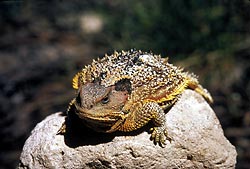
The Giant Horned Lizard is the most slender species of horned lizard and has a relatively typical lizard-like appearance. Its back and side spines are formed from modified scales, while the horns on its head are true horns with a bony core.[1][2][3]
The species can reach a length of 15 to 20 cm from snout to tail.[4]
Habitat
The species is capable of surviving in desert environments.[5]
Classification of the Giant Horned Lizard
| Kingdom | Animalia |
|---|---|
| Phylum | Chordata |
| Subphylum | Vertebrata |
| Infraphylum | Gnathostomata |
| Parvphylum | Osteichthyes |
| Megaclass | Tetrapoda |
| Class | Reptilia (Reptile) |
| Order | Squamata (Snakes) |
| Suborder | Iguania (Iguanas) |
| Family | Phrynosomatidae (North American Spiny Lizards) |
| Genus | Phrynosoma (Horned Lizard) |
| Species | Phrynosoma asio Cope, 1864 |
Where the Giant Horned Lizard is found
Checklists and occurrence records place Phrynosoma asio in 2 countries across North America. GBIF holds 665 georeferenced records of it.
Countries
Regions and cities with the most records
- Oaxaca, Mexico 176
- Guerrero, Mexico 134
- Santo Domingo Tehuantepec, Mexico 96
- Salina Cruz, Mexico 91
- Colima, Mexico 58
- Ixtepec, Mexico 52
- Zumpango del Río, Mexico 52
- Chilpancingo, Mexico 51
- Ciudad de Villa de Álvarez, Mexico 44
- Colima, Mexico 44
- Heroica Ciudad de Juchitán de Zaragoza, Mexico 33
- Michoacán, Mexico 30
- Tixtla de Guerrero, Mexico 28
- Jalisco, Mexico 26
- Tecomán, Mexico 12
- Puebla, Mexico 9
- Chiapas, Mexico 7
- Ciudad de Armería, Mexico 7
- Axochiapan, Mexico 6
- Apatzingán, Mexico 4
- Cintalapa de Figueroa, Mexico 4
- Ciudad Altamirano, Mexico 3
Range as the checklists state it
SE Mexico (Oaxaca, Guerrero, Michoacán, Colima, Chiapas, Morelos, Jalisco), Guatemala
A number beside a place is its count of GBIF occurrence records. A place without a number comes from a checklist alone. Records show where a species has been observed or collected, which can include escapes and vagrants.
Common names
English
- Giant Horned Lizard
- Giant Mexican Horned Lizard
Names in 6 other languages
- Chinese
- 大角蜥
- Danish
- Kæmpe-tudseleguan
- German
- Riesenkrötenechse
- Japanese
- コリーマオオツノトカゲ
- Portuguese
- Lagarto-de-chifre-gigante
- Spanish
- Camaleón de Grandes Cuernos, Camaleón gigante, Lagartija-cornuda gigante
Synonyms
One other scientific name has been used for this species and is now treated as a synonym of Phrynosoma asio.
- Phrynosoma spinimentum Peters, 1874
Related species
-
 Texas Horned LizardPhrynosoma cornutum
-
 Desert Horned LizardPhrynosoma platyrhinos
-
 Greater Short-horned LizardPhrynosoma hernandesi
-
 Regal Horned LizardPhrynosoma solare
-
 San Diego Horned LizardPhrynosoma blainvillii
-
 Coast Horned LizardPhrynosoma coronatum
-
 Pygmy Short-horned LizardPhrynosoma douglasii
-
 Flat-tail Horned LizardPhrynosoma mcallii
Compare
Questions and answers
What is the scientific name of the Giant Horned Lizard?
The scientific name of the Giant Horned Lizard is Phrynosoma asio. Written with its author, the full name is Phrynosoma asio Cope, 1864.
Which family does the Giant Horned Lizard belong to?
Phrynosoma asio belongs to the family Phrynosomatidae, in the order Squamata and the class Reptilia.
Where is the Giant Horned Lizard found?
Checklists and occurrence records place Phrynosoma asio in 2 countries: Mexico and Guatemala.
What is the conservation status of the Giant Horned Lizard?
The IUCN Red List category recorded for Phrynosoma asio is Least Concern (LC).
What other names does the Giant Horned Lizard have?
Phrynosoma asio is also known in English as Giant Mexican Horned Lizard.
What habitat do horned lizards live in?
The Giant Horned Lizard is capable of surviving in desert environments.[5]
Sources
Passages the profile rests on
- Phrynosoma asio is the most slender species of horned lizard and has a relatively typical lizard-like appearance. Source passage: “It is the largest horned lizard and is also the most slender (it has a more typical lizard-like appearance).” — English Wikipedia
- The spines on the back and sides are formed from modified scales. Source passage: “The spines on its back and sides are made from modified scales” — English Wikipedia
- The horns on the head are true horns with a bony core. Source passage: “the horns on its head are true horns (i.e., they have a bony core).” — English Wikipedia
- The species can reach a length of 15 to 20 cm from snout to tail. Source passage: “can reach up to 6 to 8 inches (15 to 20 cm) from snout to tail” — English Wikipedia
- The species is capable of surviving in desert environments. Source passage: “It is able to survive in the desert.” — English Wikipedia
Data
- Catalogue of Life, 2026-10-16 XR cc by
- Global Biodiversity Information Facility CC BY 4.0
- Wikidata CC0
- GeoNames CC BY 4.0
- Wikimedia Commons per image; credit shown with each image
- Within the Catalogue of Life, this name comes from The Reptile Database cc by
References
- Cope, E. D. (1864). Contributions to the herpetology of tropical America. Proc. Acad. Nat. Sci. Philadelphia 16: 166-181.
- Duméril, M. A.; M. F. Bocourt, and F. Mocquard. (1870). Etudes sur les reptiles, p. i-xiv, 1-1012. In: Recherches Zoologiques pour servir a l’Histoire de Ia Faune de l’Amérique Centrale et du Mexique. Mission Scientifique au Mexique et dans l’Amérique Centrale, Recherches zoologiques. Imprimerie Imper., Paris (Published in Parts 1870-1909).
- Bocourt, M. E. (1873). In: A. Duméril, M. F. Bocourt, and F. Mocquard, (1870-1909), Etudes sur les reptiles, p. i-xiv; In Recherches Zoologiques pour servir a l’Histoire de Ia Faune de l’Amérique Centrale et du Mexique. Mission Scientifique au Mexique et dans l’Amérique Centrale, Recherches zoologiques. Part 2, sect. 1. Imprimerie Impériale, Paris, Livr. 2-15, Pp. 33-860.
- Peters, & Wilhem Carl Hartwig. (1874). Über neue Saurier (Spæriodactylus, Anolis, Phrynosoma, Tropidolepisma, Lygosoma, Ophioscincus) aus Centralamerica, Mexico und Australien. Monatsber. Königl. Akad. Wiss. Berlin. 1873 (November): 738-747.
- Boulenger, G. A. (1885). Catalogue of the lizards in the British Museum (Natural History). Vol. 2, Second edition. London, Xiii+497 Pp.
- Gentry, A. F. (1885). A review of the genus Phrynosoma. Proc. Acad. Nat. Sci. Philad. (Ser. 3) 37: 138-148.
- Smith, Hobart M. (1944). Additions to the list of Mexican amphibians and reptiles in the Carnegie Museum. Annals of the Carnegie Museum 30: 87-92.
- Schmidt, Karl P.;Shannon, Frederick A. (1947). Notes on amphibians and reptiles of Michoacan, Mexico. Zoological Series of Field Museum of Natural History 31 (9): 63-85.
- Reeve, Wayne L. (1952). Taxonomy and distribution of the horned lizard genus Phrynosoma. Univ. Kansas Sci. Bull. 34 (14): 817-960.
- Presch, W. (1969). Evolutionary osteology and relationships of the horned lizard genus Phrynosoma (family Iguanidae). Copeia 1969 (2): 250-275.
- Baur, B. (1979). Pflege und Zucht der Riesenkrötenechse, Phrynosoma asio (Reptilia: Sauria: Iguanidae). Salamandra 15 (1): 1-12.
- Alvarez DEL TORO, M. (1982). Los Reptiles de Chiapas. 3rd ed. México: Tuxtla Gutiérrez, 248 Pp.
- McCoy, C. J., & Flores-Villela, O. A. (1985). Amphibians and reptiles of the Sessé and Mociño expedition: a lost chapter in Mexican herpetology. Annals of the Carnegie Museum 54 (5): 189-193.
- Baur, B. E. (1986). Longevity of horned lizards of the genus Phrynosoma. Bull. Maryland Herp. Soc. 22 (3): 149-151.
- Montanucci, Richard R. (1987). A phylogenetic study of the horned lizards, genus Phrynosoma, based on skeletal and external morphology. Contributions in Science (390): 1-36 + 1 Plate.
- García, A., & Ceballos, G. (1994). GUIA DE CAMPO DE LOS REPTILES Y ANFIBIOS DE LA COSTA DE JALISCO, MEXICO. Fundacion Ecologica de Cuixmala, a.c. Instituto de Biologia, Unam.
- Köhler, G. (2000). Reptilien und Amphibien Mittelamerikas, Bd 1: Krokodile, Schildkröten, Echsen. Herpeton Verlag, Offenbach, 158 Pp.
- Reeder, T. W., & Montanucci, R. R. (2001). Phylogenetic analysis of the horned lizards (Phrynomomatidae: Phrynosoma): evidence from mitochondrial DNA and morphology. Copeia 2001 (2): 309-323.
- Pianka, E. R., & Vitt, L. J. (2003). Lizards - Windows to the Evolution of Diversity. University of California Press, Berkeley, 347 Pp. [Review in Copeia 2004: 955].
- Sherbrooke, Wade C. (2003). Introduction to Horned Lizards of North America. University of California Press, Berkeley, 178 Pp.
- Casas-Andreu, G., F.R. Méndez-De la Cruz and X. Aguilar-Miguel. (2004). Anfibios y Reptiles; pp. 375–390, in A.J.M. García-Mendoza, J. Ordoñez and M. Briones-Salas (ed.). Biodiversidad de Oaxaca. Instituto de Biología, UNAM-Fondo Oaxaqueño Para La Conservación de La Naturaleza-World Wildlife Fund, México, D. F.
- Castro-Franco, R., & Guadalupe Bustos Zagal, M. (2004). Additional records and range extensions of reptiles from Morelos, México. Herpetological Review 35 (2): 196-197.
- Dost, W. (2005). Stichpunktartige Bemerkungen zu Pflege und zucht diverser Iguaniden. Iguana Rundschreiben 18 (1): 16-24.
- Meyers, J.J.; Herrel, A. & Nishikawa, K. (2006). Morphological correlates of ant eating in horned lizards (Phrynosoma). Biological Journal of the Linnean Society 89: 13–24.
- García, Ernesto Raya and Luis Fernando Martínez García. (2013). Herpetoculture notes: Phrynosoma asio (giant horned lizard) drinking behavior. Herpetological Review 44 (3): 453.
This species in other databases
Page built on 26 November 2026. See how the catalog is made and all sources and licences.
Cite this page
ScientificNames.org. (2026). Phrynosoma asio (Giant Horned Lizard). Retrieved November 26, 2026, from https://scientificnames.org/species/phrynosoma-asio
“Phrynosoma asio (Giant Horned Lizard).” ScientificNames.org, 2026, scientificnames.org/species/phrynosoma-asio. Accessed 26 Nov. 2026.
ScientificNames.org. “Phrynosoma asio (Giant Horned Lizard).” Accessed November 26, 2026. https://scientificnames.org/species/phrynosoma-asio.
@misc{scientificnames_phrynosoma_asio_giant_horned_lizard,
  author = {{ScientificNames.org}},
  title = {Phrynosoma asio (Giant Horned Lizard)},
  year = {2026},
  url = {https://scientificnames.org/species/phrynosoma-asio},
  note = {Accessed 2026-11-26}
}