Species · Reptiles
Regal Horned Lizard Phrynosoma solare
The scientific name of the Regal Horned Lizard is Phrynosoma solare. It is a species of reptile in the family Phrynosomatidae (north american spiny lizards), order Squamata. The name dates from 1845.
- Scientific name
- Phrynosoma solare Gray, 1845
- Common name
- Regal Horned Lizard
- Genus
- Phrynosoma
- Family
- Phrynosomatidae (North American Spiny Lizards)
- Order
- Squamata
- Class
- Reptilia
- Red List category
- LC Least Concern
- Recorded in
- 2 countries
- Name status
- accepted in the Catalogue of Life

Overview
Phrynosoma solare occurs in south-central Arizona, extreme southwestern New Mexico, most of Sonora, and northern Sinaloa, Mexico. It is distinguished by a crown of ten pointed horns formed by four large occipital horns and six temporal horns.
Written 26 November 2026 from the sources listed below. Each statement was checked against the passage it cites; statements that could not be supported were removed.
Appearance
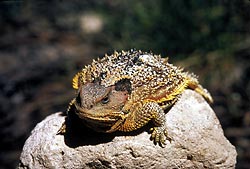
The Regal Horned Lizard has a wide, flattened, toad-like body with one row of lateral abdominal fringe scales. Its short tail is broad at the base.[1][2]
Its dorsal coloration ranges from desert gray to pastel shades of tan, brown, red, and yellow, while its underparts are pale yellowish gray. It can change its coloration from light to dark within minutes depending on its surroundings.[3][4][5]
Its ventral body surface consists of rows of keeled scales. It has four legs, each bearing five toes with a claw on every toe.[6][7]
Adults measure approximately five inches in length on average. Another description gives an adult length of approximately three to four inches from nose to tail.[8][9]
Hatchlings measure approximately 7/8 to 1-1/8 inches from snout to vent.[10]
Habitat
The Regal Horned Lizard prefers hot, dry, sandy environments and primarily occupies level or gently sloping terrain with widely spaced desert vegetation. Its preferred vegetation includes mesquite, creosote bush, and saguaro cactus.[11][12][13]
It also inhabits hot, dry environments where the ground may be covered in limestone dust. Its home range is approximately 146 meters.[14][15]
Diet
The Regal Horned Lizard's diet consists almost exclusively of harvester ants, which constitute approximately 88 percent of its stomach contents by volume. It also consumes spiders, sowbugs, and other insects, particularly ants.[16][17][18]
An individual can consume approximately 2,500 ants in one meal. It captures food using a long, sticky tongue.[19][20]
Behaviour
The Regal Horned Lizard is diurnal. Adults remain active throughout the year but are most active between April and September, particularly between 6:00 and 9:00 a.m. during their most active season.[21][22][23]
The species hibernates underground in sand during autumn and emerges in spring. Individuals bask in the morning before beginning to forage once their body temperature reaches a suitable level.[24][25]
When approached by an enemy, individuals may perform head bobbing, push-ups, and head nodding. When threatened, they can squirt blood from around their eyes as a defensive response, with the defensive blood stream reaching approximately 1.2 meters.[26][27][28]
After feeding, individuals may seek shade beneath shrubs when ground temperatures become too high.[29]
Reproduction and life cycle
The Regal Horned Lizard reproduces sexually through internal fertilization and is oviparous. Mating begins in late April, reaches its peak in June, and ends abruptly in July.[30][31]
Females generally lay eggs in late July and early August. They typically produce between 10 and 30 eggs per clutch, averaging approximately 15, and generally produce only one clutch annually.[32][33][34]
Eggs are deposited in sandy nests. They have white, flexible shells averaging approximately half an inch in diameter.[35][36]
Hatchlings receive no parental care and immediately bury themselves in sand after emerging. Individuals are classified as young adults by the end of their second summer and probably attain full growth within three years.[37][38]
Conservation
The species' populations are not protected according to the cited account. Habitat destruction and ant extermination threaten the species by reducing its habitat and dependable food supply.[39][40]
In Arizona, four individuals may be collected with a hunting license.[41]
Classification of the Regal Horned Lizard
| Kingdom | Animalia |
|---|---|
| Phylum | Chordata |
| Subphylum | Vertebrata |
| Infraphylum | Gnathostomata |
| Parvphylum | Osteichthyes |
| Megaclass | Tetrapoda |
| Class | Reptilia (Reptile) |
| Order | Squamata (Snakes) |
| Suborder | Iguania (Iguanas) |
| Family | Phrynosomatidae (North American Spiny Lizards) |
| Genus | Phrynosoma (Horned Lizard) |
| Species | Phrynosoma solare Gray, 1845 |
Where the Regal Horned Lizard is found
Checklists and occurrence records place Phrynosoma solare in 2 countries across North America. GBIF holds 4,019 georeferenced records of it.
Countries
Regions and cities with the most records
- Arizona, United States 2,310
- Sonora, Mexico 717
- Casas Adobes, United States 662
- Flowing Wells, United States 648
- Catalina Foothills, United States 618
- Oro Valley, United States 571
- Tucson, United States 407
- Tanque Verde, United States 321
- Drexel Heights, United States 310
- Green Valley, United States 207
- Sahuarita, United States 180
- Marana, United States 152
- Hermosillo, Mexico 151
- Scottsdale, United States 101
- Rio Rico, United States 93
- Tempe, United States 91
- Tempe Junction, United States 91
- Mesa, United States 69
- Sinaloa, Mexico 68
- Fountain Hills, United States 67
- Apache Junction, United States 62
- Gilbert, United States 61
- Chandler, United States 59
- Phoenix, United States 59
- Nogales, United States 48
- Sierra Vista, United States 42
- Nogales, Mexico 40
- Glendale, United States 35
- Heroica Guaymas, Mexico 35
- Empalme, Mexico 30
- Queen Creek, United States 30
- San Tan Valley, United States 28
- Sun City West, United States 23
- El Mirage, United States 22
- Surprise, United States 22
- Agua Prieta, Mexico 13
Range as the checklists state it
USA (S Arizona, New Mexico),
A number beside a place is its count of GBIF occurrence records. A place without a number comes from a checklist alone. Records show where a species has been observed or collected, which can include escapes and vagrants.
Common names
English
- Regal Horned Lizard
Names in 9 other languages
- Chinese
- 太陽角蜥
- Czech
- ropušník sluneční
- Danish
- Konge-tudseleguan
- German
- Königskrötenechse, Vierhorn-Krötenechse
- Japanese
- リーガルツノトカゲ
- Portuguese
- Lagarto-de-chifre-real
- Russian
- Солнечная рогатая ящерица
- Spanish
- Camaleón Real, Lagartija-cornuda real
- sei
- hant coáaxoj
Synonyms
One other scientific name has been used for this species and is now treated as a synonym of Phrynosoma solare.
- Phrynosoma regale Girard, 1858
Related species
-
 Texas Horned LizardPhrynosoma cornutum
-
 Desert Horned LizardPhrynosoma platyrhinos
-
 Greater Short-horned LizardPhrynosoma hernandesi
-
 Giant Horned LizardPhrynosoma asio
-
 San Diego Horned LizardPhrynosoma blainvillii
-
 Coast Horned LizardPhrynosoma coronatum
-
 Pygmy Short-horned LizardPhrynosoma douglasii
-
 Flat-tail Horned LizardPhrynosoma mcallii
Compare
Questions and answers
What is the scientific name of the Regal Horned Lizard?
The scientific name of the Regal Horned Lizard is Phrynosoma solare. Written with its author, the full name is Phrynosoma solare Gray, 1845.
Which family does the Regal Horned Lizard belong to?
Phrynosoma solare belongs to the family Phrynosomatidae, in the order Squamata and the class Reptilia.
Where is the Regal Horned Lizard found?
Checklists and occurrence records place Phrynosoma solare in 2 countries: United States and Mexico.
What is the conservation status of the Regal Horned Lizard?
The IUCN Red List category recorded for Phrynosoma solare is Least Concern (LC).
Sources
Passages the profile rests on
- The species has a wide, flattened, toad-like body with one row of lateral abdominal fringe scales. Source passage: “The Regal Horned Lizard is characterized by one row of lateral abdominal fringe scales upon a wide, flattened, toad-like body.” — animaldiversity.org
- Its tail is short and broad at the base. Source passage: “The tail is short and broad at the base.” — animaldiversity.org
- Its dorsal coloration ranges from desert gray to pastel shades of tan, brown, red, and yellow. Source passage: “The Horned lizard is typically soft desert gray along the back and head. It is composed of pastel shades of tan, brown, red, and yellow.” — animaldiversity.org
- Its underparts are pale yellowish gray. Source passage: “The underparts are pale, yellowish gray.” — animaldiversity.org
- The species can change its coloration from light to dark within minutes depending on its surroundings. Source passage: “Color change occurs within minutes, changing from light to dark or vice versa depending on the environment.” — animaldiversity.org
- Its ventral body surface consists of rows of keeled scales. Source passage: “Another distinguishing characteristic of the horned lizard is that the ventral portion of its body is composed of rows of keeled scales.” — animaldiversity.org
- The species has four legs, each bearing five toes with a claw on every toe. Source passage: “Its four legs each have five toes with a claw on each toe.” — English Wikipedia
- Adults measure approximately five inches in length on average. Source passage: “Phrynosoma solare are on average about 5 inches in length (Seymour and Royo 1999).” — animaldiversity.org
- Adult individuals are approximately three to four inches long from nose to tail according to one description. Source passage: “It is 3–4 in (117 mm) in length from nose to tail as a full adult” — English Wikipedia
- Hatchlings measure approximately 7/8 to 1-1/8 inches from snout to vent. Source passage: “They are about 7/8 to 1-1/8 inches long, snout to vent (Seymour and Royo 1998).” — animaldiversity.org
- The species prefers hot, dry, sandy environments. Source passage: “The Regal Horned Lizard prefers hot, dry, sandy environments.” — animaldiversity.org
- It primarily occupies level or gently sloping terrain with widely spaced desert vegetation. Source passage: “This horned lizard occupies primarily level or gently sloping terrain with openly spaced desert vegetation such as mesquite, creosote bush, and saguaro cactus.” — English Wikipedia
- Its preferred vegetation includes mesquite, creosote bush, and saguaro cactus. Source passage: “openly spaced desert vegetation such as mesquite, creosote bush, and saguaro cactus.” — English Wikipedia
- The species inhabits hot, dry environments where the ground may be covered in limestone dust. Source passage: “It can be found primarily in a hot and dry climate where the ground may be covered in limestone dust.” — English Wikipedia
- Its home range is approximately 146 meters. Source passage: “It has been shown to have a relatively small home range of roughly 160 yards (146 meters).” — English Wikipedia
- Harvester ants constitute approximately 88 percent of the species' stomach contents by volume. Source passage: “Their favorite is Harvester ants, which occupy about 88% of their stomach volume (Hodges 1998).” — animaldiversity.org
- The species consumes spiders, sowbugs, and other insects, particularly ants. Source passage: “The lizard eats spiders, sowbugs, and other insects, especially ants.” — animaldiversity.org
- Its diet consists almost exclusively of harvester ants. Source passage: “Their diet consists almost exclusively of harvester ants” — English Wikipedia
- An individual can consume approximately 2,500 ants in one meal. Source passage: “can eat 2500 ants in one meal.” — English Wikipedia
- The species captures food using a long, sticky tongue. Source passage: “Horned lizards do not take their food methodically, but instead take it in a toad-like fashion, with a flick of their long, sticky, tongue.” — animaldiversity.org
- The species is diurnal. Source passage: “The Regal Horned lizard is diurnal.” — animaldiversity.org
- Adults remain active throughout the year but are most active between April and September. Source passage: “Adult regal horned lizards are active year round; however, they are most active from April to September” — English Wikipedia
- During their most active season, adults are particularly active between 6:00 and 9:00 a.m. Source passage: “they are most active from April to September during the hours of 6:00 to 9:00 a.m.” — English Wikipedia
- The species hibernates underground in sand during autumn and emerges in spring. Source passage: “In the fall, they hibernate by burying themselves in the sand and emerge in the spring when the sun's rays have reached a certain temperature.” — animaldiversity.org
- Individuals bask in the morning before beginning to forage once their body temperature reaches a suitable level. Source passage: “The first few hours of the day are spent basking so their back is exposed to the sun. As soon as their body temperature rises to a specific degree, they commence foraging for food.” — animaldiversity.org
- When approached by an enemy, individuals may perform head bobbing, push-ups, and head nodding. Source passage: “When approached by an enemy, the Regal Horned lizard undergoes several diverting tactics such as head bobbing, push ups, and nodding.” — animaldiversity.org
- When threatened, the species can squirt blood from around its eyes as a defensive response. Source passage: “when under threat they can restrict blood flow from the head until mounting pressure ruptures small blood vessels in and around the eyes, resulting in a spurt of blood” — animaldiversity.org
- Its defensive blood stream can reach approximately 1.2 meters. Source passage: “This stream can range up to 4 feet (1.2 m)” — English Wikipedia
- The species can seek shade beneath shrubs after feeding when ground temperatures become too high. Source passage: “After feeding, when ground temperatures become too hot, they seek the shade of a shrub, partially concealing themselves.” — animaldiversity.org
- The species reproduces sexually through internal fertilization and is oviparous. Source passage: “Regal horned lizards are oviparous and reproduce via sexual reproduction (specifically internal fertilization).” — English Wikipedia
- Mating begins in late April, reaches its peak in June, and ends abruptly in July. Source passage: “Mating for the Regal Horned lizard begins in late April, peaks in June, and stops abruptly in July.” — animaldiversity.org
- Females generally lay eggs in late July and early August. Source passage: “Egg laying starts a few weeks later, usually in late July and early August.” — animaldiversity.org
- Females typically produce between 10 and 30 eggs per clutch, averaging approximately 15. Source passage: “The number of eggs varies anywhere from 10-30 eggs, with an average of about 15.” — animaldiversity.org
- Females generally produce only one clutch annually. Source passage: “females typically lay only one clutch annually.” — English Wikipedia
- Eggs are deposited in sandy nests. Source passage: “The eggs are laid in the sand where they require several weeks for further development before the eggs hatch.” — animaldiversity.org
- The eggs have white, flexible shells averaging approximately half an inch in diameter. Source passage: “The egg shells are white and flexible and average about one-half inch in diameter.” — English Wikipedia
- Hatchlings receive no parental care and immediately bury themselves in sand after emerging. Source passage: “The hatchlings receive no parental care upon hatching and immediately bury themselves in the sand.” — animaldiversity.org
- Individuals are classified as young adults by the end of their second summer and probably attain full growth within three years. Source passage: “they are classified as young adults by the end of the second summer and probably reach full growth in three years.” — animaldiversity.org
- The species' populations are not protected according to the cited account. Source passage: “The Regal Horned lizard populations are not protected.” — animaldiversity.org
- Habitat destruction and ant extermination threaten the species by reducing its habitat and dependable food supply. Source passage: “However, habitat destruction and ant extermination are depriving the horned lizard not only of their homes, but of their only source of a dependable diet.” — animaldiversity.org
- In Arizona, four individuals may be collected with a hunting license. Source passage: “Four individuals may be collected in Arizona with a hunting license.” — animaldiversity.org
Data
- Catalogue of Life, 2026-10-16 XR cc by
- Global Biodiversity Information Facility CC BY 4.0
- Wikidata CC0
- GeoNames CC BY 4.0
- Wikimedia Commons per image; credit shown with each image
- Within the Catalogue of Life, this name comes from The Reptile Database cc by
References
- Gray, J. E. (1845). Catalogue of the specimens of lizards in the collection of the British Museum. Trustees of Die British Museum/Edward Newman, London: Xxvii + 289 Pp.
- Girard, Charles F. (1858). United States Exploring Expedition during the Years 1838, 1839, 1840, 1841, 1842, Under the command of Charles Wilkes, U.S.N. Vol. 20. Herpetology. C. Sherman & Son, Philadelphia, Xv, 492 Pages [See Note in Zhao and Adler 1993: 369].
- Boulenger, G. A. (1885). Catalogue of the lizards in the British Museum (Natural History). Vol. 2, Second edition. London, Xiii+497 Pp.
- Gentry, A. F. (1885). A review of the genus Phrynosoma. Proc. Acad. Nat. Sci. Philad. (Ser. 3) 37: 138-148.
- Van Denburgh, J. (1895). A review of the herpetology of Lower California. Part I - Reptiles. Proc. Cal. Acad. Sci. (2) 5: 77-163.
- Cope, E. D. (1900). The crocodilians, lizards and snakes of North America. Ann. Rep. U.S. Natl. Mus. 1898: 153-1270.
- Ditmars, Raymond L. (1911). Reptiles of all lands. National Geographic 22(7): 601-633.
- Burt, Charles E. (1933). Some lizards from the Great Basin of the West and adjacent areas, with comments on the status of various forms. American Midland Naturalist 14: 228-250.
- Gloyd, Howard K. (1937). A herpetological consideration of faunal areas in Southern Arizona. Bulletin of the Chicago Academy of Sciences 5 (5): 77-136.
- Taylor, & Edward Harrison. (1938). Notes on the herpetological fauna of the Mexican state of Sonora. Univ. Kansas Sci. Bull. 24 (19): 475-503 [1936].
- Schonberger, C. F. (1945). Oviposition by Phrynosoma solare. Copeia 1945 (1): 53-54.
- Smith, Hobart M. (1946). Handbook of Lizards: Lizards of the United States and of Canada. Comstock, Ithaca, NY, Xxii + 557 Pp.
- Zweifel,R.G. and Norris,K.S. (1955). Contributions to the herpetology of Sonora, Mexico:Descriptions of new subspecies of snakes (Micruroides euryxanthus and Lampropeltis getulus) and miscellaneous collecting notes. American Midland Naturalist 54: 230-249.
- Cutter, W. L. (1959). An Instance of Blood-Squirting by Phrynosoma solare. Copeia 1959 (2): 176.
- Hardy, L.M., & McDiarmid, R.W. (1969). The amphibians and reptiles of Sinaloa, Mexico. Univ. Kansas Publ. Mus. Nat. Hist. 18 (3): 39-252.
- Presch, W. (1969). Evolutionary osteology and relationships of the horned lizard genus Phrynosoma (family Iguanidae). Copeia 1969 (2): 250-275.
- Parker, William S. (1971). Ecological observations on the regal horned lizard (Phrynosoma solare) in Arizona. Herpetologica 27 (3): 333-338.
- Van Devender, T.R. & C.W. Howard. (1973). Notes on Natural Nests and Hatching Success in the Regal Horned Lizard (Phrynosoma solare) in Southern Arizona. Herpetologica 29 (3): 238-239.
- Parker, W. S. (1974). Phrynosoma solare (Gray): Regal horned lizard. Catalogue of American Amphibians and Reptiles ( 162: 1-2.
- Baharav, D. (1975). Movement of the Horned Lizard Phrynosoma solare. Copeia 1975 (4): 649-657.
- Stebbins, R. C. (1985). A Field Guide to Western Reptiles and Amphibians, 2nd ed. Houghton Mifflin, Boston.
- Baur, B. E. (1986). Longevity of horned lizards of the genus Phrynosoma. Bull. Maryland Herp. Soc. 22 (3): 149-151.
- Axtell, R. W. (1986). The Epipterygoids in Phrynosoma solare, Still Present, but Disappearing. Journal of Herpetology 20 (1): 79-81.
- Painter, Charles W. (1993). Phrynosoma solare (regal horned lizard). USA: New Mexico. Herpetological Review 24 (4): 155.
- Degenhardt, William G.; C. W. Painter, and A. H. Price. (1996). Amphibians and reptiles of New Mexico. Univ. New Mexico Press, 431 Pp.
This species in other databases
Page built on 28 November 2026. See how the catalog is made and all sources and licences.
Cite this page
ScientificNames.org. (2026). Phrynosoma solare (Regal Horned Lizard). Retrieved November 28, 2026, from https://scientificnames.org/species/phrynosoma-solare
“Phrynosoma solare (Regal Horned Lizard).” ScientificNames.org, 2026, scientificnames.org/species/phrynosoma-solare. Accessed 28 Nov. 2026.
ScientificNames.org. “Phrynosoma solare (Regal Horned Lizard).” Accessed November 28, 2026. https://scientificnames.org/species/phrynosoma-solare.
@misc{scientificnames_phrynosoma_solare_regal_horned_lizard,
  author = {{ScientificNames.org}},
  title = {Phrynosoma solare (Regal Horned Lizard)},
  year = {2026},
  url = {https://scientificnames.org/species/phrynosoma-solare},
  note = {Accessed 2026-11-28}
}