Species · Reptiles
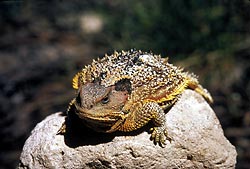
Greater Short-horned Lizard Phrynosoma hernandesi
The scientific name of the Greater Short-horned Lizard is Phrynosoma hernandesi. It is a species of reptile in the family Phrynosomatidae (north american spiny lizards), order Squamata. The name dates from 1858.
- Scientific name
- Phrynosoma hernandesi Girard, 1858
- Common name
- Greater Short-horned Lizard
- Genus
- Phrynosoma
- Family
- Phrynosomatidae (North American Spiny Lizards)
- Order
- Squamata
- Class
- Reptilia
- Red List category
- LC Least Concern
- Recorded in
- 3 countries
- Name status
- accepted in the Catalogue of Life

Overview
Written 26 November 2026 from the sources listed below. Each statement was checked against the passage it cites; statements that could not be supported were removed.
Similar species
The pygmy short-horned lizard (Phrynosoma douglasii) is a close relative with a similar basic body shape. It is considerably smaller than the Greater Short-horned Lizard at full size.[1][2]
Appearance
Its base coloration may be tan, yellow-brown, orange-brown, reddish-brown or gray, usually resembling the soil in its habitat. Two rows of large dark spots extend along its back, beginning with two large dark blotches on the neck.[3][4][5][6]
Females are generally larger than males. Females average approximately 7 cm in snout-to-vent length and can reach about 15 cm in total length, while adult males average approximately 5 cm in snout-to-vent length.[7][8][9]
Habitat
The Greater Short-horned Lizard occupies habitats ranging from semiarid plains to mountainous areas. These include shortgrass prairies, sagebrush deserts and juniper, pine and fir forests.[10][11]
Its habitat soils may be stony or rocky but generally include fine loose soil or sand. It is generally found at elevations between 900 and 11,300 feet and occurs in the Pryor Mountains.[12][13][14]
Diet
Ants constitute the primary food source of the Greater Short-horned Lizard. Its diet also includes grasshoppers, beetles, spiders, young snakes, snails, sowbugs and other insects and invertebrates.[15][16][17]
Behaviour
The Greater Short-horned Lizard uses a sit-and-wait predatory strategy, often waiting near ant nests or trails for prey. It is active during the day, is most active in the evening and burrows at night.[18][19][20]
Individuals rely extensively on camouflage to avoid predators. When threatened, they can darken their skin and inflate their bodies to twice their normal size.[21][22][23]
Individuals can squirt blood from ducts near their eyes at attacking predators. The blood contains a chemical that is noxious to wolves and coyotes.[24][25]
Individuals may roll onto their backs and play dead to avoid predation. The species emerges from hibernation in April and returns to its dens in October.[26][27]
Reproduction and life cycle
The mating season occurs in spring, generally between May and June. The Greater Short-horned Lizard is viviparous and gives birth to live young.[28][29]
Females produce between five and 48 offspring from July through September. The usual litter size is six to 18 offspring, although litters of up to 48 have been recorded.[30][31]
Newborn individuals measure approximately 24 mm in snout-to-vent length and weigh approximately 1 g each. They lack horns.[32][33][34]
Males generally become sexually active after their first year, while females generally require two years.[35]
Conservation
The Greater Short-horned Lizard is considered endangered in Saskatchewan and Alberta. It is one of five native lizard species in Canada.[36][37]
Classification of the Greater Short-horned Lizard
| Kingdom | Animalia |
|---|---|
| Phylum | Chordata |
| Subphylum | Vertebrata |
| Infraphylum | Gnathostomata |
| Parvphylum | Osteichthyes |
| Megaclass | Tetrapoda |
| Class | Reptilia (Reptile) |
| Order | Squamata (Snakes) |
| Suborder | Iguania (Iguanas) |
| Family | Phrynosomatidae (North American Spiny Lizards) |
| Genus | Phrynosoma (Horned Lizard) |
| Species | Phrynosoma hernandesi Girard, 1858 |
Where the Greater Short-horned Lizard is found
Checklists and occurrence records place Phrynosoma hernandesi in 3 countries across North America. GBIF holds 15,244 georeferenced records of it.
Countries
Regions and cities with the most records
- Arizona, United States 3,865
- New Mexico, United States 3,322
- Utah, United States 1,285
- Colorado, United States 1,037
- Flagstaff, United States 736
- Wyoming, United States 462
- Saskatchewan, Canada 402
- Tanque Verde, United States 379
- Santa Fe, United States 306
- East Millcreek, United States 254
- Oro Valley, United States 235
- Texas, United States 234
- Holladay, United States 226
- Montana, United States 223
- South Salt Lake, United States 223
- Prescott, United States 221
- Millcreek, United States 220
- Salt Lake City, United States 220
- Nevada, United States 215
- Cottonwood Heights, United States 210
- Bountiful, United States 206
- Murray, United States 203
- North Salt Lake, United States 196
- Taylorsville, United States 183
- Midvale, United States 182
- Centerville, United States 180
- Sandy, United States 171
- Nebraska, United States 167
- Prescott Valley, United States 167
- West Jordan, United States 166
- West Valley City, United States 161
- Sonora, Mexico 157
- Kearns, United States 135
- American Fork, United States 117
- Rio Rancho, United States 114
- Pleasant Grove, United States 113
Range as the checklists state it
Canada (SE Alberta, SW Saskatchewan)
A number beside a place is its count of GBIF occurrence records. A place without a number comes from a checklist alone. Records show where a species has been observed or collected, which can include escapes and vagrants.
Common names
English
- Greater Short-horned Lizard
- Baur's Short-horned Lizard
- Baur’s Short-horned Lizard [bauri]
- Great Plains Short-horned Lizard [brevirostris]
- Hernandez's Short-horned Lizard
- Mountain Short-horned Lizard
- San Luis Valley Short-horned Lizard [diminutum]
- Short-horned Lizard
- Short-tail Short-horned Lizard [brachycercum]
Names in 7 other languages
- Chinese
- 山短角蜥
- Danish
- Stor Korthornet Tudseleguan
- French
- grand iguane à petites cornes
- German
- Berg-Kurzhornkrötenechse, Kurzschwanz-Kurzhorn-Krötenechse [brachycercum]
- Polish
- frynosoma większa
- Portuguese
- Lagarto-de-chifres, Lagarto-de-chifres-curtos
- Spanish
- Camaleón Cuernitos de Hernandez, Camaleón de montaña de cuernos cortos
Synonyms
8 other scientific names have been used for this species and are now treated as synonyms of Phrynosoma hernandesi.
- Phrynosoma bauri Montanucci, 2015
- Phrynosoma diminutum Montanucci, 2015
- Phrynosoma douglassii brachycercum Smith, 1942
- Phrynosoma douglassii hernandesi Girard, 1858
- Phrynosoma ornatissimum brachycercum Smith, 1942
- Tapaya hernandesi (Girard, 1858)
- Phrynosoma hernandesi brachycercum (Smith, 1942) ambiguous synonym
- Phrynosoma hernandesi brachycercum Lemos-Espinal et al., 2004 ambiguous synonym
Subspecies and varieties
- Phrynosoma hernandesi brachycercum subspecies
- Phrynosoma hernandesi brevirostris (Great Plains Short-horned Lizard) subspecies
- Phrynosoma hernandesi hernandesi (Mountain Short-horned Lizard) subspecies
- Phrynosoma hernandesi ornatum (Salt Lake Valley Short-horned Lizard) subspecies
Related species
-
 Texas Horned LizardPhrynosoma cornutum
-
 Desert Horned LizardPhrynosoma platyrhinos
-
 Regal Horned LizardPhrynosoma solare
-
 Giant Horned LizardPhrynosoma asio
-
 San Diego Horned LizardPhrynosoma blainvillii
-
 Coast Horned LizardPhrynosoma coronatum
-
 Pygmy Short-horned LizardPhrynosoma douglasii
-
 Flat-tail Horned LizardPhrynosoma mcallii
Compare
Questions and answers
What is the scientific name of the Greater Short-horned Lizard?
The scientific name of the Greater Short-horned Lizard is Phrynosoma hernandesi. Written with its author, the full name is Phrynosoma hernandesi Girard, 1858.
Which family does the Greater Short-horned Lizard belong to?
Phrynosoma hernandesi belongs to the family Phrynosomatidae, in the order Squamata and the class Reptilia.
Where is the Greater Short-horned Lizard found?
Checklists and occurrence records place Phrynosoma hernandesi in 3 countries: United States, Canada and Mexico.
What is the conservation status of the Greater Short-horned Lizard?
The IUCN Red List category recorded for Phrynosoma hernandesi is Least Concern (LC).
What other names does the Greater Short-horned Lizard have?
Phrynosoma hernandesi is also known in English as Baur's Short-horned Lizard, Baur’s Short-horned Lizard [bauri], Great Plains Short-horned Lizard [brevirostris], Hernandez's Short-horned Lizard, Mountain Short-horned Lizard and San Luis Valley Short-horned Lizard [diminutum].
Are greater short horned lizards rare?
The Greater Short-horned Lizard is considered endangered in Saskatchewan and Alberta.[36]
Sources
Passages the profile rests on
- The pygmy short-horned lizard (Phrynosoma douglasii) is a close relative that has a similar basic body shape. Source passage: “its close relative the pygmy short-horned lizard (Phrynosoma douglasii), which has the same basic body type” — English Wikipedia
- The pygmy short-horned lizard is considerably smaller than the greater short-horned lizard at full size. Source passage: “the pygmy short-horned lizard being much smaller.” — English Wikipedia
- Its coloration can be gray, yellowish or reddish-brown, with two rows of large dark spots along the back. Source passage: “The color is gray, yellowish, or reddish-brown, and there are two rows of large dark spots on the back.” — English Wikipedia
- Its base coloration may be tan, yellow-brown, orange-brown, reddish-brown or gray. Source passage: “Base coloration can be tan, yellow-brown, orange-brown, reddish-brown or gray” — nps.gov
- Its coloration usually resembles the soil in its habitat. Source passage: “usually matches the soil where the individual lives remarkably well.” — nps.gov
- The neck has two large dark blotches, followed by additional dark blotches along the back. Source passage: “There are two large dark blotches on the neck and a series of dark blotches down the back.” — nps.gov
- Females average approximately 7 cm in snout-to-vent length and can reach about 15 cm in total length. Source passage: “females average about 7 cm (about 2.75 inches) SVL, with a maximum total length (including tail) of about 15 cm (about 6 inches)” — English Wikipedia
- Adult males average approximately 5 cm in snout-to-vent length. Source passage: “males have an SVL of only about 5 cm (about 2 inches)” — English Wikipedia
- Females are generally larger than males. Source passage: “The females tend to grow a little bigger than the males.” — nps.gov
- The species occupies habitats ranging from semiarid plains to mountainous areas. Source passage: “occupies habitats from semiarid plains to high elevations in the mountains.” — English Wikipedia
- Its habitats include shortgrass prairies, sagebrush deserts and juniper, pine and fir forests. Source passage: “shortgrass prairies, sagebrush deserts, and juniper, pine, or fir forests.” — English Wikipedia
- Its habitat soils may be stony or rocky but generally include fine loose soil or sand. Source passage: “The soil in these habitats can be stony or rocky but usually has fine loose soil or sand present.” — English Wikipedia
- The species occurs in the Pryor Mountains. Source passage: “up into the mountains, such as the Pryor Mountains.” — nps.gov
- The species is generally found at elevations between 900 and 11,300 feet. Source passage: “living in the range of 900–11,300 feet (170–3440 m).” — English Wikipedia
- Ants constitute the primary food source of the species. Source passage: “It feeds primarily on ants” — English Wikipedia
- Its diet also includes grasshoppers and beetles. Source passage: “but also takes an occasional grasshopper or beetle.” — English Wikipedia
- The species also consumes spiders, young snakes, snails, sowbugs and other insects and invertebrates. Source passage: “spiders, young snakes, snails, sowbugs and a variety of other insects and invertebrates.” — nps.gov
- The species uses a sit-and-wait predatory strategy. Source passage: “The greater short-horned lizard is a "sit-and-wait" predator.” — English Wikipedia
- Individuals often wait near ant nests or trails for prey. Source passage: “Often, it can be found sitting in the vicinity of a nest or trails.” — English Wikipedia
- The species is active during the day, is most active in the evening and burrows at night. Source passage: “It is a diurnal creature, being most active during the evening and burrowing at night.” — English Wikipedia
- Individuals rely extensively on camouflage to avoid predators. Source passage: “It relies extensively on camouflage to avoid predators.” — English Wikipedia
- When threatened, individuals can darken their skin. Source passage: “Horned lizards have been shown to darken their skin when threatened” — English Wikipedia
- When threatened, individuals can inflate their bodies to twice their normal size. Source passage: “they can inflate their bodies up to twice their normal size” — nps.gov
- Individuals can squirt blood from ducts near their eyes at attacking predators. Source passage: “They can also build up the blood pressure in regions behind their eyes and accurately squirt blood up to three feet from ducts in the corner of their eyes at attacking predators.” — nps.gov
- The blood contains a chemical that is noxious to wolves and coyotes. Source passage: “The blood also contains a chemical that is noxious to wolves and coyotes.” — nps.gov
- Individuals may roll onto their backs and play dead to avoid predation. Source passage: “They may also roll onto their backs and play dead and again escape becoming prey.” — nps.gov
- The species emerges from hibernation in April and returns to its dens in October. Source passage: “often emerging from hibernation in April and returning to their dens in October.” — nps.gov
- The mating season occurs in spring, generally between May and June. Source passage: “The mating season for P. hernandesi is in spring (May to June).” — English Wikipedia
- The species is viviparous and gives birth to live young. Source passage: “It is viviparous, giving live birth” — English Wikipedia
- Females produce between five and 48 offspring from July through September. Source passage: “the female births five to 48 offspring from July to September.” — English Wikipedia
- The usual litter size is six to 18 offspring, although litters of up to 48 have been recorded. Source passage: “Litter size is usually 6 to 18, but up to 48 has been recorded.” — nps.gov
- Newborn individuals measure approximately 24 mm in snout-to-vent length. Source passage: “The young measure about 24 mm (0.94 in) SVL” — English Wikipedia
- Newborn individuals weigh approximately 1 g each. Source passage: “weigh each about 1 g (0.035 oz).” — English Wikipedia
- Newborn individuals lack horns. Source passage: “The young have no horns yet” — English Wikipedia
- Males generally become sexually active after their first year, while females generally require two years. Source passage: “Males become sexually active after their first year of life, and females generally take two years before they can start reproducing.” — English Wikipedia
- The species is considered endangered in Saskatchewan and Alberta. Source passage: “It is also considered an endangered species in Saskatchewan and Alberta.” — English Wikipedia
- The species is one of five native lizard species in Canada. Source passage: “It is one of five native species of lizards in Canada.” — English Wikipedia
Data
- Catalogue of Life, 2026-10-16 XR cc by
- Global Biodiversity Information Facility CC BY 4.0
- Wikidata CC0
- GeoNames CC BY 4.0
- Wikimedia Commons per image; credit shown with each image
- Within the Catalogue of Life, this name comes from The Reptile Database cc by
References
- Bell, T. (1829). Description of a new species of Agama, brought from the Columbia River by Mr. Douglass. Trans. Linn. Soc. London 16: 105-107.
- Gravenhorst, J. L. C. (1833). Über Phrynosoma orbicularis, Trapelus hispidus, Phrynocephalus helioscopus, Corythophanes cristatus und Chamaeleopsis hernandesii. Acta Acad. Caes. Leop. Carol. Nat. Cur. (?) 16 (2): 909-958.
- Girard, Charles F. (1858). United States Exploring Expedition during the Years 1838, 1839, 1840, 1841, 1842, Under the command of Charles Wilkes, U.S.N. Vol. 20. Herpetology. C. Sherman & Son, Philadelphia, Xv, 492 Pages [See Note in Zhao and Adler 1993: 369].
- Cope, E. D. (1867). On the REPTILIA and BATRACHIA of the Sonoran Province of the Nearctic Region. Proc. Acad. Nat. Sci. Philadelphia 18 [1866]: 300-314.
- Cope, E. D. (1871). On a peculiar habit ... in the Phrynosomas. Proc. Acad. Nat. Sci. Philadelphia 1871: 305.
- Cope, E. D. (1875). Check-list of North American Batrachia and Reptilia with a systematic list of the higher groups, and an essay on geographical distribution based on specimens contained in the U.S. National Museum. Bull. US Natl. Mus. 1: 1-104.
- Boulenger, G. A. (1885). Catalogue of the lizards in the British Museum (Natural History). Vol. 2, Second edition. London, Xiii+497 Pp.
- Gentry, A. F. (1885). A review of the genus Phrynosoma. Proc. Acad. Nat. Sci. Philad. (Ser. 3) 37: 138-148.
- Boulenger, G. A. (1887). On the affinity of the north-American lizard fauna. Ann. Mag. Nat. Hist. (5) 20: 345-346.
- Siebenrock, & Friedrich. (1892). Ueber Wirbelassimilation bei den Sauriern. Annalen Des Königlichen Kaiserlichen Naturhistorischen Hofmuseum in Wien 7: 373-378.
- Cope, E. D. (1900). The crocodilians, lizards and snakes of North America. Ann. Rep. U.S. Natl. Mus. 1898: 153-1270.
- Van Denburgh, John and Joseph R. Slevin. (1913). A list of the amphibians and reptiles of Arizona, with notes on the species in the collection of the Academy. Proc. Cal. Acad. Sci. 3 (13): 391-454.
- Van Denburgh, & John. (1922). The Reptiles of Western North America. Volume I. Lizards. Occ. Pap. Cal. Acad. Sci. (10): 1–612.
- Woodbury, & Angus Munn. (1928). The reptiles of Zion National Park. Copeia 1928 (166): 14-21.
- Tanner, Vasco M. (1930). The amphibians and reptiles of Bryce Canyon National Park, Utah. Copeia 1930 (2): 41-43.
- Burt, Charles E. (1933). Some lizards from the Great Basin of the West and adjacent areas, with comments on the status of various forms. American Midland Naturalist 14: 228-250.
- Knowlton, G., & Janes, M. (1934). Distributional and Food Habits Notes on Utah Lizards. Copeia, 1934(1), 10-14.
- Tanner, Vasco M.;Hayward, C. Lynn. (1934). A biological study of the La Sal Mountains, Utah report No. 1 (Ecology). Proceedings of the Utah Academy of Sciences, Arts, and Letters 11: 209-235.
- Burt, Charles E. (1935). Further records of the ecology and distribution of amphibians and reptiles in the middle west. American Midland Naturalist 16 (3): 311-336.
- Eaton, Theodore H., Jr. (1935). Report on amphibians and reptiles of the Navajo country. Bulletin 3. Rainbow Bridge-Monument Valley Expedition : 1-20.
- Gloyd, Howard K. (1937). A herpetological consideration of faunal areas in Southern Arizona. Bulletin of the Chicago Academy of Sciences 5 (5): 77-136.
- Klauber, L. M. (1939). Studies of reptile life in the arid southwest I. Night collecting on the desert with ecological statistics II. Speculations on prtective coloration and pretective reflectivity III. Notes on some lizards of the southwestern United States. Bulletins of the Zoological Society of San Diego 14: 1-100.
- Smith, & Hobart. (1942). Mexican herpetological miscellany. Proc. US Natl. Mus. 92 (3153): 349-395.
- Marr, John C. (1944). Notes on amphibians and reptiles from the Central United States. American Midland Naturalist 32: 478-490.
- Smith, Hobart M. (1946). Handbook of Lizards: Lizards of the United States and of Canada. Comstock, Ithaca, NY, Xxii + 557 Pp.
This species in other databases
Page built on 28 November 2026. See how the catalog is made and all sources and licences.
Cite this page
ScientificNames.org. (2026). Phrynosoma hernandesi (Greater Short-horned Lizard). Retrieved November 28, 2026, from https://scientificnames.org/species/phrynosoma-hernandesi
“Phrynosoma hernandesi (Greater Short-horned Lizard).” ScientificNames.org, 2026, scientificnames.org/species/phrynosoma-hernandesi. Accessed 28 Nov. 2026.
ScientificNames.org. “Phrynosoma hernandesi (Greater Short-horned Lizard).” Accessed November 28, 2026. https://scientificnames.org/species/phrynosoma-hernandesi.
@misc{scientificnames_phrynosoma_hernandesi_greater_short_horned_lizard,
  author = {{ScientificNames.org}},
  title = {Phrynosoma hernandesi (Greater Short-horned Lizard)},
  year = {2026},
  url = {https://scientificnames.org/species/phrynosoma-hernandesi},
  note = {Accessed 2026-11-28}
}