Species · Birds
Panama Tyrannulet Phylloscartes flavovirens
The scientific name of the Panama Tyrannulet is Phylloscartes flavovirens. It is a species of bird in the family Tyrannidae (tyrant flycatcher), order Passeriformes. The name dates from 1862.
- Scientific name
- Phylloscartes flavovirens (Lawrence, 1862)
- Common name
- Panama Tyrannulet
- Genus
- Phylloscartes
- Family
- Tyrannidae (Tyrant Flycatcher)
- Order
- Passeriformes
- Class
- Aves
- Red List category
- LC Least Concern
- Recorded in
- 1 country
- Name status
- accepted in the Catalogue of Life

Overview
Phylloscartes flavovirens inhabits the canopy of lowland evergreen forests and nearby mature secondary forests in central and eastern Panama. It has olive-green upperparts, pale yellow underparts, a white eye-ring, and two pale yellow wing bars.
Written 27 November 2026 from the sources listed below. Each statement was checked against the passage it cites; statements that could not be supported were removed.
Appearance
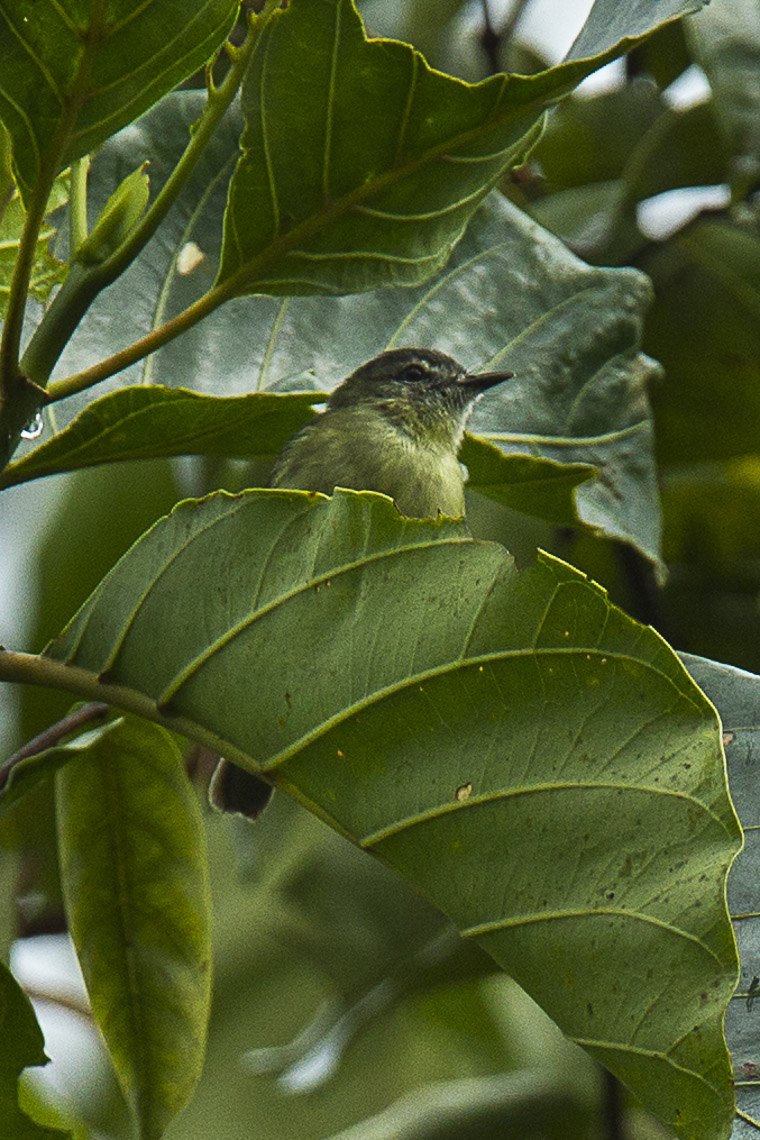
Adult Panama Tyrannulets have grayish white lores and a white eye-ring. A dusky band passes through the eye and continues around the yellowish ear coverts.[1][2]
The upperparts are olive green, with a slightly grayer crown. The dusky wings have yellowish olive-green to yellowish edges on the flight feathers, while large pale yellow tips on the dusky wing coverts form two wing bars.[3][4][5]
The tail is grayish brown with pale olive-green feather edges. The underparts are mostly pale yellow, with a slightly whiter chin and a faint olive wash on the upper breast.[6][7]
Both sexes have brown irises, black bills, and gray or black legs and feet. Males and females have the same plumage.[8][9]
The Panama Tyrannulet measures 10–11 cm in length. One recorded female weighed 8.8 g.[10][11]
Habitat
The Panama Tyrannulet inhabits the canopy of lowland evergreen forests and also occurs in nearby mature secondary forests. It occurs from near sea level to elevations of 2,000 m.[12][13][14]
The species is known only from central and eastern Panama, extending from the Canal Zone through Darién Province. It is suspected to occur in immediately adjacent Colombia, but no records from that country are available.[15][16]
Diet
The Panama Tyrannulet's diet consists mostly of arthropods.[17]
Behaviour
The Panama Tyrannulet is a year-round resident. It forages actively and almost entirely in the forest canopy.[18][19]
It typically perches horizontally on branches, often holding its tail cocked upward. It captures prey through short sallies and by hover-gleaning from leaves and twigs.[20][21]
The species typically forages alone or in pairs and often joins mixed-species feeding flocks.[22][23]
Conservation
The IUCN classifies the Panama Tyrannulet as Least Concern. Its estimated population is 20,000–50,000 mature individuals, and its population is believed to be stable.[24][25][26]
No immediate threats to the species have been identified. Its geographic range is somewhat restricted.[27][28]
Different authors describe the species as uncommon to locally fairly common or as uncommon and patchily distributed.[29]
Similar species
The Panama Tyrannulet was formerly considered conspecific with the olive-green tyrannulet and the mottle-cheeked tyrannulet by some authors. Many authors treat the three as a superspecies.[30][31]
Classification of the Panama Tyrannulet
| Kingdom | Animalia |
|---|---|
| Phylum | Chordata |
| Subphylum | Vertebrata |
| Infraphylum | Gnathostomata |
| Parvphylum | Osteichthyes |
| Megaclass | Tetrapoda |
| Class | Aves (Bird) |
| Order | Passeriformes (Passerine) |
| Family | Tyrannidae (Tyrant Flycatcher) |
| Genus | Phylloscartes (Long-tailed Tyrannulets) |
| Species | Phylloscartes flavovirens (Lawrence, 1862) |
Where the Panama Tyrannulet is found
Checklists and occurrence records place Phylloscartes flavovirens in 1 country across South America. GBIF holds 1,272 georeferenced records of it.
Countries
Regions and cities with the most records
- Panamá, Panama 993
- Alcalde Díaz, Panama 693
- Chilibre, Panama 637
- Panama City, Panama 561
- Curundú, Panama 558
- Ancón, Panama 555
- Arraiján, Panama 553
- San Miguelito, Panama 509
- Veracruz, Panama 480
- Juan Díaz, Panama 446
- Colón, Panama 122
- Darién, Panama 122
- Tocumen, Panama 23
- Panamá Oeste Province, Panama 15
- Cativá, Panama 8
- Colón, Panama 8
- Sabanitas, Panama 6
- La Chorrera, Panama 5
Range as the checklists state it
South America
A number beside a place is its count of GBIF occurrence records. A place without a number comes from a checklist alone. Records show where a species has been observed or collected, which can include escapes and vagrants.
Common names
English
- Panama Tyrannulet
- Panamanian Tyrannulet
- Yellow-green Tyrannulet
Names in 24 other languages
- Catalan
- tiranulet orellut verd i groc
- Chinese
- 黃綠姬霸鶲, 黄绿姬霸鹟
- Croatian
- panamska elenija
- Czech
- tyrančík panamský
- Danish
- Gulgrøn Tyrannulet
- Dutch
- Panamese Looftiran
- Esperanto
- panama tiraneto
- Finnish
- panamannapsija
- French
- Pipromorphe jaune-vert, Tyranneau jaune-vert
- German
- Panama-Laubtyrann, Panamalaubtyrann
- Italian
- Tirannetto gialloverde
- Japanese
- ミドリコバシハエトリ
- Lithuanian
- panaminis devynbalsis tironiukas
- Norwegian
- panamabladdanser
- Polish
- tyrańczyk panamski
- Portuguese
- borboletinha-panamense, marianinha-amarela, tiraninho-panamense
- Russian
- Панамский каричи, Панамский славковый тиранчик
- Serbian
- Žuto-zelena zviždakolika tirančica
- Slovak
- kariča žltozelená
- Spanish
- Orejerito verdiamarillo
- Swedish
- gulgrön dvärgtyrann, panamalövtyrann
- Turkish
- Yeşil-Sarı Yaprak Tiranı
- Ukrainian
- тиранчик панамський
- Welsh
- teyrn bach melynwyrdd y Gogledd
Synonyms
One other scientific name has been used for this species and is now treated as a synonym of Phylloscartes flavovirens.
- Leptopogon flavovirens Lawrence, 1862
Related species
-
 Rufous-browed TyrannuletPhylloscartes superciliaris
-
 Alagoas TyrannuletPhylloscartes ceciliae
-
 Mottle-cheeked TyrannuletPhylloscartes ventralis
-
 Minas Gerais TyrannuletPhylloscartes roquettei
-
 Ecuadorian TyrannuletPhylloscartes gualaquizae
-
 Bahia TyrannuletPhylloscartes beckeri
-
 Oustalet's TyrannuletPhylloscartes oustaleti
-
 Cinnamon-faced TyrannuletPhylloscartes parkeri
Compare
Questions and answers
What is the scientific name of the Panama Tyrannulet?
The scientific name of the Panama Tyrannulet is Phylloscartes flavovirens. Written with its author, the full name is Phylloscartes flavovirens (Lawrence, 1862).
Which family does the Panama Tyrannulet belong to?
Phylloscartes flavovirens belongs to the family Tyrannidae, in the order Passeriformes and the class Aves.
Where is the Panama Tyrannulet found?
Checklists and occurrence records place Phylloscartes flavovirens in 1 country: Panama.
What is the conservation status of the Panama Tyrannulet?
The IUCN Red List category recorded for Phylloscartes flavovirens is Least Concern (LC).
What other names does the Panama Tyrannulet have?
Phylloscartes flavovirens is also known in English as Panamanian Tyrannulet and Yellow-green Tyrannulet.
Sources
Passages the profile rests on
- Adult Panama tyrannulets have grayish white lores and a white eye-ring. Source passage: “Adults have grayish white lores and a white eye-ring.” — English Wikipedia
- The species has a dusky band through the eye that continues around its yellowish ear coverts. Source passage: “A dusky band through the eye continues around the yellowish ear coverts.” — English Wikipedia
- Its upperparts are olive green, with a slightly grayer crown. Source passage: “Their upperparts are olive green with a slighter grayer crown.” — English Wikipedia
- Its wings are dusky, with yellowish olive-green to yellowish edges on the flight feathers. Source passage: “Their wings are dusky with yellowish olive green to yellower edges on the flight feathers.” — English Wikipedia
- Its dusky wing coverts have large pale yellow tips that form two wing bars. Source passage: “Their wing coverts are dusky with large pale yellow tips that form two wing bars.” — English Wikipedia
- Its tail is grayish brown with pale olive-green feather edges. Source passage: “Their tail is grayish brown with pale olive green edges to the feathers.” — English Wikipedia
- Its underparts are mostly pale yellow, with a slightly whiter chin and a faint olive wash on the upper breast. Source passage: “Their underparts are mostly pale yellow with a slightly whiter chin and a faint olive wash on the upper breast.” — English Wikipedia
- Both sexes have brown irises, black bills, and gray or black legs and feet. Source passage: “Both sexes have a brown iris, a black bill, and gray or black legs and feet.” — English Wikipedia
- Male and female Panama tyrannulets have the same plumage. Source passage: “The sexes have the same plumage.” — English Wikipedia
- The Panama tyrannulet measures 10–11 cm in length. Source passage: “The Panama tyrannulet is 10 to 11 cm (3.9 to 4.3 in) long” — English Wikipedia
- One recorded female weighed 8.8 g. Source passage: “one female weighed 8.8 g (0.31 oz).” — English Wikipedia
- The species inhabits the canopy of lowland evergreen forests. Source passage: “It inhabits the canopy of lowland evergreen forest” — English Wikipedia
- The species also occurs in nearby mature secondary forests. Source passage: “and nearby mature secondary forest.” — English Wikipedia
- The Panama tyrannulet occurs from near sea level to elevations of 2,000 m. Source passage: “In elevation it occurs from near sea level to 2,000 m (6,600 ft).” — English Wikipedia
- The Panama tyrannulet is known only from central and eastern Panama, extending from the Canal Zone through Darién Province. Source passage: “The Panama tyrannulet is known only in central and eastern Panama from the Canal Zone through Darién Province.” — English Wikipedia
- The species is suspected to occur in immediately adjacent Colombia, but no records from that country are available. Source passage: “Though it is suspected to also occur in immediately adjacent Colombia there are no records there.” — English Wikipedia
- The Panama tyrannulet's diet consists mostly of arthropods. Source passage: “but is known to be mostly arthropods.” — English Wikipedia
- The species is a year-round resident. Source passage: “The Panama tyrannulet is a year-round resident.” — English Wikipedia
- The Panama tyrannulet forages actively and almost entirely in the forest canopy. Source passage: “It forages actively and almost entirely in the forest canopy.” — English Wikipedia
- It typically perches horizontally on branches, often holding its tail cocked upward. Source passage: “It typically perches horizontally on a branch, often with its tail cocked up” — English Wikipedia
- It captures prey through short sallies and by hover-gleaning from leaves and twigs. Source passage: “makes short sallies to grab or hover-glean prey from leaves and twigs.” — English Wikipedia
- The species typically forages alone or in pairs. Source passage: “It typically forages singly or in pairs” — English Wikipedia
- The Panama tyrannulet often joins mixed-species feeding flocks. Source passage: “and often as part of a mixed-species feeding flock.” — English Wikipedia
- The IUCN classifies the Panama tyrannulet as Least Concern. Source passage: “The IUCN has assessed the Panama tyrannulet as being of Least Concern.” — English Wikipedia
- The species has an estimated population of 20,000–50,000 mature individuals. Source passage: “its estimated population of between 20,000 and 50,000 mature individuals” — English Wikipedia
- The Panama tyrannulet's population is believed to be stable. Source passage: “is believed to be stable.” — English Wikipedia
- No immediate threats to the species have been identified. Source passage: “No immediate threats have been identified.” — English Wikipedia
- The species has a somewhat restricted geographic range. Source passage: “It has a somewhat restricted range;” — English Wikipedia
- Different authors describe the species as uncommon to locally fairly common or as uncommon and patchily distributed. Source passage: “Different authors characterize it as uncommon to locally fairly common or as uncommon and patchily distributed.” — English Wikipedia
- The Panama tyrannulet was formerly considered conspecific with the olive-green tyrannulet and the mottle-cheeked tyrannulet by some authors. Source passage: “Some early twentieth century authors considered the Panama tyrannulet and what are now the olive-green tyrannulet (P. virescens) and mottle-cheeked tyrannulet (P. ventralis) as conspecific.” — English Wikipedia
- The Panama tyrannulet, olive-green tyrannulet, and mottle-cheeked tyrannulet are treated by many authors as a superspecies. Source passage: “The three are now treated by many authors as a superspecies.” — English Wikipedia
Data
- Catalogue of Life, 2026-10-16 XR cc by
- Global Biodiversity Information Facility CC BY 4.0
- Wikidata CC0
- GeoNames CC BY 4.0
- Wikimedia Commons per image; credit shown with each image
- Within the Catalogue of Life, this name comes from The Integrated Taxonomic Information System cc0
References
- Gill, Frank, & and Minturn Wright. (2006). Birds of the World: Recommended English Names.
This species in other databases
Page built on 27 November 2026. See how the catalog is made and all sources and licences.
Cite this page
ScientificNames.org. (2026). Phylloscartes flavovirens (Panama Tyrannulet). Retrieved November 27, 2026, from https://scientificnames.org/species/phylloscartes-flavovirens
“Phylloscartes flavovirens (Panama Tyrannulet).” ScientificNames.org, 2026, scientificnames.org/species/phylloscartes-flavovirens. Accessed 27 Nov. 2026.
ScientificNames.org. “Phylloscartes flavovirens (Panama Tyrannulet).” Accessed November 27, 2026. https://scientificnames.org/species/phylloscartes-flavovirens.
@misc{scientificnames_phylloscartes_flavovirens_panama_tyrannulet,
  author = {{ScientificNames.org}},
  title = {Phylloscartes flavovirens (Panama Tyrannulet)},
  year = {2026},
  url = {https://scientificnames.org/species/phylloscartes-flavovirens},
  note = {Accessed 2026-11-27}
}