Species · Birds
Oustalet's Tyrannulet Phylloscartes oustaleti
The scientific name of the Oustalet's Tyrannulet is Phylloscartes oustaleti. It is a species of bird in the family Tyrannidae (tyrant flycatcher), order Passeriformes. The name dates from 1887.
- Scientific name
- Phylloscartes oustaleti (P. L. Sclater, 1887)
- Common name
- Oustalet's Tyrannulet
- Genus
- Phylloscartes
- Family
- Tyrannidae (Tyrant Flycatcher)
- Order
- Passeriformes
- Class
- Aves
- Red List category
- LC Least Concern
- Recorded in
- 1 country
- Name status
- accepted in the Catalogue of Life

Overview
Phylloscartes oustaleti inhabits humid subtropical and tropical forests in Brazil, primarily in forest interiors at elevations of 500–900 m. It has predominantly olive-green plumage with yellow markings, a long slender tail, and a blackish line passing through the eye.
Written 27 November 2026 from the sources listed below. Each statement was checked against the passage it cites; statements that could not be supported were removed.
Appearance
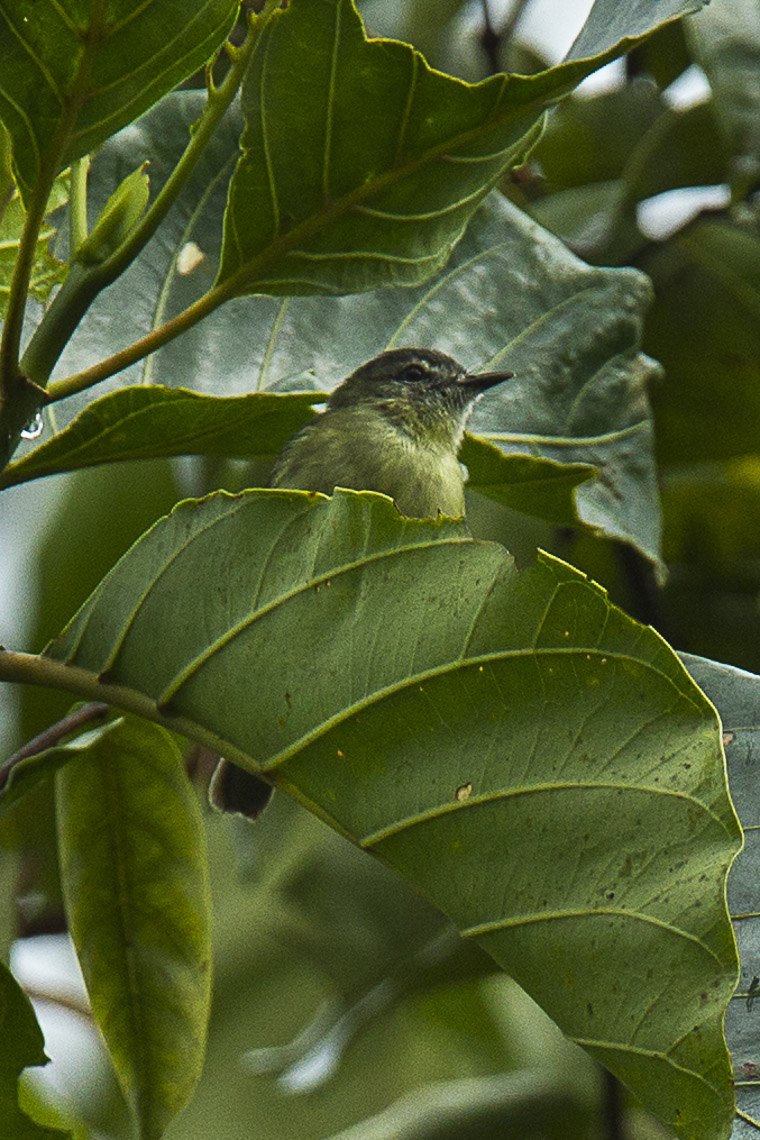
Adult Oustalet's Tyrannulets have yellowish lores extending into a broad eye-ring. The bright yellow face has a blackish line passing through the eye and curving around the ear coverts.[1][2]
The crown and upperparts are olive-colored. The wings are dusky olive, with yellowish olive edges on the flight feathers and yellowish tips on the dusky coverts that form two wing bars.[3][4][5]
The underparts are yellow, with a strong olive wash across the breast. The predominantly olive-green plumage contrasts with yellow on the throat, belly, eyebrow, and eye-rings.[6][7]
Both sexes have brown irises, long pointed black bills, and gray legs and feet. Males and females have the same plumage.[8][9]
The species has a long, slender tail that is usually held cocked.[10]
Habitat
Oustalet's Tyrannulet inhabits humid forests in subtropical and tropical zones. It primarily occupies forest interiors and only occasionally occurs along forest borders.[11][12]
Its recorded elevational range is 500–900 m. The species is associated with the Atlantic Forest of eastern Brazil.[13][14]
The species is endemic to Brazil. Its distribution extends along a narrow southeastern Brazilian band from southern Bahia to eastern Santa Catarina.[15][16]
Diet
Oustalet's Tyrannulet feeds primarily on insects and also consumes other arthropods, including spiders.[17]
Behaviour
The species forages actively in the forest sub-canopy and canopy. It typically perches horizontally on branches with its tail raised, sometimes vertically.[18][19]
It captures prey through short flights or by hover-gleaning from leaves and twigs. It usually forages in pairs or small family groups and almost always joins mixed-species feeding flocks.[20][21][22]
Oustalet's Tyrannulet is a year-round resident.[23]
Reproduction and life cycle
The species is thought to breed mainly from September through December. Its nest is a dome constructed from plant fibers and moss, with a side entrance and seed-down lining.[24][25]
Two reported nests were positioned approximately 2.3 m and 4 m above the ground.[26]
Conservation
The IUCN assessment category changed from Near Threatened in 1988 to Least Concern in March 2023. The species has a large geographic range.[27][28]
Its population size is unknown and is believed to be declining. The species is locally uncommon to fairly common and occurs in several protected areas.[29][30]
Urbanisation, industrialization, agricultural expansion, mining, and road-building are identified as current key threats.[31]
Classification of the Oustalet's Tyrannulet
| Kingdom | Animalia |
|---|---|
| Phylum | Chordata |
| Subphylum | Vertebrata |
| Infraphylum | Gnathostomata |
| Parvphylum | Osteichthyes |
| Megaclass | Tetrapoda |
| Class | Aves (Bird) |
| Order | Passeriformes (Passerine) |
| Family | Tyrannidae (Tyrant Flycatcher) |
| Genus | Phylloscartes (Long-tailed Tyrannulets) |
| Species | Phylloscartes oustaleti (P. L. Sclater, 1887) |
Where the Oustalet's Tyrannulet is found
Checklists and occurrence records place Phylloscartes oustaleti in 1 country across South America. GBIF holds 3,400 georeferenced records of it.
Countries
Regions and cities with the most records
- São Paulo, Brazil 2,541
- Guapiara, Brazil 1,290
- Espírito Santo, Brazil 249
- Paraná, Brazil 190
- Rio de Janeiro, Brazil 154
- Santa Catarina, Brazil 143
- Santa Teresa, Brazil 118
- Fundão, Brazil 110
- Vargem Alta, Brazil 87
- São Miguel Arcanjo, Brazil 78
- Cachoeiras de Macacu, Brazil 75
- Bahia, Brazil 74
- Morretes, Brazil 63
- Nova Friburgo, Brazil 62
- Antonina, Brazil 59
- Juquitiba, Brazil 59
- Salesópolis, Brazil 54
- Schroeder, Brazil 50
- Ubatuba, Brazil 49
- Apiaí, Brazil 48
- Ilhabela, Brazil 43
- São Sebastião, Brazil 43
- Biritiba Mirim, Brazil 39
- Paraty, Brazil 31
- Joinville, Brazil 30
- Cunha, Brazil 27
- Guaramirim, Brazil 25
- Jaraguá do Sul, Brazil 25
- Castelo, Brazil 23
- Iguaí, Brazil 23
- Itapoá, Brazil 21
- Pomerode, Brazil 19
- Caraguatatuba, Brazil 18
- Corupá, Brazil 18
- São Francisco do Sul, Brazil 18
- Massaranduba, Brazil 17
Range as the checklists state it
South America
A number beside a place is its count of GBIF occurrence records. A place without a number comes from a checklist alone. Records show where a species has been observed or collected, which can include escapes and vagrants.
Common names
English
- Oustalet's Tyrannulet
Names in 24 other languages
- Catalan
- tiranulet orellut d'Oustalet
- Chinese
- 欧氏姬霸鹟, 歐斯塔氏姬霸鶲
- Croatian
- maslinastozelena elenija
- Czech
- tyrančík černouchý
- Danish
- Vipstjert Børstetyran
- Dutch
- Oustalets Looftiran
- Esperanto
- orokula tiraneto
- Finnish
- keltarillinapsija
- French
- Pipromorphe d'Oustalet, Tyranneau d'Oustalet, Tyranneau d’Oustalet
- German
- Gelbohr-Laubtyrann, Goldaugen-Laubtyrann
- Italian
- Tirannetto di Oustalet
- Japanese
- ミミグロコバシハエトリ
- Lithuanian
- auksaakis devynbalsis tironiukas
- Norwegian
- gulbrillebladdanser
- Polish
- tyrańczyk złotooki
- Portuguese
- papa-moscas-de-olheiras, tiraninho-d'olheiras
- Russian
- Желтоухий каричи, Золотоглазый славковый тиранчик
- Serbian
- Dugorepa zviždakolika tirančica
- Slovak
- kariča zlatooká
- Spanish
- Orejerito de Oustalet
- Swedish
- Oustalets dvärgtyrann, långstjärtad lövtyrann, oustaletdvärgtyrann
- Turkish
- Oustalet Yaprak Tiranı
- Ukrainian
- тиранчик санта-катаринський
- Welsh
- teyrn bach Oustalet
Synonyms
One other scientific name has been used for this species and is now treated as a synonym of Phylloscartes oustaleti.
- Leptopogon oustaleti P. L. Sclater, 1887
Related species
-
 Rufous-browed TyrannuletPhylloscartes superciliaris
-
 Alagoas TyrannuletPhylloscartes ceciliae
-
 Mottle-cheeked TyrannuletPhylloscartes ventralis
-
 Minas Gerais TyrannuletPhylloscartes roquettei
-
 Ecuadorian TyrannuletPhylloscartes gualaquizae
-
 Bahia TyrannuletPhylloscartes beckeri
-
 Cinnamon-faced TyrannuletPhylloscartes parkeri
-
 Olive-green TyrannuletPhylloscartes virescens
Compare
Questions and answers
What is the scientific name of the Oustalet's Tyrannulet?
The scientific name of the Oustalet's Tyrannulet is Phylloscartes oustaleti. Written with its author, the full name is Phylloscartes oustaleti (P. L. Sclater, 1887).
Which family does the Oustalet's Tyrannulet belong to?
Phylloscartes oustaleti belongs to the family Tyrannidae, in the order Passeriformes and the class Aves.
Where is the Oustalet's Tyrannulet found?
Checklists and occurrence records place Phylloscartes oustaleti in 1 country: Brazil.
What is the conservation status of the Oustalet's Tyrannulet?
The IUCN Red List category recorded for Phylloscartes oustaleti is Least Concern (LC).
Sources
Passages the profile rests on
- Adult Oustalet's Tyrannulets have yellowish lores extending into a broad eye-ring. Source passage: “Adults have yellowish lores whose color extends to a wide eye-ring.” — English Wikipedia
- The bird's face is bright yellow with a blackish line passing through the eye and curving around the ear coverts. Source passage: “Their face is otherwise bright yellow with a blackish line through the eye that continues as a crescent around the ear coverts.” — English Wikipedia
- Its crown and upperparts are olive-colored. Source passage: “Their crown and upperparts are olive.” — English Wikipedia
- Its wings are dusky olive with yellowish olive edges on the flight feathers. Source passage: “Their wings are dusky olive with yellowish olive edges on the flight feathers.” — English Wikipedia
- Its dusky wing coverts have yellowish tips that form two wing bars. Source passage: “Their wing coverts are dusky with yellowish tips that form two wing bars.” — English Wikipedia
- Its underparts are yellow with a strong olive wash across the breast. Source passage: “Their underparts are yellow with a heavy wash of olive on the breast.” — English Wikipedia
- Its predominantly olive-green plumage contrasts with yellow on the throat, belly, eyebrow, and eye-rings. Source passage: “Mostly olive-green apart from yellow throat, belly, eyebrow, eyerings,” — ebird.org
- Both sexes have brown irises, long pointed black bills, and gray legs and feet. Source passage: “Both sexes have a brown iris, a long, pointed, black bill, and gray legs and feet.” — English Wikipedia
- Males and females have the same plumage. Source passage: “The sexes have the same plumage.” — English Wikipedia
- The species has a long, slender tail that is usually held cocked. Source passage: “Small flycatcher with a long slender tail, which is usually held cocked.” — ebird.org
- The species inhabits humid forests in subtropical and tropical zones. Source passage: “It inhabits humid forest in the subtropical and tropical zones.” — English Wikipedia
- It primarily occupies forest interiors and only occasionally occurs along forest borders. Source passage: “It primarily is found in the forest interior and only occasionally at its borders.” — English Wikipedia
- Its recorded elevational range is 500–900 m. Source passage: “In elevation it ranges between 500 and 900 m (1,600 and 3,000 ft).” — English Wikipedia
- The species is associated with the Atlantic Forest of eastern Brazil. Source passage: “endemic to the Atlantic Forest in eastern Brazil” — academia.edu
- The species is endemic to Brazil. Source passage: “It is endemic to Brazil.” — English Wikipedia
- Its distribution extends along a narrow southeastern Brazilian band from southern Bahia to eastern Santa Catarina. Source passage: “Oustalet's tyrannulet is found along a narrow band in southeastern Brazil from southern Bahia south to eastern Santa Catarina.” — English Wikipedia
- The species feeds primarily on insects and also consumes other arthropods, including spiders. Source passage: “Oustalet's tyrannulet feeds primarily on insects and also other arthropods like spiders in its diet.” — English Wikipedia
- The species forages actively in the forest sub-canopy and canopy. Source passage: “It forages actively, mostly in the forest's sub-canopy and canopy.” — English Wikipedia
- It typically perches horizontally on branches with its tail raised, sometimes vertically. Source passage: “It typically perches horizontally on a branch, usually with its tail cocked up sometimes to the vertical” — English Wikipedia
- It captures prey through short flights or by hover-gleaning from leaves and twigs. Source passage: “makes short sallies to snatch or hover-glean prey from leaves and twigs.” — English Wikipedia
- It usually forages in pairs or small family groups. Source passage: “It typically forages in pairs or small family groups” — English Wikipedia
- It almost always joins mixed-species feeding flocks while foraging. Source passage: “almost always as part of a mixed-species feeding flock.” — English Wikipedia
- The species is a year-round resident. Source passage: “Oustalet's tyrannulet is a year-round resident.” — English Wikipedia
- The species is thought to breed mainly from September through December. Source passage: “Oustalet's tyrannulet is thought to breed mostly between September and December.” — English Wikipedia
- Its nest is a dome constructed from plant fibers and moss, with a side entrance and seed-down lining. Source passage: “Its nest is a dome made from plant fibers and moss with a side entrance and lined with seed down.” — English Wikipedia
- Two reported nests were positioned approximately 2.3 m and 4 m above the ground. Source passage: “One was placed about 2.3 m (8 ft) above the ground and another about 4 m (13 ft) up.” — English Wikipedia
- The IUCN assessment category changed from Near Threatened in 1988 to Least Concern in March 2023. Source passage: “The IUCN originally in 1988 assessed Oustalet's tyrannulet as Near Threatened but since March 2023 as being of Least Concern.” — English Wikipedia
- The species has a large geographic range. Source passage: “It has a large range;” — English Wikipedia
- Its population size is unknown and is believed to be declining. Source passage: “its population size is not known and is believed to be decreasing.” — English Wikipedia
- The species is locally uncommon to fairly common and occurs in several protected areas. Source passage: “It is considered locally uncommon to fairly common and occurs in several protected areas.” — English Wikipedia
- Urbanisation, industrialization, agricultural expansion, mining, and road-building are identified as current key threats. Source passage: “Current key threats are urbanisation, industrialization, agricultural expansion, mining and road-building.” — English Wikipedia
Data
- Catalogue of Life, 2026-10-16 XR cc by
- Global Biodiversity Information Facility CC BY 4.0
- Wikidata CC0
- GeoNames CC BY 4.0
- Wikimedia Commons per image; credit shown with each image
- Within the Catalogue of Life, this name comes from The Integrated Taxonomic Information System cc0
References
- Gill, Frank, & and Minturn Wright. (2006). Birds of the World: Recommended English Names.
This species in other databases
Page built on 29 November 2026. See how the catalog is made and all sources and licences.
Cite this page
ScientificNames.org. (2026). Phylloscartes oustaleti (Oustalet's Tyrannulet). Retrieved November 29, 2026, from https://scientificnames.org/species/phylloscartes-oustaleti
“Phylloscartes oustaleti (Oustalet's Tyrannulet).” ScientificNames.org, 2026, scientificnames.org/species/phylloscartes-oustaleti. Accessed 29 Nov. 2026.
ScientificNames.org. “Phylloscartes oustaleti (Oustalet's Tyrannulet).” Accessed November 29, 2026. https://scientificnames.org/species/phylloscartes-oustaleti.
@misc{scientificnames_phylloscartes_oustaleti_oustalets_tyrannulet,
  author = {{ScientificNames.org}},
  title = {Phylloscartes oustaleti (Oustalet's Tyrannulet)},
  year = {2026},
  url = {https://scientificnames.org/species/phylloscartes-oustaleti},
  note = {Accessed 2026-11-29}
}