Species · Birds
Rufous-browed Tyrannulet Phylloscartes superciliaris
The scientific name of the Rufous-browed Tyrannulet is Phylloscartes superciliaris. It is a species of bird in the family Tyrannidae (tyrant flycatcher), order Passeriformes. The name dates from 1868.
- Scientific name
- Phylloscartes superciliaris (P. L. Sclater & Salvin, 1868)
- Common name
- Rufous-browed Tyrannulet
- Genus
- Phylloscartes
- Family
- Tyrannidae (Tyrant Flycatcher)
- Order
- Passeriformes
- Class
- Aves
- Red List category
- LC Least Concern
- Recorded in
- 5 countries
- Name status
- accepted in the Catalogue of Life

Overview
The Rufous-browed Tyrannulet (Phylloscartes superciliaris) is a bird in the family Tyrannidae, order Passeriformes, class Aves. It inhabits humid and wet montane evergreen forests in the subtropical zone, with a disjunct distribution recorded in Colombia, Costa Rica, Ecuador, Panama, and Venezuela, and possible occurrence in Peru. It is marked by a chestnut forecrown, a pearly gray crown, bright olive upperparts, and white ear coverts bordered by a thin black marking.
Written 27 November 2026 from the sources listed below. Each statement was checked against the passage it cites; statements that could not be supported were removed.
Appearance
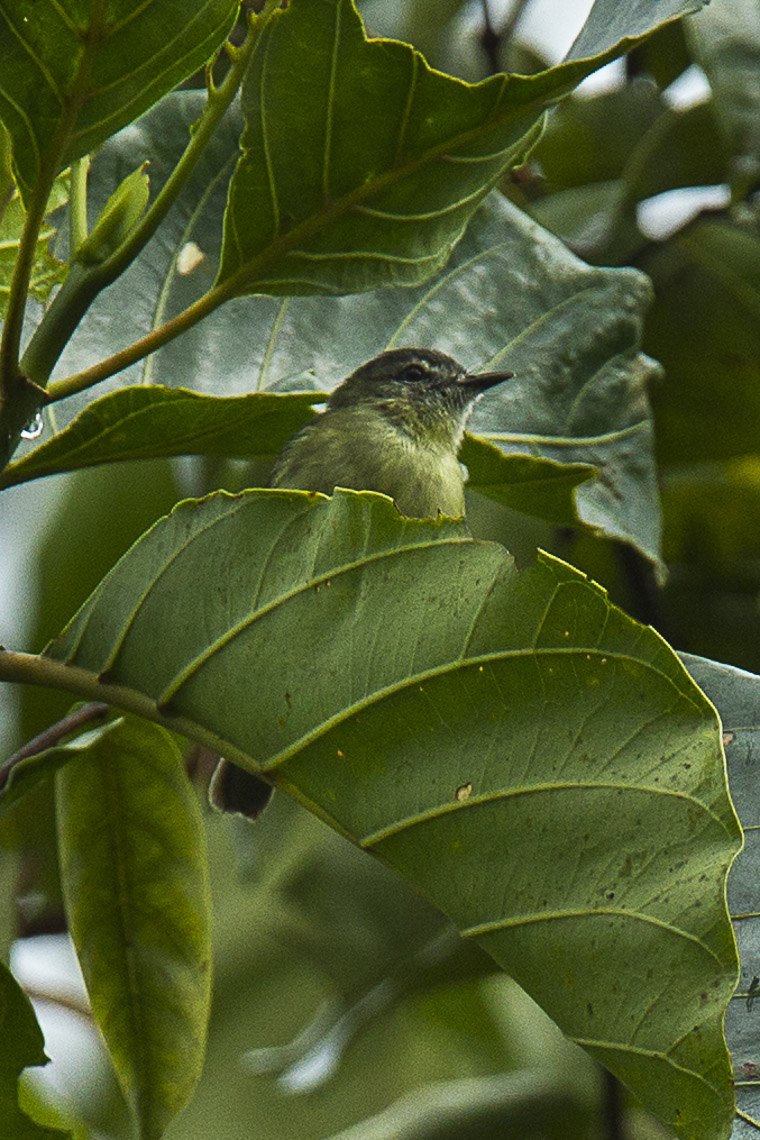
Adult nominate birds have a bright chestnut forecrown and lores extending backward as a thin supercilium. The nominate subspecies has a pearly gray crown and bright olive upperparts.[1][2]
The ear coverts are white and bordered by a conspicuous thin black marking. The throat is grayish white, while the remaining underparts are predominantly white.[3][4]
Both sexes have dark brown irises, black bills, and gray legs and feet. Their plumage is identical.[5][6]
The species has a gray cap, a white cheek with a black border, and a thin rufous marking above the cheek.[7]
It measures between 9.5 and 12 cm in length. Three measured individuals weighed between 7 and 9 g.[8][9]
Habitat
The Rufous-browed Tyrannulet inhabits the canopy and edges of humid and wet montane evergreen forests in the subtropical zone.[10]
In Costa Rica, it occurs at elevations between 500 and 1,300 m. In Colombia, it occurs between 1,000 and 2,200 m.[11][12]
In Venezuela, it occurs between 1,650 and 2,000 m. In Ecuador, it occurs between 1,300 and 1,700 m.[13][14]
In Peru, it has been reported between 1,400 and 1,800 m.[15]
Diet
Its diet is thought to consist primarily of insects and to include small fruits.[16]
Behaviour
The Rufous-browed Tyrannulet is a year-round resident. It forages actively, mainly in the forest canopy and occasionally at lower levels near forest edges.[17][18]
It typically perches horizontally on branches, often holding its tail upward. It captures prey through short flights to hover and glean from leaves and twigs.[19][20]
It generally forages alone or in pairs and occasionally in small family groups. It regularly participates in mixed-species feeding flocks.[21][22]
Reproduction and life cycle
The species is thought to breed in Costa Rica between March and May or June.[23]
Conservation
The IUCN classifies the Rufous-browed Tyrannulet as Least Concern. The species was most recently assessed for the IUCN Red List in 2022.[24][25]
The estimated population comprises at least 50,000 mature individuals. BirdLife International reports an estimated population of 50,000 to 499,999 mature individuals.[26][27]
The population is believed to be decreasing. No immediate threats to the species have been identified.[28][29]
Similar species
The rufous-lored tyrannulet and the cinnamon-faced tyrannulet are identified as close relatives of the Rufous-browed Tyrannulet.[30][31]
Classification of the Rufous-browed Tyrannulet
| Kingdom | Animalia |
|---|---|
| Phylum | Chordata |
| Subphylum | Vertebrata |
| Infraphylum | Gnathostomata |
| Parvphylum | Osteichthyes |
| Megaclass | Tetrapoda |
| Class | Aves (Bird) |
| Order | Passeriformes (Passerine) |
| Family | Tyrannidae (Tyrant Flycatcher) |
| Genus | Phylloscartes (Long-tailed Tyrannulets) |
| Species | Phylloscartes superciliaris (P. L. Sclater & Salvin, 1868) |
Where the Rufous-browed Tyrannulet is found
Checklists and occurrence records place Phylloscartes superciliaris in 5 countries across North America and South America. GBIF holds 3,473 georeferenced records of it.
Countries
Regions and cities with the most records
- Cartago Province, Costa Rica 691
- Turrialba, Costa Rica 667
- Risaralda Department, Colombia 556
- Alajuela Province, Costa Rica 537
- Paraíso, Costa Rica 470
- Antioquia, Colombia 417
- Panamá Oeste Province, Panama 314
- Zamora Chinchipe, Ecuador 217
- Santander Department, Colombia 172
- Guanacaste Province, Costa Rica 170
- Quesada, Costa Rica 156
- Limón Province, Costa Rica 50
- Heredia Province, Costa Rica 46
- Cartago, Costa Rica 44
- Guápiles, Costa Rica 38
- Chocó, Colombia 35
- Belén de Umbría, Colombia 32
- Ciudad Bolívar, Colombia 31
- Puntarenas Province, Costa Rica 30
- Chiriquí Province, Panama 29
- Yarumal, Colombia 26
- Morona-Santiago Province, Ecuador 25
- Anserma, Colombia 24
- Caldas Department, Colombia 21
- Quinchía, Colombia 20
- Coclé, Panama 17
- Siquirres, Costa Rica 17
- San José, Costa Rica 14
- Cundinamarca, Colombia 11
- Nariño, Colombia 8
- Sibaté, Colombia 8
- Soacha, Colombia 8
- Funza, Colombia 7
- Madrid, Colombia 7
- Mosquera, Colombia 7
- Zamora, Ecuador 7
Range as the checklists state it
Middle America
South America
A number beside a place is its count of GBIF occurrence records. A place without a number comes from a checklist alone. Records show where a species has been observed or collected, which can include escapes and vagrants.
Common names
English
- Rufous-browed Tyrannulet
Names in 24 other languages
- Catalan
- tiranulet orellut cella-rogenc
- Chinese
- 棕額姬霸鶲, 棕额姬霸鹟
- Croatian
- bjelolica elenija
- Czech
- tyrančík rezavobrvý
- Danish
- Rødbrynet Tyrannulet
- Dutch
- Roodbrauwlooftiran
- Esperanto
- rufbrova tiraneto
- Finnish
- ruskokulmanapsija
- French
- Pipromorphe à sourcils roux, Tyranneau à sourcils roux
- German
- Rostbrauen-Laubtyrann, Rostbrauenlaubtyrann, Weißwangen-Laubtyrann
- Italian
- Tirannetto dai sopraccigli, Tiranno piccolo dai sopraccigli rossicci
- Japanese
- アカマユコバシハエトリ
- Lithuanian
- Rusvabruvis devynbalsinis tironiukas, rusvabruvis devynbalsis tironiukas
- Norwegian
- rustbrynbladdanser
- Polish
- tyrańczyk rdzawobrewy
- Portuguese
- borboletinha-de-viseira, tiraninho-de-sobrancelha-ruiva
- Russian
- Краснобровый каричи, Рыже-бурый славковый тиранчик
- Serbian
- Riđoobrvasta zviždakolika tirančica
- Slovak
- kariča bielolíca
- Spanish
- Mosquerito Cejirrufo, Orejerito cejirrufo
- Swedish
- rödbrynad dvärgtyrann, rödbrynad lövtyrann
- Turkish
- Kzııl Kaşlı Yaprak Tiranı
- Ukrainian
- тиранчик рудобровий
- Welsh
- teyrn bach aelgoch
Synonyms
One other scientific name has been used for this species and is now treated as a synonym of Phylloscartes superciliaris.
- Leptotriccus superciliaris P. L. Sclater & Salvin, 1868
Subspecies and varieties
- Phylloscartes superciliaris griseocapillus subspecies
- Phylloscartes superciliaris palloris subspecies
- Phylloscartes superciliaris superciliaris subspecies
Related species
-
 Alagoas TyrannuletPhylloscartes ceciliae
-
 Mottle-cheeked TyrannuletPhylloscartes ventralis
-
 Minas Gerais TyrannuletPhylloscartes roquettei
-
 Ecuadorian TyrannuletPhylloscartes gualaquizae
-
 Bahia TyrannuletPhylloscartes beckeri
-
 Oustalet's TyrannuletPhylloscartes oustaleti
-
 Cinnamon-faced TyrannuletPhylloscartes parkeri
-
 Olive-green TyrannuletPhylloscartes virescens
Compare
Questions and answers
What is the scientific name of the Rufous-browed Tyrannulet?
The scientific name of the Rufous-browed Tyrannulet is Phylloscartes superciliaris. Written with its author, the full name is Phylloscartes superciliaris (P. L. Sclater & Salvin, 1868).
Which family does the Rufous-browed Tyrannulet belong to?
Phylloscartes superciliaris belongs to the family Tyrannidae, in the order Passeriformes and the class Aves.
Where is the Rufous-browed Tyrannulet found?
Checklists and occurrence records place Phylloscartes superciliaris in 5 countries: Costa Rica, Colombia, Panama, Ecuador and Venezuela.
What is the conservation status of the Rufous-browed Tyrannulet?
The IUCN Red List category recorded for Phylloscartes superciliaris is Least Concern (LC).
Where is the Rufous-browed Tyrannulet found?
It is recorded in Colombia, Costa Rica, Ecuador, Panama, and Venezuela, with possible occurrence in Peru. Its geographic distribution is disjunct.[32][33]
Where does the nominate subspecies occur?
It occurs on the Caribbean slope of Costa Rica, from the Cordillera de Guanacaste to the Cordillera Central. It also occurs in western Panama between Bocas del Toro and Coclé provinces.[34][35]
Where does P. s. palloris occur?
It occurs in Darién Province in eastern Panama and adjacent northwestern Colombia.[36]
Where does P. s. griseocapillus occur?
It occurs in the Serranía del Perijá along the Colombia–Venezuela border and patchily in the northern Colombian Andes. In southern Ecuador, it occurs on the eastern Andean slope in the Cordillera de Cutucú and Cordillera del Cóndor.[37][38][39]
Is the species confirmed in Peru?
The species is treated as hypothetical in Peru because the available records consist only of sightings.[40]
Sources
Passages the profile rests on
- Adult nominate birds have a bright chestnut forecrown and lores extending backward as a thin supercilium. Source passage: “The forecrown and lores of nominate adults are bright chestnut that extends to the rear as a thin supercilium.” — English Wikipedia
- The nominate subspecies has a pearly gray crown and bright olive upperparts. Source passage: “Their crown is pearly gray and the rest of their upperparts are bright olive.” — English Wikipedia
- Its ear coverts are white and bordered by a conspicuous thin black marking. Source passage: “Their ear coverts are white with a thin but conspicuous black border” — English Wikipedia
- Its throat is grayish white, while the remaining underparts are predominantly white. Source passage: “Their throat is grayish white. The rest of their underparts are white” — English Wikipedia
- Both sexes have dark brown irises, black bills, and gray legs and feet. Source passage: “Both sexes of all subspecies have a dark brown iris, a black bill, and gray legs and feet.” — English Wikipedia
- The sexes have identical plumage. Source passage: “The sexes have the same plumage.” — English Wikipedia
- The species has a gray cap, white cheek with a black border, and a thin rufous marking above the cheek. Source passage: “Look for head pattern: gray cap, white cheek with black border, and thin rufous mark above” — ebird.org
- The species measures between 9.5 and 12 cm in length. Source passage: “The rufous-browed tyrannulet is 9.5 to 12 cm (3.7 to 4.7 in) long;” — English Wikipedia
- Three measured individuals weighed between 7 and 9 g. Source passage: “three individuals weighed 7 to 9 g (0.25 to 0.32 oz).” — English Wikipedia
- The species inhabits the canopy and edges of humid and wet montane evergreen forests in the subtropical zone. Source passage: “The rufous-browed tyrannulet inhabits the canopy and edges of humid and wet montane evergreen forest in the subtropical zone.” — English Wikipedia
- In Costa Rica, the species occurs at elevations between 500 and 1,300 m. Source passage: “between 500 and 1,300 m (1,600 and 4,300 ft) in Costa Rica” — English Wikipedia
- In Colombia, the species occurs at elevations between 1,000 and 2,200 m. Source passage: “between 1,000 and 2,200 m (3,300 and 7,200 ft) in Colombia” — English Wikipedia
- In Venezuela, the species occurs at elevations between 1,650 and 2,000 m. Source passage: “between 1,650 and 2,000 m (5,400 and 6,600 ft) in Venezuela” — English Wikipedia
- In Ecuador, the species occurs at elevations between 1,300 and 1,700 m. Source passage: “between 1,300 and 1,700 m (4,300 and 5,600 ft) in Ecuador” — English Wikipedia
- In Peru, the species has been reported at elevations between 1,400 and 1,800 m. Source passage: “between 1,400 and 1,800 m (4,600 and 5,900 ft) in Peru.” — English Wikipedia
- Its diet is thought to consist primarily of insects and to include small fruits. Source passage: “is thought to be primarily insects and include small fruits.” — English Wikipedia
- The species is a year-round resident. Source passage: “The rufous-browed tyrannulet is a year-round resident.” — English Wikipedia
- It forages actively, mainly in the forest canopy and occasionally at lower levels near forest edges. Source passage: “It forages actively, mostly in the forest canopy and sometimes lower, especially at forest edges.” — English Wikipedia
- It typically perches horizontally on branches, often holding its tail upward. Source passage: “It typically perches horizontally on a branch, often with its tail cocked up,” — English Wikipedia
- It captures prey by making short flights to hover and glean from leaves and twigs. Source passage: “makes short sallies to hover-glean prey from leaves and twigs.” — English Wikipedia
- It generally forages alone or in pairs and occasionally in small family groups. Source passage: “It typically forages singly, in pairs, and sometimes in small family groups,” — English Wikipedia
- It regularly participates in mixed-species feeding flocks. Source passage: “regularly as part of a mixed-species feeding flock.” — English Wikipedia
- The species is thought to breed in Costa Rica between March and May or June. Source passage: “The rufous-browed tyrannulet is thought to breed between March and May or June in Costa Rica.” — English Wikipedia
- The IUCN has classified the species as Least Concern. Source passage: “The IUCN has assessed the rufous-browed tyrannulet as being of Least Concern.” — English Wikipedia
- The species was most recently assessed for the IUCN Red List in 2022. Source passage: “has most recently been assessed for The IUCN Red List of Threatened Species in 2022.” — iucnredlist.org
- The estimated population comprises at least 50,000 mature individuals. Source passage: “its population is estimated to be at least 50,000 mature individuals” — English Wikipedia
- BirdLife International reports an estimated population of 50,000 to 499,999 mature individuals. Source passage: “Number of mature individuals 50,000 - 499,999” — datazone.birdlife.org
- The population is believed to be decreasing. Source passage: “and is believed to be decreasing.” — English Wikipedia
- No immediate threats to the species have been identified. Source passage: “No immediate threats have been identified.” — English Wikipedia
- The rufous-lored tyrannulet is identified as one of the closest relatives of this species. Source passage: “the rufous-browed tyrannulet's closest relatives are the rufous-lored tyrannulet (P. flaviventris)” — English Wikipedia
- The cinnamon-faced tyrannulet is identified as another close relative of this species. Source passage: “and the cinnamon-faced tyrannulet (P. parkeri).” — English Wikipedia
- The species has a disjunct geographic distribution. Source passage: “The rufous-browed tyrannulet has a disjunct distribution.” — English Wikipedia
- The species is recorded in Colombia, Costa Rica, Ecuador, Panama, and Venezuela, with possible occurrence in Peru. Source passage: “It is found in Colombia, Costa Rica, Ecuador, Panama, Venezuela, and possibly Peru.” — English Wikipedia
- The nominate subspecies occurs on the Caribbean slope of Costa Rica, from the Cordillera de Guanacaste to the Cordillera Central. Source passage: “It is found in Costa Rica on the Caribbean slope from the Cordillera de Guanacaste to the Cordillera Central” — English Wikipedia
- The nominate subspecies also occurs in western Panama between Bocas del Toro and Coclé provinces. Source passage: “separately in western Panama from Bocas del Toro Province to Coclé Province, also on the Caribbean slope.” — English Wikipedia
- The subspecies P. s. palloris occurs in Darién Province in eastern Panama and adjacent northwestern Colombia. Source passage: “Subspecies P. s. palloris is found in eastern Panama's Darién Province and adjacent northwestern Colombia.” — English Wikipedia
- The subspecies P. s. griseocapillus occurs in the Serranía del Perijá along the Colombia–Venezuela border. Source passage: “found in the Serranía del Perijá that straddles the Colombia-Venezuela border,” — English Wikipedia
- The subspecies P. s. griseocapillus also occurs patchily in the northern Colombian Andes. Source passage: “patchily in the northern Colombian Andes,” — English Wikipedia
- In southern Ecuador, P. s. griseocapillus occurs on the eastern Andean slope in the Cordillera de Cutucú and Cordillera del Cóndor. Source passage: “on the eastern Andean slope in southern Ecuador's Cordillera de Cutucú and Cordillera del Cóndor.” — English Wikipedia
- The species is treated as hypothetical in Peru because the available records consist only of sightings. Source passage: “has only sight records from Peru and therefore treats the rufous-browed tyrannulet as hypothetical in that country.” — English Wikipedia
- The species was originally described in 1868 under the scientific name Leptotriccus superciliaris. Source passage: “The rufous-browed tyrannulet was originally described in 1868 as Leptotriccus superciliaris.” — English Wikipedia
- The species is currently classified in the genus Phylloscartes. Source passage: “It was later transferred to genus Mecocerculus and then to its present genus Phylloscartes.” — English Wikipedia
Data
- Catalogue of Life, 2026-10-16 XR cc by
- Global Biodiversity Information Facility CC BY 4.0
- Wikidata CC0
- GeoNames CC BY 4.0
- Wikimedia Commons per image; credit shown with each image
- Within the Catalogue of Life, this name comes from The Integrated Taxonomic Information System cc0
References
- Gill, Frank, & and Minturn Wright. (2006). Birds of the World: Recommended English Names.
This species in other databases
Page built on 27 November 2026. See how the catalog is made and all sources and licences.
Cite this page
ScientificNames.org. (2026). Phylloscartes superciliaris (Rufous-browed Tyrannulet). Retrieved November 27, 2026, from https://scientificnames.org/species/phylloscartes-superciliaris
“Phylloscartes superciliaris (Rufous-browed Tyrannulet).” ScientificNames.org, 2026, scientificnames.org/species/phylloscartes-superciliaris. Accessed 27 Nov. 2026.
ScientificNames.org. “Phylloscartes superciliaris (Rufous-browed Tyrannulet).” Accessed November 27, 2026. https://scientificnames.org/species/phylloscartes-superciliaris.
@misc{scientificnames_phylloscartes_superciliaris_rufous_browed_tyrannulet,
  author = {{ScientificNames.org}},
  title = {Phylloscartes superciliaris (Rufous-browed Tyrannulet)},
  year = {2026},
  url = {https://scientificnames.org/species/phylloscartes-superciliaris},
  note = {Accessed 2026-11-27}
}