Species · Birds
Black-fronted Tyrannulet Phylloscartes nigrifrons
The scientific name of the Black-fronted Tyrannulet is Phylloscartes nigrifrons. It is a species of bird in the family Tyrannidae (tyrant flycatcher), order Passeriformes. The name dates from 1884.
- Scientific name
- Phylloscartes nigrifrons (Salvin & Godman, 1884)
- Common name
- Black-fronted Tyrannulet
- Genus
- Phylloscartes
- Family
- Tyrannidae (Tyrant Flycatcher)
- Order
- Passeriformes
- Class
- Aves
- Red List category
- LC Least Concern
- Recorded in
- 3 countries
- Name status
- accepted in the Catalogue of Life

Overview
The Black-fronted Tyrannulet is a monotypic bird species in the family Tyrannidae, order Passeriformes, and class Aves. It occurs in Brazil, Guyana, and Venezuela, primarily on the tepuis of Amazonas and Bolívar states in Venezuela. Adults have a black forecrown, lores, and post-loral area that create a frowning appearance, together with a narrow white supercilium.
Written 27 November 2026 from the sources listed below. Each statement was checked against the passage it cites; statements that could not be supported were removed.
Similar species
The rufous-lored tyrannulet (P. flaviventris) and cinnamon-faced tyrannulet (P. parkeri) are considered its closest relatives.[1]
Appearance
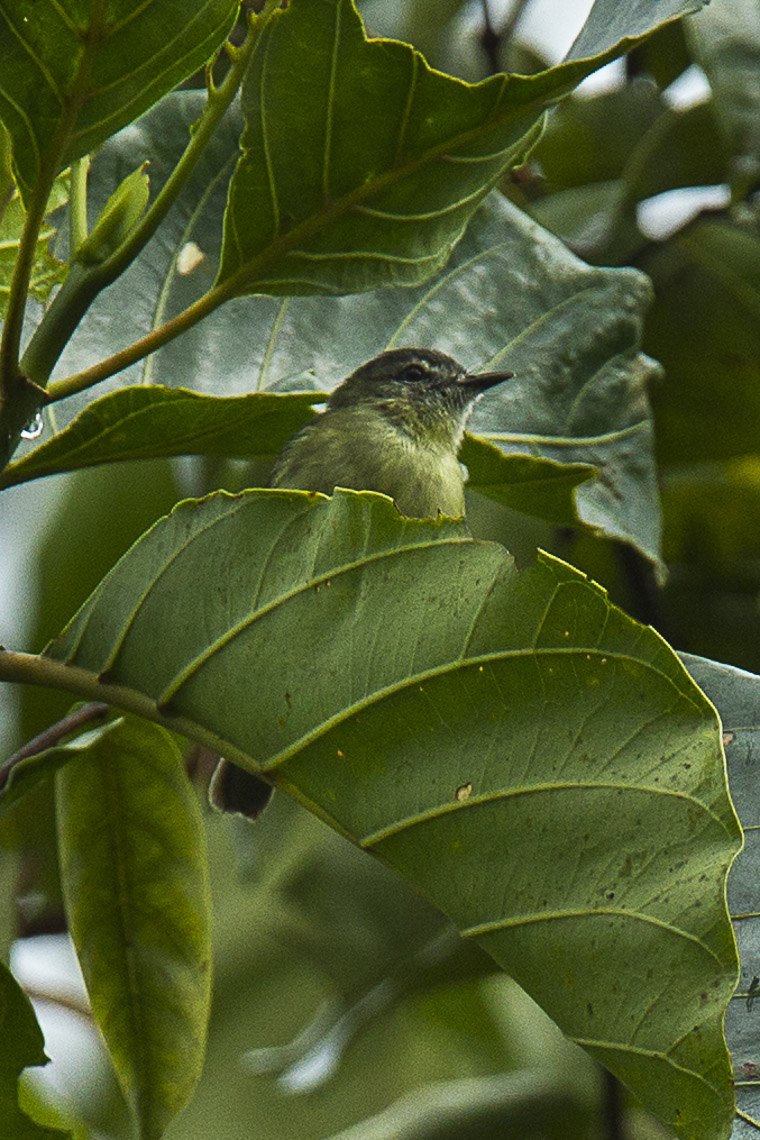
Males and females have identical plumage. Adults have a black forecrown, lores, and post-loral area that create a frowning appearance, with a narrow white supercilium.[2][3][4]
The face is predominantly grizzled white and blackish, with a black crescent surrounding the ear coverts. The crown is dark gray, while the remaining upperparts are dark olive.[5][6]
The blackish wings have narrow pale olive-yellow edges on the flight feathers. The blackish wing coverts have pale yellow to yellowish-white tips that form two wing bars.[7][8]
The tail is long, slender, and olive-colored. The throat is mottled gray and white, the breast is pale gray, and the belly is pale yellowish white.[9][10]
Both sexes have brown irises, black bills, and gray legs and feet.[11]
Habitat
The species primarily inhabits the interior and edges of humid montane evergreen forest. It also occurs, to a lesser extent, in mature secondary forest dominated by Melastomataceae.[12][13]
Its elevational range in Venezuela is 900–1,800 m. Its elevational range in Brazil is 800–1,800 m.[14][15]
Diet
Its documented diet includes insects, spiders, and small fruits.[16]
Behaviour
The species remains in its range throughout the year. It forages actively from the lower forest story through the canopy.[17][18]
It usually perches horizontally on branches with its tail raised. It captures prey by making short flights to hover and glean from leaves and twigs.[19][20]
It generally forages in pairs or small family groups and usually joins mixed-species feeding flocks while foraging.[21][22]
Reproduction and life cycle
The species' breeding biology has not been documented.[23]
Conservation
The IUCN classifies the species as Least Concern. It has a large geographic range and is considered fairly common.[24][25][26]
Its population size and the number of mature individuals are unknown, and its population is believed to be declining. No immediate threats to the species have been identified.[27][28][29]
Gold prospecting and uncontrolled tourism have reportedly caused severe localized effects within its remote range.[30]
Classification of the Black-fronted Tyrannulet
| Kingdom | Animalia |
|---|---|
| Phylum | Chordata |
| Subphylum | Vertebrata |
| Infraphylum | Gnathostomata |
| Parvphylum | Osteichthyes |
| Megaclass | Tetrapoda |
| Class | Aves (Bird) |
| Order | Passeriformes (Passerine) |
| Family | Tyrannidae (Tyrant Flycatcher) |
| Genus | Phylloscartes (Long-tailed Tyrannulets) |
| Species | Phylloscartes nigrifrons (Salvin & Godman, 1884) |
Where the Black-fronted Tyrannulet is found
Checklists and occurrence records place Phylloscartes nigrifrons in 3 countries across South America. GBIF holds 281 georeferenced records of it.
Countries
Regions and cities with the most records
- Bolívar, Venezuela 224
- Roraima, Brazil 12
- Cuyuni-Mazaruni, Guyana 8
- Amazonas, Venezuela 3
- Pacaraima, Brazil 3
- Potaro-Siparuni, Guyana 3
- Santa Elena de Uairén, Venezuela 3
Range as the checklists state it
South America
A number beside a place is its count of GBIF occurrence records. A place without a number comes from a checklist alone. Records show where a species has been observed or collected, which can include escapes and vagrants.
Common names
English
- Black-fronted Tyrannulet
Names in 24 other languages
- Catalan
- tiranulet orellut frontnegre
- Chinese
- 黑額姬霸鶲, 黑额姬霸鹟
- Croatian
- crnočela elenija
- Czech
- tyrančík černočelý
- Danish
- Sortpandet Tyrannulet
- Dutch
- Zwartvoorhoofdlooftiran
- Esperanto
- nigrafrunta tiraneto
- Finnish
- mustaotsanapsija
- French
- Pipromorphe à front noir, Tyranneau à front noir
- German
- Schwarzstirn-Laubtyrann
- Italian
- Tirannetto frontenera
- Japanese
- クロビタイコバシハエトリ
- Lithuanian
- juodakaktis devynbalsis tironiukas
- Norwegian
- svartpannebladdanser
- Polish
- tyrańczyk czarnoczelny
- Portuguese
- maria-de-testa-preta, tiraninho-de-testa-preta
- Russian
- Чернолобый каричи, Чернолобый славковый тиранчик
- Serbian
- Crnočela zviždakolika tirančica
- Slovak
- kariča čiernočelá
- Spanish
- Orejerito frentinegro
- Swedish
- svartpannad dvärgtyrann, svartpannad lövtyrann
- Turkish
- Kara Alınlı Yaprak Tiranı
- Ukrainian
- тиранчик чорнолобий
- Welsh
- teyrn bach bronddu
Synonyms
3 other scientific names have been used for this species and are now treated as synonyms of Phylloscartes nigrifrons.
- Leptopogon nigrifrons Salvin & Godman, 1884
- Mecocerculus nigrifrons Chapman, FM, 1929
- Phylloscartes nigrifrons maguirei Phelps, WH Sr; Phelps, WH Jr, 1951
Related species
-
 Rufous-browed TyrannuletPhylloscartes superciliaris
-
 Alagoas TyrannuletPhylloscartes ceciliae
-
 Mottle-cheeked TyrannuletPhylloscartes ventralis
-
 Minas Gerais TyrannuletPhylloscartes roquettei
-
 Ecuadorian TyrannuletPhylloscartes gualaquizae
-
 Bahia TyrannuletPhylloscartes beckeri
-
 Oustalet's TyrannuletPhylloscartes oustaleti
-
 Cinnamon-faced TyrannuletPhylloscartes parkeri
Compare
Questions and answers
What is the scientific name of the Black-fronted Tyrannulet?
The scientific name of the Black-fronted Tyrannulet is Phylloscartes nigrifrons. Written with its author, the full name is Phylloscartes nigrifrons (Salvin & Godman, 1884).
Which family does the Black-fronted Tyrannulet belong to?
Phylloscartes nigrifrons belongs to the family Tyrannidae, in the order Passeriformes and the class Aves.
Where is the Black-fronted Tyrannulet found?
Checklists and occurrence records place Phylloscartes nigrifrons in 3 countries: Venezuela, Guyana and Brazil.
What is the conservation status of the Black-fronted Tyrannulet?
The IUCN Red List category recorded for Phylloscartes nigrifrons is Least Concern (LC).
How large is the Black-fronted Tyrannulet?
It measures 12–13 cm in length. Five measured individuals weighed between 8 and 11.1 g.[31][32]
Where does the Black-fronted Tyrannulet occur?
It occurs in Brazil, Guyana, and Venezuela, primarily on the tepuis of Amazonas and Bolívar states in Venezuela. Its distribution extends marginally into adjacent western Guyana and far northwestern Brazil.[33][34][35]
What is the scientific name history of the species?
It was originally described in 1884 under the scientific name Leptopogon nigrifrons. It was subsequently assigned to Mecocerculus before being transferred to Phylloscartes.[36][37]
What is the conservation status of the Black-fronted Tyrannulet?
The IUCN classifies it as Least Concern. Its population size is unknown and believed to be declining, although no immediate threats have been identified.[24][27][28]
When was the species most recently assessed for the IUCN Red List?
It was most recently assessed in 2024.[38]
Sources
Passages the profile rests on
- The rufous-lored tyrannulet (P. flaviventris) and cinnamon-faced tyrannulet (P. parkeri) are considered its closest relatives. Source passage: “it appears that the black-fronted tyrannulet's closest relatives are the rufous-lored tyrannulet (P. flaviventris) and the cinnamon-faced tyrannulet (P. parkeri).” — English Wikipedia
- Males and females have identical plumage. Source passage: “The sexes have the same plumage.” — English Wikipedia
- Adults have a black forecrown, lores, and post-loral area that create a frowning appearance. Source passage: “Adults have a black forecrown ("front"), lores, and area behind the lores which give it a frowning appearance.” — English Wikipedia
- The species has a narrow white supercilium. Source passage: “They have a thin white supercilium.” — English Wikipedia
- Its face is predominantly grizzled white and blackish, with a black crescent surrounding the ear coverts. Source passage: “Their face is otherwise grizzled white and blackish with a black crescent around the ear coverts.” — English Wikipedia
- Its crown is dark gray, while the remaining upperparts are dark olive. Source passage: “Their crown is dark gray and the rest of their upperparts are dark olive.” — English Wikipedia
- Its blackish wings have narrow pale olive-yellow edges on the flight feathers. Source passage: “Their wings are blackish with thin pale olive yellow edges on the flight feathers.” — English Wikipedia
- Its blackish wing coverts have pale yellow to yellowish-white tips that form two wing bars. Source passage: “Their wing coverts are blackish with pale yellow to yellowish white tips that form two wing bars.” — English Wikipedia
- The species has a long, slender olive-colored tail. Source passage: “Their long slender tail is olive.” — English Wikipedia
- Its throat is mottled gray and white, its breast is pale gray, and its belly is pale yellowish white. Source passage: “Their throat is mottled gray and white, their breast is pale gray, and their belly is pale yellowish white.” — English Wikipedia
- Both sexes have brown irises, black bills, and gray legs and feet. Source passage: “Both sexes have a brown iris, a black bill, and gray legs and feet.” — English Wikipedia
- The species primarily inhabits the interior and edges of humid montane evergreen forest. Source passage: “It primarily inhabits the interior and edges of humid montane evergreen forest” — English Wikipedia
- It also occurs, to a lesser extent, in mature secondary forest dominated by Melastomataceae. Source passage: “and to a lesser extent mature secondary forest dominated by Melastomataceae.” — English Wikipedia
- Its elevational range in Venezuela is 900–1,800 m. Source passage: “In elevation it ranges between 900 and 1,800 m (3,000 and 5,900 ft) in Venezuela” — English Wikipedia
- Its elevational range in Brazil is 800–1,800 m. Source passage: “and between 800 and 1,800 m (2,600 and 5,900 ft) in Brazil.” — English Wikipedia
- Its documented diet includes insects, spiders, and small fruits. Source passage: “is known to include insects, spiders, and small fruits.” — English Wikipedia
- The species remains in its range throughout the year. Source passage: “The black-fronted tyrannulet is a year-round resident.” — English Wikipedia
- The species forages actively from the lower forest story through the canopy. Source passage: “It forages actively, from the forest's lower story to its canopy.” — English Wikipedia
- It usually perches horizontally on branches with its tail raised. Source passage: “It typically perches horizontally on a branch, usually with its tail cocked up,” — English Wikipedia
- It captures prey by making short flights to hover and glean from leaves and twigs. Source passage: “and makes short sallies to hover-glean prey from leaves and twigs.” — English Wikipedia
- It generally forages in pairs or small family groups. Source passage: “It typically forages in pairs or small family groups” — English Wikipedia
- It usually joins mixed-species feeding flocks while foraging. Source passage: “and usually as part of a mixed-species feeding flock.” — English Wikipedia
- The species' breeding biology has not been documented. Source passage: “Nothing is known about the black-fronted tyrannulet's breeding biology.” — English Wikipedia
- The IUCN classifies the species as Least Concern. Source passage: “The IUCN has assessed the black-fronted tyrannulet as being of Least Concern.” — English Wikipedia
- The species has a large geographic range. Source passage: “It has a large range;” — English Wikipedia
- The species is considered fairly common. Source passage: “It is considered fairly common” — English Wikipedia
- Its population size is unknown and is believed to be declining. Source passage: “its population size is not known and is believed to be decreasing.” — English Wikipedia
- No immediate threats to the species have been identified. Source passage: “No immediate threats have been identified.” — English Wikipedia
- The number of mature individuals in the species' population is unknown. Source passage: “Number of mature individuals Unknown” — datazone.birdlife.org
- Gold prospecting and uncontrolled tourism have reportedly caused severe localized effects within its remote range. Source passage: “there are reports of severe local effects within this region from gold prospectors and 'uncontrolled tourism'” — English Wikipedia
- The species measures 12–13 cm in length. Source passage: “The black-fronted tyrannulet is 12 to 13 cm (4.7 to 5.1 in) long;” — English Wikipedia
- Five measured individuals weighed between 8 and 11.1 g. Source passage: “five individuals weighed 8 to 11.1 g (0.28 to 0.39 oz).” — English Wikipedia
- The species occurs in Brazil, Guyana, and Venezuela. Source passage: “It is found in Brazil, Guyana, and Venezuela.” — English Wikipedia
- The species occurs primarily on the tepuis of Amazonas and Bolívar states in Venezuela. Source passage: “The black-fronted tyrannulet is found primarily in Venezuela, on the tepuis in the states of Amazonas and Bolívar.” — English Wikipedia
- Its distribution extends marginally into adjacent western Guyana and far northwestern Brazil. Source passage: “Its range extends slightly into adjacent western Guyana and far northwestern Brazil.” — English Wikipedia
- The species was originally described in 1884 under the scientific name Leptopogon nigrifrons. Source passage: “The black-fronted tyrannulet was originally described in 1884 as Leptopogon nigrifrons.” — English Wikipedia
- The species was subsequently assigned to Mecocerculus before being transferred to Phylloscartes. Source passage: “It was later transferred to genus Mecocerculus and then to its present genus Phylloscartes.” — English Wikipedia
- The species was most recently assessed for the IUCN Red List in 2024. Source passage: “Black-fronted Tyrannulet Phylloscartes nigrifrons has most recently been assessed for The IUCN Red List of Threatened Species in 2024.” — iucnredlist.org
Data
- Catalogue of Life, 2026-10-16 XR cc by
- Global Biodiversity Information Facility CC BY 4.0
- Wikidata CC0
- GeoNames CC BY 4.0
- Wikimedia Commons per image; credit shown with each image
- Within the Catalogue of Life, this name comes from The Integrated Taxonomic Information System cc0
References
- Gill, Frank, & and Minturn Wright. (2006). Birds of the World: Recommended English Names.
This species in other databases
Page built on 29 November 2026. See how the catalog is made and all sources and licences.
Cite this page
ScientificNames.org. (2026). Phylloscartes nigrifrons (Black-fronted Tyrannulet). Retrieved November 29, 2026, from https://scientificnames.org/species/phylloscartes-nigrifrons
“Phylloscartes nigrifrons (Black-fronted Tyrannulet).” ScientificNames.org, 2026, scientificnames.org/species/phylloscartes-nigrifrons. Accessed 29 Nov. 2026.
ScientificNames.org. “Phylloscartes nigrifrons (Black-fronted Tyrannulet).” Accessed November 29, 2026. https://scientificnames.org/species/phylloscartes-nigrifrons.
@misc{scientificnames_phylloscartes_nigrifrons_black_fronted_tyrannulet,
  author = {{ScientificNames.org}},
  title = {Phylloscartes nigrifrons (Black-fronted Tyrannulet)},
  year = {2026},
  url = {https://scientificnames.org/species/phylloscartes-nigrifrons},
  note = {Accessed 2026-11-29}
}