Species · Birds
Olive-green Tyrannulet Phylloscartes virescens
The scientific name of the Olive-green Tyrannulet is Phylloscartes virescens. It is a species of bird in the family Tyrannidae (tyrant flycatcher), order Passeriformes. The name dates from 1925.
- Scientific name
- Phylloscartes virescens Todd, 1925
- Common name
- Olive-green Tyrannulet
- Genus
- Phylloscartes
- Family
- Tyrannidae (Tyrant Flycatcher)
- Order
- Passeriformes
- Class
- Aves
- Red List category
- LC Least Concern
- Recorded in
- 4 countries
- Name status
- accepted in the Catalogue of Life

Overview
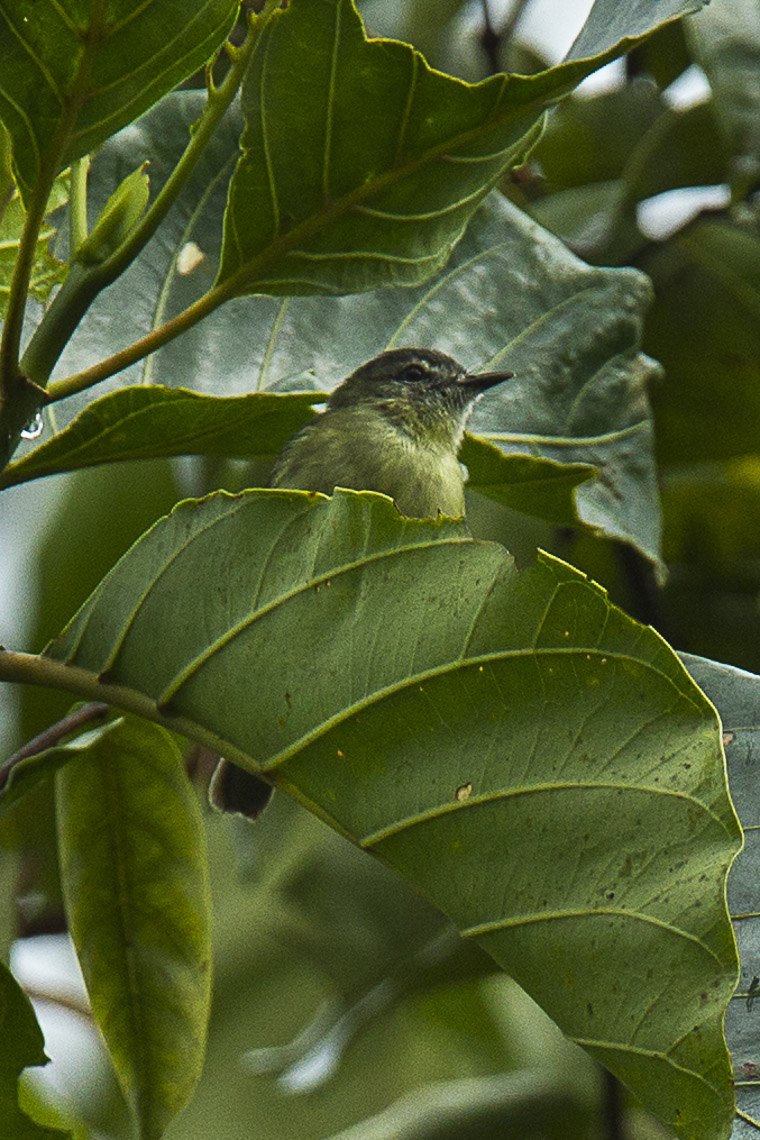
Phylloscartes virescens occurs in Brazil, French Guiana, Guyana, and Suriname. It has olive-colored upperparts, medium-yellow underparts, and a prominent yellowish eye-ring.
Written 27 November 2026 from the sources listed below. Each statement was checked against the passage it cites; statements that could not be supported were removed.
Similar species
The Olive-green Tyrannulet was historically considered conspecific by some early twentieth-century authors with the Panama Tyrannulet and the Mottle-cheeked Tyrannulet. Many authors now treat the three species as a superspecies.[1][2]
The Olive-green Tyrannulet is a monotypic species.[3]
Appearance
The Olive-green Tyrannulet measures approximately 12 cm in length. The sexes have identical plumage.[4][5]
Adults have black lores and a yellowish-white area behind the lores that connects to a prominent yellowish eye-ring. The rest of the face is yellowish green.[6][7]
The crown and upperparts are olive-colored. The wings are dusky, with thin yellow edges on the flight feathers, and the dusky wing coverts have medium-yellow tips that form two wing bars.[8][9][10]
The underparts are medium yellow. Both sexes have brown irises, long pointed black bills, and gray legs and feet.[11][12]
Habitat
The Olive-green Tyrannulet primarily inhabits humid primary evergreen forest and also occurs in mature secondary forest. It occurs at elevations below approximately 500 m.[13][14][15]
Most of its range lies north of the Amazon River, between the Negro River and the state of Amapá. A few records occur south of the Amazon River.[16][17]
Habitat across much of its range remains undisturbed.[18]
Diet
The Olive-green Tyrannulet feeds on arthropods.[19]
Behaviour
The Olive-green Tyrannulet is a year-round resident. It forages actively and almost entirely in the forest canopy.[20][21]
It typically perches horizontally on branches, sometimes holding its tail slightly raised. It captures prey through short sallies or by hover-gleaning from leaves and twigs.[22][23]
The Olive-green Tyrannulet usually forages alone or in pairs. It also usually forages as part of mixed-species feeding flocks.[24][25]
Both sexes produce songs consisting of high, reedy notes preceded by a louder exclamatory note.[26]
Reproduction and life cycle
The Olive-green Tyrannulet is thought to breed between December and March.[27]
Conservation
The Olive-green Tyrannulet is classified as Least Concern by the IUCN. Its most recent assessment for the IUCN Red List was in 2024.[28][29]
Its population size is unknown, and its population is believed to be decreasing. The species is considered rare and potentially overlooked.[30][31][32]
No immediate threats to the Olive-green Tyrannulet have been identified.[33]
Classification of the Olive-green Tyrannulet
| Kingdom | Animalia |
|---|---|
| Phylum | Chordata |
| Subphylum | Vertebrata |
| Infraphylum | Gnathostomata |
| Parvphylum | Osteichthyes |
| Megaclass | Tetrapoda |
| Class | Aves (Bird) |
| Order | Passeriformes (Passerine) |
| Family | Tyrannidae (Tyrant Flycatcher) |
| Genus | Phylloscartes (Long-tailed Tyrannulets) |
| Species | Phylloscartes virescens Todd, 1925 |
Where the Olive-green Tyrannulet is found
Checklists and occurrence records place Phylloscartes virescens in 4 countries across South America. GBIF holds 515 georeferenced records of it.
Countries
Regions and cities with the most records
- Amazonas, Brazil 326
- Presidente Figueiredo, Brazil 41
- Upper Takutu-Upper Essequibo, Guyana 37
- Potaro-Siparuni, Guyana 27
- Pará, Brazil 17
- Sipaliwini District, Suriname 17
- Maranhão, Brazil 16
- Kourou, French Guiana 7
- Manaus, Brazil 7
- Brokopondo District, Suriname 6
- Commewijne District, Suriname 6
- Lelydorp, Suriname 6
- Paramaribo, Suriname 6
- Amapá, Brazil 3
Range as the checklists state it
South America
A number beside a place is its count of GBIF occurrence records. A place without a number comes from a checklist alone. Records show where a species has been observed or collected, which can include escapes and vagrants.
Common names
English
- Olive-green Tyrannulet
- Guianan Tyrannulet
Names in 24 other languages
- Catalan
- tiranulet orellut verdós
- Chinese
- 橄榄绿姬霸鹟, 橄綠姬霸鶲
- Croatian
- gvajanska elenija
- Czech
- tyrančík guyanský
- Danish
- Olivengrøn Tyrannulet
- Dutch
- Surinaamse Looftiran
- Esperanto
- oliveca tiraneto
- Finnish
- guayanannapsija
- French
- Pipromorphe verdâtre, Tyranneau verdâtre
- German
- Guayanalaubtyrann, Guyanalaubtyrann, Surinam-Laubtyrann
- Italian
- Tirannetto verdeoliva
- Japanese
- オリーブコバシハエトリ
- Lithuanian
- surinaminis devynbalsis tironiukas
- Norwegian
- guyanabladdanser
- Polish
- tyrańczyk gujański
- Portuguese
- borboletinha-guianense, tiraninho-esverdeado-guianense
- Russian
- Суринамский каричи, Суринамский славковый тиранчик
- Serbian
- Gvajanska zviždakolika tirančica
- Slovak
- kariča zelenkavá
- Spanish
- Orejerito verdoso
- Swedish
- olivdvärgtyrann, olivgrön lövtyrann
- Turkish
- Zeytuni-Yeşil Yaprak Tiranı
- Ukrainian
- тиранчик гвіанський
- Welsh
- teyrn bach melynwyrdd y De
Related species
-
 Rufous-browed TyrannuletPhylloscartes superciliaris
-
 Alagoas TyrannuletPhylloscartes ceciliae
-
 Mottle-cheeked TyrannuletPhylloscartes ventralis
-
 Minas Gerais TyrannuletPhylloscartes roquettei
-
 Ecuadorian TyrannuletPhylloscartes gualaquizae
-
 Bahia TyrannuletPhylloscartes beckeri
-
 Oustalet's TyrannuletPhylloscartes oustaleti
-
 Cinnamon-faced TyrannuletPhylloscartes parkeri
Compare
Questions and answers
What is the scientific name of the Olive-green Tyrannulet?
The scientific name of the Olive-green Tyrannulet is Phylloscartes virescens. Written with its author, the full name is Phylloscartes virescens Todd, 1925.
Which family does the Olive-green Tyrannulet belong to?
Phylloscartes virescens belongs to the family Tyrannidae, in the order Passeriformes and the class Aves.
Where is the Olive-green Tyrannulet found?
Checklists and occurrence records place Phylloscartes virescens in 4 countries: Brazil, Guyana, Suriname and French Guiana.
What is the conservation status of the Olive-green Tyrannulet?
The IUCN Red List category recorded for Phylloscartes virescens is Least Concern (LC).
What other names does the Olive-green Tyrannulet have?
Phylloscartes virescens is also known in English as Guianan Tyrannulet.
Sources
Passages the profile rests on
- The Olive-green Tyrannulet was historically considered conspecific by some early twentieth-century authors with the Panama Tyrannulet and the Mottle-cheeked Tyrannulet. Source passage: “Some early twentieth century authors considered the olive-green tyrannulet and what are now the Panama tyrannulet (P. flavovirens) and mottle-cheeked tyrannulet (P. ventralis) as conspecific.” — English Wikipedia
- The Olive-green Tyrannulet, Panama Tyrannulet, and Mottle-cheeked Tyrannulet are now treated by many authors as a superspecies. Source passage: “The three are now treated by many authors as a superspecies.” — English Wikipedia
- The Olive-green Tyrannulet is a monotypic species. Source passage: “The olive-green tyrannulet is monotypic.” — English Wikipedia
- The sexes of the Olive-green Tyrannulet have identical plumage. Source passage: “The sexes have the same plumage.” — English Wikipedia
- The Olive-green Tyrannulet measures approximately 12 cm in length. Source passage: “The olive-green tyrannulet is about 12 cm (4.7 in) long.” — English Wikipedia
- Adult Olive-green Tyrannulets have black lores and a yellowish-white area behind the lores that connects to a prominent yellowish eye-ring. Source passage: “Adults have black lores and a faint yellowish white area behind the lores that connects with a prominent yellowish eye-ring.” — English Wikipedia
- The face of the adult Olive-green Tyrannulet is otherwise yellowish green. Source passage: “Their face is otherwise yellowish green.” — English Wikipedia
- The crown and upperparts of the Olive-green Tyrannulet are olive-colored. Source passage: “Their crown and upperparts are olive.” — English Wikipedia
- The wings of the Olive-green Tyrannulet are dusky, with thin yellow edges on the flight feathers. Source passage: “Their wings are dusky with thin yellow edges on the flight feathers.” — English Wikipedia
- The wing coverts are dusky and have medium-yellow tips that form two wing bars. Source passage: “Their wing coverts are dusky with medium yellow tips that form two wing bars.” — English Wikipedia
- The underparts of the Olive-green Tyrannulet are medium yellow. Source passage: “Their underparts are medium yellow.” — English Wikipedia
- Both sexes have brown irises, long pointed black bills, and gray legs and feet. Source passage: “Both sexes have a brown iris, a long, pointed, black bill, and gray legs and feet.” — English Wikipedia
- The Olive-green Tyrannulet primarily inhabits humid primary evergreen forest. Source passage: “The species mostly inhabits humid primary evergreen forest” — English Wikipedia
- The species also occurs in mature secondary forest. Source passage: “but also occurs in mature secondary forest.” — English Wikipedia
- The Olive-green Tyrannulet occurs at elevations below approximately 500 m. Source passage: “In elevation it occurs below about 500 m (1,600 ft).” — English Wikipedia
- Most of the species' range lies north of the Amazon River, between the Negro River and the state of Amapá. Source passage: “It range is mostly north of the Amazon River between the Negro river and the state of Amapá” — English Wikipedia
- A few records of the Olive-green Tyrannulet occur south of the Amazon River. Source passage: “though there are also a few records south of the Amazon.” — English Wikipedia
- Habitat across much of the Olive-green Tyrannulet's range remains undisturbed. Source passage: “The habitat in much of its range is undisturbed.” — English Wikipedia
- The Olive-green Tyrannulet feeds on arthropods. Source passage: “The olive-green tyrannulet feeds on arthropods.” — English Wikipedia
- The Olive-green Tyrannulet is a year-round resident. Source passage: “The olive-green tyrannulet is a year-round resident.” — English Wikipedia
- The species forages actively and almost entirely in the forest canopy. Source passage: “It forages actively and almost entirely in the forest canopy.” — English Wikipedia
- The Olive-green Tyrannulet typically perches horizontally on branches, sometimes holding its tail slightly raised. Source passage: “It typically perches horizontally on a branch, sometimes with its tail slightly cocked up” — English Wikipedia
- The species captures prey by making short sallies to grab it or hover-glean it from leaves and twigs. Source passage: “and makes short sallies to grab or hover-glean prey from leaves and twigs.” — English Wikipedia
- The Olive-green Tyrannulet usually forages alone or in pairs. Source passage: “It typically forages singly or in pairs” — English Wikipedia
- The species usually forages as part of mixed-species feeding flocks. Source passage: “and usually as part of a mixed-species feeding flock.” — English Wikipedia
- Both sexes produce songs consisting of high, reedy notes preceded by a louder exclamatory note. Source passage: “Both sexes of the olive-green tyrannulet sing "a series of high, reedy notes preceded by louder, exclamatory note” — English Wikipedia
- The Olive-green Tyrannulet is thought to breed between December and March. Source passage: “The olive-green tyrannulet is thought to breed between December and March.” — English Wikipedia
- The Olive-green Tyrannulet is classified as Least Concern by the IUCN. Source passage: “The IUCN has assessed the olive-green tyrannulet as being of Least Concern.” — English Wikipedia
- The Olive-green Tyrannulet was most recently assessed for the IUCN Red List in 2024. Source passage: “Olive-green Tyrannulet Phylloscartes virescens has most recently been assessed for The IUCN Red List of Threatened Species in 2024.” — iucnredlist.org
- The population size of the Olive-green Tyrannulet is unknown. Source passage: “Its population size is not known” — English Wikipedia
- The population of the Olive-green Tyrannulet is believed to be decreasing. Source passage: “and is believed to be decreasing.” — English Wikipedia
- The Olive-green Tyrannulet is considered rare and potentially overlooked. Source passage: “It is considered rare and "perhaps often overlooked".” — English Wikipedia
- No immediate threats to the Olive-green Tyrannulet have been identified. Source passage: “No immediate threats have been identified.” — English Wikipedia
Data
- Catalogue of Life, 2026-10-16 XR cc by
- Global Biodiversity Information Facility CC BY 4.0
- Wikidata CC0
- GeoNames CC BY 4.0
- Wikimedia Commons per image; credit shown with each image
- Within the Catalogue of Life, this name comes from The Integrated Taxonomic Information System cc0
References
- Todd, & Clyde, W. E. (1925). Sixteen New Birds from Brazil and Guiana. Proceedings of the Biological Society of Washington, Vol. 38. where the name was published
- Gill, Frank, & and Minturn Wright. (2006). Birds of the World: Recommended English Names.
This species in other databases
Page built on 28 November 2026. See how the catalog is made and all sources and licences.
Cite this page
ScientificNames.org. (2026). Phylloscartes virescens (Olive-green Tyrannulet). Retrieved November 28, 2026, from https://scientificnames.org/species/phylloscartes-virescens
“Phylloscartes virescens (Olive-green Tyrannulet).” ScientificNames.org, 2026, scientificnames.org/species/phylloscartes-virescens. Accessed 28 Nov. 2026.
ScientificNames.org. “Phylloscartes virescens (Olive-green Tyrannulet).” Accessed November 28, 2026. https://scientificnames.org/species/phylloscartes-virescens.
@misc{scientificnames_phylloscartes_virescens_olive_green_tyrannulet,
  author = {{ScientificNames.org}},
  title = {Phylloscartes virescens (Olive-green Tyrannulet)},
  year = {2026},
  url = {https://scientificnames.org/species/phylloscartes-virescens},
  note = {Accessed 2026-11-28}
}