Species · Birds
Rufous-tailed Plantcutter Phytotoma rara
The scientific name of the Rufous-tailed Plantcutter is Phytotoma rara. It is a species of bird in the family Cotingidae (contingas), order Passeriformes. The name dates from 1782.
- Scientific name
- Phytotoma rara Molina, 1782
- Common name
- Rufous-tailed Plantcutter
- Genus
- Phytotoma
- Family
- Cotingidae (Contingas)
- Order
- Passeriformes
- Class
- Aves
- Red List category
- LC Least Concern
- Recorded in
- 2 countries
- Name status
- accepted in the Catalogue of Life

Overview
The Rufous-tailed Plantcutter is a passerine bird belonging to the cotinga family. It has a stocky body, short wings, a red eye, and a long black tail with a reddish base.
Written 26 November 2026 from the sources listed below. Each statement was checked against the passage it cites; statements that could not be supported were removed.
Appearance
The Rufous-tailed Plantcutter has a stocky body, short wings, a red eye, and a long black tail with a reddish base. Adults measure approximately 18–20 centimetres in length.[1][2]
Males have grey-brown upperparts with dark streaks and chestnut-coloured crowns and underparts. They also have a white wing bar.[3][4]
Females have buff underparts marked with brown streaks and a buff wing marking. They lack the chestnut crown characteristic of males but may have cinnamon colouring on the forehead and throat.[5][4][6]
Habitat
The Rufous-tailed Plantcutter inhabits scrub, forest edges, and river valleys in Chile and western Argentina. It also occurs in varied wooded and semi-open habitats, including town gardens.[7][8]
It is frequently observed in gardens, farmland, and orchards.[9]
Diet
The Rufous-tailed Plantcutter feeds on buds, leaves, and fruits, which it strips off using its serrated bill. It occasionally consumes insects.[10][11]
Behaviour
The Rufous-tailed Plantcutter produces a song consisting of stuttering notes followed by a rasping trill.[12]
Birds breeding in southern or high-altitude areas move northwards or towards lower elevations during winter.[13]
The species is sometimes regarded as an agricultural pest.[14]
Reproduction and life cycle
The Rufous-tailed Plantcutter builds a cup-shaped nest from root fibres and twigs in a fork of a shrub or tree.[15]
Clutches contain between two and four eggs. The eggs are blue-green and have dark spots concentrated toward the larger end.[16][17]
Conservation
The Rufous-tailed Plantcutter is classified as Least Concern by the International Union for Conservation of Nature. It was most recently assessed for the IUCN Red List in 2024.[18][19]
The species has a large geographical range and is considered to have a large total population despite not being particularly common. Its population trend is considered stable.[20][21][22]
Classification of the Rufous-tailed Plantcutter
| Kingdom | Animalia |
|---|---|
| Phylum | Chordata |
| Subphylum | Vertebrata |
| Infraphylum | Gnathostomata |
| Parvphylum | Osteichthyes |
| Megaclass | Tetrapoda |
| Class | Aves (Bird) |
| Order | Passeriformes (Passerine) |
| Family | Cotingidae (Contingas) |
| Genus | Phytotoma (Plantcutter) |
| Species | Phytotoma rara Molina, 1782 |
Where the Rufous-tailed Plantcutter is found
Checklists and occurrence records place Phytotoma rara in 2 countries across South America. GBIF holds 53,861 georeferenced records of it.
Countries
Regions and cities with the most records
- Santiago Metropolitan, Chile 16,923
- Valparaiso, Chile 15,311
- Santiago, Chile 15,201
- Peñalolén, Chile 15,010
- Renca, Chile 14,563
- Quilicura, Chile 13,794
- Lo Prado, Chile 13,602
- La Pintana, Chile 11,559
- Maipú, Chile 10,925
- San Bernardo, Chile 9,466
- Puente Alto, Chile 7,995
- Quilpué, Chile 6,160
- Viña del Mar, Chile 6,109
- Concón, Chile 6,094
- Los Lagos Region, Chile 5,758
- Cartagena, Chile 4,880
- San Antonio, Chile 4,733
- Villa Alemana, Chile 4,195
- Valparaíso, Chile 3,939
- Quintero, Chile 3,705
- El Quisco, Chile 2,832
- Padre Hurtado, Chile 2,158
- Puerto Montt, Chile 1,913
- Biobio, Chile 1,754
- Puerto Varas, Chile 1,741
- Araucania, Chile 1,637
- San Pedro de la Paz, Chile 1,261
- Concepción, Chile 1,232
- Hualpén, Chile 1,204
- Penco, Chile 1,189
- Coquimbo Region, Chile 1,181
- Los Ríos Region, Chile 1,179
- Talcahuano, Chile 1,163
- Limache, Chile 1,154
- Rio Negro, Argentina 1,140
- Chiguayante, Chile 1,138
Range as the checklists state it
South America
A number beside a place is its count of GBIF occurrence records. A place without a number comes from a checklist alone. Records show where a species has been observed or collected, which can include escapes and vagrants.
Common names
English
- Rufous-tailed Plantcutter
Names in 26 other languages
- Arabic
- قاطع النباتات أصهب الذيل
- Catalan
- cotinga tallabranques de Xile
- Chinese
- 棕尾刈草鳥, 棕尾割草鸟
- Croatian
- šarenoglava kotinga
- Czech
- bylinorubec chilský
- Danish
- Chilebladskærer, Chilensk Bladskærer
- Dutch
- Roodstaartzaagvink
- Esperanto
- ĉilia folitranĉulo
- Finnish
- chilensilpoja
- French
- Rara à queue rousse
- German
- Rotschwanz-Pflanzenmäher
- Hungarian
- chilei kaszálómadár
- Italian
- Tagliafoglie codarossiccia, Tagliafoglie codirosso
- Japanese
- チリクサカリドリ, チリークサカリドリ
- Lithuanian
- čilinis ūgliapjovys
- Norwegian
- chileplanteklipper
- Polish
- ziołosiek rudosterny
- Portuguese
- Corta-Ramos-de-Cauda-Ruiva, corta-ramos-austral, corta-ramos-rabirruivo
- Russian
- Чилийский листорез, Чилийский траворез
- Serbian
- Riđorepi rezač
- Slovak
- štepár širokozobý
- Spanish
- Cortarramas chileno, Rara
- Swedish
- chileväxtmejare
- Turkish
- Şili Yaprak Kotingası
- Ukrainian
- рара рудохвоста
- arn
- Kamtrü
Related species
-
 White-tipped PlantcutterPhytotoma rutila
-
 Peruvian PlantcutterPhytotoma raimondii
-
 CapuchinbirdPerissocephalus tricolor
-
 Andean Cock-of-the-rockRupicola peruvianus
-
 White BellbirdProcnias albus
-
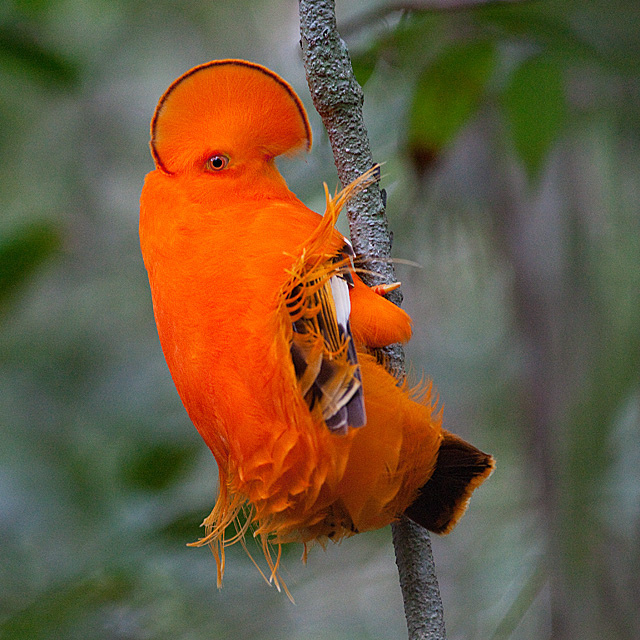 Guianan Cock-of-the-rockRupicola rupicola
-
 Screaming PihaLipaugus vociferans
-
 Bare-throated BellbirdProcnias nudicollis
Compare
Questions and answers
What is the scientific name of the Rufous-tailed Plantcutter?
The scientific name of the Rufous-tailed Plantcutter is Phytotoma rara. Written with its author, the full name is Phytotoma rara Molina, 1782.
Which family does the Rufous-tailed Plantcutter belong to?
Phytotoma rara belongs to the family Cotingidae, in the order Passeriformes and the class Aves.
Where is the Rufous-tailed Plantcutter found?
Checklists and occurrence records place Phytotoma rara in 2 countries: Chile and Argentina.
What is the conservation status of the Rufous-tailed Plantcutter?
The IUCN Red List category recorded for Phytotoma rara is Least Concern (LC).
Where does the Rufous-tailed Plantcutter occur?
The species occurs in southern South America. Its Chilean range extends from the Magallanes Region north to Atacama, and its Argentine range extends from Santa Cruz north to Mendoza. It has also been recorded as a vagrant in the Falkland Islands.[23][24][25][26]
What is the conservation status of the Rufous-tailed Plantcutter?
It is classified as Least Concern by the International Union for Conservation of Nature. Its population trend is considered stable.[18][22]
How many eggs does the Rufous-tailed Plantcutter lay?
Clutches contain between two and four eggs. The eggs are blue-green with dark spots concentrated toward the larger end.[16][17]
Does the Rufous-tailed Plantcutter migrate?
Birds breeding in southern or high-altitude areas move northwards or towards lower elevations during winter.[13]
Sources
Passages the profile rests on
- The species has a stocky body, short wings, a red eye, and a long black tail with a reddish base. Source passage: “It is a stocky bird, 18-20 centimetres in length, with short wings and a red eye. The longish tail is black with a reddish base.” — English Wikipedia
- Adults measure approximately 18–20 centimetres in length. Source passage: “It is a stocky bird, 18-20 centimetres in length” — English Wikipedia
- Males have grey-brown upperparts with dark streaks and chestnut-coloured crowns and underparts. Source passage: “The upperparts of the male are grey-brown with dark streaks while the crown and underparts are chestnut-coloured.” — English Wikipedia
- Males have a white wing bar, whereas females have a buff wing marking. Source passage: “There is a white bar on the wing and a pattern of dark and pale areas on the face. Females have buff underparts with brown streaks and have buff rather than white in the wings.” — English Wikipedia
- Females have buff underparts marked with brown streaks. Source passage: “Females have buff underparts with brown streaks” — English Wikipedia
- Females lack the chestnut crown characteristic of males but may have cinnamon colouring on the forehead and throat. Source passage: “They do not have the males' chestnut crown but may show a cinnamon wash to the forehead and throat.” — English Wikipedia
- The species inhabits scrub, forest edges, and river valleys in Chile and western Argentina. Source passage: “inhabiting scrub, forest edge and river valleys in Chile and western Argentina.” — English Wikipedia
- The species occurs in varied wooded and semi-open habitats, including town gardens. Source passage: “Distinctive bird found in varied wooded and semiopen habitats, from town gardens to ...” — ebird.org
- The species is frequently observed in gardens, farmland, and orchards. Source passage: “Birds are often seen in gardens, farmland and orchards” — English Wikipedia
- The species feeds on buds, leaves, and fruits, which it strips off using its serrated bill. Source passage: “is used for stripping off buds, leaves and fruits.” — English Wikipedia
- The species occasionally consumes insects. Source passage: “Insects are eaten on occasions” — English Wikipedia
- The species produces a song consisting of stuttering notes followed by a rasping trill. Source passage: “The song is a series of stuttering notes followed by a rasping trill” — English Wikipedia
- Birds breeding in southern or high-altitude areas move northwards or towards lower elevations during winter. Source passage: “Birds breeding in southern or high-altitude regions move northwards or towards the lowlands in winter.” — English Wikipedia
- The species is sometimes regarded as an agricultural pest. Source passage: “are sometimes considered to be a pest.” — English Wikipedia
- The species builds a cup-shaped nest from root fibres and twigs in a fork of a shrub or tree. Source passage: “The nest is a cup of root fibres and twigs built in a fork in a shrub or tree.” — English Wikipedia
- Clutches contain between two and four eggs. Source passage: “Two to four eggs are laid” — English Wikipedia
- The eggs are blue-green and have dark spots concentrated toward the larger end. Source passage: “they are blue-green with dark spots concentrated at the larger end.” — English Wikipedia
- The species is classified as Least Concern by the International Union for Conservation of Nature. Source passage: “the International Union for Conservation of Nature has rated the bird's conservation status as being of "least concern".” — English Wikipedia
- The species was most recently assessed for the IUCN Red List in 2024. Source passage: “has most recently been assessed for The IUCN Red List of Threatened Species in 2024.” — iucnredlist.org
- The species is described as having a large geographical range. Source passage: “This species has a large range,” — datazone.birdlife.org
- The species is considered to have a large total population despite not being particularly common. Source passage: “though not particularly common, is presumed to have a large total population.” — English Wikipedia
- The population trend of the species is considered stable. Source passage: “The population trend is thought to be stable” — English Wikipedia
- The species occurs in southern South America and is the southernmost-ranging member of the cotinga family. Source passage: “The rufous-tailed plantcutter is found further south than any other cotinga” — English Wikipedia
- Its Chilean range extends from the Magallanes Region north to Atacama. Source passage: “The range extends from Magallanes region north to Atacama in Chile” — English Wikipedia
- Its Argentine range extends from Santa Cruz north to Mendoza. Source passage: “and from Santa Cruz north to Mendoza in Argentina.” — English Wikipedia
- The species has been recorded as a vagrant in the Falkland Islands. Source passage: “It has been recorded as a vagrant to the Falkland Islands.” — English Wikipedia
Data
- Catalogue of Life, 2026-10-16 XR cc by
- Global Biodiversity Information Facility CC BY 4.0
- Wikidata CC0
- GeoNames CC BY 4.0
- Wikimedia Commons per image; credit shown with each image
- Within the Catalogue of Life, this name comes from The Integrated Taxonomic Information System cc0
References
- Molina, & Giovanni Ignazio. (1782). Saggio Sulla Storia Naturale Del Chili. where the name was published
- Gill, Frank, & and Minturn Wright. (2006). Birds of the World: Recommended English Names.
This species in other databases
Page built on 28 November 2026. See how the catalog is made and all sources and licences.
Cite this page
ScientificNames.org. (2026). Phytotoma rara (Rufous-tailed Plantcutter). Retrieved November 28, 2026, from https://scientificnames.org/species/phytotoma-rara
“Phytotoma rara (Rufous-tailed Plantcutter).” ScientificNames.org, 2026, scientificnames.org/species/phytotoma-rara. Accessed 28 Nov. 2026.
ScientificNames.org. “Phytotoma rara (Rufous-tailed Plantcutter).” Accessed November 28, 2026. https://scientificnames.org/species/phytotoma-rara.
@misc{scientificnames_phytotoma_rara_rufous_tailed_plantcutter,
  author = {{ScientificNames.org}},
  title = {Phytotoma rara (Rufous-tailed Plantcutter)},
  year = {2026},
  url = {https://scientificnames.org/species/phytotoma-rara},
  note = {Accessed 2026-11-28}
}