Species · Amphibians
Golden Treefrog Phytotriades auratus
The scientific name of the Golden Treefrog is Phytotriades auratus. It is a species of amphibian in the family Hylidae (hylids), order Anura. The name dates from 1917.
- Scientific name
- Phytotriades auratus (Boulenger, 1917)
- Common name
- Golden Treefrog
- Genus
- Phytotriades
- Family
- Hylidae (Hylids)
- Order
- Anura
- Class
- Amphibia
- Red List category
- EN Endangered
- Recorded in
- 2 countries
- Name status
- accepted in the Catalogue of Life

Overview
Phytotriades auratus is known from the summits of El Cerro del Aripo and El Tucuche in Trinidad and Cerro Humo on Venezuela's Paria Peninsula. Adults have a chocolate-brown back with two iridescent golden-yellow stripes.
Written 27 November 2026 from the sources listed below. Each statement was checked against the passage it cites; statements that could not be supported were removed.
Similar species
Phytotriades auratus is the sole currently recognized species in the genus Phytotriades. The genus was separated from Phyllodytes primarily on the basis of genetic evidence, although AmphibiaWeb continues to classify the species within Phyllodytes.[1][2][3]
Appearance
Adults have a chocolate-brown back with two iridescent golden-yellow stripes. The species has serrated teeth and sharp mandibular fangs, which are larger in males than in females.[4][5]
Adult males reach a maximum snout–vent length of 29 mm, while adult females reach a maximum snout–vent length of 35 mm.[6][7]
Habitat
On Trinidad, the species inhabits montane rainforest and elfin woodland at approximately 940 m above sea level. On Venezuela's Cerro Humo, it has been found in elfin forest near the mountain summit at 1,250 m elevation.[8][9]
The species is closely associated with the giant bromeliad Glomeropitcairnia erectiflora. It is associated with cool, humid tropical montane forests on isolated mountain summits and peaks.[10][11]
Behaviour
Males defend territories and can use their fangs during combat. Males are not known to produce calls.[12][13][14]
Reproduction and life cycle
The species' tadpoles develop inside giant bromeliads. Newly hatched tadpoles measure 14 mm in length and can grow to 40 mm.[15][16][17]
The species probably has low fecundity, with no more than five or six tadpoles recorded in a single bromeliad tank.[18]
Conservation
Trinidadian populations are threatened by bromeliad collection and the collection of frog specimens. The Northern Range Game Sanctuary, also called the El Tucuche Reserve, provides some protection to one population.[19][20]
Part of the species' habitat on Cerro Humo lies within Península de Paria National Park, where enforcement of protection remains limited. Slash-and-burn agricultural clearance threatens potential habitat on the slopes of Cerro Humo.[21][22][23]
Classification of the Golden Treefrog
| Kingdom | Animalia |
|---|---|
| Phylum | Chordata |
| Subphylum | Vertebrata |
| Infraphylum | Gnathostomata |
| Parvphylum | Osteichthyes |
| Megaclass | Tetrapoda |
| Class | Amphibia (Amphibians) |
| Order | Anura (Frogs) |
| Family | Hylidae (Hylids) |
| Genus | Phytotriades (Trinidad Golden Treefrogs) |
| Species | Phytotriades auratus (Boulenger, 1917) |
Where the Golden Treefrog is found
Checklists and occurrence records place Phytotriades auratus in 2 countries. GBIF holds 114 georeferenced records of it.
Countries
Regions and cities with the most records
- Diego Martin, Trinidad and Tobago 61
- Laventille, Trinidad and Tobago 61
- Port of Spain, Trinidad and Tobago 61
- Tunapuna, Trinidad and Tobago 56
- Paradise, Trinidad and Tobago 54
- Arima, Trinidad and Tobago 45
- Tunapuna/Piarco, Trinidad and Tobago 44
- Chaguanas, Trinidad and Tobago 6
A number beside a place is its count of GBIF occurrence records. A place without a number comes from a checklist alone. Records show where a species has been observed or collected, which can include escapes and vagrants.
Common names
English
- Golden Treefrog
- El Tucuche Golden Frog
- Trinidad Golden Treefrog
- Trinidad Heart-tongued Frogs
- Trinidad Heart-tongued Frog
Names in 4 other languages
- Czech
- rosnička nazlátlá
- German
- Gold-Blatthüpfer, Trinidad-Goldfrosch
- Russian
- Золотистый листник
- Spanish
- Rana Dorada Arborícola, Rana Dorada de Trinidad
Synonyms
2 other scientific names have been used for this species and are now treated as synonyms of Phytotriades auratus.
- Amphodus auratus Boulenger, 1917
- Phyllodytes auratus (Boulenger, 1917)
Related species
-
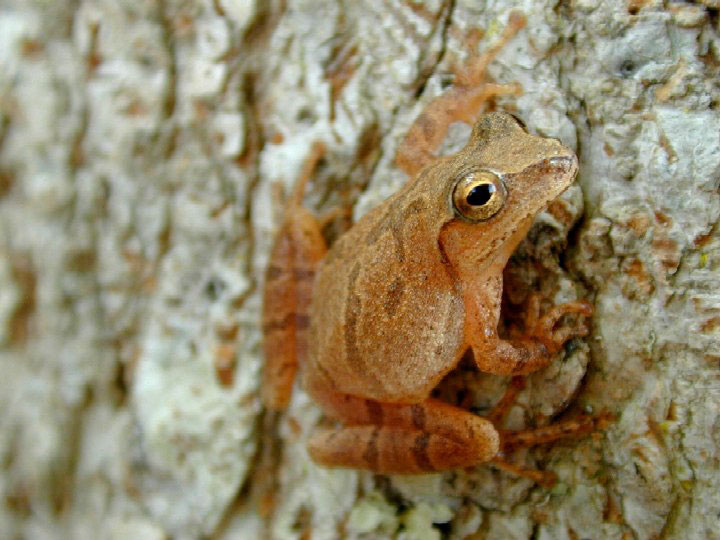 Spring PeeperPseudacris crucifer
-
 Cuban Tree FrogOsteopilus septentrionalis
-
 Pacific Tree FrogPseudacris regilla
-
 Rabbs' Fringe-limbed TreefrogEcnomiohyla rabborum
- European Tree FrogHyla arborea
-
 Mission Golden-eyed Tree FrogTrachycephalus resinifictrix
-
 Paradoxical FrogPseudis paradoxa
-
 Squirrel Tree FrogDryophytes squirellus
Compare
Questions and answers
What is the scientific name of the Golden Treefrog?
The scientific name of the Golden Treefrog is Phytotriades auratus. Written with its author, the full name is Phytotriades auratus (Boulenger, 1917).
Which family does the Golden Treefrog belong to?
Phytotriades auratus belongs to the family Hylidae, in the order Anura and the class Amphibia.
Where is the Golden Treefrog found?
Checklists and occurrence records place Phytotriades auratus in 2 countries: Trinidad and Tobago and Venezuela.
What is the conservation status of the Golden Treefrog?
The IUCN Red List category recorded for Phytotriades auratus is Endangered (EN).
What other names does the Golden Treefrog have?
Phytotriades auratus is also known in English as El Tucuche Golden Frog, Trinidad Golden Treefrog, Trinidad Heart-tongued Frogs and Trinidad Heart-tongued Frog.
Sources
Passages the profile rests on
- Phytotriades auratus is the sole currently recognized species in the genus Phytotriades. Source passage: “As currently delimited, the genus is monotypic and contains Phytotriades auratus,” — English Wikipedia
- The genus Phytotriades was separated from Phyllodytes primarily on the basis of genetic evidence. Source passage: “Phytotriades was separated from the genus Phyllodytes based primarily on genetic evidence;” — English Wikipedia
- AmphibiaWeb continues to classify Phytotriades auratus within the genus Phyllodytes. Source passage: “AmphibiaWeb continues to include Phytotriades auratus in Phyllodytes.” — English Wikipedia
- Adults have a chocolate-brown back with two iridescent golden-yellow stripes. Source passage: “The dorsum is chocolate brown in colour and has two iridescent, golden yellow stripes.” — English Wikipedia
- The species has serrated teeth and sharp mandibular fangs, which are larger in males than in females. Source passage: “They have serrated teeth and sharp "fangs", larger in males than in females, on their mandibles.” — English Wikipedia
- Adult males reach a maximum snout–vent length of 29 mm. Source passage: “Males grow to 29 mm (1.1 in)” — English Wikipedia
- Adult females reach a maximum snout–vent length of 35 mm. Source passage: “females to 35 mm (1.4 in) in snout–vent length.” — English Wikipedia
- On Trinidad, the species inhabits montane rainforest and elfin woodland at approximately 940 m above sea level. Source passage: “On Trinidad, the species occurs in montane rainforest and elfin woodland at around 940 m (3,080 ft) above sea level.” — English Wikipedia
- On Venezuela's Cerro Humo, the species has been found in elfin forest near the mountain summit at 1,250 m elevation. Source passage: “On Cerro Humo, the species was found in the elfin forest near the summit of the mountain (1,250 m (4,100 ft)).” — English Wikipedia
- The species is closely associated with the giant bromeliad Glomeropitcairnia erectiflora. Source passage: “Phytotriades auratus is closely associated with the giant bromeliad Glomeropitcairnia erectiflora;” — English Wikipedia
- The species is associated with cool, humid tropical montane forests on isolated mountain summits and peaks. Source passage: “The species appears to be specialized for life in high humidity relatively cool tropical montane forests on isolated mountain crests and peaks.” — English Wikipedia
- Males defend territories. Source passage: “Males are territorial” — English Wikipedia
- Males can use their fangs during combat. Source passage: “Males are territorial and can use their fangs in combat.” — English Wikipedia
- Males are not known to produce calls. Source passage: “Males are not known to call” — English Wikipedia
- Newly hatched tadpoles measure 14 mm in length. Source passage: “The tadpoles hatch at a length of 14 mm (0.55 in)” — English Wikipedia
- Tadpoles can grow to 40 mm in length. Source passage: “and grow to 40 mm (1.6 in).” — English Wikipedia
- The species' tadpoles develop inside giant bromeliads. Source passage: “also the tadpoles develop in these bromeliads.” — English Wikipedia
- The species probably has low fecundity, with no more than five or six tadpoles recorded in a single bromeliad tank. Source passage: “Fecundity is probably low, with maximally 5–6 tadpoles found in a single bromeliad tank.” — English Wikipedia
- Trinidadian populations are threatened by bromeliad collection and the collection of frog specimens. Source passage: “Trinidadian populations are threatened by the collection of bromeliads and collecting of specimens.” — English Wikipedia
- The Northern Range Game Sanctuary, also called the El Tucuche Reserve, provides some protection to one population. Source passage: “The Northern Range Game Sanctuary (also known as the El Tucuche Reserve) provides some protection to one of the populations.” — English Wikipedia
- Part of the species' habitat on Cerro Humo lies within Península de Paria National Park. Source passage: “On Cerro Humo, a part of the habitat falls within the Península de Paria National Park,” — English Wikipedia
- Enforcement of protection within Península de Paria National Park remains limited. Source passage: “although enforcement remains limited.” — English Wikipedia
- Slash-and-burn agricultural clearance threatens potential habitat on the slopes of Cerro Humo. Source passage: “Clearance for slash-and-burn plots threatens the potential habitat of the species on the slopes of the mountain.” — English Wikipedia
Data
- Catalogue of Life, 2026-10-16 XR cc by
- Global Biodiversity Information Facility CC BY 4.0
- Wikidata CC0
- GeoNames CC BY 4.0
- Wikimedia Commons per image; credit shown with each image
- Within the Catalogue of Life, this name comes from The Integrated Taxonomic Information System cc0
This species in other databases
Page built on 28 November 2026. See how the catalog is made and all sources and licences.
Cite this page
ScientificNames.org. (2026). Phytotriades auratus (Golden Treefrog). Retrieved November 28, 2026, from https://scientificnames.org/species/phytotriades-auratus
“Phytotriades auratus (Golden Treefrog).” ScientificNames.org, 2026, scientificnames.org/species/phytotriades-auratus. Accessed 28 Nov. 2026.
ScientificNames.org. “Phytotriades auratus (Golden Treefrog).” Accessed November 28, 2026. https://scientificnames.org/species/phytotriades-auratus.
@misc{scientificnames_phytotriades_auratus_golden_treefrog,
  author = {{ScientificNames.org}},
  title = {Phytotriades auratus (Golden Treefrog)},
  year = {2026},
  url = {https://scientificnames.org/species/phytotriades-auratus},
  note = {Accessed 2026-11-28}
}