Species · Mammals
Hispaniolan Hutia Plagiodontia aedium
The scientific name of the Hispaniolan Hutia is Plagiodontia aedium. It is a species of mammal in the family Echimyidae (coypu), order Rodentia. The name dates from 1836.
- Scientific name
- Plagiodontia aedium F. Cuvier, 1836
- Common name
- Hispaniolan Hutia
- Genus
- Plagiodontia
- Family
- Echimyidae (Coypu)
- Order
- Rodentia
- Class
- Mammalia
- Red List category
- LC Least Concern
- Recorded in
- 2 countries
- Name status
- accepted in the Catalogue of Life

Overview
The Hispaniolan Hutia is the only living member of the genus Plagiodontia. The species is endemic to the Caribbean island of Hispaniola, which is divided between Haiti and the Dominican Republic. It has short, dense brownish or grayish fur on its upper parts, buff-colored underparts, and a scaly, almost entirely hairless tail.
Written 26 November 2026 from the sources listed below. Each statement was checked against the passage it cites; statements that could not be supported were removed.
Appearance
The Hispaniolan Hutia has short, dense fur that is brownish or grayish on its upper parts and buff-colored underneath. Its tail is scaly and almost entirely hairless.[1][2]
Each forefoot and hind foot has five clawed digits, except for the thumb, which has a short, blunt nail. Females have three pairs of lateral thoracic mammary glands.[3][4]
Habitat
The species inhabits both dry and moist forests. Its reported habitat includes rough hillsides and ravines ranging from sea level to 2,000 metres in elevation.[5][6]
Some populations use burrows, while others shelter in tree cavities. Individuals have also been captured in hollow trees near a lagoon.[7][8]
Diet
Wild individuals feed mainly on roots and fruits. Captive individuals in a translocation study showed food preferences for Clusia rosea and Guarea guidonea.[9][10]
Carrot was the only supplementary food consumed by captive individuals in the translocation study.[11]
Behaviour
Wild individuals are active at night and hide during the day. Captive individuals have also been observed displaying nocturnal and arboreal activity.[12][13]
The species can live in male-female pairs, and three or four individuals have been reported to occupy the same burrow system. Individuals communicate using soft chirping sounds resembling bird calls.[14][15][16]
Individuals in a translocation study were organized into family groups containing one dominant adult male, subordinate males, and one or two adult females. A territorial fight occurred between a subadult male and a dominant male from different families during acclimation in a holding pen.[17][18]
Reproduction and life cycle
The reported gestation period ranges from 123 to 150 days, and litter sizes range from one to two offspring. The offspring are highly precocial at birth.[19][20][21]
Conservation
Recent surveys have recorded surviving populations in southeastern Haiti and the Massif de la Hotte. The species has been confirmed in Jaragua, Del Este, Los Haitises, and Sierra de Bahoruco National Parks, as well as the privately protected Punta Cana Ecological Reserve.[22][23][24]
The IUCN Red List classified the species as Least Concern in 2024. It faces population declines associated with forest habitat loss, human hunting, and predation by non-native animals.[25][26]
Identified threats include deforestation, hunting, competition from introduced rodents, and predation by introduced mammals. The species has been recognized as a global conservation priority.[27][28]
Translocation monitoring found that one of two relocated family groups successfully selected the designated habitat area, while one relocated family abandoned the selected area during monitoring. The study identified accurate population abundance and density data as necessary for supporting the survival of relocated animals.[29][30][31]
Classification of the Hispaniolan Hutia
| Kingdom | Animalia |
|---|---|
| Phylum | Chordata |
| Subphylum | Vertebrata |
| Infraphylum | Gnathostomata |
| Parvphylum | Osteichthyes |
| Megaclass | Tetrapoda |
| Class | Mammalia (Mammal) |
| Subclass | Theria |
| Infraclass | Eutheria |
| Order | Rodentia (Rodent) |
| Suborder | Hystricomorpha |
| Infraorder | Hystricognathi (Hystricognath Rodents) |
| Family | Echimyidae (Coypu) |
| Subfamily | Capromyinae |
| Tribe | Plagiodontini |
| Genus | Plagiodontia (Hispaniolan Hutias) |
| Species | Plagiodontia aedium F. Cuvier, 1836 |
Where the Hispaniolan Hutia is found
Checklists and occurrence records place Plagiodontia aedium in 2 countries across North America. GBIF holds 270 georeferenced records of it.
Countries
Regions and cities with the most records
- Grand'Anse, Haiti 82
- El Seíbo, Dominican Republic 17
- Sud, Haiti 14
- Sud-Est, Haiti 12
- Kenscoff, Haiti 9
- Pétionville, Haiti 9
- Les Cayes, Haiti 8
- Grand Gosier, Haiti 5
- Ouest, Haiti 4
- Pedernales Province, Dominican Republic 4
- Santa Cruz de El Seibo, Dominican Republic 4
Range as the checklists state it
Caribbean
A number beside a place is its count of GBIF occurrence records. A place without a number comes from a checklist alone. Records show where a species has been observed or collected, which can include escapes and vagrants.
Common names
English
- Hispaniolan Hutia
- Cuvier's Hutia
- Hispanolan Hutia
Names in 10 other languages
- Czech
- zaguti obecná
- Dutch
- Zagoeti van Cuvier
- Finnish
- gonavesaarenhutia
- French
- Hutia de Cuvier, Plagiodonte de Haïti, Rat Cayes commun
- Japanese
- ハイチフチア
- Polish
- domingohutia haitańska
- Portuguese
- Hutia-de-Hispanola
- Russian
- Кювьерова хутия
- Spanish
- Jutía de La Española
- hat
- Zagouti
Subspecies and varieties
- Plagiodontia aedium aedium subspecies
- Plagiodontia aedium bondi subspecies
- Plagiodontia aedium hylaeum subspecies
Related species
-
 Samaná HutiaPlagiodontia ipnaeum
- Wide-toothed HutiaPlagiodontia araeum
- Small Haitian HutiaPlagiodontia spelaeum
-
 NutriaMyocastor coypus
-
 Red-crested Tree-ratSantamartamys rufodorsalis
-
 Desmarest's HutiaCapromys pilorides
-
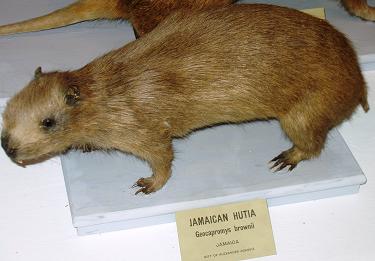 Jamaican ConeyGeocapromys brownii
-
 Armored RatHoplomys gymnurus
Compare
Questions and answers
What is the scientific name of the Hispaniolan Hutia?
The scientific name of the Hispaniolan Hutia is Plagiodontia aedium. Written with its author, the full name is Plagiodontia aedium F. Cuvier, 1836.
Which family does the Hispaniolan Hutia belong to?
Plagiodontia aedium belongs to the family Echimyidae, in the order Rodentia and the class Mammalia.
Where is the Hispaniolan Hutia found?
Checklists and occurrence records place Plagiodontia aedium in 2 countries: Haiti and Dominican Republic.
What is the conservation status of the Hispaniolan Hutia?
The IUCN Red List category recorded for Plagiodontia aedium is Least Concern (LC).
What other names does the Hispaniolan Hutia have?
Plagiodontia aedium is also known in English as Cuvier's Hutia and Hispanolan Hutia.
What do hutias eat?
Wild Hispaniolan Hutias feed mainly on roots and fruits. Captive individuals showed food preferences for Clusia rosea and Guarea guidonea, and carrot was the only supplementary food they consumed in a translocation study.[9][10][11]
What does a hutia look like?
The Hispaniolan Hutia has short, dense brownish or grayish fur on its upper parts and buff-colored fur underneath. Its tail is scaly and almost entirely hairless, and each foot has five clawed digits except for the thumb, which has a short, blunt nail.[1][2][3]
Where are hutias found?
The Hispaniolan Hutia is endemic to the Caribbean island of Hispaniola, which is divided between Haiti and the Dominican Republic. Surviving populations have been recorded in southeastern Haiti and the Massif de la Hotte, and the species has been confirmed in Jaragua, Del Este, Los Haitises, and Sierra de Bahoruco National Parks, as well as the Punta Cana Ecological Reserve.[32][22][23][24]
Sources
Passages the profile rests on
- The species has short, dense fur that is brownish or grayish on its upper parts and buff-colored underneath. Source passage: “The short, dense pelage is brownish or grayish on the upper parts and buffy on the underparts.” — English Wikipedia
- Its tail is scaly and almost entirely hairless. Source passage: “The tail is scaly, and practically naked.” — English Wikipedia
- Each forefoot and hind foot has five clawed digits, except for the thumb, which has a short, blunt nail. Source passage: “Both the forefoot and the hind foot have five digits, all armed with claws (except the thumb, which has a short, blunt nail).” — English Wikipedia
- Females have three pairs of lateral thoracic mammary glands. Source passage: “Females have three pairs of lateral thoracic mammae.” — English Wikipedia
- The species inhabits both dry and moist forests. Source passage: “Hispaniolan hutias inhabit both dry and moist forests on the island.” — English Wikipedia
- Its reported habitat includes rough hillsides and ravines ranging from sea level to 2,000 metres in elevation. Source passage: “they occupy rough hillsides and ravines from sea level to 2,000 meters in elevation” — English Wikipedia
- Some populations use burrows, while others shelter in tree cavities. Source passage: “some populations use burrows and feed near the ground, and other populations may den in tree cavities” — English Wikipedia
- Individuals have been captured in hollow trees near a lagoon. Source passage: “Specimens of the P. a. hylaeum subspecies were caught in December in hollow trees near a lagoon” — English Wikipedia
- Wild individuals feed mainly on roots and fruits. Source passage: “feed mainly on roots and fruits” — English Wikipedia
- Captive individuals in a translocation study showed food preferences for Clusia rosea and Guarea guidonea. Source passage: “hutias showed trophic preferences for Clusia rosea and Guarea guidonea.” — pmc.ncbi.nlm.nih.gov
- The only supplementary food consumed by the captive individuals in the translocation study was carrot. Source passage: “The only supplementary food they consumed was Daucus carota.” — pmc.ncbi.nlm.nih.gov
- Wild individuals are active at night and hide during the day. Source passage: “Wild specimens are reported to be active only at night; they hide during the day” — English Wikipedia
- Captive individuals have been observed displaying nocturnal and arboreal activity. Source passage: “Captive hutias have been observed to be nocturnal and arboreal” — English Wikipedia
- The species can live in male-female pairs. Source passage: “live in male-female pairs.” — English Wikipedia
- Three or four individuals have been reported to occupy the same burrow system. Source passage: “three or four individuals commonly occupy the same burrow system.” — English Wikipedia
- Individuals communicate using soft chirping sounds resembling bird calls. Source passage: “Individuals communicate through soft, almost bird-like chirps.” — English Wikipedia
- Individuals in a translocation study were organized into family groups containing one dominant adult male, subordinate males, and one or two adult females. Source passage: “individuals are organized in independent family groups with one dominant adult male, subordinate males, and one or two adult females with their offsprings.” — pmc.ncbi.nlm.nih.gov
- A territorial fight occurred between a subadult male and a dominant male from different families during acclimation in a holding pen. Source passage: “A fight was observed between members of different families during the acclimation period in the holding pen, between a subadult male and another dominant one, evidencing territorial behavior.” — pmc.ncbi.nlm.nih.gov
- The reported gestation period for the species ranges from 123 to 150 days. Source passage: “Recorded gestation has been 123–150 days” — English Wikipedia
- Reported litter sizes range from one to two offspring. Source passage: “litter sizes of one to two young in this species” — English Wikipedia
- The offspring are highly precocial at birth. Source passage: “which are highly precocial” — English Wikipedia
- Recent surveys have recorded surviving populations in southeastern Haiti and the Massif de la Hotte. Source passage: “Recent surveys in Haiti have found P. aedium to be living as remnant populations in the southeast and on the Massif de la Hotte.” — English Wikipedia
- The species has been confirmed in Jaragua, Del Este, Los Haitises, and Sierra de Bahoruco National Parks. Source passage: “these include Jaragua, Del Este, Los Haitises, and Sierra de Bahoruco National Parks.” — English Wikipedia
- The species has also been discovered in the privately protected Punta Cana Ecological Reserve. Source passage: “Hutia population have also been discovered in privately protected areas such as Punta Cana Ecological Reserve.” — English Wikipedia
- The IUCN Red List classified the species as Least Concern in 2024. Source passage: “The IUCN Red List classifies P. aedium as "least concern" as of 2024” — English Wikipedia
- The species faces population declines associated with forest habitat loss, human hunting, and predation by non-native animals. Source passage: “though its population is declining due to loss of forest habitat, human hunting and predation by non-native animals such as dogs.” — English Wikipedia
- Deforestation, hunting, competition from introduced rodents, and predation by introduced mammals are identified as threats. Source passage: “threatened by deforestation, hunting, competition from introduced rodents such as rats and mice, and predation by the introduced small Indian mongoose (Urva auropunctata), as well as feral dogs and cats.” — English Wikipedia
- The species has been recognized as a global conservation priority. Source passage: “Plagiodontia aedium and Solenodon paradoxus (Solenodon) have been recognized globally as conservation priority species” — pmc.ncbi.nlm.nih.gov
- Translocation monitoring found that one of two relocated family groups successfully selected the designated habitat area. Source passage: “the selection of habitat for relocation, based on the characterization of active burrows in the area, was successful in one of the two families relocated.” — pmc.ncbi.nlm.nih.gov
- One relocated family abandoned the selected translocation area during monitoring. Source passage: “One of the families abandoned the selected area for translocation during the monitoring.” — pmc.ncbi.nlm.nih.gov
- The translocation study identified accurate population abundance and density data as necessary for supporting the survival of relocated animals. Source passage: “accurate population data of the targeted population, such as abundance and density, are necessary to guarantee the survival of the translocated animals in the new environment.” — pmc.ncbi.nlm.nih.gov
- The species is endemic to the Caribbean island of Hispaniola, which is divided between Haiti and the Dominican Republic. Source passage: “endemic to forests on the Caribbean island of Hispaniola (split between Haiti and the Dominican Republic).” — English Wikipedia
Data
- Catalogue of Life, 2026-10-16 XR cc by
- Global Biodiversity Information Facility CC BY 4.0
- Wikidata CC0
- GeoNames CC BY 4.0
- Wikimedia Commons per image; credit shown with each image
- Within the Catalogue of Life, this name comes from The Integrated Taxonomic Information System cc0
References
- Ann. Sci. Nat. Zool. (Paris), ser 2 vol.6 p.347 where the name was published
- Wilson, Don E., and DeeAnn M. Reeder, eds. (1993). Mammal Species of the World: A Taxonomic and Geographic Reference, 2nd Ed., 3rd Printing.
- Woods, Charles A., and C. William Kilpatrick / Wilson, Don E., and DeeAnn M. Reeder, eds. (2005). Infraorder Hystricognathi Brandt, 1855. Mammal Species of the World: A Taxonomic and Geographic Reference, 3rd Ed., Vol. 2.
- Wilson, Don E., T. E. Lacher Jr., and R. A. Mittermeier, eds. (2016). Handbook of the Mammals of the World. Vol. 6: Lagomorphs and Rodents I.
This species in other databases
Page built on 28 November 2026. See how the catalog is made and all sources and licences.
Cite this page
ScientificNames.org. (2026). Plagiodontia aedium (Hispaniolan Hutia). Retrieved November 28, 2026, from https://scientificnames.org/species/plagiodontia-aedium
“Plagiodontia aedium (Hispaniolan Hutia).” ScientificNames.org, 2026, scientificnames.org/species/plagiodontia-aedium. Accessed 28 Nov. 2026.
ScientificNames.org. “Plagiodontia aedium (Hispaniolan Hutia).” Accessed November 28, 2026. https://scientificnames.org/species/plagiodontia-aedium.
@misc{scientificnames_plagiodontia_aedium_hispaniolan_hutia,
  author = {{ScientificNames.org}},
  title = {Plagiodontia aedium (Hispaniolan Hutia)},
  year = {2026},
  url = {https://scientificnames.org/species/plagiodontia-aedium},
  note = {Accessed 2026-11-28}
}