Species · Mammals
Desmarest's Hutia Capromys pilorides
The scientific name of the Desmarest's Hutia is Capromys pilorides. It is a species of mammal in the family Echimyidae (coypu), order Rodentia. The name dates from 1822.
- Scientific name
- Capromys pilorides (Say, 1822)
- Common name
- Desmarest's Hutia
- Genus
- Capromys
- Family
- Echimyidae (Coypu)
- Order
- Rodentia
- Class
- Mammalia
- Red List category
- LC Least Concern
- Recorded in
- 2 countries
- Name status
- accepted in the Catalogue of Life

Overview
Capromys pilorides is widespread throughout Cuba and also occurs on Isla de la Juventud, the Sabana archipelago and the Doce Lagunas archipelago. It has a stout body, short legs and thick, coarse fur, and is the largest living species of hutia.
Written 26 November 2026 from the sources listed below. Each statement was checked against the passage it cites; statements that could not be supported were removed.
Appearance
Desmarest's Hutia has a stout, stocky body and short legs. Its thick, coarse fur extends to the tip of its tail and ranges in colour from black and brown to light sand and red.[1][2][3]
Its feet have five toes equipped with large claws that help it climb. Its stomach is divided into three compartments by constrictions in the gut.[4][5]
Females have two lateral thoracic pairs of mammary glands.[6]
Its head-and-body length ranges from 31 to 60 cm, and its tail measures between 14 and 29 cm long. Its body weight ranges from 2.8 to 8.5 kg.[7][8][9]
Habitat
Desmarest's Hutia occupies montane cloud forests, arid coastal semi-deserts, semi-deciduous forests, marshy lowlands and mountainous habitats.[10]
Northern Cuban populations commonly inhabit marshy areas with abundant red mangroves and occupy the branches and roots of mangrove trees. Southern Cuban populations generally favour terrestrial habitats.[11][12][13]
At night, individuals rest in hollows in rocks or trees.[14]
Diet
Desmarest's Hutia is omnivorous and primarily eats bark, leaves and fruit. It occasionally eats small vertebrates, including lizards.[15][16]
Behaviour
Individuals normally live in pairs but may also occur alone or in small groups. The species is diurnal and does not dig burrows.[17][18]
Its usual movement is a slow, waddling gait, although it can hop quickly when pursued. Both sexes mark their territories using urine.[19][20]
Reproduction and life cycle
Desmarest's Hutia breeds throughout the year, with peak breeding activity occurring in June and July. Gestation normally lasts approximately 120 to 126 days.[21][22]
Females normally give birth to between one and three young per litter. Newborn young weigh an average of approximately 230 g.[23][24]
Young are precocial, with fur, open eyes and the ability to walk shortly after birth. They are weaned at approximately five months of age.[25][26]
Individuals reach sexual maturity at approximately ten months of age.[27]
Conservation
Desmarest's Hutia is not considered an immediate conservation concern because some areas retain high population densities. However, populations have declined substantially in the mountainous regions of eastern Cuba.[28][29]
The Wild Animals Protection Act of 1968 prohibits capturing or killing hutias without a permit from the Ministry of Agriculture and Fisheries.[30]
A population transplantation moved individuals from East Plan Cay to the Exuma Cays Land and Sea Park. Population densities in some protected areas have reached 50 to 100 individuals per hectare.[31][32]
Uses
Desmarest's Hutia has traditionally been hunted for food in Cuba because its meat is considered agreeable and provides a substantial meal.[33]
The species can damage agricultural crops in areas where it is abundant.[34]
Classification of the Desmarest's Hutia
| Kingdom | Animalia |
|---|---|
| Phylum | Chordata |
| Subphylum | Vertebrata |
| Infraphylum | Gnathostomata |
| Parvphylum | Osteichthyes |
| Megaclass | Tetrapoda |
| Class | Mammalia (Mammal) |
| Subclass | Theria |
| Infraclass | Eutheria |
| Order | Rodentia (Rodent) |
| Suborder | Hystricomorpha |
| Infraorder | Hystricognathi (Hystricognath Rodents) |
| Family | Echimyidae (Coypu) |
| Subfamily | Capromyinae |
| Tribe | Capromyini |
| Genus | Capromys |
| Species | Capromys pilorides (Say, 1822) |
Where the Desmarest's Hutia is found
Checklists and occurrence records place Capromys pilorides in 2 countries across North America. GBIF holds 739 georeferenced records of it.
Countries
Regions and cities with the most records
- Isla de la Juventud, Cuba 109
- Pinar del Río, Cuba 107
- Matanzas Province, Cuba 65
- Guantánamo Province, Cuba 58
- Cienfuegos Province, Cuba 37
- Sancti Spíritus Province, Cuba 35
- Minas de Matahambre, Cuba 27
- Camagüey, Cuba 25
- Abreus, Cuba 21
- Cienfuegos, Cuba 21
- Palmira, Cuba 21
- Rodas, Cuba 20
- Villa Clara Province, Cuba 20
- Nuevitas, Cuba 14
- Nueva Gerona, Cuba 13
- Trinidad, Cuba 13
- Ciego de Ávila Province, Cuba 10
- Holguín Province, Cuba 10
- Condado, Cuba 9
- Sibanicú, Cuba 9
- Manicaragua, Cuba 7
- Sancti Spíritus, Cuba 7
- Viñales, Cuba 7
- Cabaiguán, Cuba 6
- Cumanayagua, Cuba 6
- Arroyo Naranjo, Cuba 5
- Fontanar, Cuba 5
- Guanabacoa, Cuba 5
- Jagüey Grande, Cuba 5
- Jatibonico, Cuba 5
- Mayabeque, Cuba 5
- San Miguel del Padrón, Cuba 5
- Santiago de las Vegas, Cuba 5
- Baracoa, Cuba 4
- Bejucal, Cuba 4
- Consolación del Sur, Cuba 4
1 more country has a few records outside this range
These countries hold a few records of Capromys pilorides but lie outside the range the checklists give for it. Such records are often zoo or garden specimens, museum material or vagrants, so the species is not counted as occurring there.
Range as the checklists state it
Caribbean
A number beside a place is its count of GBIF occurrence records. A place without a number comes from a checklist alone. Records show where a species has been observed or collected, which can include escapes and vagrants.
Common names
English
- Desmarest's Hutia
- Cuban Ground Hutia
- Cuban Hutia
- Desmarest S Hutia
- Garrido's Hutia
Names in 11 other languages
- Czech
- hutia Garridova
- Dutch
- Cubaanse Hutia
- Finnish
- guantanamonhutia, majanhutia
- French
- Hutia cubain
- German
- Hutiaconga, Kuba-Baumratte
- Japanese
- デマレフチア
- Norwegian Bokmål
- Garridobeverrotte
- Polish
- Hutia kubańska
- Portuguese
- Hutia-cubana
- Russian
- Кубинская хутия
- Spanish
- Jutia conga, Jutía conga
Synonyms
3 other scientific names have been used for this species and are now treated as synonyms of Capromys pilorides.
- Capromys geayi Pousarges, 1899
- Capromys gundlachius Varona, 1983
- Isodon pilorides Say, 1822
Subspecies and varieties
- Capromys pilorides ciprianoi subspecies
- Capromys pilorides doceleguas subspecies
- Capromys pilorides gundlachianus (Archipiélago de Sabana Hutia) subspecies
- Capromys pilorides pilorides subspecies
- Capromys pilorides relictus subspecies
Related species
-
 NutriaMyocastor coypus
-
 Red-crested Tree-ratSantamartamys rufodorsalis
-
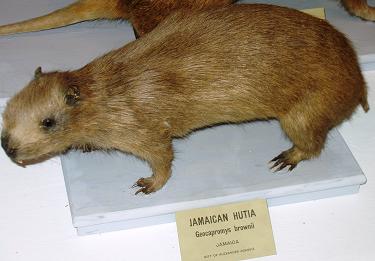 Jamaican ConeyGeocapromys brownii
-
 Hispaniolan HutiaPlagiodontia aedium
-
 Armored RatHoplomys gymnurus
-
 Bahamian HutiaGeocapromys ingrahami
- Garrido's HutiaMysateles garridoi
- Dwarf HutiaMesocapromys nanus
Compare
Questions and answers
What is the scientific name of the Desmarest's Hutia?
The scientific name of the Desmarest's Hutia is Capromys pilorides. Written with its author, the full name is Capromys pilorides (Say, 1822).
Which family does the Desmarest's Hutia belong to?
Capromys pilorides belongs to the family Echimyidae, in the order Rodentia and the class Mammalia.
Where is the Desmarest's Hutia found?
Checklists and occurrence records place Capromys pilorides in 2 countries: Cuba and United States.
What is the conservation status of the Desmarest's Hutia?
The IUCN Red List category recorded for Capromys pilorides is Least Concern (LC).
What other names does the Desmarest's Hutia have?
Capromys pilorides is also known in English as Cuban Ground Hutia, Cuban Hutia, Desmarest S Hutia and Garrido's Hutia.
Can you eat hutia?
Desmarest's Hutia has traditionally been hunted for food in Cuba because its meat is considered agreeable and provides a substantial meal.[33]
Where are hutias found?
Desmarest's Hutia is naturally restricted to Cuba and nearby islands. Its range includes Isla de la Juventud, the Sabana archipelago and the Doce Lagunas archipelago.[35][36][37]
Sources
Passages the profile rests on
- The species has a stout, stocky body and short legs. Source passage: “The body is stocky and the legs short.” — English Wikipedia
- Its fur is thick, coarse and extends to the tip of its tail. Source passage: “It has thick, coarse fur which extends to the tip of the tail.” — English Wikipedia
- Its body fur ranges in colour from black and brown to light sand and red. Source passage: “The colour of the body fur varies from black to brown, with a light sand colour and red also seen.” — English Wikipedia
- Its feet have five toes equipped with large claws that help it climb. Source passage: “The feet have five toes with large claws which assist the animal in climbing.” — English Wikipedia
- Its stomach is divided into three compartments by constrictions in the gut. Source passage: “The stomach is divided into three compartments by constrictions in the gut” — English Wikipedia
- Females have two lateral thoracic pairs of mammary glands. Source passage: “Females have two lateral thoracic pairs of mammae.” — animaldiversity.org
- Its head-and-body length ranges from 31 to 60 cm. Source passage: “The Desmarest's hutia has a head-and-body length of 31–60 cm (12–24 in)” — English Wikipedia
- Its tail measures between 14 and 29 cm long. Source passage: “a tail that is 14–29 cm (5.5–11.4 in) long” — English Wikipedia
- Its body weight ranges from 2.8 to 8.5 kg. Source passage: “weighs 2.8–8.5 kg (6.2–18.7 lb).” — English Wikipedia
- The species occupies montane cloud forests, arid coastal semi-deserts, semi-deciduous forests, marshy lowlands and mountainous habitats. Source passage: “They are found in all types of habitats such as montane cloud forests, arid coastal semi-deserts, semi-deciduous forests, low, marshy areas and even in the mountains of eastern Cuba.” — animaldiversity.org
- Northern Cuban populations commonly inhabit marshy areas with abundant red mangroves. Source passage: “Those that live in the north tend to live in marshy areas where an abundance of red mangroves grow.” — animaldiversity.org
- Northern populations commonly occupy the branches and roots of mangrove trees. Source passage: “This group generally lives in the branches and roots of the mangroves that grow there.” — animaldiversity.org
- Southern Cuban populations generally favour terrestrial habitats. Source passage: “southern populations tend to favour a more terrestrial habitat.” — English Wikipedia
- At night, individuals rest in hollows in rocks or trees. Source passage: “during the night they rest in hollows in rocks or trees.” — English Wikipedia
- The species is omnivorous and primarily eats bark, leaves and fruit. Source passage: “They are omnivorous but eat mostly bark, leaves and fruit.” — English Wikipedia
- It occasionally eats small vertebrates, including lizards. Source passage: “However, they have been known to also feed on small vertebrates, including small lizards.” — animaldiversity.org
- Individuals normally live in pairs but may also occur alone or in small groups. Source passage: “Desmarest's hutias normally live in pairs, but can be found individually or in small groups.” — English Wikipedia
- The species is diurnal and does not dig burrows. Source passage: “They are diurnal and do not burrow” — English Wikipedia
- Its usual movement is a slow, waddling gait, although it can hop quickly when pursued. Source passage: “It moves with a slow, waddling gait, but can perform a quick hop when pursued.” — English Wikipedia
- Both sexes mark their territories using urine. Source passage: “Both males and females scent mark their territory with urine.” — English Wikipedia
- The species breeds throughout the year, with peak breeding activity occurring in June and July. Source passage: “They breed throughout the year with a gestation period of between 110 and 140 days (normally around 120 to 126 days), although peak breeding season is in June/July.” — English Wikipedia
- Gestation normally lasts approximately 120 to 126 days. Source passage: “they have a gestation period of around 120-126 days.” — animaldiversity.org
- Females normally give birth to between one and three young per litter. Source passage: “They normally produce between one and three young” — English Wikipedia
- Newborn young weigh an average of approximately 230 g. Source passage: “weighing an average of 230 g (8.1 oz).” — English Wikipedia
- Young are precocial, with fur, open eyes and the ability to walk shortly after birth. Source passage: “The young are precocial, with fur, fully open eyes and the ability to walk.” — English Wikipedia
- Young are weaned at approximately five months of age. Source passage: “They are weaned at around five months” — English Wikipedia
- Individuals reach sexual maturity at approximately ten months of age. Source passage: “they do not reach sexual maturity until they are about 10 months old.” — animaldiversity.org
- The species is not considered an immediate conservation concern because some areas retain high population densities. Source passage: “Capromys pilorides are not as much of a conservation concern because there still are some areas that have a high density of this species.” — animaldiversity.org
- Populations have declined substantially in the mountainous regions of eastern Cuba. Source passage: “In the mountainous areas of eastern Cuba, numbers of Desmarest's hutia are decreasing.” — English Wikipedia
- The Wild Animals Protection Act of 1968 prohibits capturing or killing hutias without a permit from the Ministry of Agriculture and Fisheries. Source passage: “The Wild Animals Protection Act of 1968 protects hutias from being captured or killed unless a permit is obtained from the Ministry of Agriculture and Fisheries.” — animaldiversity.org
- A population transplantation moved individuals from East Plan Cay to the Exuma Cays Land and Sea Park. Source passage: “This transplantation removed some C.pilorides from East Plan Cay and transplanted them to the Exuma Cays Land and Sea Park.” — animaldiversity.org
- Population densities in some protected areas have reached 50 to 100 individuals per hectare. Source passage: “There are also some protected areas where the density of C.pilorides has reached 50-100 individuals per hectare.” — animaldiversity.org
- The species has traditionally been hunted for food in Cuba because its meat is considered agreeable and provides a substantial meal. Source passage: “Hutias were traditionally hunted for food in Cuba as their flesh was agreeable and their size meant they provided a substantial meal.” — English Wikipedia
- The species can damage agricultural crops in areas where it is abundant. Source passage: “In some areas they are so abundant that they cause damage to crops and are viewed as a pest.” — English Wikipedia
- The species is naturally restricted to Cuba and nearby islands. Source passage: “Capromys pilorides lives only in Cuba and on several, small nearby islands” — animaldiversity.org
- Its range includes Isla de la Juventud, the Sabana archipelago and the Doce Lagunas archipelago. Source passage: “They are found on the main island, Isla de la Juventud, the Sabana archipelago, the Doce Lagunas archipelago” — English Wikipedia
- The species is widespread throughout Cuba. Source passage: “Capromys pilorides are widespread throughout all of Cuba.” — animaldiversity.org
- It is the largest living species of hutia. Source passage: “It is the largest living hutia” — English Wikipedia
Data
- Catalogue of Life, 2026-10-16 XR cc by
- Global Biodiversity Information Facility CC BY 4.0
- Wikidata CC0
- GeoNames CC BY 4.0
- Wikimedia Commons per image; credit shown with each image
- Within the Catalogue of Life, this name comes from The Integrated Taxonomic Information System cc0
References
- Jour. Acad. Nat. Sci. Philadelphia vol.2 p.333 where the name was published
- Wilson, Don E., and DeeAnn M. Reeder, eds. (1993). Mammal Species of the World: A Taxonomic and Geographic Reference, 2nd Ed., 3rd Printing.
- Woods, Charles A., and C. William Kilpatrick / Wilson, Don E., and DeeAnn M. Reeder, eds. (2005). Infraorder Hystricognathi Brandt, 1855. Mammal Species of the World: A Taxonomic and Geographic Reference, 3rd Ed., Vol. 2.
- Wilson, Don E., T. E. Lacher Jr., and R. A. Mittermeier, eds. (2016). Handbook of the Mammals of the World. Vol. 6: Lagomorphs and Rodents I.
- Silva, Hansel Caballero, and Carlos A. Mancina. (2023). Capromys pilorides (Rodentia: Echimyidae). Mammalian Species, Vol. 55, No. 1027.
This species in other databases
Page built on 26 November 2026. See how the catalog is made and all sources and licences.
Cite this page
ScientificNames.org. (2026). Capromys pilorides (Desmarest's Hutia). Retrieved November 26, 2026, from https://scientificnames.org/species/capromys-pilorides
“Capromys pilorides (Desmarest's Hutia).” ScientificNames.org, 2026, scientificnames.org/species/capromys-pilorides. Accessed 26 Nov. 2026.
ScientificNames.org. “Capromys pilorides (Desmarest's Hutia).” Accessed November 26, 2026. https://scientificnames.org/species/capromys-pilorides.
@misc{scientificnames_capromys_pilorides_desmarests_hutia,
  author = {{ScientificNames.org}},
  title = {Capromys pilorides (Desmarest's Hutia)},
  year = {2026},
  url = {https://scientificnames.org/species/capromys-pilorides},
  note = {Accessed 2026-11-26}
}