Species · Insects
Mouse Dung Beetle Planolinoides borealis
The scientific name of the Mouse Dung Beetle is Planolinoides borealis. It is a species of insect in the family Scarabaeidae (dung beetles), order Coleoptera. The name dates from 1827.
- Scientific name
- Planolinoides borealis (Gyllenhal, 1827)
- Common name
- Mouse Dung Beetle
- Genus
- Planolinoides
- Family
- Scarabaeidae (Dung Beetles)
- Order
- Coleoptera
- Class
- Insecta
- Recorded in
- 35 countries
- Name status
- accepted in the Catalogue of Life

Overview
Planolinoides borealis occurs in the Nearctic and Palaearctic regions, including the listed locations in Canada, Alaska, United States, and other countries. Adults are blackish or piceous, with reddish anterior pronotal angles and usually reddish areas on the elytra.
Written 27 November 2026 from the sources listed below. Each statement was checked against the passage it cites; statements that could not be supported were removed.
Appearance
Adults have an oblong, convex, glabrous body with moderate shine, although parts of the elytra are dull. They are blackish or piceous, with reddish anterior pronotal angles.[1][2]
The elytra usually have reddish areas but can also be entirely reddish. Adults measure approximately 3.5–5 mm in length.[3][4]
Habitat
The Mouse Dung Beetle occurs in the Nearctic region in Canada in Alberta, British Columbia, Labrador, Manitoba, New Brunswick, Newfoundland, Northwest Territories, Nova Scotia, Ontario, Quebec, Saskatchewan, and Yukon Territory. It also occurs in Alaska, United States.[5][6]
In the Palaearctic region, it occurs in Austria, Belarus, Belgium, Bosnia Herzegovina, Bulgaria, Croatia, the Czech Republic, Denmark, Estonia, Finland, France, Georgia, Germany, Great Britain, Hungary, Ireland, Italy, Kazakhstan, Latvia, Lithuania, Macedonia, Montenegro, Mongolia, the Netherlands, Norway, Poland, Portugal, Romania, Russia, Serbia, Slovakia, Spain, Sweden, Switzerland, and Ukraine.[7]
Its Russian distribution includes the Russian Far East and Siberia.[8]
Classification of the Mouse Dung Beetle
| Kingdom | Animalia |
|---|---|
| Phylum | Arthropoda |
| Subphylum | Hexapoda |
| Class | Insecta (Insect) |
| Order | Coleoptera (Beetle) |
| Suborder | Polyphaga |
| Series | Staphyliniformia |
| Superfamily | Scarabaeoidea |
| Family | Scarabaeidae (Dung Beetles) |
| Subfamily | Aphodiinae |
| Tribe | Aphodiini |
| Subtribe | Aphodiina |
| Genus | Planolinoides |
| Species | Planolinoides borealis (Gyllenhal, 1827) |
Where the Mouse Dung Beetle is found
Checklists and occurrence records place Planolinoides borealis in 35 countries across Asia and Europe. GBIF holds 2,961 georeferenced records of it.
Countries
- Aland Islands 21
- Austria 6
- Belarus
- Belgium
- Bulgaria
- Croatia
- Czechia
- Denmark 51
- Estonia 34
- Finland 537
- France 425
- Georgia
- Germany 15
- Hungary 2
- Ireland
- Italy
- Kazakhstan
- Latvia 4
- Lithuania 4
- Mongolia 1
- Montenegro
- North Macedonia
- Norway 562
- Poland 36
- Portugal 4
- Romania
- Russia 14
- Serbia
- Slovakia
- Spain 149
- Sweden 807
- Switzerland 118
- The Netherlands 11
- Ukraine
- United Kingdom 160
Regions and cities with the most records
- Västerbotten, Sweden 159
- Provence-Alpes-Côte d'Azur, France 154
- Akershus, Norway 148
- England, United Kingdom 120
- Norrbotten, Sweden 91
- Östergötland, Sweden 91
- Kalmar, Sweden 69
- Occitanie, France 65
- Bulle, Switzerland 63
- Collado-Villalba, Spain 62
- Fribourg, Switzerland 60
- Madrid, Spain 58
- Corsica, France 53
- Finnmark, Norway 50
- Västra Götaland, Sweden 46
- Île-de-France, France 43
- Troms, Norway 42
- Ticino, Switzerland 41
- Buskerud, Norway 40
- Montreux, Switzerland 40
- Espoo, Finland 38
- Vevey, Switzerland 38
- Lugano, Switzerland 37
- Väståboland, Finland 36
- Galapagar, Spain 33
- Nordland, Norway 31
- Skåne, Sweden 31
- Swarzędz, Poland 31
- Västernorrland, Sweden 31
- Środa Wielkopolska, Poland 31
- Como, Italy 30
- Hauts-de-France, France 30
- Jämtland, Sweden 30
- Malnate, Italy 30
- Varese, Italy 30
- Kirkkonummi, Finland 29
2 more countries have a few records outside this range
These countries hold a few records of Planolinoides borealis but lie outside the range the checklists give for it. Such records are often zoo or garden specimens, museum material or vagrants, so the species is not counted as occurring there.
Range as the checklists state it
Nearctic(Canada:Alberta, British Columbia, Labrador, Manitoba, New Brunswick, Newfoundland, Northwest Territories, Nova Scotia, Ontario, Quebec, Saskatchewan, Yukon Territory, USA:Alaska), Palaearctic(Austria, Belarus, Belgium, Bosnia Herzegovina, Bulgaria, Croatia, Czech Republic, Denmark, Estonia, Finland, France, Georgia, Germany, Great Britian, Hungary, Ireland, Italy, Kazakhstan, Latvia, Lithuania, Macedonia, Montenegro, Mongolia, Netherlands, Norway, Poland, Portugal, Romania, Russia, Russia Far East, Serbia, Siberia, Slovakia, Spain, Sweden, Switzerland, Ukraine)
A number beside a place is its count of GBIF occurrence records. A place without a number comes from a checklist alone. Records show where a species has been observed or collected, which can include escapes and vagrants.
Common names
English
- Mouse Dung Beetle
Names in 5 other languages
- Finnish
- Pohjanlantiainen
- German
- Nördlicher Dungkäfer
- Norwegian
- Nordig gjødselbille
- Norwegian Bokmål
- nordlig gjødselbille
- Swedish
- Nordig dyngbagge, nordlig dyngbagge
Synonyms
11 other scientific names have been used for this species and are now treated as synonyms of Planolinoides borealis.
- Agrilinus (Planolinus) borealis basomaculatus Negrobov, 2010
- Agrilinus (Planolinus) borealis bimaculatus Negrobov, 2010
- Agrilinus (Planolinus) borealis varvarinus Negrobov, 2010
- Aphodius borealis Gyllenhal, 1827
- Aphodius errans Brown, 1930
- Aphodius hespericus Gistel, 1857
- Aphodius putridus Sturm, 1805
- Aphodius putridus evanescens Bouskell, 1901
- Aphodius putridus gyllenhalii Seidlitz, 1891
- Aphodius sedulus Harold, 1871
- Planolinus borealis (Gyllenhal, 1827)
Related species
- Planolinoides aenictus
- Planolinoides duplex
- Planolinoides neotomae
- Planolinoides pectoralis
-
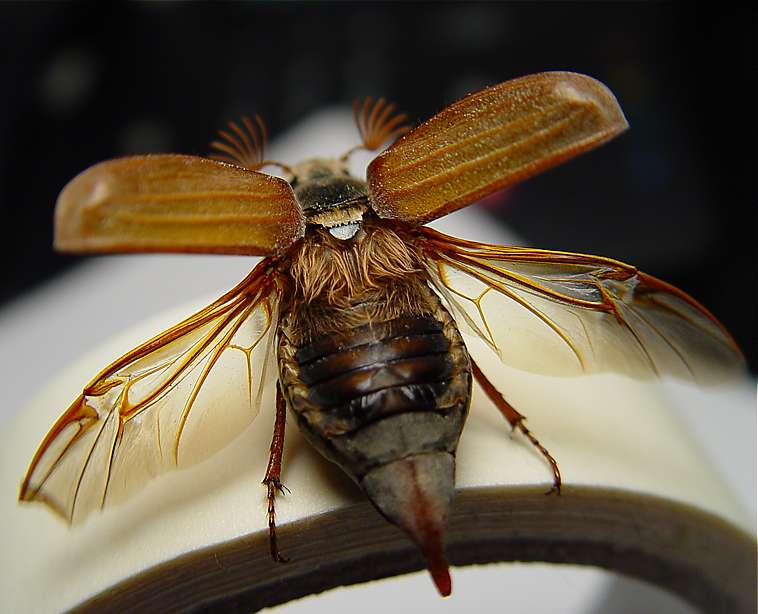 CockchaferMelolontha melolontha
-
 Hercules BeetleDynastes (Dynastes) hercules
-
 Japanese BeetlePopillia japonica
-
 Japanese Rhinoceros BeetleTrypoxylus dichotomus
Compare
Questions and answers
What is the scientific name of the Mouse Dung Beetle?
The scientific name of the Mouse Dung Beetle is Planolinoides borealis. Written with its author, the full name is Planolinoides borealis (Gyllenhal, 1827).
Which family does the Mouse Dung Beetle belong to?
Planolinoides borealis belongs to the family Scarabaeidae, in the order Coleoptera and the class Insecta.
Where is the Mouse Dung Beetle found?
Checklists and occurrence records place Planolinoides borealis in 35 countries, including Sweden, Norway, Finland, France, United Kingdom and Spain.
Sources
Passages the profile rests on
- Adults have an oblong, convex, glabrous body with moderate shine, although parts of the elytra are dull. Source passage: “They have an oblong, convex, glabrous, moderately shiny body, although the elytra are partly dull.” — English Wikipedia
- Adults are blackish or piceous, with reddish anterior pronotal angles. Source passage: “They are blackish or piceous, with the anterior angles of the pronotum reddish.” — English Wikipedia
- The elytra usually have reddish areas, but can also be entirely reddish. Source passage: “The elytra ussually have some reddish areas, but are sometimes completely reddish.” — English Wikipedia
- Adults measure approximately 3.5–5 mm in length. Source passage: “Adults reach a length of about 3.5–5 mm (0.14–0.20 in).” — English Wikipedia
- In the Nearctic region, the species occurs in Canada in Alberta, British Columbia, Labrador, Manitoba, New Brunswick, Newfoundland, Northwest Territories, Nova Scotia, Ontario, Quebec, Saskatchewan, and Yukon Territory. Source passage: “Nearctic: Canada (Alberta, British Columbia, Labrador, Manitoba, New Brunswick, Newfoundland, Northwest Territories, Nova Scotia, Ontario, Quebec, Saskatchewan, Yukon Territory)” — English Wikipedia
- In the Nearctic region, the species occurs in Alaska, United States. Source passage: “United States (Alaska).” — English Wikipedia
- In the Palaearctic region, the species occurs in Austria, Belarus, Belgium, Bosnia Herzegovina, Bulgaria, Croatia, the Czech Republic, Denmark, Estonia, Finland, France, Georgia, Germany, Great Britain, Hungary, Ireland, Italy, Kazakhstan, Latvia, Lithuania, Macedonia, Montenegro, Mongolia, the Netherlands, Norway, Poland, Portugal, Romania, Russia, Serbia, Slovakia, Spain, Sweden, Switzerland, and Ukraine. Source passage: “Palaearctic: Austria, Belarus, Belgium, Bosnia Herzegovina, Bulgaria, Croatia, the Czech Republic, Denmark, Estonia, Finland, France, Georgia, Germany, Great Britian, Hungary, Ireland, Italy, Kazakhstan, Latvia, Lithuania, Macedonia, Montenegro, Mongolia, the Netherlands, Norway, Poland, Portugal, Romania, Russia (including the Russian Far East and Siberia), Serbia, Slovakia, Spain, Sweden, Switzerland and Ukraine.” — English Wikipedia
- The species' Russian distribution includes the Russian Far East and Siberia. Source passage: “Russia (including the Russian Far East and Siberia)” — English Wikipedia
Data
- Catalogue of Life, 2026-10-16 XR cc by
- Global Biodiversity Information Facility CC BY 4.0
- Wikidata CC0
- GeoNames CC BY 4.0
- Wikimedia Commons per image; credit shown with each image
- Within the Catalogue of Life, this name comes from World Scarabaeidae Database cc by
References
- Dellacasa, M., & Dellacasa, G. (2005). Comments on some systematic and nomenclatural questions in Aphodiinae with descriptions of new genera and on Italian taxa (Coleoptera Aphodiidae). Memorie Della Società Entomologica Italiana, Genova 84:45-99. https://doi.org/10.4081/memoriesei.2005.45 Link where the name was published
This species in other databases
Page built on 28 November 2026. See how the catalog is made and all sources and licences.
Cite this page
ScientificNames.org. (2026). Planolinoides borealis (Mouse Dung Beetle). Retrieved November 28, 2026, from https://scientificnames.org/species/planolinoides-borealis
“Planolinoides borealis (Mouse Dung Beetle).” ScientificNames.org, 2026, scientificnames.org/species/planolinoides-borealis. Accessed 28 Nov. 2026.
ScientificNames.org. “Planolinoides borealis (Mouse Dung Beetle).” Accessed November 28, 2026. https://scientificnames.org/species/planolinoides-borealis.
@misc{scientificnames_planolinoides_borealis_mouse_dung_beetle,
  author = {{ScientificNames.org}},
  title = {Planolinoides borealis (Mouse Dung Beetle)},
  year = {2026},
  url = {https://scientificnames.org/species/planolinoides-borealis},
  note = {Accessed 2026-11-28}
}