Species · Insects
Plesiopalacephala castanea
Plesiopalacephala castanea has no English name on record in the checklists used here. It is a species of insect in the family Scarabaeidae (dung beetles), order Coleoptera. The name dates from 1855.
- Scientific name
- Plesiopalacephala castanea (Klug, 1855)
- Genus
- Plesiopalacephala
- Family
- Scarabaeidae (Dung Beetles)
- Order
- Coleoptera
- Class
- Insecta
- Recorded in
- 1 country
- Name status
- accepted in the Catalogue of Life
Overview
The species is recorded from Mozambique. Adults have a brownish-black body with a metallic lustre, long reddish-yellow hairs, and brown elytra with scattered hairs.
Written 28 November 2026 from the sources listed below. Each statement was checked against the passage it cites; statements that could not be supported were removed.
Appearance
Adults have a brownish-black body with a metallic lustre and long reddish-yellow hairs covering most of the body. The brown elytra bear a few scattered hairs rather than dense hair coverage.[1][2]
The head is truncate at the front and lacks hairs up to the vertex. The clypeus has a reflexed margin and coarse punctation, while the vertex bears longer reddish-yellow hairs.[3][4][5]
The antennae are brown with a black club. The pronotum is densely and finely scaly, and the scutellum is punctate.[6][7][8]
The elytra are punctate and have a rugose border. The middle legs are reddish-brown and covered with rusty-brown hairs.[9][10]
Classification of Plesiopalacephala castanea
| Kingdom | Animalia |
|---|---|
| Phylum | Arthropoda |
| Subphylum | Hexapoda |
| Class | Insecta (Insect) |
| Order | Coleoptera (Beetle) |
| Suborder | Polyphaga |
| Series | Staphyliniformia |
| Superfamily | Scarabaeoidea |
| Family | Scarabaeidae (Dung Beetles) |
| Subfamily | Melolonthinae |
| Tribe | Tanyproctini |
| Subtribe | Tanyproctina |
| Genus | Plesiopalacephala |
| Species | Plesiopalacephala castanea (Klug, 1855) |
Where Plesiopalacephala castanea is found
Checklists and occurrence records place Plesiopalacephala castanea in 1 country across Africa.
Countries
Range as the checklists state it
Afrotropical(Mozambique)
A number beside a place is its count of GBIF occurrence records. A place without a number comes from a checklist alone. Records show where a species has been observed or collected, which can include escapes and vagrants.
Synonyms
One other scientific name has been used for this species and is now treated as a synonym of Plesiopalacephala castanea.
- Cyclomera castanea Klug, 1855
Related species
- Plesiopalacephala delgadoensis
-
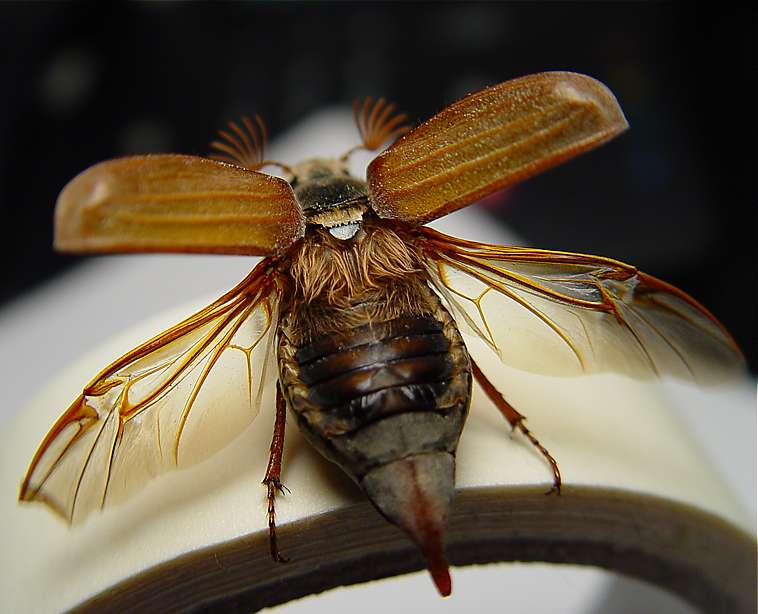 CockchaferMelolontha melolontha
-
 Hercules BeetleDynastes (Dynastes) hercules
-
 Japanese BeetlePopillia japonica
-
 Japanese Rhinoceros BeetleTrypoxylus dichotomus
-
 Sacred ScarabScarabaeus sacer
-
 Figeater BeetleCotinis (Cotinis) mutabilis
-
 Atlas BeetleChalcosoma atlas
Compare
Questions and answers
Where is Plesiopalacephala castanea recorded?
The species is recorded from Mozambique.[11]
How long are the adults?
Adults reach approximately 18 mm in length.[12]
Sources
Passages the profile rests on
- Adults have a brownish-black body with a metallic lustre and long reddish-yellow hairs covering most of the body. Source passage: “They are brownish-black, not without metallic lustre, and covered with long, reddish-yellow hairs” — English Wikipedia
- The elytra are brown and bear a few scattered hairs rather than dense hair coverage. Source passage: “the elytra only are differently coloured, being brown, but instead of being densely hairy they have a few scattered hairs.” — English Wikipedia
- The head is truncate at the front and lacks hairs up to the vertex. Source passage: “The head is truncate in front, free of hairs up to the vertex” — English Wikipedia
- The clypeus has a reflexed margin and coarse punctation. Source passage: “the clypeus is reflexed at the margin and coarsely punctate” — English Wikipedia
- The vertex bears longer reddish-yellow hairs. Source passage: “the vertex is covered with longer, reddish-yellow hairs.” — English Wikipedia
- The antennae are brown with a black club. Source passage: “The antennae are brown, except for the black club.” — English Wikipedia
- The pronotum is densely and finely scaly. Source passage: “The pronotum is densely and finely scaly” — English Wikipedia
- The scutellum is punctate. Source passage: “the scutellum punctate” — English Wikipedia
- The elytra are punctate and have a rugose border. Source passage: “the elytra punctate, with a rugose border.” — English Wikipedia
- The middle legs are reddish-brown and covered with rusty-brown hairs. Source passage: “The middle legs are reddish-brown, with rusty-brown hairs.” — English Wikipedia
- The species is recorded from Mozambique. Source passage: “It is found in Mozambique.” — English Wikipedia
- Adults reach approximately 18 mm in length. Source passage: “Adults reach a length of about 18 mm (0.71 in).” — English Wikipedia
Data
- Catalogue of Life, 2026-10-16 XR cc by
- Wikidata CC0
- GeoNames CC BY 4.0
- Within the Catalogue of Life, this name comes from World Scarabaeidae Database cc by
References
- Lacroix, M. (2006). Contribution a la connaissance des Pachydeminae africains. X.. Nouveau genre, mise au point et designation de lectotypes (Coleoptera, Melolonthidae). Coléoptères 12(18):235-270. where the name was published
This species in other databases
Page built on 29 November 2026. See how the catalog is made and all sources and licences.
Cite this page
ScientificNames.org. (2026). Plesiopalacephala castanea. Retrieved November 29, 2026, from https://scientificnames.org/species/plesiopalacephala-castanea
“Plesiopalacephala castanea.” ScientificNames.org, 2026, scientificnames.org/species/plesiopalacephala-castanea. Accessed 29 Nov. 2026.
ScientificNames.org. “Plesiopalacephala castanea.” Accessed November 29, 2026. https://scientificnames.org/species/plesiopalacephala-castanea.
@misc{scientificnames_plesiopalacephala_castanea,
  author = {{ScientificNames.org}},
  title = {Plesiopalacephala castanea},
  year = {2026},
  url = {https://scientificnames.org/species/plesiopalacephala-castanea},
  note = {Accessed 2026-11-29}
}