Species · Birds
Giant Weaver Ploceus grandis
The scientific name of the Giant Weaver is Ploceus grandis. It is a species of bird in the family Ploceidae (bishops), order Passeriformes. The name dates from 1844.
- Scientific name
- Ploceus grandis (G. R. Gray, 1844)
- Common name
- Giant Weaver
- Genus
- Ploceus
- Family
- Ploceidae (Bishops)
- Order
- Passeriformes
- Class
- Aves
- Red List category
- NT Near Threatened
- Recorded in
- 4 countries
- Name status
- accepted in the Catalogue of Life

Overview
The Giant Weaver is an enormous weaver. The species is endemic to São Tomé Island. It has a robust bill resembling that of a barbet.
Written 27 November 2026 from the sources listed below. Each statement was checked against the passage it cites; statements that could not be supported were removed.
Appearance
The Giant Weaver has a robust bill resembling that of a barbet. It is described as an enormous weaver.[1][2]
Habitat
The species inhabits subtropical and tropical moist lowland forests. It occurs in forests and along forest edges.[3][4]
The Giant Weaver is most frequently found in agroforests. It also occurs in plantations.[5][6]
Behaviour
The species can climb trees and branches.[7]
Conservation
The Giant Weaver is described as patchily common and fairly common.[8][9]
Classification of the Giant Weaver
| Kingdom | Animalia |
|---|---|
| Phylum | Chordata |
| Subphylum | Vertebrata |
| Infraphylum | Gnathostomata |
| Parvphylum | Osteichthyes |
| Megaclass | Tetrapoda |
| Class | Aves (Bird) |
| Order | Passeriformes (Passerine) |
| Family | Ploceidae (Bishops) |
| Genus | Ploceus (Typical Weavers) |
| Species | Ploceus grandis (G. R. Gray, 1844) |
Where the Giant Weaver is found
Checklists and occurrence records place Ploceus grandis in 4 countries. GBIF holds 671 georeferenced records of it.
Countries
Regions and cities with the most records
- São Tomé, Sao Tome and Principe 285
- Brazzaville, Republic of the Congo 3
- Brazzaville, Republic of the Congo 3
- Kinshasa, Democratic Republic of the Congo 3
A number beside a place is its count of GBIF occurrence records. A place without a number comes from a checklist alone. Records show where a species has been observed or collected, which can include escapes and vagrants.
Common names
English
- Giant Weaver
- GIWE
Names in 25 other languages
- Catalan
- teixidor gegant
- Chinese
- 大织雀, 巨織布鳥
- Croatian
- velika pletilja
- Czech
- snovač velký
- Danish
- Kæmpevæver
- Dutch
- Reuzenwever
- Esperanto
- giganta teksbirdo
- Finnish
- jättikutoja
- French
- Malimbe géant, Tisserin géant
- German
- Riesenweber
- Hungarian
- óriás-szövőmadár
- Italian
- Tessitore gigante
- Japanese
- オニハタオリ
- Lithuanian
- milžiniškasis audėjas
- Norwegian
- kjempevever
- Polish
- wikłacz wielki
- Portuguese
- Camussela, Tecelão-grande, tecelão-gigante
- Russian
- Гигантский ткач
- Serbian
- Džinovska tekstor tkalja
- Slovak
- pletiarka veľká
- Spanish
- Tejedor gigante
- Swedish
- jättevävare
- Turkish
- Dev Dokumacı
- Ukrainian
- ткачик гігантський
- Welsh
- gwehydd mawr
Synonyms
3 other scientific names have been used for this species and are now treated as synonyms of Ploceus grandis.
- Hyphantornis grandis Gray, GR, 1844
- Malimbus grandis Gray, GR, 1844
- Ploceus collaris Fraser, L, 1843
Related species
-
 Southern Masked WeaverPloceus velatus
-
 Village WeaverPloceus cucullatus
-
 Cape WeaverPloceus capensis
-
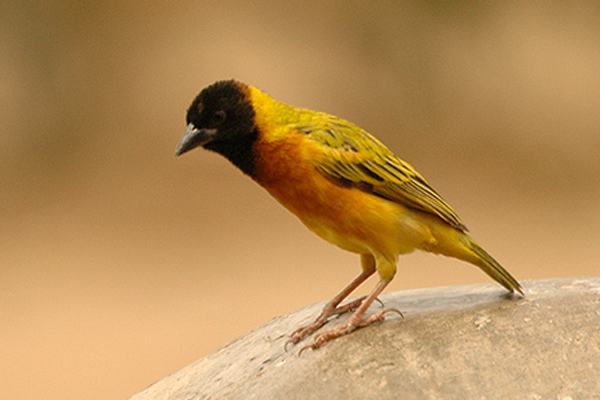 Black-headed WeaverPloceus melanocephalus
-
 Eastern Golden WeaverPloceus subaureus
-
 Asian Golden WeaverPloceus hypoxanthus
-
 Baglafecht WeaverPloceus baglafecht
-
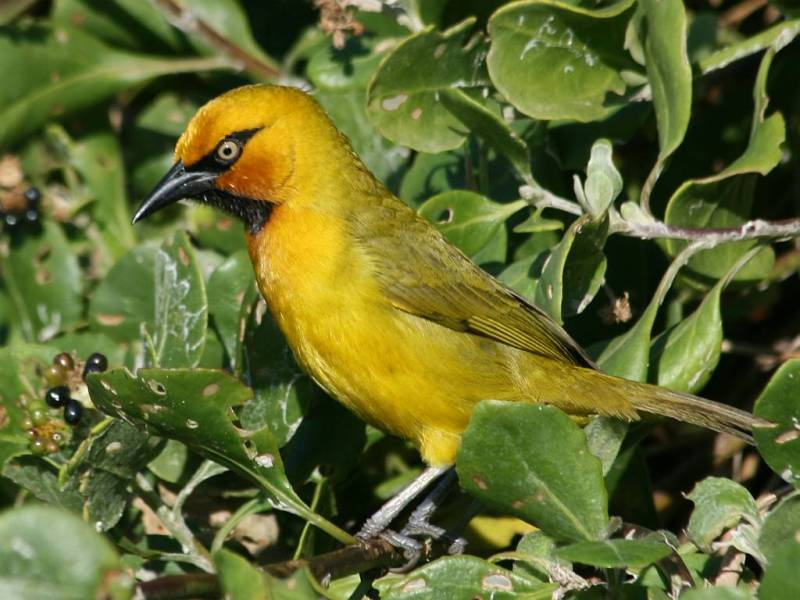 Spectacled WeaverPloceus ocularis
Compare
Questions and answers
What is the scientific name of the Giant Weaver?
The scientific name of the Giant Weaver is Ploceus grandis. Written with its author, the full name is Ploceus grandis (G. R. Gray, 1844).
Which family does the Giant Weaver belong to?
Ploceus grandis belongs to the family Ploceidae, in the order Passeriformes and the class Aves.
Where is the Giant Weaver found?
Checklists and occurrence records place Ploceus grandis in 4 countries: Sao Tome and Principe, Angola, Gabon and Republic of the Congo.
What is the conservation status of the Giant Weaver?
The IUCN Red List category recorded for Ploceus grandis is Near Threatened (NT).
What other names does the Giant Weaver have?
Ploceus grandis is also known in English as GIWE.
Sources
Passages the profile rests on
- The species has a robust bill resembling that of a barbet. Source passage: “with a robust barbet-like bill” — ebird.org
- The species is described as an enormous weaver. Source passage: “A spectacular enormous weaver endemic to São Tomé” — ebird.org
- The species inhabits subtropical and tropical moist lowland forests. Source passage: “Its natural habitat is subtropical or tropical moist lowland forests.” — English Wikipedia
- The species occurs in forests and along forest edges. Source passage: “Fairly common in forest, forest edge, and plantations.” — ebird.org
- The species is most frequently found in agroforests. Source passage: “most frequently found in agroforests” — datazone.birdlife.org
- The species occurs in plantations. Source passage: “Fairly common in forest, forest edge, and plantations.” — ebird.org
- The species can climb trees and branches. Source passage: “It can climb trees and branches, rather like a treecreeper or sittella.” — English Wikipedia
- The species is described as patchily common. Source passage: “It is patchily common, most frequently found in agroforests and in non ...” — datazone.birdlife.org
- The species is described as fairly common. Source passage: “Fairly common in forest, forest edge, and plantations.” — ebird.org
Data
- Catalogue of Life, 2026-10-16 XR cc by
- Global Biodiversity Information Facility CC BY 4.0
- Wikidata CC0
- GeoNames CC BY 4.0
- Wikimedia Commons per image; credit shown with each image
- Within the Catalogue of Life, this name comes from The Integrated Taxonomic Information System cc0
References
- Gill, Frank, & and Minturn Wright. (2006). Birds of the World: Recommended English Names.
This species in other databases
Page built on 28 November 2026. See how the catalog is made and all sources and licences.
Cite this page
ScientificNames.org. (2026). Ploceus grandis (Giant Weaver). Retrieved November 28, 2026, from https://scientificnames.org/species/ploceus-grandis
“Ploceus grandis (Giant Weaver).” ScientificNames.org, 2026, scientificnames.org/species/ploceus-grandis. Accessed 28 Nov. 2026.
ScientificNames.org. “Ploceus grandis (Giant Weaver).” Accessed November 28, 2026. https://scientificnames.org/species/ploceus-grandis.
@misc{scientificnames_ploceus_grandis_giant_weaver,
  author = {{ScientificNames.org}},
  title = {Ploceus grandis (Giant Weaver)},
  year = {2026},
  url = {https://scientificnames.org/species/ploceus-grandis},
  note = {Accessed 2026-11-28}
}