Species · Birds
Chestnut Weaver Ploceus rubiginosus
The scientific name of the Chestnut Weaver is Ploceus rubiginosus. It is a species of bird in the family Ploceidae (bishops), order Passeriformes. The name dates from 1840.
- Scientific name
- Ploceus rubiginosus Rüppell, 1840
- Common name
- Chestnut Weaver
- Genus
- Ploceus
- Family
- Ploceidae (Bishops)
- Order
- Passeriformes
- Class
- Aves
- Red List category
- LC Least Concern
- Recorded in
- 10 countries
- Name status
- accepted in the Catalogue of Life

Overview
The Chestnut Weaver occurs in eastern and south-western Africa, including Kenya, Botswana, Ethiopia, Somalia, Uganda, Tanzania, Angola, and Namibia. The species has distinctive male and female plumage and a song consisting of harsh, sizzling sounds and occasional high-pitched chirps.
Written 26 November 2026 from the sources listed below. Each statement was checked against the passage it cites; statements that could not be supported were removed.
Uses
The Chestnut Weaver is regarded as an agricultural pest during its breeding season because its colonies damage crops. In Kenya, it has been reported to damage bulrush millet crops.[1][2]
The species is considered a threat to millet, sorghum, and rice grain crops.[3]
Appearance
Male and female Chestnut Weavers have different plumage appearances. The non-breeding male has dull red eyes, a grayish-brown head, and dark-orange to bright-orange body plumage.[4][5][6]
The male's wings have black and beige coloration, and its tail is long and brown.[7]
The female has pale-brown plumage and yellow coloration around her dark eyes. Her wing feathers have black edges, and her tail is brown.[8][9]
Habitat
The Chestnut Weaver generally inhabits dry environments. Its habitats include shrubland and thornveld, typically at elevations below 1,500 metres.[10][11]
Diet
The Chestnut Weaver eats seeds, grasses, cultivated grains, termites, and aloe nectar.[12]
Young Chestnut Weavers generally eat insects, including caterpillars, grasshoppers, and crickets.[13]
Behaviour
The Chestnut Weaver is both nomadic and resident. Its movements are influenced by rainfall and food availability.[14][15]
The species has a distinctive song consisting of harsh, sizzling sounds and occasional high-pitched chirps.[16]
Chestnut Weavers forage in small groups and are often observed in flocks. They catch insects in flight and also search for food on the ground.[17][18][19]
Reproduction and life cycle
Chestnut Weavers are colonial breeders that nest together in groups.[20]
In Ethiopia, Chestnut Weavers breed in October. In Uganda, they breed from May through July, and in Kenya, from April through July.[21][22][23]
In the northern arid region, Chestnut Weavers breed in November. In Tanzania, they breed from March through April, and in Namibia, from December through May.[24][25][26]
Classification of the Chestnut Weaver
| Kingdom | Animalia |
|---|---|
| Phylum | Chordata |
| Subphylum | Vertebrata |
| Infraphylum | Gnathostomata |
| Parvphylum | Osteichthyes |
| Megaclass | Tetrapoda |
| Class | Aves (Bird) |
| Order | Passeriformes (Passerine) |
| Family | Ploceidae (Bishops) |
| Genus | Ploceus (Typical Weavers) |
| Species | Ploceus rubiginosus Rüppell, 1840 |
Where the Chestnut Weaver is found
Checklists and occurrence records place Ploceus rubiginosus in 10 countries. GBIF holds 16,302 georeferenced records of it.
Countries
- Angola 32
- Botswana 8
- Eritrea 7
- Ethiopia 632
- Kenya 6,289
- Namibia 7,065
- Somalia 211
- South Africa 12
- Tanzania 1,922
- Uganda 124
Regions and cities with the most records
- Kunene Region, Namibia 3,739
- Khomas Region, Namibia 1,292
- Arusha, Tanzania 1,194
- Taita Taveta, Kenya 1,036
- Otjozondjupa Region, Namibia 947
- Kajiado County, Kenya 851
- Windhoek, Namibia 715
- Isiolo County, Kenya 652
- Erongo Region, Namibia 576
- Arusha, Tanzania 558
- Samburu County, Kenya 546
- Baringo, Kenya 480
- Nairobi, Kenya 450
- Imara Daima Estate, Kenya 448
- Nairobi County, Kenya 408
- Laikipia, Kenya 404
- Oromiya, Ethiopia 395
- Meru County, Kenya 366
- Nakuru County, Kenya 350
- Usa River, Tanzania 350
- Ongata Rongai, Kenya 347
- Manyara, Tanzania 340
- Ngong, Kenya 324
- Kikuyu, Kenya 310
- Karuri, Kenya 292
- Kiambu, Kenya 287
- Kilimanjaro, Tanzania 237
- Kiserian, Kenya 232
- Okahandja, Namibia 230
- Kingori, Tanzania 224
- Mbuguni, Tanzania 215
- Oshikoto Region, Namibia 211
- Mlolongo, Kenya 200
- Woqooyi Galbeed, Somalia 198
- Hargeysa, Somalia 190
- Githunguri, Kenya 177
1 more country has a few records outside this range
These countries hold a few records of Ploceus rubiginosus but lie outside the range the checklists give for it. Such records are often zoo or garden specimens, museum material or vagrants, so the species is not counted as occurring there.
A number beside a place is its count of GBIF occurrence records. A place without a number comes from a checklist alone. Records show where a species has been observed or collected, which can include escapes and vagrants.
Common names
English
- Chestnut Weaver
- CHWE
Names in 27 other languages
- Afrikaans
- Bruinwewer
- Catalan
- teixidor castany
- Chinese
- 栗織布鳥, 栗织雀
- Croatian
- kestenjasta pletilja
- Czech
- snovač hnědavý
- Danish
- Rødbrun Væver
- Dutch
- Kastanjewever
- Esperanto
- kaŝtana teksbirdo
- Finnish
- kastanjakutoja
- French
- Malimbe roux, Tisserin roux, Tisserin rubigineux
- German
- Maronenweber
- Hungarian
- gesztenyebarna szövőmadár
- Irish
- Fíodóir rua
- Italian
- Tessitore castano
- Japanese
- クリイロハタオリ
- Lithuanian
- kaštoninis audėjas
- Norwegian
- kastanjevever
- Polish
- wikłacz kasztanowaty
- Portuguese
- tecelão-castanho
- Russian
- Каштановый ткач
- Serbian
- Kestenjasta tekstor tkalja
- Slovak
- pletiarka gaštanová
- Spanish
- Tejedor castaño
- Swedish
- kastanjevävare
- Turkish
- Kahverengi Dokumacı
- Ukrainian
- ткачик каштановий
- Welsh
- gwehydd gwinau’r De
Synonyms
One other scientific name has been used for this species and is now treated as a synonym of Ploceus rubiginosus.
- Malimbus rubiginosus Rüppell, WPES, 1840
Subspecies and varieties
- Ploceus rubiginosus cinnamominus subspecies
- Ploceus rubiginosus rubiginosus subspecies
- Ploceus rubiginosus trothae subspecies
Related species
-
 Southern Masked WeaverPloceus velatus
-
 Village WeaverPloceus cucullatus
-
 Cape WeaverPloceus capensis
-
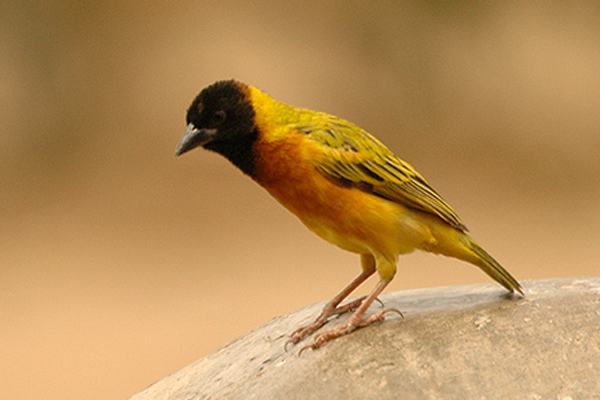 Black-headed WeaverPloceus melanocephalus
-
 Eastern Golden WeaverPloceus subaureus
-
 Asian Golden WeaverPloceus hypoxanthus
-
 Baglafecht WeaverPloceus baglafecht
-
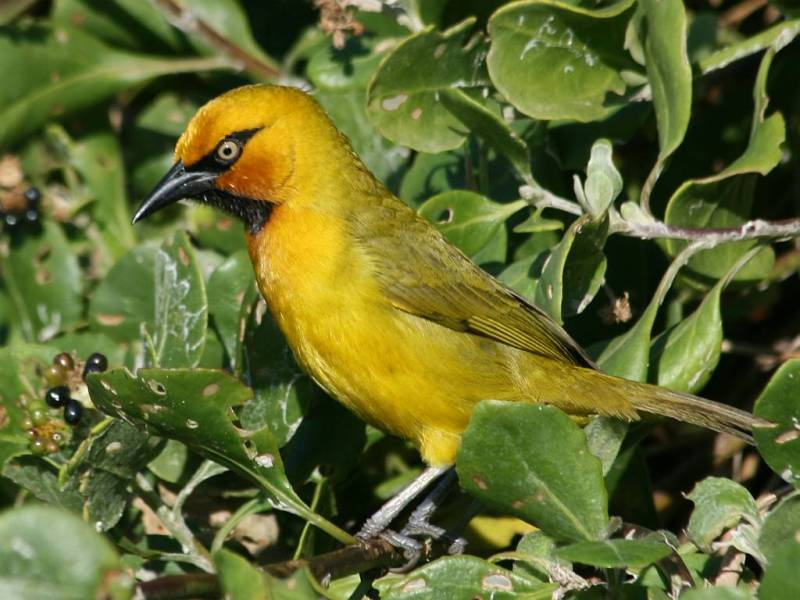 Spectacled WeaverPloceus ocularis
Compare
Questions and answers
What is the scientific name of the Chestnut Weaver?
The scientific name of the Chestnut Weaver is Ploceus rubiginosus. Written with its author, the full name is Ploceus rubiginosus Rüppell, 1840.
Which family does the Chestnut Weaver belong to?
Ploceus rubiginosus belongs to the family Ploceidae, in the order Passeriformes and the class Aves.
Where is the Chestnut Weaver found?
Checklists and occurrence records place Ploceus rubiginosus in 10 countries, including Namibia, Kenya, Tanzania, Ethiopia, Somalia and Uganda.
What is the conservation status of the Chestnut Weaver?
The IUCN Red List category recorded for Ploceus rubiginosus is Least Concern (LC).
What other names does the Chestnut Weaver have?
Ploceus rubiginosus is also known in English as CHWE.
Sources
Passages the profile rests on
- Chestnut Weavers are regarded as agricultural pests during their breeding season because their colonies damage crops. Source passage: “During their breeding season, they are seen as pests by farmers because they form large colonies and destroy crops.” — English Wikipedia
- In Kenya, Chestnut Weavers have been reported to damage bulrush millet crops. Source passage: “In Kenya, they have been known to destroy Bulrush Millet” — English Wikipedia
- The species is considered a threat to millet, sorghum, and rice grain crops. Source passage: “are considered a threat to the Millet, Sorghum, and rice grains.” — English Wikipedia
- Male and female Chestnut Weavers have different plumage appearances. Source passage: “Both the male and female look different from one another.” — English Wikipedia
- The non-breeding male has dull red eyes and a grayish-brown head. Source passage: “The non-breeding male has dull red eyes, a grayish-brown head” — English Wikipedia
- The non-breeding male has dark-orange to bright-orange body plumage. Source passage: “with the rest of his body being an ombre of dark orange to a brighter orange” — English Wikipedia
- The male's wings have black and beige coloration, and its tail is long and brown. Source passage: “its wings are covered in black and beige colors, and it has a long brown tail.” — English Wikipedia
- The female has pale-brown plumage and yellow coloration around her dark eyes. Source passage: “The female is a pale brown, with yellow coloring around their dark eyes” — English Wikipedia
- The female has black edges on her wing feathers and a brown tail. Source passage: “it has black edges around the feathers of its wings, and a brown tail.” — English Wikipedia
- The species generally inhabits dry environments. Source passage: “Its general habitat is dry.” — English Wikipedia
- Its habitats include shrubland and thornveld, typically at elevations below 1,500 metres. Source passage: “It can be found in shrubland and thornveld, typically below 1,500 Meters.” — English Wikipedia
- The Chestnut Weaver eats seeds, grasses, cultivated grains, termites, and aloe nectar. Source passage: “Their diet consists of seeds, grasses, cultivated grains, insects such as termites, and the nectar of aloes.” — English Wikipedia
- Young Chestnut Weavers generally eat insects, including caterpillars, grasshoppers, and crickets. Source passage: “Young chestnut weavers usually only eat insects such as caterpillars, grasshoppers, and crickets.” — English Wikipedia
- The Chestnut Weaver is both nomadic and resident. Source passage: “It is a nomadic as well as residential species” — English Wikipedia
- Its movements are influenced by rainfall and food availability. Source passage: “moves in response to rainfall and food availability.” — English Wikipedia
- The species has a distinctive song consisting of harsh, sizzling sounds and occasional high-pitched chirps. Source passage: “It has a distinct song, it is a harsh, sizzling sound with occasional high-pitched chirps.” — English Wikipedia
- Chestnut Weavers forage in small groups. Source passage: “They also forage in small groups” — English Wikipedia
- The species catches insects in flight and also searches for food on the ground. Source passage: “catching insects through the air or foraging on the ground.” — English Wikipedia
- The species is often observed in flocks. Source passage: “It is often seen in flocks” — English Wikipedia
- Chestnut Weavers are colonial breeders that nest together in groups. Source passage: “they are colonial breeders; many birds nest together in one area.” — English Wikipedia
- In Ethiopia, Chestnut Weavers breed in October. Source passage: “They breed in October in Ethiopia” — English Wikipedia
- In Uganda, Chestnut Weavers breed from May through July. Source passage: “May to July in Uganda” — English Wikipedia
- In Kenya, Chestnut Weavers breed from April through July. Source passage: “April to July in Kenya” — English Wikipedia
- In the northern arid region, Chestnut Weavers breed in November. Source passage: “November in the northern arid region” — English Wikipedia
- In Tanzania, Chestnut Weavers breed from March through April. Source passage: “March to April in Tanzania” — English Wikipedia
- In Namibia, Chestnut Weavers breed from December through May. Source passage: “December to May in Namibia.” — English Wikipedia
Data
- Catalogue of Life, 2026-10-16 XR cc by
- Global Biodiversity Information Facility CC BY 4.0
- Wikidata CC0
- GeoNames CC BY 4.0
- Wikimedia Commons per image; credit shown with each image
- Within the Catalogue of Life, this name comes from The Integrated Taxonomic Information System cc0
References
- Gill, Frank, & and Minturn Wright. (2006). Birds of the World: Recommended English Names.
This species in other databases
Page built on 28 November 2026. See how the catalog is made and all sources and licences.
Cite this page
ScientificNames.org. (2026). Ploceus rubiginosus (Chestnut Weaver). Retrieved November 28, 2026, from https://scientificnames.org/species/ploceus-rubiginosus
“Ploceus rubiginosus (Chestnut Weaver).” ScientificNames.org, 2026, scientificnames.org/species/ploceus-rubiginosus. Accessed 28 Nov. 2026.
ScientificNames.org. “Ploceus rubiginosus (Chestnut Weaver).” Accessed November 28, 2026. https://scientificnames.org/species/ploceus-rubiginosus.
@misc{scientificnames_ploceus_rubiginosus_chestnut_weaver,
  author = {{ScientificNames.org}},
  title = {Ploceus rubiginosus (Chestnut Weaver)},
  year = {2026},
  url = {https://scientificnames.org/species/ploceus-rubiginosus},
  note = {Accessed 2026-11-28}
}