Species · Mammals
African Striped Weasel Poecilogale albinucha
The scientific name of the African Striped Weasel is Poecilogale albinucha. It is a species of mammal in the family Mustelidae (mustelids), order Carnivora. The name dates from 1864.
- Scientific name
- Poecilogale albinucha (Gray, 1864)
- Common name
- African Striped Weasel
- Genus
- Poecilogale
- Family
- Mustelidae (Mustelids)
- Order
- Carnivora
- Class
- Mammalia
- Red List category
- LC Least Concern
- Recorded in
- 12 countries
- Name status
- accepted in the Catalogue of Life

Overview
Poecilogale albinucha occurs across sub-Saharan Africa, from the Democratic Republic of the Congo and Kenya in the north to southern South Africa.
Written 26 November 2026 from the sources listed below. Each statement was checked against the passage it cites; statements that could not be supported were removed.
Appearance
In captive individuals, the white dorsal stripe can vary in colour from light yellow to deep buff.[1]
Adult head-and-body length ranges from 24 to 35 cm, and the tail measures approximately 13.8 to 21.5 cm. Males are generally larger than females.[2][3][4]
Six males sampled in KwaZulu-Natal in 1978 had an average weight of 339 g. Three males sampled in the former Cape Province in 1981 averaged 357 g, while females sampled in KwaZulu-Natal in 1978 averaged 251 g.[5][6][7]
Individuals from western Uganda have been reported to be slightly larger than those from eastern and southern areas.[8]
Habitat
The African Striped Weasel commonly inhabits savanna and veld grasslands containing termite mounds. It has also been recorded in semideserts, rainforests, fynbos and pine plantations.[9][10]
The species occurs in moist habitats receiving more than 60 cm of annual rainfall and has been recorded in forest-edge, grassland and marsh environments.[11][12]
It commonly lives below 1,500 m elevation but has occasionally been recorded at 2,200 m.[13]
Diet
Rodents constitute the vast majority of the African Striped Weasel's diet. It occasionally eats birds and has also been reported to consume snakes and insects.[14][15][16]
Behaviour
The African Striped Weasel is primarily nocturnal. Individuals are generally solitary but sometimes occur in family groups of up to four.[17][18]
When frightened or stressed, the weasel may release an odor from its anal glands. It may store captured prey in its burrow rather than eating it immediately.[19][20]
The species obtains most of its moisture from its food and drinks water infrequently.[21]
Reproduction and life cycle
The breeding season extends from spring to the end of summer. Litters typically contain between two and three young.[22][23]
The gestation period is approximately 30 days and is also reported to last 31 to 33 days. Captive births have been recorded between September and April.[24][25][26]
Young are fully weaned at approximately 11 weeks of age and are nearly full grown by approximately 20 weeks. Females may produce another litter during the same breeding season if their first litter is lost.[27][28][29]
Similar species
The African Striped Weasel is often confused with the zorilla. The striped polecat is its closest living relative.[30][31]
Conservation
The African Striped Weasel has been classified as Least Concern on the IUCN Red List since 1996.[32]
Uses
The species is used in some local traditional medicine practices and in rituals performed by shamans. Some African communities use its skins in ceremonial costumes and ornaments.[33][34][35]
The African Striped Weasel benefits agriculture by killing rodents and other crop-damaging animals. However, it may also kill chickens raised by humans.[36][37]
Classification of the African Striped Weasel
| Kingdom | Animalia |
|---|---|
| Phylum | Chordata |
| Subphylum | Vertebrata |
| Infraphylum | Gnathostomata |
| Parvphylum | Osteichthyes |
| Megaclass | Tetrapoda |
| Class | Mammalia (Mammal) |
| Subclass | Theria |
| Infraclass | Eutheria |
| Order | Carnivora (Carnivores) |
| Suborder | Caniformia (Dog-like Carnivores) |
| Family | Mustelidae (Mustelids) |
| Subfamily | Ictonychinae (Grisons) |
| Genus | Poecilogale (African Striped Weasel) |
| Species | Poecilogale albinucha (Gray, 1864) |
Where the African Striped Weasel is found
Checklists and occurrence records place Poecilogale albinucha in 12 countries across Africa. GBIF holds 329 georeferenced records of it.
Countries
- Angola 51
- Democratic Republic of the Congo 64
- Kenya 8
- Mozambique 4
- Republic of the Congo 4
- Rwanda 8
- South Africa 85
- South Sudan 4
- Tanzania 3
- Uganda 61
- Zambia 24
- Zimbabwe 13
Regions and cities with the most records
- Western Cape, South Africa 49
- Kisoro, Uganda 47
- Stellenbosch, South Africa 12
- Grabouw, South Africa 10
- Franschhoek, South Africa 9
- Kuils River, South Africa 9
- Le Roux, South Africa 9
- Somerset West, South Africa 9
- Free State, South Africa 8
- Huíla, Angola 8
- KwaZulu-Natal, South Africa 6
- Paarl, South Africa 6
- Hermanus, South Africa 5
- Rubanda, Uganda 5
- Bíe, Angola 4
- Kabale, Uganda 4
- Kraaifontein, South Africa 4
- Malanje, Angola 4
- Wellington, South Africa 4
- Gurúè, Mozambique 3
- Zambezia Province, Mozambique 3
Range as the checklists state it
Africa
A number beside a place is its count of GBIF occurrence records. A place without a number comes from a checklist alone. Records show where a species has been observed or collected, which can include escapes and vagrants.
Common names
English
- African Striped Weasel
- African Weasel
- Snake Muishond
- Snake Weasel
- Striped Weasel
- White-naped Weasel
Names in 18 other languages
- Afrikaans
- Slangmuishond
- Arabic
- ابن عرس مخطط أفريقي
- Chinese
- 白頸鼬
- Czech
- zorila páskovaná
- Dutch
- Witnekwezel
- Finnish
- kirjokärppä
- French
- Poecilogale à nuque blanche
- German
- Kappeniltis, Weissnackenwiesel
- Italian
- Zorilla dalla nuca bianca
- Japanese
- ゾリラモドキ
- Korean
- 아프리카줄무늬족제비
- Norwegian Bokmål
- Afrikansk Striperøyskatt, Hvitnakkeilder, Striperøyskatt
- Polish
- Zorilka białogrzbieta, Łasica afrykańska
- Portuguese
- Doninha‑listrada
- Russian
- Африканская ласка, Полосатая ласка
- Spanish
- Comadreja africana rayada, Comadreja rayada africana
- Turkish
- Afrika şeritli gelinciği
- Zulu
- Nyengelezi
Synonyms
9 other scientific names have been used for this species and are now treated as synonyms of Poecilogale albinucha.
- Poecilogale albinucha albinucha (Gray, 1864)
- Poecilogale albinucha bechuanae Roberts, 1931
- Poecilogale albinucha doggetti Thomas & Schwann, 1904
- Poecilogale albinucha lebombo Roberts, 1931
- Poecilogale albinucha transvaalensis Roberts, 1926
- Zorilla africana Peters, 1865
- Zorilla albinucha Gray, 1864
- Zorilla flavistriata Bocage, 1865
- Zorrilla albinucha Gray, 1865
Related species
-
 WolverineGulo gulo
-
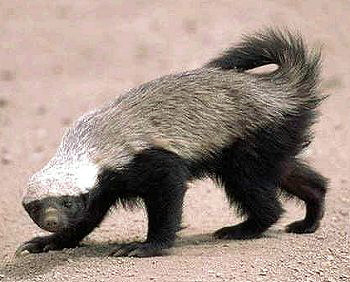 Honey BadgerMellivora capensis
-
 StoatMustela erminea
-
 Sea OtterEnhydra lutris
- SableMartes zibellina
-
 European Pine MartenMartes martes
-
 Least WeaselMustela nivalis
-
 European BadgerMeles meles
Compare
Questions and answers
What is the scientific name of the African Striped Weasel?
The scientific name of the African Striped Weasel is Poecilogale albinucha. Written with its author, the full name is Poecilogale albinucha (Gray, 1864).
Which family does the African Striped Weasel belong to?
Poecilogale albinucha belongs to the family Mustelidae, in the order Carnivora and the class Mammalia.
Where is the African Striped Weasel found?
Checklists and occurrence records place Poecilogale albinucha in 12 countries, including South Africa, Democratic Republic of the Congo, Uganda, Angola, Zambia and Zimbabwe.
What is the conservation status of the African Striped Weasel?
The IUCN Red List category recorded for Poecilogale albinucha is Least Concern (LC).
What other names does the African Striped Weasel have?
Poecilogale albinucha is also known in English as African Weasel, Snake Muishond, Snake Weasel, Striped Weasel and White-naped Weasel.
What is the diet of a weasel?
Rodents constitute the vast majority of the African Striped Weasel's diet. It occasionally eats birds and has also been reported to consume snakes and insects.[14][15][16]
Sources
Passages the profile rests on
- The white dorsal stripe can vary in captive individuals from light yellow to deep buff. Source passage: “In captive individuals, the white stripe color may vary from light yellow to deep buff.” — animaldiversity.org
- Adult head-and-body length ranges from 24 to 35 cm. Source passage: “Adults have a head-body length of 24 to 35 cm (9 to 14 in)” — English Wikipedia
- The tail measures approximately 13.8 to 21.5 cm in length. Source passage: “with the tail adding a further 13.8 to 21.5 cm (5 to 8 in).” — English Wikipedia
- Males are generally larger than females. Source passage: “This species exhibits sexual dimorphism, with males being larger than females.” — English Wikipedia
- Six males sampled in KwaZulu-Natal in 1978 had an average weight of 339 g. Source passage: “Six males sampled in KwaZulu-Natal in 1978 weighed an average of 339 g (12 oz)” — English Wikipedia
- Three males sampled in the former Cape Province in 1981 averaged 357 g. Source passage: “three sampled in the former Cape Province in 1981 had an average weight of 357 g (13 oz).” — English Wikipedia
- Females sampled in KwaZulu-Natal in 1978 averaged 251 g. Source passage: “251 g (9 oz) and 215 g (8 oz) were the average weights of females according to the same respective studies” — English Wikipedia
- Individuals from western Uganda have been reported to be slightly larger than those from eastern and southern areas. Source passage: “Individuals from western Uganda have been found to be slightly larger than those from areas further east and south.” — animaldiversity.org
- The species commonly inhabits savanna and veld grasslands containing termite mounds. Source passage: “It is often found in savannah and veld environments where termite mounds are present” — English Wikipedia
- The species has also been recorded in semideserts, rainforests, fynbos and pine plantations. Source passage: “However, the species appears to tolerate a wide range of habitats, having also been seen in semideserts, rainforests, fynbos and pine plantations” — English Wikipedia
- The species occurs in moist habitats receiving more than 60 cm of annual rainfall. Source passage: “It occurs in moist habitats with an annual rainfall of over 60 cm (24 in).” — English Wikipedia
- The species has been recorded in forest-edge, grassland and marsh environments. Source passage: “It has been found in forest edge, grassland, and marsh regions” — animaldiversity.org
- The species commonly lives below 1,500 m elevation but has occasionally been recorded at 2,200 m. Source passage: “It commonly lives below 1,500 m (4,921 ft) elevation, but may occasionally be found as high as 2,200 m (7,218 ft).” — English Wikipedia
- Rodents constitute the vast majority of the species' diet. Source passage: “with the vast majority of their diet consisting of rodents of their own size or smaller” — English Wikipedia
- The species occasionally eats birds. Source passage: “though they occasionally eat birds as well.” — English Wikipedia
- The species has also been reported to consume snakes and insects. Source passage: “It eats mainly small mammals (rodents, rats, mole rats, etc.) and birds, but also eats snakes and insects” — animaldiversity.org
- The species is primarily nocturnal. Source passage: “The African striped weasel is a mostly nocturnal animal” — English Wikipedia
- African striped weasels are generally solitary but sometimes occur in family groups of up to four individuals. Source passage: “African striped weasels are generally solitary, but may occasionally be seen in pairs or family groups of up to four individuals.” — English Wikipedia
- The weasel may release an odor from its anal glands when frightened or stressed. Source passage: “The animal will release an odor from its anal glands when it is attacked or under stress.” — animaldiversity.org
- The species may store captured prey in its burrow rather than eating it immediately. Source passage: “They sometimes store prey in their burrow instead of eating it immediately” — English Wikipedia
- The species obtains most of its moisture from its food and drinks water infrequently. Source passage: “They do not drink frequently, gaining most of their moisture requirements through their food.” — English Wikipedia
- The breeding season extends from spring to the end of summer. Source passage: “Breeding takes place from spring to the end of summer” — English Wikipedia
- Litters typically contain between two and three young. Source passage: “two to three young tend to be born per litter” — English Wikipedia
- The gestation period is approximately 30 days. Source passage: “after a gestation period of about 30 days.” — English Wikipedia
- The gestation period is reported to last 31 to 33 days. Source passage: “the gestation period is 31-33 days.” — animaldiversity.org
- Captive births have been recorded between September and April. Source passage: “Births of captive animals were found to occur from September to April” — animaldiversity.org
- Young are fully weaned at approximately 11 weeks of age. Source passage: “Young are fully weaned at about 11 weeks” — animaldiversity.org
- Young are nearly full grown by approximately 20 weeks of age. Source passage: “and nearly full grown at 20 weeks.” — animaldiversity.org
- Females may produce another litter during the same breeding season if their first litter is lost. Source passage: “If their first litter is lost, they will mate a second time in the season.” — animaldiversity.org
- The African striped weasel is often confused with the zorilla. Source passage: “It looks very similar to, and is often confused with, the zorilla” — animaldiversity.org
- The striped polecat is identified as the African striped weasel's closest living relative. Source passage: “Genetic analyses indicate that the closest living relative of the African striped weasel is the striped polecat” — English Wikipedia
- The species has been classified as Least Concern on the IUCN Red List since 1996. Source passage: “it has been listed as Least Concern on the IUCN Red List since 1996” — English Wikipedia
- The species is used in some local traditional medicine practices. Source passage: “though it is commonly used in local traditional medicine.” — English Wikipedia
- Some African communities use the species' skins in ceremonial costumes and ornaments. Source passage: “their skins are used by some African tribes in ceremonial costumes or ornaments.” — animaldiversity.org
- The species is used in rituals performed by shamans. Source passage: “They are also used in rituals performed by shamans” — animaldiversity.org
- The species provides a benefit to agriculture by killing rodents and other crop-damaging animals. Source passage: “The striped weasel is beneficial to humans because of the service they provide by killing rats, mice, springhares, locusts and their larvae, all of which may damage crops.” — animaldiversity.org
- The species may kill chickens raised by humans. Source passage: “The striped weasel may kill chickens that are being raised by humans” — animaldiversity.org
Data
- Catalogue of Life, 2026-10-16 XR cc by
- Global Biodiversity Information Facility CC BY 4.0
- Wikidata CC0
- GeoNames CC BY 4.0
- Wikimedia Commons per image; credit shown with each image
- Within the Catalogue of Life, this name comes from The Integrated Taxonomic Information System cc0
References
- Proc. Zool. Soc. Lond. vol.1864 p.69, plate X where the name was published
- Wilson, Don E., and DeeAnn M. Reeder, eds. (1993). Mammal Species of the World: A Taxonomic and Geographic Reference, 2nd Ed., 3rd Printing.
- Wilson, Don E., and F. Russell Cole. (2000). Common Names of Mammals of the World.
- Wilson, Don E., and DeeAnn M. Reeder, eds. (2005). Mammal Species of the World: A Taxonomic and Geographic Reference, 3rd Ed., Vols. 1 & 2.
- Larivière, S., and A. P. Jennings / Don E. Wilson and Russell A. Mittermeier, eds. (2009). Family Mustelidae (Weasels and relatives). Handbook of the Mammals of the World. Vol. 1: Carnivores.
- Kingdon, Jonathan, and Michael Hoffmann, eds. (2013). Mammals of Africa, Vol. 5: Carnivores, Pangolins, Equids and Rhinoceroses.
- Burgin, Connor J., Don E. Wilson, Russell A. Mittermeier, Anthony B. Rylands, et al. (2020). Illustrated Checklist of the Mammals of the World. Vol. 1. Monotremata to Rodentia.
This species in other databases
Page built on 28 November 2026. See how the catalog is made and all sources and licences.
Cite this page
ScientificNames.org. (2026). Poecilogale albinucha (African Striped Weasel). Retrieved November 28, 2026, from https://scientificnames.org/species/poecilogale-albinucha
“Poecilogale albinucha (African Striped Weasel).” ScientificNames.org, 2026, scientificnames.org/species/poecilogale-albinucha. Accessed 28 Nov. 2026.
ScientificNames.org. “Poecilogale albinucha (African Striped Weasel).” Accessed November 28, 2026. https://scientificnames.org/species/poecilogale-albinucha.
@misc{scientificnames_poecilogale_albinucha_african_striped_weasel,
  author = {{ScientificNames.org}},
  title = {Poecilogale albinucha (African Striped Weasel)},
  year = {2026},
  url = {https://scientificnames.org/species/poecilogale-albinucha},
  note = {Accessed 2026-11-28}
}