Species · Mammals
West African Oyan Poiana leightoni
The scientific name of the West African Oyan is Poiana leightoni. It is a species of mammal in the family Viverridae (oyans), order Carnivora. The name dates from 1908.
- Scientific name
- Poiana leightoni Pocock, 1908
- Common name
- West African Oyan
- Genus
- Poiana
- Family
- Viverridae (Oyans)
- Order
- Carnivora
- Class
- Mammalia
- Red List category
- VU Vulnerable
- Name status
- accepted in the Catalogue of Life

Overview
The West African Oyan is one of Africa's least-known small carnivores. It inhabits the canopy of tropical forests in West Africa and is native to the Upper Guinean forests. It has yellowish to reddish brown fur with dark spots and a tail marked by 10 to 12 dark rings.
Written 26 November 2026 from the sources listed below. Each statement was checked against the passage it cites; statements that could not be supported were removed.
Appearance
The West African Oyan has a slender, elongated body, an elongated head, and a pointed muzzle. Its fur ranges from yellowish to reddish brown, with dark oval-shaped spots on the neck and smaller spots on the back and legs.[1][2]
Its throat, chest, and belly are lighter in colour and lack spots. Its tail has between 10 and 12 dark rings.[3][4]
Its body measures 30–38 cm in length, and its tail measures 35–40 cm.[5][6]
Habitat
The West African Oyan inhabits the canopy of tropical forests in West Africa. It is native to the Upper Guinean forests of West Africa.[7][8]
Two records of the species in Ivory Coast date from the 1960s and 1970s. It was recorded at ten localities in Liberia between the 1960s and late 1980s.[9][10]
Its occurrence in Sierra Leone and Guinea is uncertain.[11]
Conservation
The West African Oyan is probably affected by habitat loss caused by tropical forest logging. Hunting for bushmeat is identified as a probable threat to the species.[12][13]
Classification of the West African Oyan
| Kingdom | Animalia |
|---|---|
| Phylum | Chordata |
| Subphylum | Vertebrata |
| Infraphylum | Gnathostomata |
| Parvphylum | Osteichthyes |
| Megaclass | Tetrapoda |
| Class | Mammalia (Mammal) |
| Subclass | Theria |
| Infraclass | Eutheria |
| Order | Carnivora (Carnivores) |
| Suborder | Feliformia (Cat-like Carnivores) |
| Family | Viverridae (Oyans) |
| Subfamily | Genettinae (Oyans) |
| Genus | Poiana (Oyans) |
| Species | Poiana leightoni Pocock, 1908 |
Where the West African Oyan is found
Checklists place Poiana leightoni in Africa.
Range as the checklists state it
Africa
A number beside a place is its count of GBIF occurrence records. A place without a number comes from a checklist alone. Records show where a species has been observed or collected, which can include escapes and vagrants.
Common names
English
- West African Oyan
- Leighton S Linsang
- Leighton's Linsang
- Leighton's Oyan
- West African Linsang
Names in 13 other languages
- Arabic
- لنسنغ غرب أفريقيا, لنسنغ ليتوني
- French
- Poiane d'Afrique occidentale, Poiane de Leighton, Poiane d’Afrique occidentale
- German
- West Afrika Linsang, Westafrikanischer Linsang
- Hungarian
- Nyugat-afrikai pojána
- Italian
- Linsango di Leighton
- Japanese
- レイトンリンサン
- Korean
- 라이톤린상
- Norwegian Bokmål
- Vestafrikansk Linsang
- Polish
- pojana zachodnioafrykańska
- Portuguese
- Oyan-da-África-Ocidental
- Russian
- Линзанг Лейтона
- Spanish
- Linsang de África Occidental, Oyán occidental
- Turkish
- Batı Afrika Oyanı
Synonyms
One other scientific name has been used for this species and is now treated as a synonym of Poiana leightoni.
- Poiana richardsonii liberiensis Pocock, 1908
Related species
-
 Central African OyanPoiana richardsonii
-
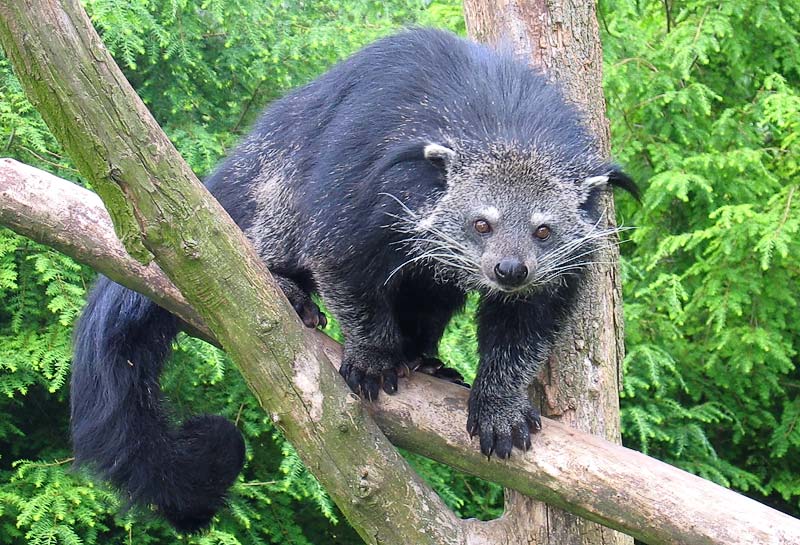 BinturongArctictis binturong
-
 Asian Palm CivetParadoxurus hermaphroditus
-
 African CivetCivettictis civetta
-
 Common GenetGenetta genetta
-
 Masked Palm CivetPaguma larvata
-
 Large Indian CivetViverra zibetha
-
 Malabar Large-spotted CivetViverra civettina
Compare
Questions and answers
What is the scientific name of the West African Oyan?
The scientific name of the West African Oyan is Poiana leightoni. Written with its author, the full name is Poiana leightoni Pocock, 1908.
Which family does the West African Oyan belong to?
Poiana leightoni belongs to the family Viverridae, in the order Carnivora and the class Mammalia.
What is the conservation status of the West African Oyan?
The IUCN Red List category recorded for Poiana leightoni is Vulnerable (VU).
What other names does the West African Oyan have?
Poiana leightoni is also known in English as Leighton S Linsang, Leighton's Linsang, Leighton's Oyan and West African Linsang.
What animals are native to West Africa?
The West African Oyan is native to the Upper Guinean forests of West Africa.[8]
Sources
Passages the profile rests on
- The species has a slender, elongated body, an elongated head, and a pointed muzzle. Source passage: “The West African oyan's body is slender and long, with an elongated head and a pointed muzzle.” — English Wikipedia
- Its fur ranges from yellowish to reddish brown and has dark oval-shaped spots on the neck and smaller spots on the back and legs. Source passage: “Its fur is yellowish to reddish brown with dark oval shaped spots on the neck, and small spots on the back and legs.” — English Wikipedia
- Its throat, chest, and belly are lighter in colour and lack spots. Source passage: “Its throat, chest and belly are lighter in colour and without spots.” — English Wikipedia
- Its tail has between 10 and 12 dark rings. Source passage: “Its tail has 10 to 12 dark rings.” — English Wikipedia
- Its body measures 30–38 cm in length. Source passage: “Its body is 30–38 cm (12–15 in) long” — English Wikipedia
- Its tail measures 35–40 cm in length. Source passage: “with a 35–40 cm (14–16 in) long tail.” — English Wikipedia
- The species inhabits the canopy of tropical forests in West Africa. Source passage: “The West African oyan inhabits the canopy of tropical forests in West Africa.” — English Wikipedia
- The species is native to the Upper Guinean forests of West Africa. Source passage: “The West African oyan (Poiana leightoni), also known as the West African linsang, is a linsang species native to the Upper Guinean forests in West Africa.” — English Wikipedia
- Two records of the species in Ivory Coast date from the 1960s and 1970s. Source passage: “Two known records in the Ivory Coast date to the 1960s and 1970s.” — English Wikipedia
- The species was recorded at ten localities in Liberia between the 1960s and late 1980s. Source passage: “In Liberia, it was recorded in ten localities between the 1960s and late 1980s.” — English Wikipedia
- Its occurrence in Sierra Leone and Guinea is uncertain. Source passage: “Its presence in Sierra Leone and Guinea is uncertain.” — English Wikipedia
- The species is probably affected by habitat loss caused by tropical forest logging. Source passage: “The West African oyan is probably affected by habitat loss due to logging of tropical forests” — English Wikipedia
- Hunting for bushmeat is identified as a probable threat to the species. Source passage: “and by hunting for bushmeat.” — English Wikipedia
Data
- Catalogue of Life, 2026-10-16 XR cc by
- Wikidata CC0
- Wikimedia Commons per image; credit shown with each image
- Within the Catalogue of Life, this name comes from The Integrated Taxonomic Information System cc0
References
- Proc. Zool. Soc. Lond. vol.1907 p.1043 where the name was published
- Wilson, Don E., and DeeAnn M. Reeder, eds. (2005). Mammal Species of the World: A Taxonomic and Geographic Reference, 3rd Ed., Vols. 1 & 2.
- Jennings, A. P., and G. Veron / Don E. Wilson and Russell A. Mittermeier, eds. (2009). Family Viverridae (Civets, Genets and Oyans). Handbook of the Mammals of the World. Vol. 1: Carnivores.
This species in other databases
Page built on 27 November 2026. See how the catalog is made and all sources and licences.
Cite this page
ScientificNames.org. (2026). Poiana leightoni (West African Oyan). Retrieved November 27, 2026, from https://scientificnames.org/species/poiana-leightoni
“Poiana leightoni (West African Oyan).” ScientificNames.org, 2026, scientificnames.org/species/poiana-leightoni. Accessed 27 Nov. 2026.
ScientificNames.org. “Poiana leightoni (West African Oyan).” Accessed November 27, 2026. https://scientificnames.org/species/poiana-leightoni.
@misc{scientificnames_poiana_leightoni_west_african_oyan,
  author = {{ScientificNames.org}},
  title = {Poiana leightoni (West African Oyan)},
  year = {2026},
  url = {https://scientificnames.org/species/poiana-leightoni},
  note = {Accessed 2026-11-27}
}