Species · Insects
Propomacrus bimucronatus
Propomacrus bimucronatus has no English name on record in the checklists used here. It is a species of insect in the family Scarabaeidae (dung beetles), order Coleoptera. The name dates from 1781.
- Scientific name
- Propomacrus bimucronatus (Pallas, 1781)
- Genus
- Propomacrus
- Family
- Scarabaeidae (Dung Beetles)
- Order
- Coleoptera
- Class
- Insecta
- Recorded in
- 10 countries
- Name status
- accepted in the Catalogue of Life

Overview
Propomacrus bimucronatus has an intermittent distribution in Cyprus, Greece, Iran, Israel, Syria, Turkey, and the southern and central Balkans. It is regarded as an ornamental insect because of its unusual appearance and ornamental value.
Written 28 November 2026 from the sources listed below. Each statement was checked against the passage it cites; statements that could not be supported were removed.
Habitat
The species belongs to a genus whose members are mainly found in alpine regions of Asia, the Near East and southeastern Europe.[1]
Diet
Adult Propomacrus bimucronatus feed on tree sap and rotten fruits. Its larvae feed on rotten wood and humus soil.[2][3]
Conservation
Propomacrus bimucronatus is classified as Near Threatened (NT) in the European Red List of Saproxylic Beetles.[4]
Uses
Propomacrus bimucronatus is regarded as an ornamental insect because of its unusual appearance and ornamental value.[5]
Similar species
Phylogenetic analyses place Propomacrus bimucronatus in the same branch as Propomacrus davidi, Cheirotonus jansoni and Cheirotonus gestroi.[6]
Classification of Propomacrus bimucronatus
| Kingdom | Animalia |
|---|---|
| Phylum | Arthropoda |
| Subphylum | Hexapoda |
| Class | Insecta (Insect) |
| Order | Coleoptera (Beetle) |
| Suborder | Polyphaga |
| Series | Staphyliniformia |
| Superfamily | Scarabaeoidea |
| Family | Scarabaeidae (Dung Beetles) |
| Subfamily | Melolonthinae |
| Tribe | Euchirini |
| Genus | Propomacrus |
| Species | Propomacrus bimucronatus (Pallas, 1781) |
Where Propomacrus bimucronatus is found
Checklists and occurrence records place Propomacrus bimucronatus in 10 countries across Asia and Europe. GBIF holds 90 georeferenced records of it.
Countries
Regions and cities with the most records
- İzmir Province, Turkey 7
- Karabağlar, Turkey 4
- Konak, Turkey 4
- Menderes, Turkey 4
- İzmir, Turkey 4
- Aradíppou, Cyprus 3
- Larnaca, Cyprus 3
- Larnaka, Cyprus 3
A number beside a place is its count of GBIF occurrence records. A place without a number comes from a checklist alone. Records show where a species has been observed or collected, which can include escapes and vagrants.
Common names
Names in 2 other languages
- German
- Türkische Langarmkäfer
- Japanese
- ヒメテナガコガネ
Synonyms
One other scientific name has been used for this species and is now treated as a synonym of Propomacrus bimucronatus.
- Scarabaeus bimucronatus Pallas, 1781
Subspecies and varieties
- Propomacrus bimucronatus bimucronatus subspecies
- Propomacrus bimucronatus cypriacus subspecies
Related species
- Propomacrus davidi
-
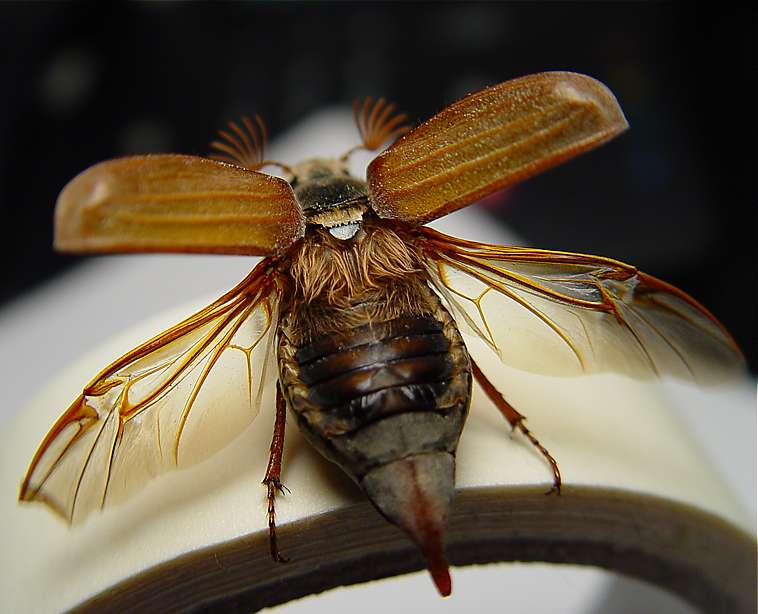 CockchaferMelolontha melolontha
-
 Hercules BeetleDynastes (Dynastes) hercules
-
 Japanese BeetlePopillia japonica
-
 Japanese Rhinoceros BeetleTrypoxylus dichotomus
-
 Sacred ScarabScarabaeus sacer
-
 Figeater BeetleCotinis (Cotinis) mutabilis
-
 Atlas BeetleChalcosoma atlas
Compare
Questions and answers
Sources
Passages the profile rests on
- The species belongs to a genus whose members are mainly found in alpine regions of Asia, the Near East and southeastern Europe. Source passage: “The species of Propomacrus are giant beetles, and mainly found in the alpine regions of Asia, the Near East and southeastern Europe” — pmc.ncbi.nlm.nih.gov
- Adult P. bimucronatus feed on tree sap and rotten fruits. Source passage: “The adults of P. davidi and P. bimucronatus feed on the sap of trees and rotten fruits.” — pmc.ncbi.nlm.nih.gov
- The larvae of P. bimucronatus feed on rotten wood and humus soil. Source passage: “The larvae feed on rotten wood and humus soil” — pmc.ncbi.nlm.nih.gov
- P. bimucronatus is classified as Near Threatened (NT) in the European Red List of Saproxylic Beetles. Source passage: “It was listed as Near Threatened (NT) in the European Red List of Saproxylic Beetles” — pmc.ncbi.nlm.nih.gov
- P. bimucronatus is regarded as an ornamental insect because of its unusual appearance and ornamental value. Source passage: “the two species are famous ornamental insects because of their peculiar appearance and good ornamental value” — pmc.ncbi.nlm.nih.gov
- Phylogenetic analyses place P. bimucronatus in the same branch as P. davidi, Cheirotonus jansoni and Cheirotonus gestroi. Source passage: “The results showed that P. davidi, P. bimucronatus, Cheirotonus jansoni and Cheirotonus gestroi clustered in the same branch” — pmc.ncbi.nlm.nih.gov
Data
- Catalogue of Life, 2026-10-16 XR cc by
- Global Biodiversity Information Facility CC BY 4.0
- Wikidata CC0
- GeoNames CC BY 4.0
- Wikimedia Commons per image; credit shown with each image
- Within the Catalogue of Life, this name comes from World Scarabaeidae Database cc by
References
- Pallas, P. S. (1781). Icones Insectorum praesertim Rossiae Siberiaeque pecularium quae collegit et Descriptionibus illustravit. Walther. Erlangae:1-96. https://doi.org/10.5962/bhl.title.15809 Link where the name was published
This species in other databases
Page built on 28 November 2026. See how the catalog is made and all sources and licences.
Cite this page
ScientificNames.org. (2026). Propomacrus bimucronatus. Retrieved November 28, 2026, from https://scientificnames.org/species/propomacrus-bimucronatus
“Propomacrus bimucronatus.” ScientificNames.org, 2026, scientificnames.org/species/propomacrus-bimucronatus. Accessed 28 Nov. 2026.
ScientificNames.org. “Propomacrus bimucronatus.” Accessed November 28, 2026. https://scientificnames.org/species/propomacrus-bimucronatus.
@misc{scientificnames_propomacrus_bimucronatus,
  author = {{ScientificNames.org}},
  title = {Propomacrus bimucronatus},
  year = {2026},
  url = {https://scientificnames.org/species/propomacrus-bimucronatus},
  note = {Accessed 2026-11-28}
}