Species · Insects
Pseudagolius coloradensis
Pseudagolius coloradensis has no English name on record in the checklists used here. It is a species of insect in the family Scarabaeidae (dung beetles), order Coleoptera. The name dates from 1870.
- Scientific name
- Pseudagolius coloradensis (Horn, 1870)
- Genus
- Pseudagolius
- Family
- Scarabaeidae (Dung Beetles)
- Order
- Coleoptera
- Class
- Insecta
- Recorded in
- 3 countries
- Name status
- accepted in the Catalogue of Life
Overview
The species occurs in Canada, the United States, and Mexico. Adults are approximately 6–7.5 mm long, with a convex, strongly shiny, hairless, piceous-brownish body and reddish-testaceous antennae.
Written 27 November 2026 from the sources listed below. Each statement was checked against the passage it cites; statements that could not be supported were removed.
Appearance
The adult body is convex, strongly shiny, hairless, and piceous-brownish in coloration. The antennae are reddish-testaceous.[1][2]
Adults measure approximately 6–7.5 mm in length.[3]
Habitat
In Canada, the species is recorded from Alberta, Manitoba, and Saskatchewan. In the United States, it is recorded from Arizona, Colorado, Iowa, New Mexico, North Dakota, and South Dakota.[4][5]
In Mexico, the species is recorded from Chihuahua, Coahuila, Distrito Federal, Durango, Guanajuato, Hidalgo, Jalisco, México, Michoacán, Nayarit, Oaxaca, Puebla, Querétaro, San Luis Potosí, Tlaxcala, Veracruz, and Zacatecas.[6]
Classification of Pseudagolius coloradensis
| Kingdom | Animalia |
|---|---|
| Phylum | Arthropoda |
| Subphylum | Hexapoda |
| Class | Insecta (Insect) |
| Order | Coleoptera (Beetle) |
| Suborder | Polyphaga |
| Series | Staphyliniformia |
| Superfamily | Scarabaeoidea |
| Family | Scarabaeidae (Dung Beetles) |
| Subfamily | Aphodiinae |
| Tribe | Aphodiini |
| Subtribe | Aphodiina |
| Genus | Pseudagolius |
| Species | Pseudagolius coloradensis (Horn, 1870) |
Where Pseudagolius coloradensis is found
Checklists and occurrence records place Pseudagolius coloradensis in 3 countries across North America. GBIF holds 750 georeferenced records of it.
Countries
Regions and cities with the most records
- Arizona, United States 487
- Colorado, United States 73
- New Mexico, United States 51
- Dakota Ridge, United States 49
- Golden, United States 49
- Ken Caryl, United States 49
- Lakewood, United States 49
- Arvada, United States 48
- Columbine, United States 48
- Englewood, United States 48
- Littleton, United States 48
- Wheat Ridge, United States 48
- Illinois, United States 18
- Flagstaff, United States 16
- Saskatchewan, Canada 16
- Champaign, United States 13
- Denver, United States 13
- Urbana, United States 13
- Durango, Mexico 12
- Green Valley, United States 12
- Hidalgo, Mexico 12
- Zacualtipán, Mexico 11
- Nogales, Mexico 10
- Nogales, United States 10
- Rio Rico, United States 10
- Nebraska, United States 9
- Texas, United States 9
- Durango, United States 8
- Danville, United States 5
- Jalisco, Mexico 5
- Manitoba, Canada 5
- Puebla, Mexico 5
- Sierra Vista, United States 5
- Zacatecas, Mexico 5
- California, United States 4
- Payson, United States 4
Range as the checklists state it
Nearctic(Canada: Alberta, Manitoba, Saskatchewan, USA:Arizona, Colorado, Iowa, New Mexico, North Dakota, South Dakota), Mexican Transition zone(Mexico:Chihuahua, Coahuila, Distrito Federal, Durango, Guanajuato, Hidalgo, Jalisco, México, Michoacán, Nayarit, Oaxaca, Puebla, Querétaro, San Luis Potosí, Tlaxcala, Veracruz, Zacatecas)
A number beside a place is its count of GBIF occurrence records. A place without a number comes from a checklist alone. Records show where a species has been observed or collected, which can include escapes and vagrants.
Synonyms
2 other scientific names have been used for this species and are now treated as synonyms of Pseudagolius coloradensis.
- Aphodius coloradensis Horn, 1870
- Aphodius flohri Bates, 1887
Related species
- Pseudagolius bicolor
- Pseudagolius caballeroi
- Pseudagolius warneri
-
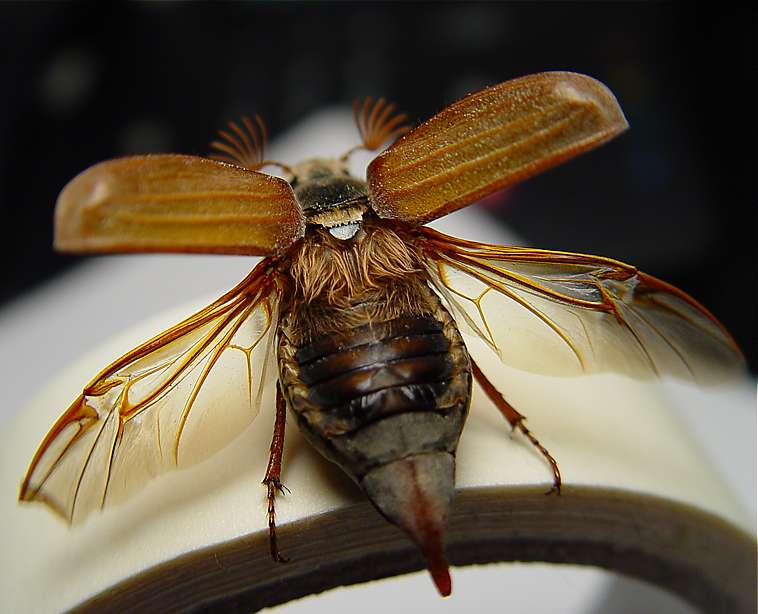 CockchaferMelolontha melolontha
-
 Hercules BeetleDynastes (Dynastes) hercules
-
 Japanese BeetlePopillia japonica
-
 Japanese Rhinoceros BeetleTrypoxylus dichotomus
-
 Sacred ScarabScarabaeus sacer
Compare
Questions and answers
How large are adults?
Adults measure approximately 6–7.5 mm in length.[3]
What is the adult's appearance?
The adult body is convex, strongly shiny, hairless, and piceous-brownish. The antennae are reddish-testaceous.[1][2]
Where does Pseudagolius coloradensis occur?
The species occurs in Canada, the United States, and Mexico.[7]
Sources
Passages the profile rests on
- The adult body is convex, strongly shiny, hairless, and piceous-brownish in coloration. Source passage: “They have a convex, strongly shiny, glabrous, piceous-brownish body” — English Wikipedia
- The antennae are reddish-testaceous. Source passage: “with the antennae reddish-testaceous.” — English Wikipedia
- Adults measure approximately 6–7.5 mm in length. Source passage: “Adults reach a length of about 6–7.5 mm (0.24–0.30 in).” — English Wikipedia
- In Canada, the species is recorded from Alberta, Manitoba, and Saskatchewan. Source passage: “Canada (Alberta, Manitoba, Saskatchewan)” — English Wikipedia
- In the United States, the species is recorded from Arizona, Colorado, Iowa, New Mexico, North Dakota, and South Dakota. Source passage: “the United States (Arizona, Colorado, Iowa, New Mexico, North Dakota, South Dakota)” — English Wikipedia
- In Mexico, the species is recorded from Chihuahua, Coahuila, Distrito Federal, Durango, Guanajuato, Hidalgo, Jalisco, México, Michoacán, Nayarit, Oaxaca, Puebla, Querétaro, San Luis Potosí, Tlaxcala, Veracruz, and Zacatecas. Source passage: “Mexico (Chihuahua, Coahuila, Distrito Federal, Durango, Guanajuato, Hidalgo, Jalisco, México, Michoacán, Nayarit, Oaxaca, Puebla, Querétaro, San Luis Potosí, Tlaxcala, Veracruz, Zacatecas).” — English Wikipedia
- Pseudagolius coloradensis occurs in Canada, the United States, and Mexico. Source passage: “It is found in Canada (Alberta, Manitoba, Saskatchewan), the United States (Arizona, Colorado, Iowa, New Mexico, North Dakota, South Dakota) and Mexico (Chihuahua, Coahuila, Distrito Federal, Durango, Guanajuato, Hidalgo, Jalisco, México, Michoacán, Nayarit, Oaxaca, Puebla, Querétaro, San Luis Potosí, Tlaxcala, Veracruz, Zacatecas).” — English Wikipedia
Data
- Catalogue of Life, 2026-10-16 XR cc by
- Global Biodiversity Information Facility CC BY 4.0
- Wikidata CC0
- GeoNames CC BY 4.0
- Within the Catalogue of Life, this name comes from World Scarabaeidae Database cc by
References
- Dellacasa, G., Bordat, P., & Dellacasa, M. (2001). A revisional essay of world genus-group taxa of Aphodiinae (Coleoptera: Aphodiidae). Memorie Della Società Entomologica Italiana, Genova 79:1-482. https://archive.org/download/revisionalessayv792dell/revisionalessayv792dell.pdf Link where the name was published
This species in other databases
Page built on 29 November 2026. See how the catalog is made and all sources and licences.
Cite this page
ScientificNames.org. (2026). Pseudagolius coloradensis. Retrieved November 29, 2026, from https://scientificnames.org/species/pseudagolius-coloradensis
“Pseudagolius coloradensis.” ScientificNames.org, 2026, scientificnames.org/species/pseudagolius-coloradensis. Accessed 29 Nov. 2026.
ScientificNames.org. “Pseudagolius coloradensis.” Accessed November 29, 2026. https://scientificnames.org/species/pseudagolius-coloradensis.
@misc{scientificnames_pseudagolius_coloradensis,
  author = {{ScientificNames.org}},
  title = {Pseudagolius coloradensis},
  year = {2026},
  url = {https://scientificnames.org/species/pseudagolius-coloradensis},
  note = {Accessed 2026-11-29}
}