Species · Fishes
Red-cheeked Fairy Basslet Pseudanthias huchtii
The scientific name of the Red-cheeked Fairy Basslet is Pseudanthias huchtii. It is a species of fish in the family Anthiadidae (anthiases), order Perciformes. The name dates from 1857.
- Scientific name
- Pseudanthias huchtii (Bleeker, 1857)
- Common name
- Red-cheeked Fairy Basslet
- Genus
- Pseudanthias
- Family
- Anthiadidae (Anthiases)
- Order
- Perciformes
- Class
- Teleostei
- Red List category
- LC Least Concern
- Environment
- marine
- Recorded in
- 8 countries
- Name status
- accepted in the Catalogue of Life

Overview
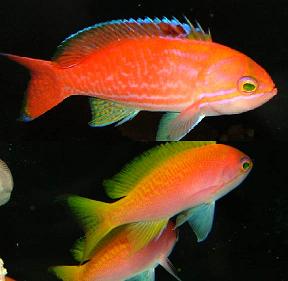
The Red-cheeked Fairy Basslet occurs in the Western Central Pacific Ocean, where it inhabits aggregations around coral reef drop-offs. Males have an orange stripe extending from the eye to the centre of the pectoral fin and a broad maroon band along the forward margin of the pelvic fin.
Written 27 November 2026 from the sources listed below. Each statement was checked against the passage it cites; statements that could not be supported were removed.
Habitat
The species occurs in the Western Central Pacific Ocean. Its range extends from the Maluku Islands and the Philippines eastward to Vanuatu, reaches the Great Barrier Reef in the Tasman Sea to the south, and extends as far as Palau in Micronesia to the east.[1][2][3][4]
The species also occurs at Scott Reef and the Ashmore Reefs in the Timor Sea. It inhabits aggregations around drop-offs near the outer crests of coral reefs.[5][6]
Appearance
Males have an orange stripe extending from the eye to the centre of the pectoral fin. They also have a broad maroon band along the forward margin of the pelvic fin.[7][8]
The dorsal fin has 10 spines and 17 soft rays. The anal fin has 3 spines and 7 soft rays.[9][10]
Behaviour
The species forms aggregations around coral reef drop-offs. It interacts with Pseudanthias squamipinnis.[11][12]
The species is a nonandric protogynous hermaphrodite, with all individuals initially developing as females. Males defend territories and guard harems of females.[13][14]
Reproduction and life cycle
The largest and most dominant females change sex to become males.[15]
Uses
The species is described as aggressive and occurs infrequently in the aquarium trade.[16][17]
Classification of the Red-cheeked Fairy Basslet
| Kingdom | Animalia |
|---|---|
| Phylum | Chordata |
| Subphylum | Vertebrata |
| Infraphylum | Gnathostomata |
| Parvphylum | Osteichthyes |
| Gigaclass | Actinopterygii |
| Superclass | Actinopteri |
| Class | Teleostei (Teleost) |
| Order | Perciformes |
| Suborder | Percoidei |
| Family | Anthiadidae (Anthiases) |
| Genus | Pseudanthias (Typical Indo-Pacific Anthiases and Goldies) |
| Species | Pseudanthias huchtii (Bleeker, 1857) |
Where the Red-cheeked Fairy Basslet is found
Checklists and occurrence records place Pseudanthias huchtii in 8 countries. GBIF holds 956 georeferenced records of it.
Countries
- Australia 37
- Indonesia 404
- Malaysia 26
- Palau 14
- Papua New Guinea 31
- Philippines 380
- Solomon Islands 33
- Timor Leste 31
Regions and cities with the most records
- Danao, Philippines 36
- Dumaguete, Philippines 36
- Bauan, Philippines 28
- San Pascual, Philippines 27
- Sibulan, Philippines 26
- Amlapura, Indonesia 24
- Amlapura city, Indonesia 24
- Batangas, Philippines 24
- Bedugul, Indonesia 24
- Taal, Philippines 23
- Guihulñgan, Philippines 21
- Wongsorejo, Indonesia 18
- Tagbilaran City, Philippines 17
- Bali, Indonesia 14
- Sabah, Malaysia 10
- Dili, Timor Leste 9
- Daanbantayan, Philippines 8
- Klungkung, Indonesia 7
- Bitung, Indonesia 6
- Cebu City, Philippines 6
- Lapu-Lapu City, Philippines 6
- Mandaue City, Philippines 6
- Sumbawa Besar, Indonesia 6
- Jetafe, Philippines 5
- Manado, Indonesia 5
- Romblon, Philippines 5
- Ambon, Indonesia 4
- Calapan, Philippines 4
- Labuan Bajo, Indonesia 4
- Rosario, Philippines 4
- Apas, Philippines 3
- Consolacion, Philippines 3
- Davao, Philippines 3
- Guadalcanal Province, Solomon Islands 3
- Honiara, Solomon Islands 3
- Inabanga, Philippines 3
A number beside a place is its count of GBIF occurrence records. A place without a number comes from a checklist alone. Records show where a species has been observed or collected, which can include escapes and vagrants.
Common names
English
- Red-cheeked Fairy Basslet
- Hucht's Fairy Basslet
- Hucht's Sea Perch
- Pacific Basslet
- Pink Pacific Basslet
- Red-cheeked Anthia
- Red-cheeked Anthias
- Threadfin Anthias
Names in 8 other languages
- Catalan
- Anthias verd
- Chinese
- 赫氏擬花鮨
- Czech
- bradáč rudolící
- French
- Anthias verdâtre
- Italian
- Anthias di Hutch, Anthias guancia rossa
- Portuguese
- Anthias-da-Melanésia, Anthias-esverdeado
- Spanish
- Anthias de Cachetes Rosados
- sgd
- Lapu-lapu
Synonyms
5 other scientific names have been used for this species and are now treated as synonyms of Pseudanthias huchtii.
- Anthias huchtii Bleeker, 1857
- Anthias hutchii Bleeker, 1857
- Anthias mortoni MacLeay, 1883
- Pseudanthias huchti (Bleeker, 1857)
- Pseudoanthias huchti (Bleeker, 1857)
Related species
-
 Sea GoldiePseudanthias squamipinnis
-
 Squarespot AnthiasPseudanthias pleurotaenia
-
 Red-belted AnthiasPseudanthias rubrizonatus
-
 Two-spot BassletPseudanthias bimaculatus
-
 Red-bar AnthiasPseudanthias cooperi
-
 Pink Sea-perchPseudanthias hypselosoma
- Orange-headed AnthiasPseudanthias heemstrai
- Hawaiian AnthiasPseudanthias thompsoni
Compare
Questions and answers
What is the scientific name of the Red-cheeked Fairy Basslet?
The scientific name of the Red-cheeked Fairy Basslet is Pseudanthias huchtii. Written with its author, the full name is Pseudanthias huchtii (Bleeker, 1857).
Which family does the Red-cheeked Fairy Basslet belong to?
Pseudanthias huchtii belongs to the family Anthiadidae, in the order Perciformes and the class Teleostei.
Where is the Red-cheeked Fairy Basslet found?
Checklists and occurrence records place Pseudanthias huchtii in 8 countries, including Indonesia, Philippines, Australia, Solomon Islands, Papua New Guinea and Timor Leste.
What is the conservation status of the Red-cheeked Fairy Basslet?
The IUCN Red List category recorded for Pseudanthias huchtii is Least Concern (LC).
What other names does the Red-cheeked Fairy Basslet have?
Pseudanthias huchtii is also known in English as Hucht's Fairy Basslet, Hucht's Sea Perch, Pacific Basslet, Pink Pacific Basslet, Red-cheeked Anthia and Red-cheeked Anthias.
Sources
Passages the profile rests on
- The species occurs in the Western Central Pacific Ocean. Source passage: “It comes from the Western Central Pacific Ocean.” — English Wikipedia
- Its Western Pacific range extends from the Maluku Islands and the Philippines eastward to Vanuatu. Source passage: “from the Maluku Islands and the Philippines east to Vanuatu,” — English Wikipedia
- Its southern distribution reaches the Great Barrier Reef in the Tasman Sea. Source passage: “south as far the Great Barrier Reef in the Tasman Sea,” — English Wikipedia
- Its eastern distribution extends as far as Palau in Micronesia. Source passage: “their distribution extends as far east as Palau in Micronesia.” — English Wikipedia
- The species occurs in aggregations around drop-offs near the outer crests of coral reefs. Source passage: “found in aggregations at drop offs around the outer crests of coral reefs.” — English Wikipedia
- The species occurs at Scott Reef and the Ashmore Reefs in the Timor Sea. Source passage: “as well as the Scott Reef and the Ashmore Reefs in the Timor Sea” — English Wikipedia
- Males have an orange stripe extending from the eye to the centre of the pectoral fin. Source passage: “The males possess an obvious orange stripe which runs from their eye to the centre of their pectoral fin” — English Wikipedia
- Males have a broad maroon band along the forward margin of the pelvic fin. Source passage: “a broad maroon band on the forward margin of the pelvic fin.” — English Wikipedia
- The dorsal fin has 10 spines and 17 soft rays. Source passage: “There are 10 spines in the dorsal fin and 17 soft rays” — English Wikipedia
- The anal fin has 3 spines and 7 soft rays. Source passage: “the anal fin contains 3 spines and 7 soft rays.” — English Wikipedia
- The species forms aggregations around coral reef drop-offs. Source passage: “found in aggregations at drop offs around the outer crests of coral reefs.” — English Wikipedia
- The species interacts with Pseudanthias squamipinnis. Source passage: “They will interact with Pseudanthias squamipinnis.” — English Wikipedia
- The species is a nonandric protogynous hermaphrodite, with all individuals initially developing as females. Source passage: “they are nonandric protogynous hermaphrodites in which all the fish are born female” — English Wikipedia
- Males defend territories and guard harems of females. Source passage: “The males are territorial and guard a harem of females.” — English Wikipedia
- The largest and most dominant females change sex to become males. Source passage: “the largest and most dominant females will change sex to become males.” — English Wikipedia
- The species occasionally appears in the aquarium trade. Source passage: “It occasionally makes its way into the aquarium trade.” — English Wikipedia
- The species is described as aggressive and occurs infrequently in the aquarium trade. Source passage: “This is an aggressive species and infrequently appears in the aquarium trade.” — English Wikipedia
Data
- Catalogue of Life, 2026-10-16 XR cc by
- Global Biodiversity Information Facility CC BY 4.0
- Wikidata CC0
- GeoNames CC BY 4.0
- Wikimedia Commons per image; credit shown with each image
- Within the Catalogue of Life, this name comes from World Register of Marine Species cc by
References
- Bleeker, P. (1857) Achtste bijdrage tot de kennis der vischfauna van Amboina. Acta Societatis Regiae Scientiarum Indo- Neerlandicae, 2 (Art. 7), 1 - 102. where the name was published
This species in other databases
- Catalogue of Life 4NKNK
- Wikidata Q3233570
- iNaturalist 179885
- WoRMS urn:lsid:marinespecies.org:taxname:277458
- ITIS 643360
Page built on 29 November 2026. See how the catalog is made and all sources and licences.
Cite this page
ScientificNames.org. (2026). Pseudanthias huchtii (Red-cheeked Fairy Basslet). Retrieved November 29, 2026, from https://scientificnames.org/species/pseudanthias-huchtii
“Pseudanthias huchtii (Red-cheeked Fairy Basslet).” ScientificNames.org, 2026, scientificnames.org/species/pseudanthias-huchtii. Accessed 29 Nov. 2026.
ScientificNames.org. “Pseudanthias huchtii (Red-cheeked Fairy Basslet).” Accessed November 29, 2026. https://scientificnames.org/species/pseudanthias-huchtii.
@misc{scientificnames_pseudanthias_huchtii_red_cheeked_fairy_basslet,
  author = {{ScientificNames.org}},
  title = {Pseudanthias huchtii (Red-cheeked Fairy Basslet)},
  year = {2026},
  url = {https://scientificnames.org/species/pseudanthias-huchtii},
  note = {Accessed 2026-11-29}
}