Species · Fishes
Sea Goldie Pseudanthias squamipinnis
The scientific name of the Sea Goldie is Pseudanthias squamipinnis. It is a species of fish in the family Anthiadidae (anthiases), order Perciformes. The name dates from 1855.
- Scientific name
- Pseudanthias squamipinnis (Peters, 1855)
- Common name
- Sea Goldie
- Genus
- Pseudanthias
- Family
- Anthiadidae (Anthiases)
- Order
- Perciformes
- Class
- Teleostei
- Red List category
- LC Least Concern
- Environment
- marine
- Recorded in
- 37 countries
- Name status
- accepted in the Catalogue of Life

Overview
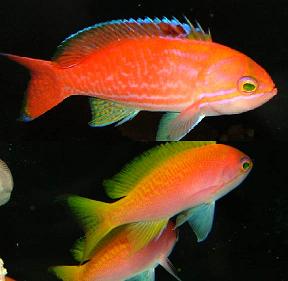
Pseudanthias squamipinnis occurs in the western Indian Ocean, including the Red Sea, and in the Pacific Ocean eastward to Japan, the Great Barrier Reef, and southeast Australia. Females are orange or gold with a violet streak below the eye, while males are fuchsia-colored with an elongated third dorsal-fin ray, a red pectoral-fin patch, and elongated tail margins.
Written 26 November 2026 from the sources listed below. Each statement was checked against the passage it cites; statements that could not be supported were removed.
Diet
The Sea Goldie feeds primarily on zooplankton.[1]
Behaviour
A male typically maintains a harem of five to ten females. The species often occurs in very large schools above reefs and is often found in association with Chromis dimidiata.[2][3][4]
Reproduction and life cycle
The Sea Goldie is a protogynous hermaphrodite. When the male dies or leaves, the largest and most dominant female undergoes hormonal and physical changes to become the new male.[5][6]
The transition from female to male can take several weeks to several months. Spawning occurs at sunset in the Red Sea between December and February.[7][8]
Appearance
Female individuals are orange or gold and have a violet streak below the eye. They reach a maximum length of 7 cm.[9][10]
Male individuals are fuchsia-colored and have an elongated third dorsal-fin ray, a red pectoral-fin patch, and elongated tail margins. They reach a maximum length of 15 cm.[11][12]
Habitat
The Sea Goldie inhabits areas around coral outcrops in clear lagoons, patch reefs, and steep slopes. It is absent from the Persian Gulf, Hawaii, and Oman.[13][14]
Uses
The Sea Goldie is traded in the aquarium industry.[15]
Classification of the Sea Goldie
| Kingdom | Animalia |
|---|---|
| Phylum | Chordata |
| Subphylum | Vertebrata |
| Infraphylum | Gnathostomata |
| Parvphylum | Osteichthyes |
| Gigaclass | Actinopterygii |
| Superclass | Actinopteri |
| Class | Teleostei (Teleost) |
| Order | Perciformes |
| Suborder | Percoidei |
| Family | Anthiadidae (Anthiases) |
| Genus | Pseudanthias (Typical Indo-Pacific Anthiases and Goldies) |
| Species | Pseudanthias squamipinnis (Peters, 1855) |
Where the Sea Goldie is found
Checklists and occurrence records place Pseudanthias squamipinnis in 37 countries. GBIF holds 4,833 georeferenced records of it.
Countries
- Australia 562
- British Indian Ocean Territory 21
- Comoros 38
- Egypt 1,509
- Fiji 19
- India 8
- Indonesia 63
- Iran 3
- Israel 110
- Japan 695
- Jordan 33
- Kenya 25
- Madagascar 27
- Malaysia 17
- Maldives 249
- Mauritius 14
- Mayotte 53
- Mozambique 52
- New Caledonia 66
- Palau 11
- Papua New Guinea 13
- Philippines 171
- Reunion 72
- Saudi Arabia 210
- Seychelles 141
- Solomon Islands 6
- South Africa 324
- South Korea 24
- Sri Lanka 21
- Sudan 21
- Taiwan 108
- Tanzania 46
- Thailand 11
- Timor Leste 3
- Tonga 78
- Vanuatu 6
- Wallis and Futuna 3
Regions and cities with the most records
- Sharm el-Sheikh, Egypt 188
- Hurghada, Egypt 163
- Aqaba, Jordan 145
- Eilat, Israel 145
- Safaga, Egypt 127
- Scottburgh, South Africa 90
- eMkhomazi, South Africa 89
- eMuziwezinto, South Africa 89
- Coffs Harbour, Australia 68
- Al Quşayr, Egypt 55
- New South Wales, Australia 54
- KwaZulu-Natal, South Africa 51
- Dzaoudzi, Mayotte 49
- Mamoudzou, Mayotte 49
- Kaouéni, Mayotte 48
- Koungou, Mayotte 48
- Labattoir, Mayotte 44
- Southern District, Israel 31
- Ḩaql, Saudi Arabia 30
- Kagoshima, Japan 29
- Durban, South Africa 24
- Saint-Leu, Reunion 22
- Seogwipo, South Korea 22
- Male, Maldives 21
- Pinetown, South Africa 21
- Nishinoomote, Japan 19
- Ntuzuma, South Africa 17
- Victoria, Seychelles 17
- Hendala, Sri Lanka 16
- Hengchun, Taiwan 16
- Ja Ela, Sri Lanka 16
- Kandana, Sri Lanka 16
- Katunayaka, Sri Lanka 16
- Negombo, Sri Lanka 16
- Peliyagoda, Sri Lanka 16
- Wattala, Sri Lanka 16
1 more country has a few records outside this range
These countries hold a few records of Pseudanthias squamipinnis but lie outside the range the checklists give for it. Such records are often zoo or garden specimens, museum material or vagrants, so the species is not counted as occurring there.
A number beside a place is its count of GBIF occurrence records. A place without a number comes from a checklist alone. Records show where a species has been observed or collected, which can include escapes and vagrants.
Common names
English
- Sea Goldie
- Goldie
- Indian Ocean Lyretail Anthias
- Lyretail Anthias
- Lyretail Coralfish
- Lyretail Fairy Basslet
- Onestripe Goldie
- Orange Basslet
- Orange Fairy Basslet
- Orange Seaperch
- Rainbow
- Red Coral Perch
- Scalefin Basslet
- Scalefin Fairy Basslet
- Scalefin Anthias
Names in 17 other languages
- Catalan
- Anthias daurat
- Chinese
- 絲鰭擬花鮨, 金擬花鱸
- Czech
- bradáč šupinoploutvý
- Danish
- Juvel-fanebars
- Dutch
- Rode Vlaggenbaars
- French
- Anthias commun, Anthias à queue de lyre, Barbier commun, Barbier rouge
- German
- Juwelen-Fahnenbarsch
- Hebrew
- פזית ים סוף
- Italian
- Anthias coda a lira, Pesce lancere coda a lira
- Japanese
- キンギョハナダイ
- Mandarin Chinese
- 過魚
- Polish
- Papużak Łuskopłetwy
- Portuguese
- Anthias-dourado
- Spanish
- Anthias Naranja de Coral, Tres colas dorado indico
- Thai
- ปลากะรังจิ๋วสีทอง
- Turkish
- hani baligi
- div
- ކަށިކެޔޮމަސް
Synonyms
10 other scientific names have been used for this species and are now treated as synonyms of Pseudanthias squamipinnis.
- Anthias cheirospilos Bleeker, 1857
- Anthias lepidolepis Bleeker, 1857
- Anthias sqamipinnis (Peters, 1855)
- Anthias squamipinnis (Peters, 1855)
- Anthias squammipinnis (Peters, 1855)
- Franzia squamipinnis (Peters, 1855)
- Pseudanthias squammipinnis (Peters, 1855)
- Pseudantthias squamipinnis (Peters, 1855)
- Pseudoanthias squamipinnis (Peters, 1855)
- Serranus squamipinnis Peters, 1855
Related species
-
 Squarespot AnthiasPseudanthias pleurotaenia
-
 Red-belted AnthiasPseudanthias rubrizonatus
-
 Two-spot BassletPseudanthias bimaculatus
-
 Red-bar AnthiasPseudanthias cooperi
-
 Red-cheeked Fairy BassletPseudanthias huchtii
-
 Pink Sea-perchPseudanthias hypselosoma
- Orange-headed AnthiasPseudanthias heemstrai
- Hawaiian AnthiasPseudanthias thompsoni
Compare
Questions and answers
What is the scientific name of the Sea Goldie?
The scientific name of the Sea Goldie is Pseudanthias squamipinnis. Written with its author, the full name is Pseudanthias squamipinnis (Peters, 1855).
Which family does the Sea Goldie belong to?
Pseudanthias squamipinnis belongs to the family Anthiadidae, in the order Perciformes and the class Teleostei.
Where is the Sea Goldie found?
Checklists and occurrence records place Pseudanthias squamipinnis in 37 countries, including Egypt, Japan, Australia, South Africa, Maldives and Saudi Arabia.
What is the conservation status of the Sea Goldie?
The IUCN Red List category recorded for Pseudanthias squamipinnis is Least Concern (LC).
What other names does the Sea Goldie have?
Pseudanthias squamipinnis is also known in English as Goldie, Indian Ocean Lyretail Anthias, Lyretail Anthias, Lyretail Coralfish, Lyretail Fairy Basslet and Onestripe Goldie.
Sources
Passages the profile rests on
- The species feeds primarily on zooplankton. Source passage: “The sea goldie feeds primarily on zooplankton.” — English Wikipedia
- A male typically maintains a harem of five to ten females. Source passage: “a male retains a harem of five to 10 females” — English Wikipedia
- The species often occurs in very large schools above reefs. Source passage: “They are often found in very large schools above the reef.” — English Wikipedia
- The species is often found in association with Chromis dimidiata. Source passage: “often found in the company of Chromis dimidiata.” — English Wikipedia
- The species is a protogynous hermaphrodite. Source passage: “Like other anthias, the sea goldie is a protogynous hermaphrodite;” — English Wikipedia
- When the male dies or leaves, the largest and most dominant female undergoes hormonal and physical changes to become the new male. Source passage: “when the male dies or leaves, the largest and most dominant female will undergo hormonal and physical changes to become the harems new male.” — English Wikipedia
- The transition from female to male can take several weeks to several months. Source passage: “This change can take several weeks to months to complete.” — English Wikipedia
- Spawning occurs at sunset in the Red Sea between December and February. Source passage: “Spawning occurs at sunset, between December and February (in the Red Sea).” — English Wikipedia
- Female individuals are orange or gold and have a violet streak below the eye. Source passage: “Female: Length up to 7 cm (2.75 in), orange/gold color with violet streak below the eye” — English Wikipedia
- Females reach a maximum length of 7 cm. Source passage: “Female: Length up to 7 cm (2.75 in)” — English Wikipedia
- Male individuals are fuchsia-colored and have an elongated third dorsal-fin ray, a red pectoral-fin patch, and elongated tail margins. Source passage: “Male: Length up to 15 cm (5.9 in), fuchsia color with elongated third ray of the dorsal fin, a red patch on the pectoral fin, and elongated margins of the tail” — English Wikipedia
- Males reach a maximum length of 15 cm. Source passage: “Male: Length up to 15 cm (5.9 in)” — English Wikipedia
- The species inhabits areas around coral outcrops in clear lagoons, patch reefs, and steep slopes. Source passage: “The fish lives around coral outcrops in clear lagoons, patch reefs, and steep slopes” — English Wikipedia
- The species is absent from the Persian Gulf, Hawaii, and Oman. Source passage: “It is absent from the Persian Gulf, Hawaii, and Oman.” — English Wikipedia
- The species is traded in the aquarium industry. Source passage: “It is found in the aquarium trade.” — English Wikipedia
Data
- Catalogue of Life, 2026-10-16 XR cc by
- Global Biodiversity Information Facility CC BY 4.0
- Wikidata CC0
- GeoNames CC BY 4.0
- Wikimedia Commons per image; credit shown with each image
- Within the Catalogue of Life, this name comes from World Register of Marine Species cc by
References
- Peters, W. (C. H.) (1855) Ubersicht der in Mossambique beobachteten Seefische. Bericht uber die zur Bekanntmachung geeigneten Ferhandlungen der Koniglichen Preussischen Akademie der Wissenschaften zu Berlin, 1855, 428 - 466. where the name was published
This species in other databases
- Catalogue of Life 4NKPQ
- Wikidata Q1051716
- iNaturalist 127530
- WoRMS urn:lsid:marinespecies.org:taxname:218278
- ITIS 643378
Page built on 28 November 2026. See how the catalog is made and all sources and licences.
Cite this page
ScientificNames.org. (2026). Pseudanthias squamipinnis (Sea Goldie). Retrieved November 28, 2026, from https://scientificnames.org/species/pseudanthias-squamipinnis
“Pseudanthias squamipinnis (Sea Goldie).” ScientificNames.org, 2026, scientificnames.org/species/pseudanthias-squamipinnis. Accessed 28 Nov. 2026.
ScientificNames.org. “Pseudanthias squamipinnis (Sea Goldie).” Accessed November 28, 2026. https://scientificnames.org/species/pseudanthias-squamipinnis.
@misc{scientificnames_pseudanthias_squamipinnis_sea_goldie,
  author = {{ScientificNames.org}},
  title = {Pseudanthias squamipinnis (Sea Goldie)},
  year = {2026},
  url = {https://scientificnames.org/species/pseudanthias-squamipinnis},
  note = {Accessed 2026-11-28}
}