Species · Fishes
Red-belted Anthias Pseudanthias rubrizonatus
The scientific name of the Red-belted Anthias is Pseudanthias rubrizonatus. It is a species of fish in the family Anthiadidae (anthiases), order Perciformes. The name dates from 1983.
- Scientific name
- Pseudanthias rubrizonatus (Randall, 1983)
- Common name
- Red-belted Anthias
- Genus
- Pseudanthias
- Family
- Anthiadidae (Anthiases)
- Order
- Perciformes
- Class
- Teleostei
- Red List category
- LC Least Concern
- Environment
- marine
- Recorded in
- 12 countries
- Name status
- accepted in the Catalogue of Life

Overview
Pseudanthias rubrizonatus occurs across the Indo-Pacific, from the Andaman Sea to Fiji and from southern Japan to Australia and the Great Barrier Reef. Males are distinguished by a broad vertical red bar separating the yellow posterior body from the yellow caudal fin.
Written 27 November 2026 from the sources listed below. Each statement was checked against the passage it cites; statements that could not be supported were removed.
Uses
Red-belted Anthias is traded for the aquarium industry.[1][2]
Similar species
Pseudanthias rubrizonatus is similar in appearance to Pseudanthias connelli from South Africa.[3]
Appearance
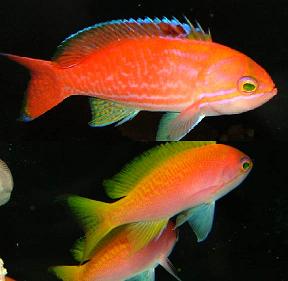
Males have pinkish to pinkish-orange coloration at the front of the body and are often bright yellow toward the rear and on the caudal fin. A broad vertical red bar separates the yellow posterior body coloration from the yellow caudal fin.[4][5]
Males have a lilac stripe extending from below the eye to the lower part of the pectoral-fin base. The dorsal fin and outer caudal-fin lobes have lilac margins.[6][7]
Females have a violet stripe instead of the lilac stripe found in males, and their caudal-fin lobes are red. Their bodies are reddish-pink, paler on the underside, with a dark spot on each scale.[8][9][10]
Juveniles have lavender-colored tips on their dorsal-fin spines.[11]
The dorsal fin has 10 spines and 16 soft rays. The anal fin has 3 spines and 7 soft rays.[12][13]
The species reaches a maximum total length of 12 cm.[14]
Habitat
Red-belted Anthias occurs at depths ranging from 3 to 152 metres. It forms aggregations around isolated coral heads and patches of rubble.[15][16]
Juveniles may occur in harbors and over silted coral reefs.[17]
Diet
Red-belted Anthias normally feeds on zooplankton and also opportunistically feeds on fish.[18][19]
Behaviour
Red-belted Anthias forms large shoals with smaller social subdivisions called harems. A typical harem consists of one male and several females.[20][21]
Females within a harem maintain a social hierarchy.[22]
Reproduction and life cycle
Red-belted Anthias is a protogynous hermaphrodite. When the male dies or disappears, the most dominant female changes sex.[23][24]
Conservation
Red-belted Anthias appears in the aquarium trade.[1]
Classification of the Red-belted Anthias
| Kingdom | Animalia |
|---|---|
| Phylum | Chordata |
| Subphylum | Vertebrata |
| Infraphylum | Gnathostomata |
| Parvphylum | Osteichthyes |
| Gigaclass | Actinopterygii |
| Superclass | Actinopteri |
| Class | Teleostei (Teleost) |
| Order | Perciformes |
| Suborder | Percoidei |
| Family | Anthiadidae (Anthiases) |
| Genus | Pseudanthias (Typical Indo-Pacific Anthiases and Goldies) |
| Species | Pseudanthias rubrizonatus (Randall, 1983) |
Where the Red-belted Anthias is found
Checklists and occurrence records place Pseudanthias rubrizonatus in 12 countries. GBIF holds 692 georeferenced records of it.
Countries
- Australia 379
- China 7
- Hong Kong 18
- Indonesia 5
- Japan 214
- New Caledonia 7
- Palau 3
- Papua New Guinea 4
- Philippines 21
- Solomon Islands 17
- Taiwan 12
- Thailand 5
Regions and cities with the most records
- Kagoshima, Japan 57
- Tarumizu, Japan 57
- Fushimi, Japan 30
- Izunokuni, Japan 30
- Kamizawa, Japan 30
- Mishima, Japan 30
- Nakatogari, Japan 30
- Numazu, Japan 30
- Susono, Japan 29
- Izu, Japan 27
- Ijūin, Japan 25
- Shuzenji, Japan 25
- Fuji, Japan 24
- Kagoshima, Japan 21
- Sunshine Coast, Australia 20
- Hang Hau, Hong Kong 17
- LOHAS Park, Hong Kong 17
- Siu Sai Wan Estate, Hong Kong 17
- Tiu Keng Leng, Hong Kong 17
- Sai Kung, Hong Kong 16
- Tseung Kwan O, Hong Kong 16
- Heng Fa Chuen, Hong Kong 14
- Kajiki, Japan 12
- Hamanoichi, Japan 11
- Shek O, Hong Kong 11
- Laguna City, Hong Kong 10
- Lam Tin, Hong Kong 10
- New South Wales, Australia 10
- Sau Mau Ping, Hong Kong 10
- Yau Tong, Hong Kong 10
- Aldrich Bay, Hong Kong 9
- Braemar Hill, Hong Kong 9
- Chek Chue, Hong Kong 9
- City Garden, Hong Kong 9
- Fortress Hill, Hong Kong 9
- Hok Yuen, Hong Kong 9
A number beside a place is its count of GBIF occurrence records. A place without a number comes from a checklist alone. Records show where a species has been observed or collected, which can include escapes and vagrants.
Common names
English
- Red-belted Anthias
- Deepsea Fairy Basslet
- Lilac-tip Basslet
- Lilac-tipped Basslet
- Lilac-tipped Seaperch
- Red-band Basslet
- Redband Anthias
- Redbar Anthias
Names in 7 other languages
- Catalan
- Anthias de barra vermella
- Chinese
- 海金魚, 紅帶擬花鮨, 紅帶擬花鱸, 紅魚, 花鱸
- Czech
- bradáč rudoskvrnný
- French
- Anthias coraline
- Japanese
- アカオビハナダイ
- Mandarin Chinese
- 過魚
- Portuguese
- Anthias-de-recife-profundo
Synonyms
2 other scientific names have been used for this species and are now treated as synonyms of Pseudanthias rubrizonatus.
- Anthias rubrizonatus Randall, 1983
- Anthisa rubrizonatus Randall, 1983
Related species
-
 Sea GoldiePseudanthias squamipinnis
-
 Squarespot AnthiasPseudanthias pleurotaenia
-
 Two-spot BassletPseudanthias bimaculatus
-
 Red-bar AnthiasPseudanthias cooperi
-
 Red-cheeked Fairy BassletPseudanthias huchtii
-
 Pink Sea-perchPseudanthias hypselosoma
- Orange-headed AnthiasPseudanthias heemstrai
- Fairy BassPseudanthias thompsoni
Compare
Questions and answers
What is the scientific name of the Red-belted Anthias?
The scientific name of the Red-belted Anthias is Pseudanthias rubrizonatus. Written with its author, the full name is Pseudanthias rubrizonatus (Randall, 1983).
Which family does the Red-belted Anthias belong to?
Pseudanthias rubrizonatus belongs to the family Anthiadidae, in the order Perciformes and the class Teleostei.
Where is the Red-belted Anthias found?
Checklists and occurrence records place Pseudanthias rubrizonatus in 12 countries, including Australia, Japan, Philippines, Hong Kong, Solomon Islands and Taiwan.
What is the conservation status of the Red-belted Anthias?
The IUCN Red List category recorded for Pseudanthias rubrizonatus is Least Concern (LC).
What other names does the Red-belted Anthias have?
Pseudanthias rubrizonatus is also known in English as Deepsea Fairy Basslet, Lilac-tip Basslet, Lilac-tipped Basslet, Lilac-tipped Seaperch, Red-band Basslet and Redband Anthias.
Sources
Passages the profile rests on
- The species appears in the aquarium trade. Source passage: “This species appears in the aquarium trade.” — English Wikipedia
- The species is traded for the aquarium industry. Source passage: “This species appears in the aquarium trade.” — English Wikipedia
- Pseudanthias rubrizonatus is similar in appearance to Pseudanthias connelli from South Africa. Source passage: “It is similar in appearance to Pseudanthias connelli of South Africa.” — English Wikipedia
- Males have pinkish to pinkish-orange coloration at the front of the body and are often bright yellow toward the rear and on the caudal fin. Source passage: “Males of this species are pinkish to pinkish orange at the anterior end of the body and are frequently bright yellow on the posterior of the body and on the caudal fin” — English Wikipedia
- Males have a broad vertical red bar separating the yellow posterior body coloration from the yellow caudal fin. Source passage: “these two areas being separated by a wide red, vertical bar.” — English Wikipedia
- Males have a lilac stripe extending from below the eye to the lower part of the pectoral-fin base. Source passage: “There is a lilac-colored stripe which runs from below the eye to the lower part of pectoral-fin base” — English Wikipedia
- Males have lilac margins on the dorsal fin and outer caudal-fin lobes. Source passage: “the dorsal fin has a lilac margin, as do the outer lobes of the caudal fin.” — English Wikipedia
- Females have a violet stripe instead of the lilac stripe found in males. Source passage: “in females, the stripe mentioned above is violet” — English Wikipedia
- Female caudal-fin lobes are red. Source passage: “the caudal-fin lobes are red.” — English Wikipedia
- Females have reddish-pink bodies that are paler on the underside, with a dark spot on each scale. Source passage: “In terms of body coloration, females are reddish pink, paler ventrally, and each scale has a dark spot in it.” — English Wikipedia
- Juveniles have lavender-colored tips on their dorsal-fin spines. Source passage: “Juveniles show lavender tips to the spines in the dorsal fin.” — English Wikipedia
- The dorsal fin has 10 spines and 16 soft rays. Source passage: “The dorsal fin of this species has 10 spines and 16 soft rays” — English Wikipedia
- The anal fin has 3 spines and 7 soft rays. Source passage: “while the anal fin has 3 spines and 7 soft rays” — English Wikipedia
- The species reaches a maximum total length of 12 cm. Source passage: “the maximum total length is 12 cm (4.7 in).” — English Wikipedia
- The species occurs at depths ranging from 3 to 152 metres. Source passage: “Pseuadanthias rubrizonatus is found at depths of 3–152 m (9.8–498.7 ft)” — English Wikipedia
- The species forms aggregations around isolated coral heads and patches of rubble. Source passage: “in aggregations around isolated coral heads and patches of rubble.” — English Wikipedia
- Juveniles may occur in harbors and over silted coral reefs. Source passage: “Juveniles may also be found in harbors and over silted coral reefs.” — English Wikipedia
- The species normally feeds on zooplankton. Source passage: “This species normally feeds on zooplankton” — English Wikipedia
- The species also opportunistically feeds on fish. Source passage: “but is opportunistically piscivorous.” — English Wikipedia
- The species forms large shoals with smaller social subdivisions called harems. Source passage: “fish of this species shoal in large numbers, although there are more intimate subdivisions within a shoal. Each of such subdivision is called "harem"” — English Wikipedia
- A typical harem consists of one male and several females. Source passage: “typically consists of one male and several females.” — English Wikipedia
- Females within a harem maintain a social hierarchy. Source passage: “The females have a hierarchy among themselves” — English Wikipedia
- The species is a protogynous hermaphrodite. Source passage: “Pseuadanthias rubrizonatus is a protogynous hermaphrodite.” — English Wikipedia
- When the male dies or disappears, the most dominant female changes sex. Source passage: “when the male dies or disappears, the most dominant female changes sex.” — English Wikipedia
Data
- Catalogue of Life, 2026-10-16 XR cc by
- Global Biodiversity Information Facility CC BY 4.0
- Wikidata CC0
- GeoNames CC BY 4.0
- Wikimedia Commons per image; credit shown with each image
- Within the Catalogue of Life, this name comes from World Register of Marine Species cc by
References
- Randall, J. E. (1983) A new fish of the genus Anthias (Perciformes: Serranidae) from the western Pacific, with notes on A. luzonensis. Freshwater and Marine Aquarium, 6 (9), 27 - 37. where the name was published
This species in other databases
- Catalogue of Life 4NKPK
- Wikidata Q930640
- iNaturalist 424259
- WoRMS urn:lsid:marinespecies.org:taxname:277477
- ITIS 643375
Page built on 27 November 2026. See how the catalog is made and all sources and licences.
Cite this page
ScientificNames.org. (2026). Pseudanthias rubrizonatus (Red-belted Anthias). Retrieved November 27, 2026, from https://scientificnames.org/species/pseudanthias-rubrizonatus
“Pseudanthias rubrizonatus (Red-belted Anthias).” ScientificNames.org, 2026, scientificnames.org/species/pseudanthias-rubrizonatus. Accessed 27 Nov. 2026.
ScientificNames.org. “Pseudanthias rubrizonatus (Red-belted Anthias).” Accessed November 27, 2026. https://scientificnames.org/species/pseudanthias-rubrizonatus.
@misc{scientificnames_pseudanthias_rubrizonatus_red_belted_anthias,
  author = {{ScientificNames.org}},
  title = {Pseudanthias rubrizonatus (Red-belted Anthias)},
  year = {2026},
  url = {https://scientificnames.org/species/pseudanthias-rubrizonatus},
  note = {Accessed 2026-11-27}
}