Species · Birds
White Hawk Pseudastur albicollis
The scientific name of the White Hawk is Pseudastur albicollis. It is a species of bird in the family Accipitridae (hawks), order Accipitriformes. The name dates from 1790.
- Scientific name
- Pseudastur albicollis (Latham, 1790)
- Common name
- White Hawk
- Genus
- Pseudastur
- Family
- Accipitridae (Hawks)
- Order
- Accipitriformes
- Class
- Aves
- Red List category
- LC Least Concern
- Environment
- terrestrial
- Recorded in
- 18 countries
- Name status
- accepted in the Catalogue of Life
Overview
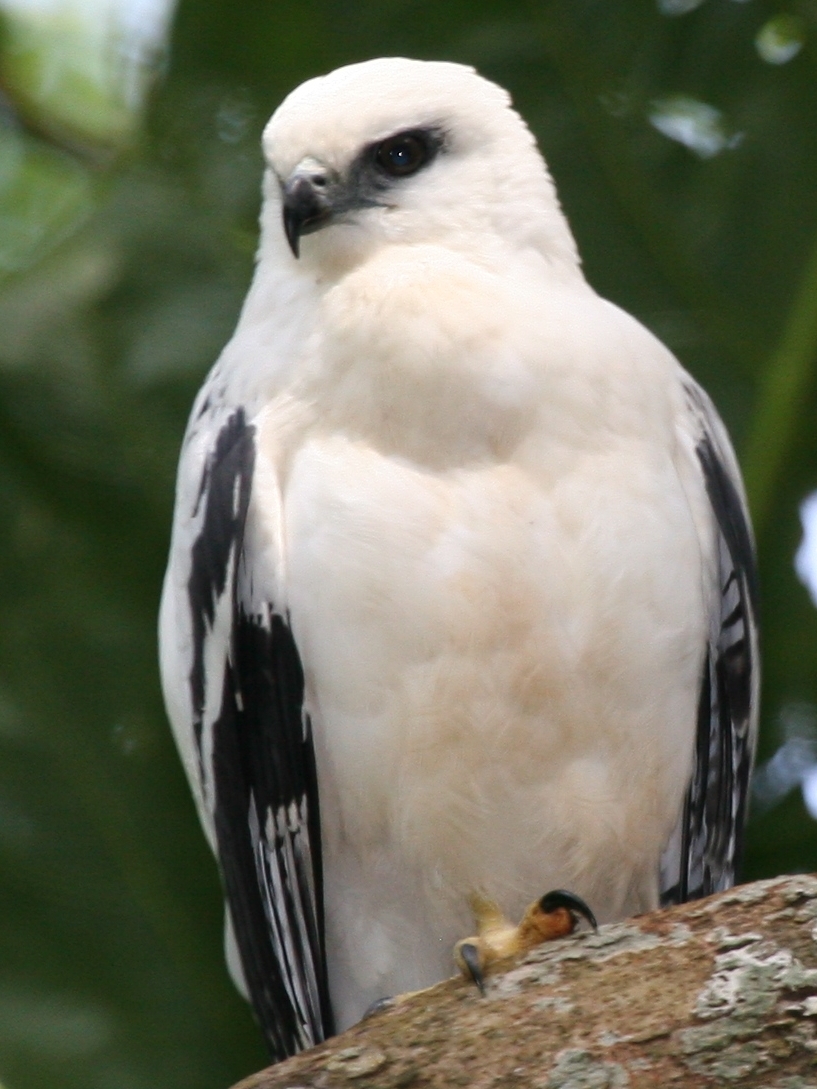
Pseudastur albicollis inhabits lowland tropical forests and other woodland environments. Adults have white heads, bodies, and underwings, black upper wings, a short black tail with a broad white band, a black bill, and yellow legs.
Written 26 November 2026 from the sources listed below. Each statement was checked against the passage it cites; statements that could not be supported were removed.
Appearance
Adult White Hawks have white heads, bodies, and underwings, with black upper wings and a short black tail bearing a broad white band. They have black bills and yellow legs.[1][2]
Females are larger and heavier than males. Adults measure 46–56 cm in length and have very broad wings; females weigh approximately 840 g, compared with approximately 650 g for males.[3][4][5][6]
Immature White Hawks have extensive black spotting on their upperparts and dark streaks on their whitish underparts.[7]
The subspecies Pseudastur albicollis ghiesbreghti is almost entirely white, apart from black markings on its outer primary feathers and a black sub-terminal tail bar. Pseudastur albicollis costaricensis has more distinct black markings on its wings and tail.[8][9]
Pseudastur albicollis williaminae has heavily black-marked wing feathers and black streaks on its crown and collar. Pseudastur albicollis albicollis has mostly black wings with white markings and a black tail band extending to the tail base.[10][11]
All four described subspecies are mainly white when viewed from below. Pseudastur albicollis albicollis is smaller than the northern subspecies.[12][13]
Habitat
White Hawks inhabit lowland forests and other woodland environments, including lowland tropical forests.[14][15]
Diet
White Hawks feed mainly on reptiles, including lizards and snakes. They also consume insects such as beetles and grasshoppers.[16][17]
Their additional food includes crabs, amphibians, and mammals. Recorded mammalian prey includes rats, squirrels, small opossums, and bats.[18][19]
White Hawks have been documented feeding on keel-billed toucans, mottled owls, white-breasted wood wrens, and great tinamous. They have also been observed feeding on young and weak birds.[20][21]
They may occasionally consume fish.[22]
Behaviour
White Hawks capture prey by making sorties from perches. They also associate with foraging groups of tufted capuchin monkeys and South American coatis to catch prey disturbed by these animals.[23][24]
White Hawks are often observed soaring or perching quietly in the forest canopy, usually soaring in mid-to-late morning. They perform aerial courtship displays.[25][26][27]
White Hawks are widespread but are usually not common within their range.[28]
Reproduction and life cycle
White Hawks construct large platform nests made of sticks in trees. They usually lay one blue-white egg with dark blotches.[29][30]
An attended White Hawk nest was observed in Ecuador in mid-August.[31]
Conservation
The IUCN does not consider the White Hawk globally threatened because of its extensive geographic range.[32]
Classification of the White Hawk
| Kingdom | Animalia |
|---|---|
| Phylum | Chordata |
| Subphylum | Vertebrata |
| Infraphylum | Gnathostomata |
| Parvphylum | Osteichthyes |
| Megaclass | Tetrapoda |
| Class | Aves (Bird) |
| Order | Accipitriformes (Hawks) |
| Family | Accipitridae (Hawks) |
| Genus | Pseudastur (Pseudastur Hawks) |
| Species | Pseudastur albicollis (Latham, 1790) |
Where the White Hawk is found
Checklists and occurrence records place Pseudastur albicollis in 18 countries across North America and South America. GBIF holds 46,398 georeferenced records of it.
Countries
- Belize 8,424
- Bolivia 293
- Brazil 1,907
- Colombia 966
- Costa Rica 17,826
- Ecuador 1,102
- El Salvador 26
- French Guiana 479
- Guatemala 1,036
- Guyana 381
- Honduras 945
- Mexico 2,188
- Nicaragua 247
- Panama 5,768
- Peru 851
- Suriname 640
- Trinidad and Tobago 2,488
- Venezuela 831
Regions and cities with the most records
- Alajuela Province, Costa Rica 9,365
- Cayo District, Belize 6,485
- San Ignacio, Belize 4,100
- Puntarenas Province, Costa Rica 4,001
- Paradise, Trinidad and Tobago 2,109
- Arima, Trinidad and Tobago 2,090
- Tunapuna, Trinidad and Tobago 2,069
- Tunapuna/Piarco, Trinidad and Tobago 1,897
- Chiapas, Mexico 1,397
- Belmopan, Belize 1,226
- Panamá, Panama 1,215
- Limón Province, Costa Rica 1,202
- Alcalde Díaz, Panama 1,106
- Guanacaste Province, Costa Rica 1,047
- Heredia Province, Costa Rica 999
- Chilibre, Panama 944
- San José, Costa Rica 936
- Panamá Oeste Province, Panama 912
- Coclé, Panama 911
- Darién, Panama 891
- Stann Creek, Belize 802
- Colón, Panama 766
- Guápiles, Costa Rica 749
- Quesada, Costa Rica 723
- Orange Walk District, Belize 712
- Amazonas, Brazil 675
- Pará, Brazil 567
- Atlántida Department, Honduras 555
- Petén, Guatemala 484
- San Miguelito, Panama 474
- Panama City, Panama 463
- Chiriquí Province, Panama 419
- Veracruz, Mexico 419
- Orellana Province, Ecuador 416
- Toledo District, Belize 392
- Sipaliwini District, Suriname 370
Range as the checklists state it
Middle America
South America
Caribbean
A number beside a place is its count of GBIF occurrence records. A place without a number comes from a checklist alone. Records show where a species has been observed or collected, which can include escapes and vagrants.
Common names
English
- White Hawk
Names in 27 other languages
- Arabic
- باز أبيض, صقر أبيض
- Catalan
- aligot blanc
- Chinese
- 白南美鵟, 白領南美鵟
- Croatian
- bijeli škanjac
- Czech
- káně pralesní
- Danish
- Hvid Våge
- Dutch
- Grote Bonte Buizerd
- Esperanto
- blanka buteo
- Estonian
- valge-selvaviu
- Finnish
- valkohaukka
- French
- Buse blanche
- German
- Schneebussard
- Hungarian
- fehér erdeiölyv
- Italian
- Poiana bianca
- Japanese
- シロノスリ
- Lithuanian
- baltasis keršasis suopis
- Norwegian
- hvitvåk
- Polish
- białostrząb duży
- Portuguese
- bútio-branco, gavião-branco
- Russian
- Белая агуйла, Белый пегий канюк
- Serbian
- Zapadni beli mišar
- Slovak
- myšiak biely
- Spanish
- Aguililla blanca, Busardo blanco, gavilán blanco
- Swedish
- vitvråk
- Turkish
- Beyaz Şahin
- Ukrainian
- канюк білий
- gcr
- Paganni
Synonyms
4 other scientific names have been used for this species and are now treated as synonyms of Pseudastur albicollis.
- Falco albicollis Latham, 1790
- Falco poecilonotus Cuvier, GLCFD
- Falco skotopterus Wied-Neuwied, M, 1830
- Leucopternis albicollis (Latham, 1790)
Subspecies and varieties
- Pseudastur albicollis albicollis (Amazonian White Hawk) subspecies
- Pseudastur albicollis costaricensis (Costa Rican White Hawk) subspecies
- Pseudastur albicollis ghiesbreghti (Snowy White Hawk) subspecies
- Pseudastur albicollis williaminae (Colombian White Hawk) subspecies
Related species
-
 Mantled HawkPseudastur polionotus
-
 Grey-backed HawkPseudastur occidentalis
-
 Bald EagleHaliaeetus leucocephalus
-
 Golden EagleAquila chrysaetos
-
 Haast's EagleHarpagornis moorei
-
 Harpy EagleHarpia harpyja
-
 Bearded VultureGypaetus barbatus
-
 Red-tailed HawkButeo jamaicensis
Compare
Questions and answers
What is the scientific name of the White Hawk?
The scientific name of the White Hawk is Pseudastur albicollis. Written with its author, the full name is Pseudastur albicollis (Latham, 1790).
Which family does the White Hawk belong to?
Pseudastur albicollis belongs to the family Accipitridae, in the order Accipitriformes and the class Aves.
Where is the White Hawk found?
Checklists and occurrence records place Pseudastur albicollis in 18 countries, including Costa Rica, Belize, Panama, Trinidad and Tobago, Mexico and Brazil.
What is the conservation status of the White Hawk?
The IUCN Red List category recorded for Pseudastur albicollis is Least Concern (LC).
How rare is it to see a white hawk?
White Hawks are widespread but are usually not common within their range.[28]
Sources
Passages the profile rests on
- Adult white hawks have white heads, bodies, and underwings, with black upper wings and a short black tail bearing a broad white band. Source passage: “has a white head, body and underwings. The upper wings are black, and the very short tail is black with a broad white band.” — English Wikipedia
- The species has a black bill and yellow legs. Source passage: “The bill is black and the legs are yellow.” — English Wikipedia
- Female white hawks are larger and heavier than males. Source passage: “The sexes are similar, but females are larger and heavier” — English Wikipedia
- Adult white hawks measure 46–56 cm in length. Source passage: “The adult white hawk ranges from 46–56 cm (18–22 in) long” — English Wikipedia
- Adult white hawks have very broad wings. Source passage: “with very broad wings” — English Wikipedia
- Female white hawks weigh approximately 840 g, compared with approximately 650 g for males. Source passage: “840 g (1.85 lb) compared to the male's 650 g (1.43 lb).” — English Wikipedia
- Immature white hawks have extensive black spotting on their upperparts and dark streaks on their whitish underparts. Source passage: “Immature birds have extensive black spotting on the upperparts and dark-streaked whitish underparts.” — English Wikipedia
- The subspecies Pseudastur albicollis ghiesbreghti is almost entirely white, apart from black markings on its outer primary feathers and a black sub-terminal tail bar. Source passage: “Entirely white, except for black markings on the outer primaries, and a black sub-terminal tail bar.” — English Wikipedia
- The subspecies Pseudastur albicollis costaricensis has more distinct black markings on its wings and tail than P. a. ghiesbreghti. Source passage: “Similar to ghiesbreghti but with more distinct black markings on the wings and tail.” — English Wikipedia
- The subspecies Pseudastur albicollis williaminae has heavily black-marked wing feathers and black streaks on its crown and collar. Source passage: “Wing feathers are more heavily marked with black, and it has black streaks on the crown and collar.” — English Wikipedia
- The subspecies Pseudastur albicollis albicollis has mostly black wings with white markings and a black tail band extending to the tail base. Source passage: “the wings are mostly black, with white markings. The black tail band extends to the base of the tail” — English Wikipedia
- All four described subspecies are mainly white when viewed from below. Source passage: “All subspecies look mainly white from below.” — English Wikipedia
- The subspecies Pseudastur albicollis albicollis is smaller than the northern subspecies. Source passage: “Smaller than the northern forms” — English Wikipedia
- White hawks inhabit lowland forests and other woodland environments. Source passage: “This is a bird of lowland forest and other woodlands.” — English Wikipedia
- White hawks occur in lowland tropical forests. Source passage: “Spectacular, broad-winged, short-tailed hawk of lowland tropical forest.” — ebird.org
- White hawks feed mainly on reptiles, including lizards and snakes. Source passage: “The white hawk feeds mainly on reptiles (such as lizards and snakes, including the eastern coral snake)” — English Wikipedia
- White hawks also consume insects, including beetles and grasshoppers. Source passage: “with some insects (such as beetles and grasshoppers)” — English Wikipedia
- White hawks additionally eat crabs, amphibians, and mammals. Source passage: “crabs, amphibians and mammals” — English Wikipedia
- Recorded mammalian prey includes rats, squirrels, small opossums, and bats. Source passage: “including rats, squirrels, small opossums and bats” — English Wikipedia
- White hawks have been documented feeding on keel-billed toucans, mottled owls, white-breasted wood wrens, and great tinamous. Source passage: “including the keel-billed toucan, the mottled owl, the white-breasted wood wren and the great tinamou.” — English Wikipedia
- White hawks have been observed feeding on young and weak birds. Source passage: “They may feed on young and weak birds, as well.” — English Wikipedia
- White hawks may occasionally consume fish. Source passage: “there is some evidence that this hawk may occasionally feed on fish.” — English Wikipedia
- White hawks capture prey by making sorties from perches. Source passage: “caught in a sortie from a perch.” — English Wikipedia
- White hawks associate with foraging groups of tufted capuchin monkeys and South American coatis to catch prey disturbed by these animals. Source passage: “It associates with foraging groups of tufted capuchin monkeys (Cebus apella) and South American coatis (Nasua nasua) to snatch prey startled by these animals.” — English Wikipedia
- White hawks are often observed soaring. Source passage: “This species is often seen soaring” — English Wikipedia
- White hawks perform spectacular aerial courtship displays. Source passage: “has a spectacular aerial courtship display.” — English Wikipedia
- White hawks are usually observed soaring in mid-to-late morning or perching quietly in the forest canopy. Source passage: “Usually seen soaring in mid-late morning or perched quietly in the forest canopy.” — ebird.org
- White hawks are widespread but are usually not common within their range. Source passage: “A widespread species, it is usually not common” — English Wikipedia
- White hawks construct large platform nests made of sticks in trees. Source passage: “It builds a large stick platform nest in a tree” — English Wikipedia
- White hawks usually lay one blue-white egg with dark blotches. Source passage: “usually lays one dark-blotched blue-white egg.” — English Wikipedia
- An attended white hawk nest was observed in Ecuador in mid-August. Source passage: “An attended nest was observed in Ecuador in mid-August.” — English Wikipedia
- The IUCN does not consider the white hawk globally threatened because of its extensive geographic range. Source passage: “the IUCN considers it not to be globally threatened due to the large extent of its range.” — English Wikipedia
Data
- Catalogue of Life, 2026-10-16 XR cc by
- Global Biodiversity Information Facility CC BY 4.0
- Wikidata CC0
- GeoNames CC BY 4.0
- Wikimedia Commons per image; credit shown with each image
- Within the Catalogue of Life, this name comes from The Integrated Taxonomic Information System cc0
References
- Index Ornithol., 1: 36. 1790 where the name was published
This species in other databases
Page built on 29 November 2026. See how the catalog is made and all sources and licences.
Cite this page
ScientificNames.org. (2026). Pseudastur albicollis (White Hawk). Retrieved November 29, 2026, from https://scientificnames.org/species/pseudastur-albicollis
“Pseudastur albicollis (White Hawk).” ScientificNames.org, 2026, scientificnames.org/species/pseudastur-albicollis. Accessed 29 Nov. 2026.
ScientificNames.org. “Pseudastur albicollis (White Hawk).” Accessed November 29, 2026. https://scientificnames.org/species/pseudastur-albicollis.
@misc{scientificnames_pseudastur_albicollis_white_hawk,
  author = {{ScientificNames.org}},
  title = {Pseudastur albicollis (White Hawk)},
  year = {2026},
  url = {https://scientificnames.org/species/pseudastur-albicollis},
  note = {Accessed 2026-11-29}
}