Species · Other invertebrates
Florida Hermit Crab Sponge Pseudospongosorites suberitoides
The scientific name of the Florida Hermit Crab Sponge is Pseudospongosorites suberitoides. It is a species of animal in the family Suberitidae, order Suberitida. The name dates from 1993.
- Scientific name
- Pseudospongosorites suberitoides (Diaz, van Soest & Pomponi, 1993)
- Common name
- Florida Hermit Crab Sponge
- Genus
- Pseudospongosorites
- Family
- Suberitidae
- Order
- Suberitida
- Class
- Demospongiae
- Environment
- marine
- Recorded in
- 3 countries
- Name status
- accepted in the Catalogue of Life
Overview
The Florida Hermit Crab Sponge, Pseudospongosorites suberitoides, is an invertebrate classified in the family Suberitidae, order Suberitida, and class Demospongiae. It occurs in the Caribbean Sea, the Gulf of Mexico, and along the Atlantic coast of the United States as far north as North Carolina. It is notable for engulfing gastropod shells and forming expanding chambers that shelter resident hermit crabs.
Written 28 November 2026 from the sources listed below. Each statement was checked against the passage it cites; statements that could not be supported were removed.
Appearance
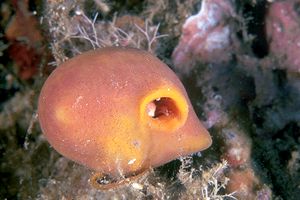
The Florida Hermit Crab Sponge has a smooth, waxy texture and is slightly compressible. It can grow to more than 10 centimeters in length.[1][2]
It typically occurs in green, brown, or tan colors, while approximately 10% of specimens are bright orange. Dead, dried specimens washed onto beaches are often turquoise-blue.[3][4]
Habitat
The species usually inhabits shallow waters near shore. It may be especially abundant along the shores of Apalachee Bay in northwestern Florida.[5][6]
The sponge colonizes gastropod shells, particularly those belonging to the genus Cantharus. It usually settles on empty shells but can also colonize living gastropods.[7][8]
Behaviour
The sponge initially grows as a thin crust before progressively engulfing the gastropod shell. It can continue growing around a shell occupied by a hermit crab.[9][10]
As the sponge engulfs the shell, the resident hermit crab moves into a chamber within the sponge. The chamber follows the spiral shape of the crab's abdomen and expands as the crab grows.[11][12]
The resident hermit crab shapes and maintains an opening in the sponge chamber.[13]
Reproduction and life cycle
All recorded specimens contain gemmules, structures that are unusual among marine sponges.[14]
Similar species
The species was initially classified in the genus Suberites because of its superficial resemblance and similar ecology. It was named in 1993 as a member of the genus Spongosorites.[15][16]
Genetic research conducted in 2002 led to the establishment of its current genus classification. Pseudospongosorites suberitoides is the only species currently recognized in its genus.[17][18][19]
Classification of the Florida Hermit Crab Sponge
| Kingdom | Animalia |
|---|---|
| Phylum | Porifera |
| Class | Demospongiae (Demosponge) |
| Subclass | Heteroscleromorpha |
| Order | Suberitida |
| Family | Suberitidae |
| Genus | Pseudospongosorites |
| Species | Pseudospongosorites suberitoides (Diaz, van Soest & Pomponi, 1993) |
Where the Florida Hermit Crab Sponge is found
Checklists and occurrence records place Pseudospongosorites suberitoides in 3 countries. GBIF holds 30 georeferenced records of it.
Countries
A number beside a place is its count of GBIF occurrence records. A place without a number comes from a checklist alone. Records show where a species has been observed or collected, which can include escapes and vagrants.
Common names
English
- Florida Hermit Crab Sponge
Synonyms
One other scientific name has been used for this species and is now treated as a synonym of Pseudospongosorites suberitoides.
- Spongosorites suberitoides Diaz, van Soest & Pomponi, 1993
Related species
-
 Hermit Crab SpongeSuberites domuncula
- Aaptos aaptos
- Orange SpongeSuberites ficus
-
 Homaxinella balfourensis
- Terpios hoshinota
- Aaptos vannamei
- Aaptos suberitoides
- Aaptos durissima
Compare
Questions and answers
What is the scientific name of the Florida Hermit Crab Sponge?
The scientific name of the Florida Hermit Crab Sponge is Pseudospongosorites suberitoides. Written with its author, the full name is Pseudospongosorites suberitoides (Diaz, van Soest & Pomponi, 1993).
Which family does the Florida Hermit Crab Sponge belong to?
Pseudospongosorites suberitoides belongs to the family Suberitidae, in the order Suberitida and the class Demospongiae.
Where is the Florida Hermit Crab Sponge found?
Checklists and occurrence records place Pseudospongosorites suberitoides in 3 countries: United States, Suriname and Venezuela.
Do hermit crabs need sponges?
The association between the Florida Hermit Crab Sponge and its hermit crab occupants is believed to benefit both organisms. The sponge provides shelter that increases in size as the crab grows, eliminating the need for the crab to search for larger empty gastropod shells.[20][21][22]
Sources
Passages the profile rests on
- The sponge has a smooth, waxy texture and is slightly compressible. Source passage: “P. suberitoides has a smooth, waxy texture and is slightly compressible.” — English Wikipedia
- The sponge can grow to more than 10 centimeters in length. Source passage: “It can grow over 10 centimeters long.” — English Wikipedia
- The sponge typically occurs in green, brown, or tan colors, while approximately 10% of specimens are bright orange. Source passage: “It is polymorphic, typically appearing as green, brown, or tan, but approximately 10% of specimens are bright orange.” — English Wikipedia
- Dead, dried specimens washed onto beaches are often turquoise-blue. Source passage: “Dead, desiccated specimens that may wash up on a beach are often turquoise-blue.” — English Wikipedia
- The species usually inhabits shallow waters near shore. Source passage: “Pseudospongosorites suberitoides is usually found in shallow water near shore.” — English Wikipedia
- The species may be especially abundant along the shores of Apalachee Bay in northwestern Florida. Source passage: “They may occur in greatest abundance on the shores of the Apalachee Bay, along the Gulf Coast in northwestern Florida.” — English Wikipedia
- The sponge colonizes gastropod shells, particularly those belonging to the genus Cantharus. Source passage: “P. suberitoides colonizes gastropod shells, especially those of the genus Cantharus.” — English Wikipedia
- The sponge usually colonizes empty gastropod shells but can also settle on living gastropods. Source passage: “These shells are typically empty (dead), but P. suberitoides has been known to colonize living gastropods as well.” — English Wikipedia
- The sponge initially grows as a thin crust before progressively engulfing the gastropod shell. Source passage: “The sponge begins as a thin crust and continues to grow around the shell until the shell is engulfed entirely.” — English Wikipedia
- The sponge can continue growing around a gastropod shell occupied by a hermit crab. Source passage: “A hermit crab using the gastropod shell as shelter continues to live in the shell as it is covered by the sponge.” — English Wikipedia
- As the sponge engulfs the shell, the resident hermit crab moves into a chamber within the sponge. Source passage: “As the shell becomes engulfed, the hermit crab inside relocates to a chamber within the sponge itself.” — English Wikipedia
- The chamber formed for the hermit crab follows the spiral shape of its abdomen and expands as the crab grows. Source passage: “This chamber conforms to fit the spiral-shape of the hermit crab's abdomen and grows with the crab as needed” — English Wikipedia
- The resident hermit crab shapes and maintains an opening in the sponge chamber. Source passage: “the hermit crab shapes and maintains an opening to continue to move about and function normally.” — English Wikipedia
- All recorded specimens contain gemmules, structures that are unusual among marine sponges. Source passage: “All P. suberitoides specimens contain gemmules, which are not usually produced by marine sponges.” — English Wikipedia
- The species was initially classified in the genus Suberites because of its superficial resemblance and similar ecology. Source passage: “Pseudospongosorites suberitoides was originally thought to represent a species in the genus Suberites, due to its superficial resemblance and similar ecology.” — English Wikipedia
- The species was named in 1993 as a member of the genus Spongosorites. Source passage: “In 1993 the species was named as a species in the genus Spongosorites” — English Wikipedia
- Genetic research conducted in 2002 led to the establishment of its current genus classification. Source passage: “Genetic work in 2002 led to its current classification as the sole member of a new genus” — English Wikipedia
- Pseudospongosorites suberitoides is the only species currently recognized in its genus. Source passage: “Currently, the genus is considered as monotypic, consisting of a single species Pseudospongosorites suberitoides.” — English Wikipedia
- The species is currently considered the only member of its genus. Source passage: “It is currently considered the only species in the genus” — inaturalist.org
- The association between the sponge and its hermit crab occupants is believed to benefit both organisms. Source passage: “This arrangement is believed to be mutually beneficial.” — English Wikipedia
- The sponge provides hermit crabs with shelter that increases in size as they grow. Source passage: “The hermit crab gets a home which grows in size” — English Wikipedia
- The sponge's growth around the hermit crab eliminates the need for the crab to search for larger empty gastropod shells. Source passage: “so the hermit crab does not need to hunt to find larger empty gastropod shells.” — English Wikipedia
Data
- Catalogue of Life, 2026-10-16 XR cc by
- Global Biodiversity Information Facility CC BY 4.0
- Wikidata CC0
- GeoNames CC BY 4.0
- Within the Catalogue of Life, this name comes from World Porifera Database cc by
This species in other databases
- Catalogue of Life 4PBZG
- Wikidata Q2689537
- iNaturalist 542942
- WoRMS urn:lsid:marinespecies.org:taxname:170800
Page built on 29 November 2026. See how the catalog is made and all sources and licences.
Cite this page
ScientificNames.org. (2026). Pseudospongosorites suberitoides (Florida Hermit Crab Sponge). Retrieved November 29, 2026, from https://scientificnames.org/species/pseudospongosorites-suberitoides
“Pseudospongosorites suberitoides (Florida Hermit Crab Sponge).” ScientificNames.org, 2026, scientificnames.org/species/pseudospongosorites-suberitoides. Accessed 29 Nov. 2026.
ScientificNames.org. “Pseudospongosorites suberitoides (Florida Hermit Crab Sponge).” Accessed November 29, 2026. https://scientificnames.org/species/pseudospongosorites-suberitoides.
@misc{scientificnames_pseudospongosorites_suberitoides_florida_hermit_crab_sponge,
  author = {{ScientificNames.org}},
  title = {Pseudospongosorites suberitoides (Florida Hermit Crab Sponge)},
  year = {2026},
  url = {https://scientificnames.org/species/pseudospongosorites-suberitoides},
  note = {Accessed 2026-11-29}
}