Species · Reptiles
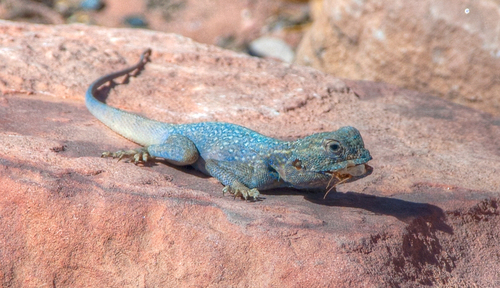
North East African Desert Agama Pseudotrapelus chlodnickii
The scientific name of the North East African Desert Agama is Pseudotrapelus chlodnickii. It is a species of reptile in the family Agamidae (agamid lizards), order Squamata. The name dates from 2015.
- Scientific name
- Pseudotrapelus chlodnickii Melnikov, Śmiełowski, Melnikova, Nazarov & Ananjeva, 2015
- Common name
- North East African Desert Agama
- Genus
- Pseudotrapelus
- Family
- Agamidae (Agamid Lizards)
- Order
- Squamata
- Class
- Reptilia
- Red List category
- LC Least Concern
- Recorded in
- 3 countries
- Name status
- accepted in the Catalogue of Life
Overview
Pseudotrapelus chlodnickii is a species of Agama native to Sudan and Libya.
Classification of the North East African Desert Agama
| Kingdom | Animalia |
|---|---|
| Phylum | Chordata |
| Subphylum | Vertebrata |
| Infraphylum | Gnathostomata |
| Parvphylum | Osteichthyes |
| Megaclass | Tetrapoda |
| Class | Reptilia (Reptile) |
| Order | Squamata (Snakes) |
| Suborder | Iguania (Iguanas) |
| Family | Agamidae (Agamid Lizards) |
| Subfamily | Agaminae |
| Genus | Pseudotrapelus (Sinai Agamas) |
| Species | Pseudotrapelus chlodnickii Melnikov, Śmiełowski, Melnikova, Nazarov & Ananjeva, 2015 |
Where the North East African Desert Agama is found
Checklists and occurrence records place Pseudotrapelus chlodnickii in 3 countries across Africa. GBIF holds 16 georeferenced records of it.
Countries
Regions and cities with the most records
Range as the checklists state it
Egypt, Sudan (Jumhūriyyat), E Libya, Eritrea
A number beside a place is its count of GBIF occurrence records. A place without a number comes from a checklist alone. Records show where a species has been observed or collected, which can include escapes and vagrants.
Common names
English
- North East African Desert Agama
Names in 1 other language
- Danish
- Nordøstafrikansk Ørkenagam
Related species
-
 Sinai AgamaPseudotrapelus sinaitus
- Aqaba AgamaPseudotrapelus aqabensis
- Tuwaiq AgamaPseudotrapelus tuwaiqensis
- Hajar Rock AgamaPseudotrapelus jensvindumi
-
 Dhofar Rock AgamaPseudotrapelus dhofarensis
- Neumann’s AgamaPseudotrapelus neumanni
-
 Frilled LizardChlamydosaurus kingii
-
 Thorny DevilMoloch horridus
Compare
Questions and answers
What is the scientific name of the North East African Desert Agama?
The scientific name of the North East African Desert Agama is Pseudotrapelus chlodnickii. Written with its author, the full name is Pseudotrapelus chlodnickii Melnikov, Śmiełowski, Melnikova, Nazarov & Ananjeva, 2015.
Which family does the North East African Desert Agama belong to?
Pseudotrapelus chlodnickii belongs to the family Agamidae, in the order Squamata and the class Reptilia.
Where is the North East African Desert Agama found?
Checklists and occurrence records place Pseudotrapelus chlodnickii in 3 countries: Egypt, Eritrea and Sudan.
What is the conservation status of the North East African Desert Agama?
The IUCN Red List category recorded for Pseudotrapelus chlodnickii is Least Concern (LC).
Sources
Data
- Catalogue of Life, 2026-10-16 XR cc by
- Global Biodiversity Information Facility CC BY 4.0
- Wikidata CC0
- English Wikipedia CC BY-SA 4.0
- GeoNames CC BY 4.0
- Within the Catalogue of Life, this name comes from The Reptile Database cc by
References
- Melnikov, Daniel; Jan Śmiełowski, Ekaterina Melnikova, Roman Nazarov, Natalia B. Ananjeva. (2015). Red’n’blues: A New Species of Pseudotrapelus (Agamidae, Sauria) from Sudan, Africa. Russ. J. Herpetol. 22 (1): 53-60.
- Melnikova, E., & Daniel Melnikov, N. A. (2015). Mitochondrial and Nuclear Gene Phylogeny of Pseudotrapelus (Sauria: Agamidae) with Considerations on the Hybridization and mtDNA Introgression between Species. Russ. J. Herpetol. 22 (1): 61-67.
- Tamar, Karin; Sebastian Scholz, Pierre-André Crochet, Philippe Geniez, Shai Meiri, Andreas Schmitz, Thomas Wilms, Salvador Carranza. (2016). Evolution around the Red Sea: Systematics and biogeography of the agamid genus Pseudotrapelus (Squamata: Agamidae) from North Africa and Arabia. Molecular Phylogenetics and Evolution 97 (2016) 55–68.
- Bauer, Aaron M.; Jonathan C. DeBoer , Dylan J. Taylor. (2017). Atlas of the Reptiles of Libya. Proc. Cal. Acad. Sci. 64 (8): 155-318.
- Milto, Konstantin D.; Samy A. Saber, Abdullah M. Nagy, Roman A. Nazarov, Daniel A. Melnikov, Natalia B. Ananjeva. (2019). First Report on the Reptile Diversity of Wadi El Gemal National Park, Eastern Desert, Egypt. Russ. J. Herpetol. 26 (3): 175-184.
- Tamar, K., Chirio, L., Shobrak, M., Busais, S., & Carranza, S. (2019). Using multilocus approach to uncover cryptic diversity within Pseudotrapelus lizards from Saudi Arabia. Saudi J. Biol. Sci. (2019). Doi:
- Zimin, A., Zimin, S. V., Shine, R., Avila, L., Bauer, A., Böhm, M., Brown, R., Barki, G., de Oliveira Caetano, G. H., Castro Herrera, F., Chapple, D. G., Chirio, L., Colli, G. R., Doan, T. M., Glaw, F., Grismer, L. L., Itescu, Y., Kraus, F., LeBreton, M.; [...] Uetz, P.; Wagner, P.; Roll, U. & Meiri, S. (2022). A global analysis of viviparity in squamates highlights its prevalence in cold climates. Global Ecology and Biogeography, 00, 1–16.
- Tamar, K., Uvizl, M., Shobrak, M., Almutairi, M., Busais, S., AlGethami, R. H. M., ... & Šmíd, J. (2023). A new species of Pseudotrapelus (Reptilia: Squamata: Agamidae) from Central Arabia. Vertebrate Zoology 73, 1033-1045.
- Spawls, Stephen; Tomáš Mazuch & Abubakr Mohammad. (2023). Handbook of Amphibians and Reptiles of North-east Africa. Bloomsbury, 640 Pp.
This species in other databases
Page built on 29 November 2026. See how the catalog is made and all sources and licences.
Cite this page
ScientificNames.org. (2026). Pseudotrapelus chlodnickii (North East African Desert Agama). Retrieved November 29, 2026, from https://scientificnames.org/species/pseudotrapelus-chlodnickii
“Pseudotrapelus chlodnickii (North East African Desert Agama).” ScientificNames.org, 2026, scientificnames.org/species/pseudotrapelus-chlodnickii. Accessed 29 Nov. 2026.
ScientificNames.org. “Pseudotrapelus chlodnickii (North East African Desert Agama).” Accessed November 29, 2026. https://scientificnames.org/species/pseudotrapelus-chlodnickii.
@misc{scientificnames_pseudotrapelus_chlodnickii_north_east_african_desert_agama,
  author = {{ScientificNames.org}},
  title = {Pseudotrapelus chlodnickii (North East African Desert Agama)},
  year = {2026},
  url = {https://scientificnames.org/species/pseudotrapelus-chlodnickii},
  note = {Accessed 2026-11-29}
}