Species · Reptiles
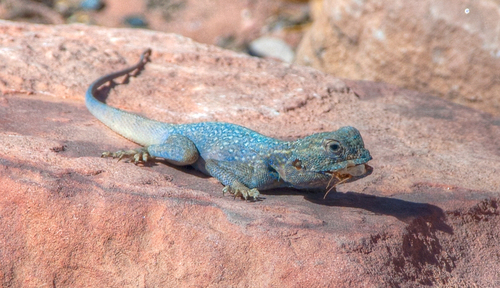
Neumann’s Agama Pseudotrapelus neumanni
The scientific name of the Neumann’s Agama is Pseudotrapelus neumanni. It is a species of reptile in the family Agamidae (agamid lizards), order Squamata. The name dates from 1905.
- Scientific name
- Pseudotrapelus neumanni (Tornier, 1905)
- Common name
- Neumann’s Agama
- Genus
- Pseudotrapelus
- Family
- Agamidae (Agamid Lizards)
- Order
- Squamata
- Class
- Reptilia
- Recorded in
- 1 country
- Name status
- accepted in the Catalogue of Life
Overview
Pseudotrapelus neumanni, Neumann's agama, is a species of Agama native to Yemen and Saudi Arabia.
Classification of the Neumann’s Agama
| Kingdom | Animalia |
|---|---|
| Phylum | Chordata |
| Subphylum | Vertebrata |
| Infraphylum | Gnathostomata |
| Parvphylum | Osteichthyes |
| Megaclass | Tetrapoda |
| Class | Reptilia (Reptile) |
| Order | Squamata (Snakes) |
| Suborder | Iguania (Iguanas) |
| Family | Agamidae (Agamid Lizards) |
| Subfamily | Agaminae |
| Genus | Pseudotrapelus (Sinai Agamas) |
| Species | Pseudotrapelus neumanni (Tornier, 1905) |
Where the Neumann’s Agama is found
Checklists and occurrence records place Pseudotrapelus neumanni in 1 country. GBIF holds 6 georeferenced records of it.
Countries
Range as the checklists state it
S Yemen, SW Saudi Arabia (Asir Mountains)
A number beside a place is its count of GBIF occurrence records. A place without a number comes from a checklist alone. Records show where a species has been observed or collected, which can include escapes and vagrants.
Common names
English
- Neumann’s Agama
- Neumann's Agama
Synonyms
One other scientific name has been used for this species and is now treated as a synonym of Pseudotrapelus neumanni.
- Agama neumanni Tornier, 1905
Related species
-
 Sinai AgamaPseudotrapelus sinaitus
- Aqaba AgamaPseudotrapelus aqabensis
- Tuwaiq AgamaPseudotrapelus tuwaiqensis
- Hajar Rock AgamaPseudotrapelus jensvindumi
- Dhofar Rock AgamaPseudotrapelus dhofarensis
- North East African Desert AgamaPseudotrapelus chlodnickii
-
 Frilled LizardChlamydosaurus kingii
-
 Thorny DevilMoloch horridus
Compare
Questions and answers
What is the scientific name of the Neumann’s Agama?
The scientific name of the Neumann’s Agama is Pseudotrapelus neumanni. Written with its author, the full name is Pseudotrapelus neumanni (Tornier, 1905).
Which family does the Neumann’s Agama belong to?
Pseudotrapelus neumanni belongs to the family Agamidae, in the order Squamata and the class Reptilia.
Where is the Neumann’s Agama found?
Checklists and occurrence records place Pseudotrapelus neumanni in 1 country: Saudi Arabia.
What other names does the Neumann’s Agama have?
Pseudotrapelus neumanni is also known in English as Neumann's Agama.
Sources
Data
- Catalogue of Life, 2026-10-16 XR cc by
- Global Biodiversity Information Facility CC BY 4.0
- Wikidata CC0
- English Wikipedia CC BY-SA 4.0
- GeoNames CC BY 4.0
- Within the Catalogue of Life, this name comes from The Reptile Database cc by
References
- Tornier, G. (1905). Schildkröten und Eidechsen aus Nord-Ost Afrika und Arabien. Aus Carlo v. Erlanger’s und Oscar Neumann’s Forschungsreise. Zool. Jahrb. Syst. 22: 365-388.
- Arnold E N. (1980). The scientific results of the Oman flora and fauna survey 1977 (Dhofar). The reptiles and amphibians of Dhofar, southern Arabia. JOURNAL OF OMAN STUDIES SPECIAL REPORT (No. 2): 273-332.
- Melnikov, D.A. and E.N. Melnikova. (2013). Taxonomic diversity of the genus Pseudotrapelus (Agamidae; Sauria) and biogeography of Afro-Arabia. [in Russian, with English Abstract]. Proceedings of the Zoological Institute of the Russian Academy of Sciences 317 (4): 438–451.
- Melnikov, Daniel; Jan Śmiełowski, Ekaterina Melnikova, Roman Nazarov, Natalia B. Ananjeva. (2015). Red’n’blues: A New Species of Pseudotrapelus (Agamidae, Sauria) from Sudan, Africa. Russ. J. Herpetol. 22 (1): 53-60.
- Melnikova, E., & Daniel Melnikov, N. A. (2015). Mitochondrial and Nuclear Gene Phylogeny of Pseudotrapelus (Sauria: Agamidae) with Considerations on the Hybridization and mtDNA Introgression between Species. Russ. J. Herpetol. 22 (1): 61-67.
- Tamar, Karin; Sebastian Scholz, Pierre-André Crochet, Philippe Geniez, Shai Meiri, Andreas Schmitz, Thomas Wilms, Salvador Carranza. (2016). Evolution around the Red Sea: Systematics and biogeography of the agamid genus Pseudotrapelus (Squamata: Agamidae) from North Africa and Arabia. Molecular Phylogenetics and Evolution 97 (2016) 55–68.
- Tamar, K., Chirio, L., Shobrak, M., Busais, S., & Carranza, S. (2019). Using multilocus approach to uncover cryptic diversity within Pseudotrapelus lizards from Saudi Arabia. Saudi J. Biol. Sci. (2019). Doi:
- Gemel, R.; G. Gassner & S. Schweiger. (2019). Katalog der Typen der Herpetologischen Sammlung des Naturhistorischen Museums Wien – 2018. Ann. Naturhist. Mus. Wien, B 121: 33–248.
- Zimin, A., Zimin, S. V., Shine, R., Avila, L., Bauer, A., Böhm, M., Brown, R., Barki, G., de Oliveira Caetano, G. H., Castro Herrera, F., Chapple, D. G., Chirio, L., Colli, G. R., Doan, T. M., Glaw, F., Grismer, L. L., Itescu, Y., Kraus, F., LeBreton, M.; [...] Uetz, P.; Wagner, P.; Roll, U. & Meiri, S. (2022). A global analysis of viviparity in squamates highlights its prevalence in cold climates. Global Ecology and Biogeography, 00, 1–16.
- Tamar, K., Uvizl, M., Shobrak, M., Almutairi, M., Busais, S., AlGethami, R. H. M., ... & Šmíd, J. (2023). A new species of Pseudotrapelus (Reptilia: Squamata: Agamidae) from Central Arabia. Vertebrate Zoology 73, 1033-1045.
- Uetz, P. H., Patel, M., Gbadamosi, Z., Nguyen, A., & Shoope, S. (2024). A Reference Database of Reptile Images. Taxonomy 4: 723–732.
This species in other databases
Page built on 25 November 2026. See how the catalog is made and all sources and licences.
Cite this page
ScientificNames.org. (2026). Pseudotrapelus neumanni (Neumann’s Agama). Retrieved November 25, 2026, from https://scientificnames.org/species/pseudotrapelus-neumanni
“Pseudotrapelus neumanni (Neumann’s Agama).” ScientificNames.org, 2026, scientificnames.org/species/pseudotrapelus-neumanni. Accessed 25 Nov. 2026.
ScientificNames.org. “Pseudotrapelus neumanni (Neumann’s Agama).” Accessed November 25, 2026. https://scientificnames.org/species/pseudotrapelus-neumanni.
@misc{scientificnames_pseudotrapelus_neumanni_neumanns_agama,
  author = {{ScientificNames.org}},
  title = {Pseudotrapelus neumanni (Neumann’s Agama)},
  year = {2026},
  url = {https://scientificnames.org/species/pseudotrapelus-neumanni},
  note = {Accessed 2026-11-25}
}