Species · Reptiles
Sinai Agama Pseudotrapelus sinaitus
The scientific name of the Sinai Agama is Pseudotrapelus sinaitus. It is a species of reptile in the family Agamidae (agamid lizards), order Squamata. The name dates from 1827.
- Scientific name
- Pseudotrapelus sinaitus (Heyden, 1827)
- Common name
- Sinai Agama
- Genus
- Pseudotrapelus
- Family
- Agamidae (Agamid Lizards)
- Order
- Squamata
- Class
- Reptilia
- Red List category
- LC Least Concern
- Recorded in
- 7 countries
- Name status
- accepted in the Catalogue of Life
Overview
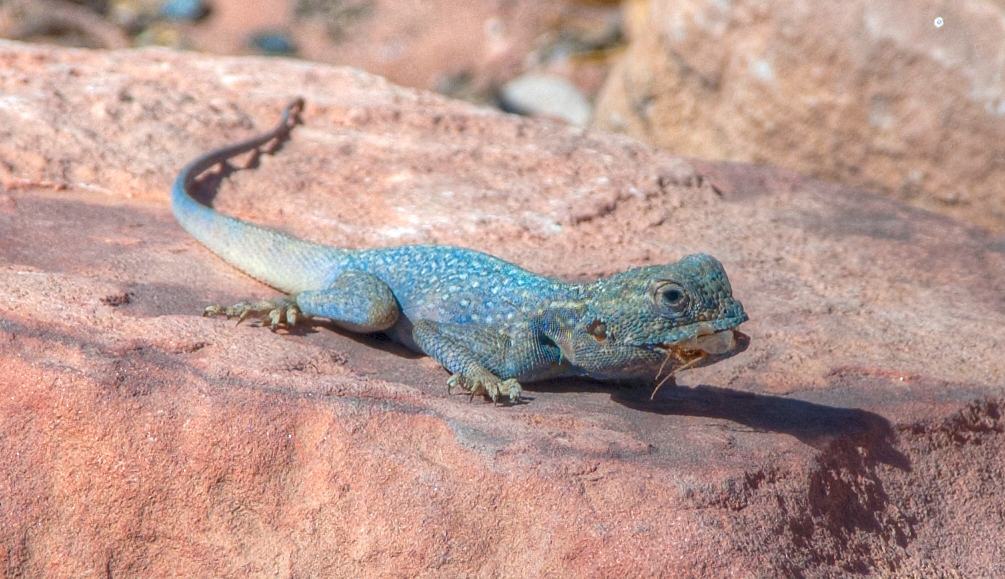
The species occurs in the Sinai Peninsula of Egypt, Israel, Jordan, Syria, southeastern Libya, eastern Egypt, and Palestine. The Sinai Agama has a small body, long legs, and an upright stance, with breeding males developing bright blue coloration.
Written 26 November 2026 from the sources listed below. Each statement was checked against the passage it cites; statements that could not be supported were removed.
Appearance
The Sinai Agama has a small body, long legs, and an upright stance. Its coloration is generally dull brown, while females and juveniles remain greyish-brown throughout the year.[1][2][3]
Breeding males develop bright blue coloration, sometimes restricted to the head and throat. Females often have a crescent-shaped red patch on each side behind the forelimbs.[4][5]
The dorsal scales are relatively small, uniformly overlapping, and slightly keeled. The scales along the tail are larger than those on the back, and the third toe is longer than the fourth toe.[6][7][8]
The species reaches a total length of approximately 18 cm. The tail can account for up to two-thirds of the animal's total length and is approximately one and a half times the length of the body.[9][10][11]
Habitat
The Sinai Agama occurs in arid areas of northeastern Africa and parts of the Middle East. Its distribution includes the Sinai Peninsula of Egypt, Israel, Jordan, Syria, southeastern Libya, eastern Egypt, and Palestine.[12][13][14]
Individuals bask on boulders, cliffs, and piles of stone during daytime.[15]
Diet
The Sinai Agama feeds on insects, other arthropods, and plants. Ants constitute a large proportion of its diet.[16][17]
Behaviour
The Sinai Agama is active during daylight hours and is ectothermic. Its long, slender limbs and tail facilitate climbing and running, and individuals often hold their tails above the ground.[18][19][20][21]
Territorial individuals raise their heads and gape to maintain their territories. Males communicate with prospective mates through head bobbing, eye movements, and front-limb push-ups.[22][23]
Reproduction and life cycle
Breeding occurs during spring and early summer. Both sexes become territorial during the breeding period.[24][25]
Females lay clutches containing five to nine eggs. The eggs are approximately 1.5 cm long.[26][27]
Classification of the Sinai Agama
| Kingdom | Animalia |
|---|---|
| Phylum | Chordata |
| Subphylum | Vertebrata |
| Infraphylum | Gnathostomata |
| Parvphylum | Osteichthyes |
| Megaclass | Tetrapoda |
| Class | Reptilia (Reptile) |
| Order | Squamata (Snakes) |
| Suborder | Iguania (Iguanas) |
| Family | Agamidae (Agamid Lizards) |
| Subfamily | Agaminae |
| Genus | Pseudotrapelus (Sinai Agamas) |
| Species | Pseudotrapelus sinaitus (Heyden, 1827) |
Where the Sinai Agama is found
Checklists and occurrence records place Pseudotrapelus sinaitus in 7 countries across Asia. GBIF holds 1,963 georeferenced records of it.
Countries
Regions and cities with the most records
- Southern District, Israel 1,457
- Eilat, Israel 869
- Aqaba, Jordan 723
- Arad, Israel 67
- West Bank, Palestinian Territory 50
- Ma’an, Jordan 36
- Banī Na‘īm, Palestinian Territory 34
- Safi, Jordan 33
- Aqaba, Jordan 20
- Mecca Region, Saudi Arabia 16
- Dimona, Israel 11
- Kuseifa, Israel 11
- Dhofar, Oman 10
- Tabuk Region, Saudi Arabia 9
- Aţ Ţafīlah, Jordan 8
- Bethlehem, Palestinian Territory 7
- Sa‘īr, Palestinian Territory 7
- Yaţţā, Palestinian Territory 7
- Abū ‘Arīsh, Saudi Arabia 6
- Al ‘Ayzarīyah, Palestinian Territory 6
- As Samū‘, Palestinian Territory 6
- Hebron, Palestinian Territory 6
- Jazan Region, Saudi Arabia 6
- Ma‘ale Adummim, Palestinian Territory 6
- Ḑamad, Saudi Arabia 6
- Bayt Jālā, Palestinian Territory 5
- 'Asir Region, Saudi Arabia 4
- Al Bahah Region, Saudi Arabia 4
- Jerusalem, Israel 4
- Ḩalḩūl, Palestinian Territory 4
- Ad Dakhiliyah, Oman 3
- Amman, Jordan 3
- Kiryat Gat, Israel 3
- Maşīrah, Oman 3
- Qiryat HaYovel, Israel 3
- Rahat, Israel 3
2 more countries have a few records outside this range
These countries hold a few records of Pseudotrapelus sinaitus but lie outside the range the checklists give for it. Such records are often zoo or garden specimens, museum material or vagrants, so the species is not counted as occurring there.
Range as the checklists state it
E Egypt, Sinai, Jordan, Syria, Saudia Arabia / Arabian peninsula
A number beside a place is its count of GBIF occurrence records. A place without a number comes from a checklist alone. Records show where a species has been observed or collected, which can include escapes and vagrants.
Common names
English
- Sinai Agama
Names in 15 other languages
- Arabic
- حرذون سينائي (عَضْرَفُوط سينائي), حرذون سيناوي
- Chinese
- 玛沙蜥, 瑪沙蜥
- Czech
- agamka sinajská
- Danish
- Sinai-ørkenagam
- Dutch
- Sinai Agaam, Sinaï-agame
- French
- Agame du Sinaï, Sinaï agama
- German
- Sinai-Agame
- Hebrew
- חרדון סיני
- Italian
- Agama del Sinai
- Japanese
- シナイアガマ
- Norwegian
- Sinaiagam
- Russian
- Синайская агама
- Spanish
- Agama sinaí
- Tamil
- ஆகமா சைனைடிடா
- bar
- Sinai-Agåma
Synonyms
5 other scientific names have been used for this species and are now treated as synonyms of Pseudotrapelus sinaitus.
- Agama arenaria Heyden, 1827
- Agama lichtensteini Gray, 1845
- Agama sinaita Heyden, 1827
- Agama straminea Lichtenstein, 1945
- Trapelus sinaiticus Tristram, 1888
Subspecies and varieties
- Pseudotrapelus sinaitus sinaitus subspecies
- Pseudotrapelus sinaitus werneri subspecies
Related species
- Aqaba AgamaPseudotrapelus aqabensis
- Tuwaiq AgamaPseudotrapelus tuwaiqensis
- Hajar Rock AgamaPseudotrapelus jensvindumi
-
 Dhofar Rock AgamaPseudotrapelus dhofarensis
- Neumann’s AgamaPseudotrapelus neumanni
- North East African Desert AgamaPseudotrapelus chlodnickii
-
 Frilled LizardChlamydosaurus kingii
-
 Thorny DevilMoloch horridus
Compare
Questions and answers
What is the scientific name of the Sinai Agama?
The scientific name of the Sinai Agama is Pseudotrapelus sinaitus. Written with its author, the full name is Pseudotrapelus sinaitus (Heyden, 1827).
Which family does the Sinai Agama belong to?
Pseudotrapelus sinaitus belongs to the family Agamidae, in the order Squamata and the class Reptilia.
Where is the Sinai Agama found?
Checklists and occurrence records place Pseudotrapelus sinaitus in 7 countries, including Israel, Yemen, Jordan, Saudi Arabia, Oman and United Arab Emirates.
What is the conservation status of the Sinai Agama?
The IUCN Red List category recorded for Pseudotrapelus sinaitus is Least Concern (LC).
Sources
Passages the profile rests on
- The Sinai agama has a small body, long legs, and an upright stance. Source passage: “The Sinai agama is a small lizard with long legs, giving it an upright stance.” — English Wikipedia
- The species generally has dull brown coloration. Source passage: “This lizard is generally a dull brown colour” — English Wikipedia
- Females and juveniles remain greyish-brown throughout the year. Source passage: “Females and juveniles are greyish-brown all year round” — English Wikipedia
- Breeding males develop bright blue coloration, sometimes restricted to the head and throat. Source passage: “during the breeding season, the male turns bright blue, or sometimes just the head and throat turn blue with the other parts remaining brown.” — English Wikipedia
- Females often have a crescent-shaped red patch on each side behind the forelimbs. Source passage: “females often have a crescent-shaped red patch on each side just behind the forelimbs.” — English Wikipedia
- The dorsal scales are relatively small, uniformly overlapping, and slightly keeled. Source passage: “The scales on the dorsal surface are relatively small, uniformly overlapping, and slightly keeled.” — English Wikipedia
- The scales along the tail are larger than those on the back. Source passage: “the scales on the tail are larger than those on the back.” — English Wikipedia
- The third toe is longer than the fourth toe. Source passage: “the third (middle) toe is the longest instead of the fourth.” — English Wikipedia
- The species reaches a total length of approximately 18 cm. Source passage: “It grows to a length of 18 cm (7 in)” — English Wikipedia
- The tail can account for up to two-thirds of the animal's total length. Source passage: “the tail accounting for up to two-thirds of its total length.” — English Wikipedia
- The tail is approximately one and a half times the length of the body. Source passage: “one and a half times as long as the body.” — English Wikipedia
- The species occurs in arid areas of northeastern Africa and parts of the Middle East. Source passage: “The Sinai agama is found in arid parts of northeastern Africa and parts of the Middle East.” — English Wikipedia
- The species occurs in the Sinai Peninsula of Egypt, Israel, Jordan, and Syria. Source passage: “found in the Sinai Peninsula (Egypt), Israel, Jordan, Syria.” — English Wikipedia
- The species is reported from southeastern Libya, eastern Egypt, and Palestine. Source passage: “found in arid areas of southeastern Libya, eastern Egypt, Palestine, ...” — inaturalist.org
- Individuals bask on boulders, cliffs, and piles of stone during daytime. Source passage: “In the daytime, they bask in the sun and are seen on boulders, cliffs, or piles of stone.” — English Wikipedia
- The species feeds on insects, other arthropods, and plants. Source passage: “feeds on insects and other arthropods and plants.” — English Wikipedia
- Ants constitute a large proportion of the species' diet. Source passage: “a large part of its diet consists of ants.” — English Wikipedia
- The species is active during daylight hours. Source passage: “Pseudotrapelus sinaitus is active during daytime” — English Wikipedia
- Its long, slender limbs and tail facilitate climbing and running. Source passage: “The limbs and tail are long and thin and allow for good climbing and running capability.” — English Wikipedia
- Individuals often hold their tails above the ground. Source passage: “the tail is often held off the ground.” — English Wikipedia
- The species is ectothermic. Source passage: “Like other lizards, the Sinai agama is ectothermic.” — English Wikipedia
- Territorial individuals raise their heads and gape to maintain their territories. Source passage: “To maintain their territory, they adopt a threatening pose by raising their heads and gaping.” — English Wikipedia
- Males communicate with prospective mates through head bobbing, eye movements, and front-limb push-ups. Source passage: “by bobbing his head, using eye movements, and doing push-ups with his front limbs.” — English Wikipedia
- Breeding occurs during spring and early summer. Source passage: “Breeding takes place in spring and early summer” — English Wikipedia
- Both sexes become territorial during the breeding period. Source passage: “when both the male and female become territorial.” — English Wikipedia
- Females lay clutches containing five to nine eggs. Source passage: “the female lays a clutch of five to nine eggs” — English Wikipedia
- The eggs are approximately 1.5 cm long. Source passage: “about 1.5 cm (0.6 in) long.” — English Wikipedia
Data
- Catalogue of Life, 2026-10-16 XR cc by
- Global Biodiversity Information Facility CC BY 4.0
- Wikidata CC0
- GeoNames CC BY 4.0
- iNaturalist per image; credit shown with each image
- Within the Catalogue of Life, this name comes from The Reptile Database cc by
References
- Heyden, C. H. G. von. (1827). Reptilien. In Rüppell, E. Atlas zu Reise im nördlichen Afrika. l. Zoologie. H. L. Brönner, Frankfurt a. M., Pp. 1-24.
- Duméril, A. M. C. and G. Bibron. (1837). Erpétologie Générale ou Histoire Naturelle Complete des Reptiles. Vol. 4. Libr. Encyclopédique Roret, Paris, 570 Pp.
- Rüppell, E. (1845). Verzeichnis der in dem Museum der Senckenbergischen naturforschenden Gesellschaft aufgestellten Sammlungen. Dritte Abteilung: Amphibien. Mus. Senckenbergianum 3 (3): 293- 316.
- Boulenger, G. A. (1885). Catalogue of the lizards in the British Museum (Nat. Hist.) I. Geckonidae, Eublepharidae, Uroplatidae, Pygopodidae, Agamidae. London: 450 Pp.
- Boulenger, G. A. (1887). A list of the reptiles and batrachians obtained near Muscat, Arabia, and presented to the British Museum by Surgeon-Major A.S.G. Jayakar. Ann. Mag. Nat. Hist. (5) 20: 407-408.
- Anderson, & John. (1896). A Contribution to the Herpetology of Arabia, with a preliminary list of the reptiles and batrachians of Egypt. London, R. H. Porter, 124 Pp.
- Anderson, & John. (1901). A list of the reptiles and batrachians obtained by Mr. A. Blayney Percival in southern Arabia. Proc. Zool. Soc. London 1901 (2): 137-152.
- Steindachner, & Franz. (1903). Batrachier und Reptilien von Südarabien und Sokotra, gesammelt während der südarabischen Expedition der kaiserlichen Akademie der Wissenschaften. Sitzungsb. Akad. Wiss. Wien, Math.-Naturwiss. Kl., 112, Abt. 1: 7-14.
- Tornier, G. (1905). Schildkröten und Eidechsen aus Nord-Ost Afrika und Arabien. Aus Carlo v. Erlanger’s und Oscar Neumann’s Forschungsreise. Zool. Jahrb. Syst. 22: 365-388.
- Werner, F. (1919). Wissenschaftliche Ergebnisse der mit Unterstützung der Kaiserlichen Akademie der Wissenschaften in Wien aus der Erbschaft Treitl von F. Werner unternommenen zoologischen Expedition nach dem Anglo-Aegyptischen Sudan (Kordofan) 1914. IV. Bearbeitung der Fische, Amphibien und Reptilien. Denkschr. Akad. Wiss Wien, Math.-Naturw. Klasse 96: 437-509.
- Mertens, R. (1922). Verzeichnis der Typen in der herpetologischen Sammlung des Senckenbergischen Museums. Senckenbergiana 4: 162-183.
- Schmidt, K. P. (1939). Reptiles and amphibians from Southwestern Asia. Publ. Field Mus. Nat. Hist., Zool. Ser., 24: 49-92.
- Wettstein, O. von & Löffler, H. (1951). Ergebnisse der österreichischen Iran-Expedition 1949l50. Sitzungsber. Akad. Wiss. Wien, Math.-Nat. Kl., Abt. 1, 160: 427-448.
- Schmidt, K. P., & Marx, H. (1956). The herpetology of Sinai. Fieldiana 39 (4): 21-40.
- Haas, & Georg. (1957). Some amphibians and reptiles from Arabia. Proc. Cal. Acad. Sci. 29 (3): 47-86.
- Werner, Y. L. (1971). Lizards and snakes from Transjordan, recently acquired by the British Museum (Natural Hisrory). Bulletin of the British Museum (Natural History), Zoology21: 213-256.
- Gorman, George C.;Shochat, Dan. (1972). A taxonomic interpretation of chromosomal and electrophoretic data on the agamid lizards of Israel with notes on some East African species. Herpetologica 28 (2): 106-112.
- Arnold E N. (1980). The scientific results of the Oman flora and fauna survey 1977 (Dhofar). The reptiles and amphibians of Dhofar, southern Arabia. JOURNAL OF OMAN STUDIES SPECIAL REPORT (No. 2): 273-332.
- Bischoff, W., & Schmidtler, J. F. (1981). Bemerkungen zur Herpetofauna der Vereinigten Arabischen Emirate, insbesondere zur Omaneidechse (Lacerta jayakari). Herpetofauna 3 (11): 12-16.
- Schätti, B., & Gasperetti, J. (1994). A contribution to the herpetofauna of Southwest Arabia. Fauna of Saudi Arabia 14: 348-423.
- Sindaco R., Fedrighini, N. & VEnchi, A. (1995). Contribution to the herpetology of Jordan. Boll. Mus. Reg. Sci. Nat. Torino 13 (1): 389-405.
- Schleich, H. H., Kästle, W., & Kabisch, K. (1996). Amphibians and Reptiles of North Africa. Koeltz, Koenigstein, 627 Pp.
- Müller, J. (1996). Angaben über einige Amphibien - und Reptilienfunde in Jordanien. Sauria 18 (3): 3-10.
- Manthey, U., & SCHUSTER, N. (1999). Agamen, 2. Aufl. Natur Und Tier Verlag (Münster), 120 Pp.
- Jongbloed, M. (2000). Field Guide to the reptiles and amphibians of the UAE - Wild about reptiles. Barkers Trident Communications, 116 Pp.
This species in other databases
Page built on 28 November 2026. See how the catalog is made and all sources and licences.
Cite this page
ScientificNames.org. (2026). Pseudotrapelus sinaitus (Sinai Agama). Retrieved November 28, 2026, from https://scientificnames.org/species/pseudotrapelus-sinaitus
“Pseudotrapelus sinaitus (Sinai Agama).” ScientificNames.org, 2026, scientificnames.org/species/pseudotrapelus-sinaitus. Accessed 28 Nov. 2026.
ScientificNames.org. “Pseudotrapelus sinaitus (Sinai Agama).” Accessed November 28, 2026. https://scientificnames.org/species/pseudotrapelus-sinaitus.
@misc{scientificnames_pseudotrapelus_sinaitus_sinai_agama,
  author = {{ScientificNames.org}},
  title = {Pseudotrapelus sinaitus (Sinai Agama)},
  year = {2026},
  url = {https://scientificnames.org/species/pseudotrapelus-sinaitus},
  note = {Accessed 2026-11-28}
}