Species · Birds
Orange-winged Pytilia Pytilia afra
The scientific name of the Orange-winged Pytilia is Pytilia afra. It is a species of bird in the family Estrildidae (munias), order Passeriformes. The name dates from 1789.
- Scientific name
- Pytilia afra (Gmelin, 1789)
- Common name
- Orange-winged Pytilia
- Genus
- Pytilia
- Family
- Estrildidae (Munias)
- Order
- Passeriformes
- Class
- Aves
- Red List category
- LC Least Concern
- Recorded in
- 16 countries
- Name status
- accepted in the Catalogue of Life

Overview
Pytilia afra inhabits forest edges, miombo woodland and wooded grasslands, generally in moist areas. Adult males are distinguished by orange greater wing coverts, red facial plumage and a green back with an olive tinge.
Written 26 November 2026 from the sources listed below. Each statement was checked against the passage it cites; statements that could not be supported were removed.
Appearance
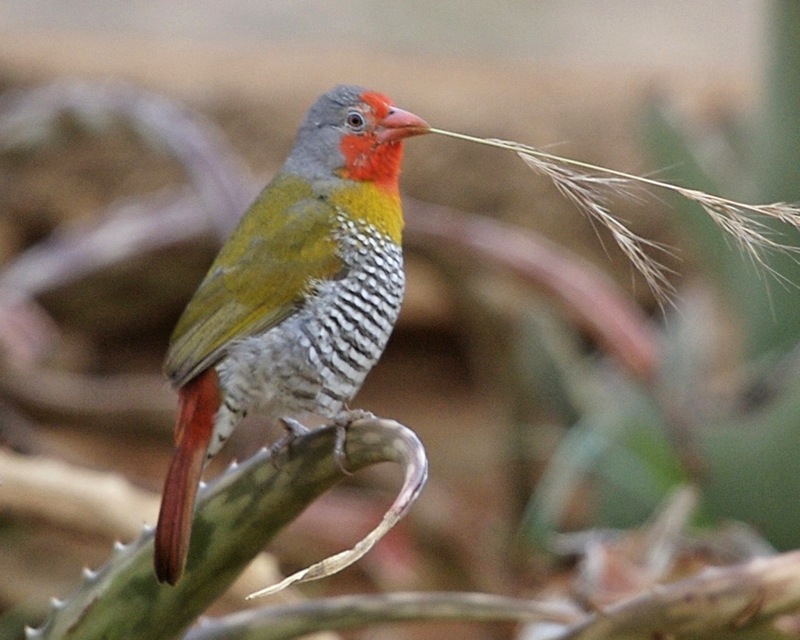
Adult males have red foreheads, faces and chins, with grey crowns and napes. Their backs are green with an olive tinge, and their greater wing coverts are orange, while their blackish-brown flight feathers have orange edges.[1][2][3]
Males have red outer tail webs and brown inner tail webs. Their throats and upper breasts are pale grey, their breasts are olive, and their underparts have off-white bars across the breast and belly.[4][5][6]
The bird has pale pink or pinkish-brown legs, orange or red eyes and a red bill. Females have greyish heads without red coloration, duller backs and wings, and broader underpart bars than males.[7][8][9]
Immature birds resemble females but have drabber plumage. Adults measure approximately 11 cm in length and weigh approximately 14–15 g.[10][11][12]
Habitat
The Orange-winged Pytilia inhabits forest edges, miombo woodland and wooded grasslands, generally in moist areas. It occurs at elevations reaching approximately 1,800 m above sea level.[13][14]
The species is associated with moister habitats than the Green-winged Pytilia.[15]
Diet
The Orange-winged Pytilia feeds on seeds while foraging on the ground. It probably also consumes insects.[16][17]
Behaviour
The species generally occurs in small flocks. Outside the breeding season, it can form larger and looser flocks, and individuals may travel great distances to locate food.[18][19][20]
The species sings through rapidly repeated whistles. It is parasitised by the broad-tailed paradise whydah, which imitates its call.[21][22]
Reproduction and life cycle
The breeding season in the southeastern Congo Basin occurs from April to May, while in Zambia and Zimbabwe it occurs from January to May. In Malawi, the breeding season occurs from March to June, and in Tanzania it occurs from April to June.[23][24][25][26]
The species' eggs weigh approximately 1.42 g. The eggs of its brood parasite weigh approximately 1.64 g, around 15% more than its own eggs.[27][28]
The incubation period lasts approximately 12–13 days. The nestling period lasts approximately 21 days.[29][30]
Conservation
The Orange-winged Pytilia is classified as Least Concern on the IUCN Red List, with a stable population trend. It was assessed as Least Concern in the 2018 IUCN Red List assessment.[31][32][33]
The species has an estimated global extent of occurrence of 8,160,000 km². Its extremely large range does not meet the range-size threshold for Vulnerable status.[34][35]
Uses
The Orange-winged Pytilia may be captured and kept as a cage bird.[36]
Similar species
The Orange-winged Pytilia resembles the Green-winged Pytilia but occupies moister habitats.[37]
Classification of the Orange-winged Pytilia
| Kingdom | Animalia |
|---|---|
| Phylum | Chordata |
| Subphylum | Vertebrata |
| Infraphylum | Gnathostomata |
| Parvphylum | Osteichthyes |
| Megaclass | Tetrapoda |
| Class | Aves (Bird) |
| Order | Passeriformes (Passerine) |
| Family | Estrildidae (Munias) |
| Genus | Pytilia (Pytilias) |
| Species | Pytilia afra (Gmelin, 1789) |
Where the Orange-winged Pytilia is found
Checklists and occurrence records place Pytilia afra in 16 countries. GBIF holds 2,836 georeferenced records of it.
Countries
- Angola 169
- Botswana 36
- Democratic Republic of the Congo 121
- Ethiopia 56
- Kenya 162
- Malawi 301
- Mozambique 137
- Namibia 14
- Nigeria 3
- Republic of the Congo 12
- Rwanda 7
- South Africa 166
- Tanzania 193
- Uganda 19
- Zambia 1,030
- Zimbabwe 410
Regions and cities with the most records
- North-Western, Zambia 271
- Southern Province, Zambia 203
- Livingstone, Zambia 158
- Limpopo, South Africa 157
- Central Province, Zambia 155
- Matabeleland North, Zimbabwe 154
- Victoria Falls, Zimbabwe 143
- Lusaka Province, Zambia 127
- Western Province, Zambia 114
- Sofala, Mozambique 103
- Mashonaland West, Zimbabwe 96
- Copperbelt, Zambia 89
- Morogoro, Tanzania 64
- Ntandabale, Zambia 61
- Madido, Zambia 59
- Murang'A, Kenya 56
- Mashonaland Central, Zimbabwe 53
- Chisankane, Zambia 52
- Kenol, Kenya 51
- Thika, Kenya 51
- Palabana, Zambia 50
- Haut-Katanga, Democratic Republic of the Congo 47
- Mikumi, Tanzania 44
- Muchinga, Zambia 40
- Choma, Zambia 37
- Chingola, Zambia 33
- Oromiya, Ethiopia 33
- Chambishi, Zambia 32
- Lusaka, Zambia 32
- Malanje, Angola 32
- Manicaland, Zimbabwe 32
- Huambo, Angola 31
- Chobe, Botswana 26
- Iringa, Tanzania 25
- Lualaba, Democratic Republic of the Congo 25
- Chinhoyi, Zimbabwe 23
1 more country has a few records outside this range
These countries hold a few records of Pytilia afra but lie outside the range the checklists give for it. Such records are often zoo or garden specimens, museum material or vagrants, so the species is not counted as occurring there.
A number beside a place is its count of GBIF occurrence records. A place without a number comes from a checklist alone. Records show where a species has been observed or collected, which can include escapes and vagrants.
Common names
English
- Orange-winged Pytilia
- Golden-backed Pytilia
- OWPY
Names in 25 other languages
- Catalan
- bec de corall aladaurat
- Chinese
- 橙翅斑腹雀
- Croatian
- narančastokrila estrilda
- Czech
- astrild Wienerův
- Dutch
- Wenerastrild
- Esperanto
- oranĝflugila estrildo
- Estonian
- kuldtiib-amadiin
- Finnish
- kultasiipipeippo
- French
- Beaumarquet à dos jaune
- German
- Sansibarfink, Wiener-Astrild, Wienerastrild, Wieners Astrild
- Hungarian
- szürketorkú asztrild
- Italian
- Pitilia aliarancio
- Japanese
- ビジョスズメ
- Lithuanian
- oranžinė pitilija
- Norwegian
- oransjevingeastrild
- Polish
- melba złotoskrzydła
- Portuguese
- aurora-d'asa-laranja, maracachão-d'asa-dourada, maracachão-de-asa-dourada
- Russian
- Желтоспинная питилия, Желтоспинный астрильд, Златокрылый астрильд
- Serbian
- Bečka astrilda
- Slovak
- pytília zlatokrídla
- Spanish
- Estrilda alinaranja
- Swedish
- orangevingad astrild
- Turkish
- Turuncu Kanatlı Pitilya
- Ukrainian
- мельба золотокрила
- Welsh
- pytilia eurgefn
Synonyms
One other scientific name has been used for this species and is now treated as a synonym of Pytilia afra.
- Fringilla afra Gmelin, JF, 1789
Related species
-
 Green-winged PytiliaPytilia melba
-
 Red-winged PytiliaPytilia phoenicoptera
-
 Yellow-winged PytiliaPytilia hypogrammica
- Red-billed PytiliaPytilia lineata
-
 Scaly-breasted MuniaLonchura punctulata
-
 Red AvadavatAmandava amandava
-
 Common WaxbillEstrilda astrild
-
 Indian SilverbillEuodice malabarica
Compare
Questions and answers
What is the scientific name of the Orange-winged Pytilia?
The scientific name of the Orange-winged Pytilia is Pytilia afra. Written with its author, the full name is Pytilia afra (Gmelin, 1789).
Which family does the Orange-winged Pytilia belong to?
Pytilia afra belongs to the family Estrildidae, in the order Passeriformes and the class Aves.
Where is the Orange-winged Pytilia found?
Checklists and occurrence records place Pytilia afra in 16 countries, including Zambia, Zimbabwe, Malawi, Tanzania, Angola and South Africa.
What is the conservation status of the Orange-winged Pytilia?
The IUCN Red List category recorded for Pytilia afra is Least Concern (LC).
What other names does the Orange-winged Pytilia have?
Pytilia afra is also known in English as Golden-backed Pytilia and OWPY.
Sources
Passages the profile rests on
- Adult males have red foreheads, faces and chins, with grey crowns and napes. Source passage: “The male's forehead, face and chin are red, and its crown and nape are grey.” — English Wikipedia
- The male has a green back with an olive tinge. Source passage: “Its back is green, with an olive tinge.” — English Wikipedia
- The male has orange greater wing coverts and blackish-brown flight feathers with orange edges. Source passage: “Its greater coverts are orange, and its primary coverts and flight feathers are blackish-brown, with orange edges.” — English Wikipedia
- The male has red outer tail webs and brown inner tail webs. Source passage: “The outer webs of its tail are red, and the inner webs are brown.” — English Wikipedia
- The male has pale grey throat and upper breast plumage and an olive breast. Source passage: “Its throat and upper breast are pale grey, and its breast is olive.” — English Wikipedia
- The underparts have off-white bars across the breast and belly. Source passage: “There are off-white bars on its breast and belly.” — English Wikipedia
- The bird has pale pink or pinkish-brown legs, orange or red eyes, and a red bill. Source passage: “Its legs are pale pink or pinkish-brown. Its eyes are orange or red, and its beak is red.” — English Wikipedia
- Females have greyish heads without red coloration. Source passage: “The female has a greyish head, with no red.” — English Wikipedia
- Females have duller backs and wings and broader underpart bars than males. Source passage: “Its back and wings are duller than the male, and the bars on its underparts are broader.” — English Wikipedia
- Immature birds resemble females but have drabber plumage. Source passage: “The immature bird is like the female, but is drabber.” — English Wikipedia
- Adults measure approximately 11 cm in length. Source passage: “The orange-winged pytilia is 11 cm (4.3 in) long” — English Wikipedia
- Adults weigh approximately 14–15 g. Source passage: “weighs 14–15 g (0.49–0.53 oz).” — English Wikipedia
- The species inhabits forest edges, miombo woodland and wooded grasslands, generally in moist areas. Source passage: “Its habitat is edges of forests, miombo woodland and wooded grasslands, usually in moist areas.” — English Wikipedia
- The species occurs at elevations reaching approximately 1,800 m above sea level. Source passage: “It is found at elevations up to 1,800 m (5,900 ft) above sea level.” — English Wikipedia
- The species is associated with moister habitats than the Green-winged Pytilia. Source passage: “Similar to Green-winged Pytilia but found in moister habitats and separated” — ebird.org
- The species feeds on seeds while foraging on the ground. Source passage: “It feeds on the ground, eating seeds” — English Wikipedia
- The species probably also consumes insects. Source passage: “probably also insects.” — English Wikipedia
- The species generally occurs in small flocks. Source passage: “The orange-winged pytilia is found in small flocks” — English Wikipedia
- Outside the breeding season, the species can form larger and looser flocks. Source passage: “can form larger, looser flocks when it is not breeding.” — English Wikipedia
- Individuals may travel great distances to locate food during the non-breeding season. Source passage: “In the non-breeding season, it can move great distances to find food.” — English Wikipedia
- The species sings through rapidly repeated whistles. Source passage: “its song is quickly repeated whistles.” — English Wikipedia
- The species is parasitised by the broad-tailed paradise whydah, which imitates its call. Source passage: “The orange-winged pytilia is parasitised by the broad-tailed paradise whydah, which mimics its call.” — English Wikipedia
- The breeding season in the southeastern Congo Basin occurs from April to May. Source passage: “April to May in the southeastern Congo Basin” — English Wikipedia
- The breeding season in Zambia and Zimbabwe occurs from January to May. Source passage: “January to May in Zambia and Zimbabwe” — English Wikipedia
- The breeding season in Malawi occurs from March to June. Source passage: “March to June in Malawi” — English Wikipedia
- The breeding season in Tanzania occurs from April to June. Source passage: “April to June in Tanzania.” — English Wikipedia
- The species' eggs weigh approximately 1.42 g. Source passage: “The eggs weigh approximately 1.42 g (0.050 oz)” — English Wikipedia
- The eggs of its brood parasite weigh approximately 1.64 g, around 15% more than its own eggs. Source passage: “those of the brood parasite weigh about 15% more, at 1.64 g (0.058 oz).” — English Wikipedia
- The incubation period lasts approximately 12–13 days. Source passage: “The pytilia's incubation period is 12 to 13 days” — English Wikipedia
- The nestling period lasts approximately 21 days. Source passage: “the nestling period is 21 days.” — English Wikipedia
- The species is classified as Least Concern on the IUCN Red List. Source passage: “the IUCN has classified the species as being of least concern.” — English Wikipedia
- The species has a stable population trend. Source passage: “Because the species has a large range and a stable population trend” — English Wikipedia
- The species was assessed as Least Concern in the 2018 IUCN Red List assessment. Source passage: “Pytilia afra has most recently been assessed for The IUCN Red List of Threatened Species in 2018. Pytilia afra is listed as Least Concern.” — iucnredlist.org
- The species has an estimated global extent of occurrence of 8,160,000 km². Source passage: “It has an estimated global extent of occurrence of 8,160,000 km2 (3,150,000 sq mi).” — English Wikipedia
- The species' extremely large range does not meet the range-size threshold for Vulnerable status. Source passage: “This species has an extremely large range, and hence does not approach the thresholds for Vulnerable under the range size criterion” — datazone.birdlife.org
- The species may be captured and kept as a cage bird. Source passage: “It may be captured and used as caged birds.” — English Wikipedia
- The Orange-winged Pytilia resembles the Green-winged Pytilia but occupies moister habitats. Source passage: “Similar to Green-winged Pytilia but found in moister habitats and separated” — ebird.org
Data
- Catalogue of Life, 2026-10-16 XR cc by
- Global Biodiversity Information Facility CC BY 4.0
- Wikidata CC0
- GeoNames CC BY 4.0
- Wikimedia Commons per image; credit shown with each image
- Within the Catalogue of Life, this name comes from The Integrated Taxonomic Information System cc0
References
- Gill, Frank, & and Minturn Wright. (2006). Birds of the World: Recommended English Names.
This species in other databases
Page built on 28 November 2026. See how the catalog is made and all sources and licences.
Cite this page
ScientificNames.org. (2026). Pytilia afra (Orange-winged Pytilia). Retrieved November 28, 2026, from https://scientificnames.org/species/pytilia-afra
“Pytilia afra (Orange-winged Pytilia).” ScientificNames.org, 2026, scientificnames.org/species/pytilia-afra. Accessed 28 Nov. 2026.
ScientificNames.org. “Pytilia afra (Orange-winged Pytilia).” Accessed November 28, 2026. https://scientificnames.org/species/pytilia-afra.
@misc{scientificnames_pytilia_afra_orange_winged_pytilia,
  author = {{ScientificNames.org}},
  title = {Pytilia afra (Orange-winged Pytilia)},
  year = {2026},
  url = {https://scientificnames.org/species/pytilia-afra},
  note = {Accessed 2026-11-28}
}