Species · Flowering plants
Shumard Oak Quercus shumardii
The scientific name of the Shumard Oak is Quercus shumardii. It is a species of flowering plant in the family Fagaceae (beech family), order Fagales.
- Scientific name
- Quercus shumardii Buckley
- Common name
- Shumard Oak
- Genus
- Quercus
- Family
- Fagaceae (Beech Family)
- Order
- Fagales
- Class
- Magnoliopsida
- Red List category
- LC Least Concern
- Recorded in
- 2 countries
- Name status
- accepted in the Catalogue of Life
Overview
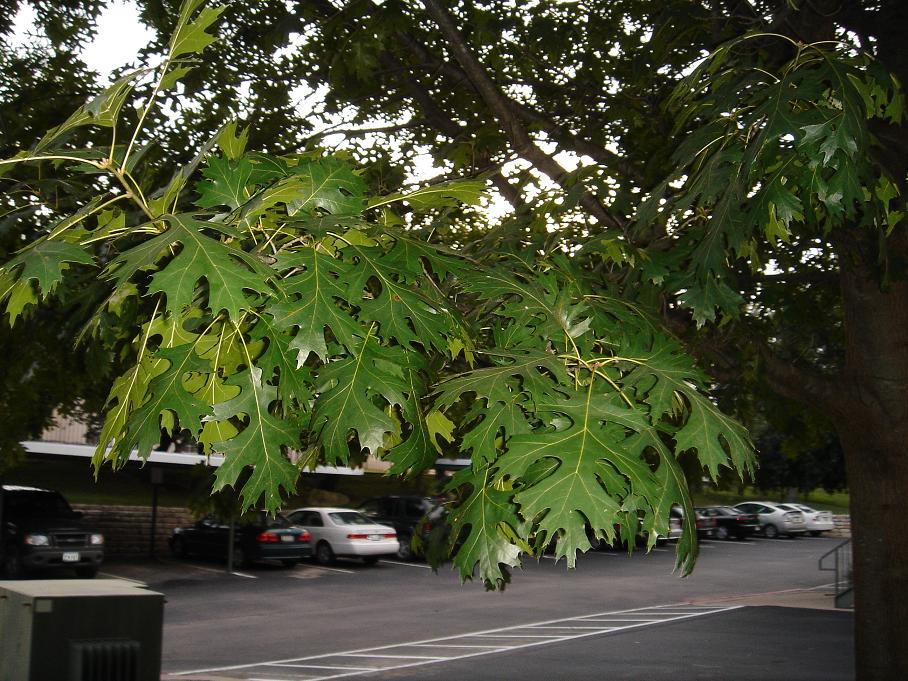
Shumard oak is native to the Atlantic coastal plain from North Carolina to northern Florida and west to central Texas, and occurs northward through the Mississippi River Valley and in parts of the northeastern United States and southern Ontario. Shumard oak is distinguished by its 5–9-lobed leaves, which turn bright red or orange in autumn, and its relatively large acorns.
Written 26 November 2026 from the sources listed below. Each statement was checked against the passage it cites; statements that could not be supported were removed.
Habitat
Shumard oak commonly occurs in lowland areas and can also grow in moist upland forests and along stream banks. It can survive in soils that experience flooding for six weeks annually.[1][2][3]
Shumard oak prefers partial to full sunlight and well-drained soil. It is drought-resistant and tolerates a wide range of soil pH levels.[4][5][6]
Diet
Shumard oak acorns provide food for wild turkeys, quail, waterfowl, white-tailed deer, feral hogs, and squirrels. They are also an important food source for birds and other mammals.[7][8]
White-tailed deer browse on Shumard oak leaves and twigs.[9]
Reproduction and life cycle
Shumard oak male and female flowers occur on the same tree. Male flowers grow in dangling catkins, while female flowers are smaller and occur close to the stem.[10][11]
Shumard oak trees begin producing seeds at a minimum age of 25 years, with 50 years being the optimum age for seed development. Acorns take approximately 1.5–3 years to mature.[12][13][14]
Shumard oak acorns must overwinter on the ground before germinating.[15]
Conservation
Shumard oak is listed as state rare (S2) and threatened in Maryland. Its populations may be threatened by fencerow brushing and field clearing for logging.[16][17]
Shumard oak is susceptible to oak wilt infection.[18]
Uses
Shumard oak is cultivated as a shade tree and for commercial purposes.[19]
Shumard oak lumber is used for flooring, furniture, interior trim, decorative molding, paneling, and cabinetry. Its wood is also used in construction and household furniture.[20][21]
Similar species
Shumard oak is closely related to Quercus buckleyi, Quercus texana, and Quercus gravesii.[22]
Appearance
Shumard oak leaves change from green to brown or red in autumn, sometimes with yellow hues. They can also turn bright red or orange.[23][24]
Young Shumard oak bark is light gray, smooth, and reflective. Mature bark develops darker coloration, ridges, and furrows.[25][26]
Shumard oak trunks are generally straight and vertical, and its branches terminate in clusters of buds. The trees produce relatively large acorns.[27][28][29]
Classification of the Shumard Oak
| Kingdom | Plantae |
|---|---|
| Subkingdom | Pteridobiotina |
| Phylum | Tracheophyta |
| Class | Magnoliopsida |
| Order | Fagales |
| Family | Fagaceae (Beech Family) |
| Subfamily | Quercoideae |
| Genus | Quercus (Acorn) |
| Species | Quercus shumardii Buckley |
Where the Shumard Oak is found
Checklists and occurrence records place Quercus shumardii in 2 countries across North America. GBIF holds 8,456 georeferenced records of it.
Countries
Regions and cities with the most records
- Texas, United States 1,527
- New York, United States 1,524
- Hoboken, United States 1,275
- New York City, United States 1,250
- Union City, United States 1,194
- Manhattan, United States 1,159
- Brooklyn, United States 1,128
- West New York, United States 1,118
- Queens, United States 1,068
- Jersey City, United States 1,064
- Secaucus, United States 1,034
- North Bergen, United States 1,017
- Bayonne, United States 958
- Cliffside Park, United States 952
- The Bronx, United States 757
- Fort Lee, United States 706
- Palisades Park, United States 673
- Staten Island, United States 633
- Harrison, United States 591
- Kearny, United States 562
- North Arlington, United States 528
- Newark, United States 516
- Elmont, United States 489
- Englewood, United States 477
- Elizabeth, United States 475
- Floral Park, United States 467
- Mount Vernon, United States 465
- Port Washington, United States 464
- New Rochelle, United States 439
- Hackensack, United States 435
- Teaneck, United States 432
- Valley Stream, United States 422
- Rutherford, United States 411
- North Valley Stream, United States 403
- Woodmere, United States 397
- Yonkers, United States 397
3 more countries have a few records outside this range
These countries hold a few records of Quercus shumardii but lie outside the range the checklists give for it. Such records are often zoo or garden specimens, museum material or vagrants, so the species is not counted as occurring there.
Range as the checklists state it
Canada (Ontario); USA (Alabama, Arkansas, Florida, Georgia, Illinois, Indiana, Kansas, Kentucky, Louisiana, Maryland, Michigan, Missouri, Mississippi, North Carolina, Ohio, Oklahoma, Pennsylvania, South Carolina, Tennessee, Texas, Virginia, West Virginia)
A number beside a place is its count of GBIF occurrence records. A place without a number comes from a checklist alone. Records show where a species has been observed or collected, which can include escapes and vagrants.
Common names
English
- Shumard Oak
- Schneck Oak
- Schneck's Oak
- Shumard Red Oak
- Shumard's Oak
- Southern Red Oak
- Spotted Oak
- Swamp Red Oak
Names in 8 other languages
- Chinese
- 舒氏红櫟
- Finnish
- leimutammi
- French
- chêne de Shumard
- German
- Shumards Eiche
- Italian
- quercia di Shumard
- Russian
- Дуб Шумарда
- Slovak
- dub Sumardov
- Spanish
- Encino rojo de pantano
Synonyms
One other scientific name has been used for this species and is now treated as a synonym of Quercus shumardii.
- Quercus shumardii var. macrocarpa (Torr.) Shinners
Subspecies and varieties
Related species
-
 Common OakQuercus robur
-
 White OakQuercus alba
-
 Northern Red OakQuercus rubra
-
 Cork OakQuercus suber
-
 Holm OakQuercus ilex
-
 Bur OakQuercus macrocarpa
-
 Southern Live OakQuercus virginiana
-
 Pin OakQuercus palustris
Compare
Questions and answers
What is the scientific name of the Shumard Oak?
The scientific name of the Shumard Oak is Quercus shumardii. Written with its author, the full name is Quercus shumardii Buckley.
Which family does the Shumard Oak belong to?
Quercus shumardii belongs to the family Fagaceae, in the order Fagales and the class Magnoliopsida.
Where is the Shumard Oak found?
Checklists and occurrence records place Quercus shumardii in 2 countries: United States and Canada.
What is the conservation status of the Shumard Oak?
The IUCN Red List category recorded for Quercus shumardii is Least Concern (LC).
What other names does the Shumard Oak have?
Quercus shumardii is also known in English as Schneck Oak, Schneck's Oak, Shumard Red Oak, Shumard's Oak, Southern Red Oak and Spotted Oak.
Sources
Passages the profile rests on
- Shumard oak commonly occurs in lowland areas. Source passage: “Shumard oak is typically found in lowland areas” — English Wikipedia
- Shumard oak can survive in soils that experience flooding for six weeks annually. Source passage: “is able to survive where the soils experience flooding for six weeks of the year.” — English Wikipedia
- Shumard oak can grow in moist upland forests and along stream banks. Source passage: “Shumard’s oak can be found near moist, upland forests and stream banks” — wp.towson.edu
- Shumard oak prefers partial to full sunlight. Source passage: “prefers partial to full sunlight.” — English Wikipedia
- Shumard oak is drought-resistant and tolerates a wide range of soil pH levels. Source passage: “It is tolerant of wide ranges of pH levels in soil. It is drought-resistant” — English Wikipedia
- Shumard oak prefers well-drained soil. Source passage: “It prefers to grow in well-drained soil” — wp.towson.edu
- Shumard oak acorns provide food for wild turkeys, quail, waterfowl, white-tailed deer, feral hogs, and squirrels. Source passage: “The acorns of the Shumard oak provide food for various songbirds, game birds such as wild turkey and quail, waterfowl, white-tailed deer, feral hogs, and various rodents such as squirrels.” — English Wikipedia
- Shumard oak acorns are an important food source for deer, squirrels, birds, and other mammals. Source passage: “The acorns from this tree serve a major role in feeding deer and squirrels. As well many different species of birds and mammals use these acorns as a food source” — wp.towson.edu
- White-tailed deer browse on Shumard oak leaves and twigs. Source passage: “The leaves and twigs can also provide browse for white-tailed deer.” — English Wikipedia
- Shumard oak male flowers grow in dangling catkins, while female flowers are smaller and occur close to the stem. Source passage: “Male flowers are represented by dangling catkins while the female flowers are smaller and can be found close to the stem.” — wp.towson.edu
- Shumard oak male and female flowers occur on the same tree. Source passage: “Male and female flowers are on the same tree but have different characteristics.” — wp.towson.edu
- Shumard oak trees begin producing seeds at a minimum age of 25 years. Source passage: “Shumard oaks begin to bear seeds at a minimum of 25 years of age” — English Wikipedia
- The optimum age for seed development in Shumard oak is 50 years. Source passage: “the optimum age for seed development is 50.” — English Wikipedia
- Shumard oak acorns take approximately 1.5–3 years to mature. Source passage: “Acorns take between 1.5 and 3 years to fully mature” — English Wikipedia
- Shumard oak acorns must overwinter on the ground before germinating. Source passage: “Acorns must overwinter on the ground before germinating.” — wp.towson.edu
- Shumard oak is listed as state rare (S2) and threatened in Maryland. Source passage: “Within the state of Maryland, the tree is listed as state rare (S2) and threatened” — wp.towson.edu
- Shumard oak populations may be threatened by fencerow brushing and field clearing for logging. Source passage: “Due to the locations of these trees are threatened by fencerow brushing and field clearing to be taken for logging.” — wp.towson.edu
- Shumard oak is susceptible to oak wilt infection. Source passage: “It is highly susceptible to oak wilt infection” — wp.towson.edu
- Shumard oak is cultivated as a shade tree and for commercial purposes. Source passage: “Shumard oak is valued for commercial use and as a shade tree.” — English Wikipedia
- Shumard oak lumber is used for flooring, furniture, interior trim, decorative molding, paneling, and cabinetry. Source passage: “Shumard oak lumber is grouped with other red oak lumber for use in flooring, furniture, interior trim, decorative molding, paneling, and cabinetry.” — English Wikipedia
- Shumard oak wood is used in construction and household furniture. Source passage: “It is used greatly in construction mainly for housing or house furniture including but not limited to cabinetry, furniture, interior trim, flooring, and veneer” — wp.towson.edu
- Quercus shumardii is closely related to Quercus buckleyi, Quercus texana, and Quercus gravesii. Source passage: “It is closely related to Quercus buckleyi (Texas red oak), Quercus texana (Nuttall's red oak), and Quercus gravesii (Chisos red oak).” — English Wikipedia
- Shumard oak leaves change from green to brown or red in autumn, sometimes with yellow hues. Source passage: “The leaves turn brown to red in the fall and sometimes have hues of yellow mixed in.” — English Wikipedia
- Shumard oak leaves turn bright red or orange in autumn. Source passage: “The tree is highly known for its dramatic autumn statement, as its leaves turn a bright red/ orange shade.” — wp.towson.edu
- Young Shumard oak bark is light gray, smooth, and reflective. Source passage: “The young bark of the Shumard oak is light gray, very smooth, and very reflective.” — English Wikipedia
- Mature Shumard oak bark develops darker coloration, ridges, and furrows. Source passage: “Shumard oak bark darkens and develops ridges and furrows as it ages.” — English Wikipedia
- Shumard oak trunks are generally straight and vertical. Source passage: “Trunks are relatively straight and vertical.” — English Wikipedia
- Shumard oak branches terminate in clusters of buds. Source passage: “Shumard oak twigs terminate in a cluster of buds.” — English Wikipedia
- Shumard oak trees produce relatively large acorns. Source passage: “Shumard oaks bear relatively large acorns, which typically reach up to 3 cm (1 in) in diameter.” — English Wikipedia
- Mature Shumard oaks typically grow 25–35 metres tall. Source passage: “Mature Shumard oaks typically reach heights of 25 to 35 metres (82 to 115 feet)” — English Wikipedia
- Exceptional Shumard oak specimens have reached heights of 60 metres. Source passage: “Record Shumard oaks have been measured at up to 60 m (200 ft) tall” — English Wikipedia
Data
- Catalogue of Life, 2026-10-16 XR cc by
- Global Biodiversity Information Facility CC BY 4.0
- Wikidata CC0
- GeoNames CC BY 4.0
- Wikimedia Commons per image; credit shown with each image
- Within the Catalogue of Life, this name comes from Synonymic Checklists of the Vascular Plants of the World cc by
References
- Buckley. (1860). Proc. Acad. Nat. Sci. Philadelphia 12: 444 (1860 publ. 1861). where the name was published
This species in other databases
- Catalogue of Life 4R64C
- Wikidata Q4112184
- iNaturalist 54786
- World Flora Online wfo-0000293271
- GRIN 70539
Page built on 29 November 2026. See how the catalog is made and all sources and licences.
Cite this page
ScientificNames.org. (2026). Quercus shumardii (Shumard Oak). Retrieved November 29, 2026, from https://scientificnames.org/species/quercus-shumardii
“Quercus shumardii (Shumard Oak).” ScientificNames.org, 2026, scientificnames.org/species/quercus-shumardii. Accessed 29 Nov. 2026.
ScientificNames.org. “Quercus shumardii (Shumard Oak).” Accessed November 29, 2026. https://scientificnames.org/species/quercus-shumardii.
@misc{scientificnames_quercus_shumardii_shumard_oak,
  author = {{ScientificNames.org}},
  title = {Quercus shumardii (Shumard Oak)},
  year = {2026},
  url = {https://scientificnames.org/species/quercus-shumardii},
  note = {Accessed 2026-11-29}
}