Species · Mammals
Brown Rat Rattus norvegicus
The scientific name of the Brown Rat is Rattus norvegicus. It is a species of mammal in the family Muridae (mice), order Rodentia. The name dates from 1769.
- Scientific name
- Rattus norvegicus (Berkenhout, 1769)
- Common name
- Brown Rat
- Genus
- Rattus
- Family
- Muridae (Mice)
- Order
- Rodentia
- Class
- Mammalia
- Red List category
- LC Least Concern
- Environment
- terrestrial
- Recorded in
- 117 countries
- Name status
- accepted in the Catalogue of Life
Overview
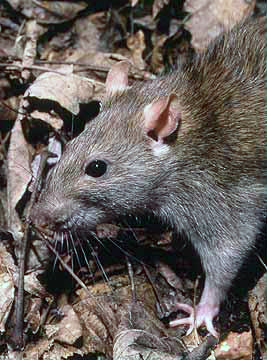
Rattus norvegicus occupies garbage dumps, sewers, open fields, woodlands, and basements, commonly near human settlements and water. It typically has brown or dark grey fur, bald ears and a bald tail that is shorter than its body.
Written 26 November 2026 from the sources listed below. Each statement was checked against the passage it cites; statements that could not be supported were removed.
Conservation
The Brown Rat is classified as a species of least concern.[1]
Uses
Brown rats have been widely used in medical and genetic research. Laboratory rats derived from brown rats serve as model organisms in biological research.[2][3]
Selective breeding has produced domesticated fancy rats kept as pets. Brown rat burrows contribute to soil aeration.[4][5]
Similar species
The Brown Rat can be confused with the black rat, but the two species differ in the shape of their temporal ridges. The Himalayan field rat is closely related to the Brown Rat.[6][7]
Appearance
The Brown Rat typically has brown or dark grey fur with lighter grey or brown underparts. Wild individuals have coarse brownish dorsal fur that may contain black or white hairs.[8][9]
The Brown Rat has bald ears and a bald tail that is shorter than its body. Captive-bred individuals may have white, brown, or black fur.[10][11][12]
Head-and-body length ranges from 15 to 28 cm, and tail length ranges from 10.5 to 24 cm. Adult individuals generally weigh between 140 and 500 g, with males generally larger than females.[13][14][15][16]
Habitat
The Brown Rat originally inhabited forests and brushy areas in Asia. It is originally native to northern China.[17][18]
Brown rats occupy garbage dumps, sewers, open fields, woodlands, and basements. They commonly establish habitats near human settlements and frequently inhabit areas near water.[19][20][21]
Brown rats construct elaborate burrows containing chambers for food storage and nesting. They also dig extensive burrow systems.[22][23]
Diet
Brown rats are omnivorous and consume almost any available food. Cereals constitute a substantial portion of their diet, and urban populations commonly consume discarded human food in metropolitan areas.[24][25][26]
Brown rats prey on chicks, mice, and small lizards. They have also been observed catching fingerling fish near a hatchery in West Virginia.[27][28]
Behaviour
Brown rats are primarily nocturnal. They can swim both on the water's surface and underwater.[29][30]
Brown rats commonly live in large hierarchical social groups dominated by males, with hierarchy determined by individual size. They commonly groom one another and sleep together.[31][32][33]
Brown rats communicate through vocalizations and visual body postures. They use scent as their primary sensory channel for finding food and distinguishing group members.[34][35]
Brown rats can remember routes through complex sewer and burrow networks.[36]
Reproduction and life cycle
Brown rats have a polygynandrous mating system in which both sexes have multiple partners. Females reach sexual maturity at approximately four months of age, while males reach sexual maturity at approximately three months.[37][38][39]
Female brown rats experience postpartum estrus approximately 18 hours after giving birth. They can produce approximately seven litters annually.[40][41]
Gestation lasts approximately 22 to 24 days, and litters average approximately eight pups. Newborn pups weigh approximately 5 grams.[42][43][44]
Young brown rats generally open their eyes between 14 and 17 days after birth and are weaned at three to four weeks of age. Multiple females may share nests and collectively care for offspring.[45][46][47]
Classification of the Brown Rat
| Kingdom | Animalia |
|---|---|
| Phylum | Chordata |
| Subphylum | Vertebrata |
| Infraphylum | Gnathostomata |
| Parvphylum | Osteichthyes |
| Megaclass | Tetrapoda |
| Class | Mammalia (Mammal) |
| Subclass | Theria |
| Infraclass | Eutheria |
| Order | Rodentia (Rodent) |
| Suborder | Myomorpha (Mice) |
| Superfamily | Muroidea |
| Family | Muridae (Mice) |
| Subfamily | Murinae (Old World Mice) |
| Genus | Rattus (Old World Rats) |
| Species | Rattus norvegicus (Berkenhout, 1769) |
Where the Brown Rat is found
Checklists and occurrence records place Rattus norvegicus in 117 countries across Asia, North America and Oceania. GBIF holds 272,245 georeferenced records of it.
Countries
- Aland Islands 6
- Albania 10
- American Samoa 7
- Andorra 7
- Armenia 9
- Australia 2,461
- Austria 836
- Azerbaijan 6
- Bahamas 9
- Barbados 4
- Belarus 18
- Belgium 102,475
- Belize 5
- Bermuda 6
- Bonaire, Saint Eustatius and Saba 7
- Bosnia and Herzegovina 15
- Brazil 416
- Bulgaria 101
- Cambodia 157
- Canada 1,688
- China 984
- Costa Rica 17
- Croatia 50
- Cuba 7
- Curacao 29
- Cyprus 3
- Czechia 148
- Denmark 2,482
- Dominica 4
- Dominican Republic 20
- Estonia 698
- Fiji 3
- Finland 1,198
- France 19,083
- French Polynesia 17
- Georgia 111
- Germany 10,360
- Greece 84
- Guadeloupe 7
- Guam 11
- Guatemala 6
- Guernsey 10
- Haiti 19
- Hong Kong 30
- Hungary 72
- Iceland 3
- India 88
- Indonesia 391
- Iran 97
- Iraq 20
- Ireland 1,587
- Isle of Man 279
- Israel 48
- Italy 643
- Jamaica 3
- Japan 1,036
- Jersey 13
- Kazakhstan 66
- Kuwait 13
- Kyrgyzstan 3
- Latvia 12
- Lebanon 9
- Liechtenstein 10
- Lithuania 19
- Luxembourg 258
- Macao 11
- Malaysia 58
- Martinique 192
- Mexico 375
- Moldova 43
- Mongolia 12
- Montenegro 10
- Nepal 3
- New Caledonia 31
- New Zealand 1,466
- North Korea 12
- North Macedonia 5
- Northern Mariana Islands 6
- Norway 3,890
- Pakistan 14
- Palau 6
- Panama 12
- Philippines 335
- Poland 1,098
- Portugal 2,137
- Puerto Rico 14
- Romania 822
- Russia 2,442
- Saint Barthelemy 4
- Saint Kitts and Nevis 3
- Saint Lucia 5
- Saint Pierre and Miquelon 3
- Serbia 114
- Singapore 23
- Slovakia 29
- Slovenia 43
- South Korea 2,324
- Spain 10,671
- Sri Lanka 9
- Sweden 3,564
- Switzerland 4,817
- Syria 8
- Taiwan 1,391
- Thailand 104
- The Netherlands 32,246
- Tonga 5
- Trinidad and Tobago 51
- Turkey 54
- Turkmenistan 10
- U.S. Virgin Islands 5
- Ukraine 779
- United Kingdom 44,419
- United States 10,017
- Uzbekistan 49
- Vanuatu 26
- Vietnam 178
- Wallis and Futuna 6
Regions and cities with the most records
- England, United Kingdom 36,894
- Zele, Belgium 26,131
- Dendermonde, Belgium 25,636
- Lebbeke, Belgium 24,658
- Evergem, Belgium 24,320
- Lokeren, Belgium 24,221
- Wetteren, Belgium 23,578
- Hamme, Belgium 22,839
- Eeklo, Belgium 22,140
- Zottegem, Belgium 22,025
- Lede, Belgium 21,523
- Merelbeke, Belgium 21,388
- Gentbrugge, Belgium 21,192
- Herzele, Belgium 20,739
- Temse, Belgium 20,674
- Sint-Amandsberg, Belgium 20,650
- Bornem, Belgium 20,433
- Gent, Belgium 20,179
- Destelbergen, Belgium 20,006
- Sint-Niklaas, Belgium 19,779
- Hoboken, Belgium 19,624
- Maldegem, Belgium 19,326
- Wilrijk, Belgium 19,243
- Zwijndrecht, Belgium 19,159
- Puurs, Belgium 19,124
- Wondelgem, Belgium 18,842
- Mariakerke, Belgium 18,778
- Beveren, Belgium 18,564
- Lochristi, Belgium 18,272
- Boom, Belgium 18,220
- Edegem, Belgium 18,129
- Kontich, Belgium 18,026
- Willebroek, Belgium 18,002
- Aalst, Belgium 17,837
- Haaltert, Belgium 17,462
- Sint-Gillis-Waas, Belgium 16,952
35 more countries have a few records outside this range
These countries hold a few records of Rattus norvegicus but lie outside the range the checklists give for it. Such records are often zoo or garden specimens, museum material or vagrants, so the species is not counted as occurring there.
- Algeria 27
- Angola 14
- Argentina 180
- Benin 99
- Chile 291
- Colombia 297
- Democratic Republic of the Congo 22
- Djibouti 3
- Ecuador 71
- Egypt 122
- Ethiopia 3
- Falkland Islands 4
- French Guiana 19
- French Southern Territories 19
- Ghana 3
- Guyana 10
- Kenya 12
- Madagascar 4
- Mauritius 56
- Mayotte 20
- Morocco 18
- Mozambique 20
- Nigeria 71
- Paraguay 12
- Peru 13
- Reunion 206
- Saint Helena 16
- Sao Tome and Principe 6
- South Africa 161
- South Georgia and the South Sandwich Islands 5
- Suriname 113
- Tanzania 16
- Tunisia 18
- Uruguay 10
- Venezuela 13
Range as the checklists state it
Europe & Northern Asia (excluding China)
North America
Southern Asia
Australia
A number beside a place is its count of GBIF occurrence records. A place without a number comes from a checklist alone. Records show where a species has been observed or collected, which can include escapes and vagrants.
Common names
English
- Brown Rat
- Common Brown Rat
- Common Rat
- Domestic Rat
- Dumbo Rat
- Fancy Rat
- Hanover Rat
- Lab Rat
- Laboratory Rat
- Norway Rat
- Pet Rat
- Sewer Rat
- Street Rat
- Water Rat
- Wharf Rat
- Norwegian Rat
Names in 69 other languages
- Afrikaans
- Bruinrot
- Arabic
- جرذ أسمر, جرذ اسمر, جرذ النرويجي
- Azerbaijani
- Boz siçovul
- Basque
- Arratoi arrunt
- Belarusian
- Шэры пацук
- Bengali
- বাদামি ধেমসা ইদুর
- Breton
- Razh rous
- Bulgarian
- Сив плъх
- Catalan
- Rata comuna
- Chinese
- 溝鼠, 褐家鼠
- Croatian
- Smeđi štakor
- Czech
- potkan
- Danish
- Brun rotte
- Dutch
- Rioolrat, bruine rat
- Esperanto
- Bruna rato
- Estonian
- Rändrott
- Faroese
- Brún rotta
- Finnish
- Isorotta, rotta
- French
- Rat brun, Rat d'égout, Rat de Norvège, Rat gris, Surmulot, rat surmulot
- Galician
- Rata común
- German
- Wanderratte
- Greek
- Αρουραίος ο Νορβηγικός, Κοινός καστανός αρουραίος
- Hebrew
- חולדת חוף
- Hungarian
- Vándorpatkány
- Indonesian
- Tikus Got, tikus coklat, tikus laboratorium, tikus rumah besar
- Irish
- Francach donn
- Italian
- Pantegana, Ratto delle chiaviche, Ratto domestico, Ratto grigio, Ratto norvegese, Surmolotto
- Japanese
- ドブネズミ, ラット
- Kazakh
- Сұр егеуқұйрық
- Korean
- 시궁쥐, 집쥐
- Latvian
- pelēkā žurka
- Lithuanian
- Pilkoji žiurkė
- Luxembourgish
- Brong Rat
- Macedonian
- Сив стаорец
- Malay
- Tikus mondok
- Māori
- Kaingarua, Kiore, Maungarua, Pouhawaiki
- Northern Sami
- roahttu
- Norwegian Bokmål
- Vandrerotte, rotte
- Papiamento
- Djaka
- Persian
- جرذ بني, موش صحرایی قهوهای
- Polish
- Szczur wędrowny
- Portuguese
- Ratazana-castanha, Rato-marrom
- Romanian
- Șobolan cenușiu
- Russian
- Pasyuk, Seraya Krysa, Пасюк, Серая крыса
- Scottish Gaelic
- luch-Fhrangach, luchan-Frangach, radain, radan, rodain, rodan
- Serbian
- Sivi pacov, Смеђи пацов, сиви пацов
- Slovak
- potkan hnedý
- Slovenian
- siva podgana
- Spanish
- Guarén, Rata de Noruega, Rata gris asiática, Rata noruega, Rata parda
- Swedish
- brun råtta, vandrarråtta
- Thai
- หนูท่อ, หนูนอร์เวย์, หนูบ้าน
- Turkish
- Göçmen Sıçan, Lağım Faresi, Norveç Sıçanı
- Ukrainian
- Пацюк сірий
- Vietnamese
- Chuột nâu
- Welsh
- Llygod Ffyrnig, Llygoden Ffyrnig
- als
- Wanderradde
- bak
- Һоро ҡомаҡ
- bos
- Smeđi pacov
- chv
- Йĕкехӳре, Сăрă йĕкехӳре
- cos
- Pontica
- frr
- Waanerroot
- fry
- Brune rôt, Wetterrôt
- glv
- Roddan
- ipk
- Aviŋŋaqpak
- nav
- Łéʼétsoh łibáhígíí
- nds
- Bruune rott
- que
- Paqu hatun ukucha
- sco
- Grund ratton
- wln
- Brun rat
Synonyms
41 other scientific names have been used for this species and are now treated as synonyms of Rattus norvegicus.
- Epimys norvegicus (Berkenhout, 1769)
- Epimys norvegicus (Erxleben, 1777)
- Epimys norvegicus caraco Sowerby, 1923
- Epimys norvegicus socer Miller, 1914
- Mus aquaticus Rutty, 1772
- Mus caraco Pallas, 1779
- Mus caspius Oken, 1816
- Mus decumanoides Hodgson, 1841
- Mus decumanus Pallas, 1779
- Mus decumanus hybridus Bechstein, 1800
- Mus decumanus major Hoffmann, 1887
- Mus griseipectus Milne-Edwards, 1872
- Mus hibernicus Thompson, 1837
- Mus humiliatus Milne-Edwards, 1868
- Mus javanus Hermann, 1804
- Mus magnirostris Mearns, 1905
- Mus maniculatus Wagner, 1848
- Mus maurus Waterhouse, 1837
- Mus norvegicus Berkenhout, 1769
- Mus norvegicus praestans Trouessart, 1904
- Mus plumbeus Milne-Edwards, 1874
- Mus surmolottus Severinus, 1779
- Mus sylvaticus discolor Noack, 1918
- Rattus albinus (Donaldson, 1912)
- Rattus albus Hatai, 1907
- Rattus aquaticus (Rutty, 1772)
- Rattus caraco Pallas, 1779
- Rattus caspius Oken, 1816
- Rattus decimallus Pallas, 1779
- Rattus decumanus (Pallas, 1778)
- Rattus humiliatus insolatus A. B. Howell, 1927
- Rattus humiliatus sowerbyi A. B. Howell, 1928
- Rattus norvegicus albus Hatai, 1907
- Rattus norvegicus caraco : Vinogradov & Obolensky, 1927
- Rattus norvegicus norvegicus norvegicus: Kuroda, 1938
- Rattus norvegicus otomoi Yamada, 1930
- Rattus norvegicus primarius Kastschenko, 1912
- Rattus norvegicus suffureoventris Kuroda, 1952
- Rattus novergicus (Berkenhout, 1769) Hinton, 1918
- Rattus rattoides insolatus (Howell, 1927) Ellerman, 1949
Showing 40 of 41.
Related species
-
 Black RatRattus rattus
-
 Polynesian RatRattus exulans
-
 Bush RatRattus fuscipes
-
 Maclear's RatRattus macleari
-
 Bulldog RatRattus nativitatis
-
 Ricefield RatRattus argentiventer
-
 Australian Swamp RatRattus lutreolus
- Long-haired RatRattus villosissimus
Compare
Questions and answers
What is the scientific name of the Brown Rat?
The scientific name of the Brown Rat is Rattus norvegicus. Written with its author, the full name is Rattus norvegicus (Berkenhout, 1769).
Which family does the Brown Rat belong to?
Rattus norvegicus belongs to the family Muridae, in the order Rodentia and the class Mammalia.
Where is the Brown Rat found?
Checklists and occurrence records place Rattus norvegicus in 117 countries, including Belgium, United Kingdom, The Netherlands, France, Spain and Germany.
What is the conservation status of the Brown Rat?
The IUCN Red List category recorded for Rattus norvegicus is Least Concern (LC).
What other names does the Brown Rat have?
Rattus norvegicus is also known in English as Common Brown Rat, Common Rat, Domestic Rat, Dumbo Rat, Fancy Rat and Hanover Rat.
What do Rattus norvegicus eat?
Brown rats are omnivorous and consume almost any available food, including cereals, discarded human food, chicks, mice, and small lizards.[24][25][26][28]
What food do brown rats eat?
Brown rats eat almost any available food. Their diet includes cereals, discarded human food, chicks, mice, and small lizards.[24][25][26][28]
Sources
Passages the profile rests on
- The brown rat is classified as a species of least concern. Source passage: “Brown rats are a species of least concern.” — nationalzoo.si.edu
- Brown rats have been widely used in medical and genetic research. Source passage: “Norway rats have been widely used in medical and genetic research.” — animaldiversity.org
- Laboratory rats derived from brown rats are used as model organisms in biological research. Source passage: “the laboratory rat (rats used as model organisms in biological research).” — English Wikipedia
- Selective breeding of brown rats has produced domesticated fancy rats kept as pets. Source passage: “Selective breeding of the brown rat has produced the fancy rat (rats kept as pets)” — English Wikipedia
- Brown rat burrows contribute to soil aeration. Source passage: “their burrows help aerate the soil.” — nationalzoo.si.edu
- The brown rat can be confused with the black rat, but the two species differ in the shape of their temporal ridges. Source passage: “Norway rats can be easily mistaken for black rats, however, the temporal ridges of the Norway rat are straight, whereas those of the black rat are curved.” — animaldiversity.org
- The Himalayan field rat is closely related to the brown rat. Source passage: “The Himalayan field rat (Rattus nitidus) has recently been identified as closely related” — English Wikipedia
- The brown rat typically has brown or dark grey fur with lighter grey or brown underparts. Source passage: “The brown rat's fur is usually brown or dark grey, while the underparts are lighter grey or brown.” — English Wikipedia
- Wild brown rats have coarse brownish dorsal fur that may contain black or white hairs. Source passage: “In natural populations, these rats are covered with coarse, brownish fur (sometimes splotched with black or white hairs) on their dorsal surface” — animaldiversity.org
- The brown rat has bald ears and a bald tail. Source passage: “The ears and tail are bald.” — animaldiversity.org
- The brown rat's tail is shorter than its body. Source passage: “The length of the tail is shorter than the length of the body.” — animaldiversity.org
- Captive-bred brown rats may have white, brown, or black fur. Source passage: “Various strains of these rats bred in captivity may be white, brown, or black.” — animaldiversity.org
- The brown rat's head-and-body length ranges from 15 to 28 cm. Source passage: “The head and body length ranges from 15 to 28 cm (5.9 to 11.0 in)” — English Wikipedia
- The brown rat's tail measures between 10.5 and 24 cm. Source passage: “the tail ranges in length from 10.5 to 24 cm (4.1 to 9.4 in)” — English Wikipedia
- Adult brown rats generally weigh between 140 and 500 g. Source passage: “Adult weight ranges from 140 to 500 g (4.9 to 17.6 oz).” — English Wikipedia
- Male brown rats are generally larger than females. Source passage: “They range from 0.5 to just over 1 pound (200 to 500 grams), and males are generally larger than females.” — nationalzoo.si.edu
- Brown rats originally inhabited forests and brushy areas in Asia. Source passage: “In Asia, R. norvegicus was native to forests and brushy areas.” — animaldiversity.org
- The brown rat is originally native to northern China. Source passage: “Despite being known as the Norway rat, Rattus norvegicus is native to northern China.” — nationalzoo.si.edu
- Brown rats occupy garbage dumps, sewers, open fields, woodlands, and basements. Source passage: “They occupy a variety of habitats including garbage dumps, sewers, open fields and woodlands, basements, and nearly anywhere else that food and shelter might be found.” — animaldiversity.org
- Brown rats commonly establish habitats near human settlements. Source passage: “Habitat: Brown Rats are generally found near human sites, but will” — tn.gov
- Brown rats frequently inhabit areas near water. Source passage: “Often, these rats take up residence in areas near water.” — animaldiversity.org
- Brown rats construct elaborate burrows containing chambers for food storage and nesting. Source passage: “Brown rats may build elaborate burrows with chambers for food storage and nesting.” — nationalzoo.si.edu
- Brown rats dig extensive burrow systems. Source passage: “Brown rats dig well, and often excavate extensive burrow systems.” — English Wikipedia
- Brown rats are omnivorous and consume almost any available food. Source passage: “The brown rat is a true omnivore and consumes almost anything, but cereals form a substantial part of its diet.” — English Wikipedia
- Cereals constitute a substantial portion of the brown rat's diet. Source passage: “cereals form a substantial part of its diet.” — English Wikipedia
- Brown rats commonly consume discarded human food in metropolitan areas. Source passage: “In metropolitan areas, they survive mainly on discarded human food and anything else that can be eaten without negative consequences.” — English Wikipedia
- Brown rats have been observed catching fingerling fish near a hatchery in West Virginia. Source passage: “Brown rats living near a hatchery in West Virginia catch fingerling fish.” — English Wikipedia
- Brown rats prey on chicks, mice, and small lizards. Source passage: “Also preyed upon by brown rats are chicks, mice and small lizards.” — English Wikipedia
- Brown rats are primarily nocturnal. Source passage: “The brown rat is nocturnal” — English Wikipedia
- Brown rats are capable of swimming both on the water's surface and underwater. Source passage: “is a good swimmer, both on the surface and underwater” — English Wikipedia
- Brown rats commonly live in large hierarchical social groups. Source passage: “Brown rats live in large, hierarchical groups, either in burrows or subsurface places, such as sewers and cellars.” — English Wikipedia
- Brown rats commonly groom one another and sleep together. Source passage: “Rats commonly groom each other and sleep together.” — English Wikipedia
- Brown rats generally live in groups dominated by males, with hierarchy determined by individual size. Source passage: “Brown rats typically live in large, male-dominated groups with hierarchy determined by size.” — nationalzoo.si.edu
- Brown rats communicate through vocalizations and visual body postures. Source passage: “They are vocal, and also use visual cues such as body postures when communicating.” — animaldiversity.org
- Brown rats use scent as their primary sensory channel for finding food and distinguishing group members. Source passage: “Scent is the Norway rats' best sensory channel, and it is used to find food and distinguish between individuals of a group.” — animaldiversity.org
- Brown rats can remember routes through complex sewer and burrow networks. Source passage: “They are able to remember their way around complex sewer and burrow networks.” — animaldiversity.org
- Brown rats have a polygynandrous mating system in which both sexes have multiple partners. Source passage: “Brown rats are polygynandrous, meaning that females and males within a group have multiple partners.” — nationalzoo.si.edu
- Female brown rats reach sexual maturity at approximately four months of age. Source passage: “Females reach sexual maturity around four months and males at three months.” — nationalzoo.si.edu
- Male brown rats reach sexual maturity at approximately three months of age. Source passage: “Males usually reach sexual maturity at 3 months and females at 4.” — animaldiversity.org
- Female brown rats experience postpartum estrus approximately 18 hours after giving birth. Source passage: “Around 18 hours after giving birth, females experience postpartum estrus, and mate again.” — animaldiversity.org
- Female brown rats can produce approximately seven litters annually. Source passage: “An average female is capable of giving birth approximately seven times per year.” — animaldiversity.org
- Brown rat gestation lasts approximately 22 to 24 days. Source passage: “Gestation lasts between 22 and 24 days.” — nationalzoo.si.edu
- Brown rat litters average approximately eight pups. Source passage: “the litter of approximately 8 pups is born.” — animaldiversity.org
- Newborn brown rats weigh approximately 5 grams. Source passage: “Newborns weigh an average of 5 grams” — animaldiversity.org
- Young brown rats generally open their eyes between 14 and 17 days after birth. Source passage: “It takes 14 to 17 days for the young's eyes to open.” — animaldiversity.org
- Brown rat pups are generally weaned at three to four weeks of age. Source passage: “milk-fed until weaning occurs at 3 to 4 weeks” — animaldiversity.org
- Multiple female brown rats may share nests and collectively care for offspring. Source passage: “Often, the litters of numerous females will occupy the same nest, and all the young are cared for by the adults, regardless of who the true mothers are.” — animaldiversity.org
- Brown rats living in rural environments consume a more varied range of foods than urban populations. Source passage: “By contrast, in rural areas, they show a wide range of dietary niche specializations” — pmc.ncbi.nlm.nih.gov
Data
- Catalogue of Life, 2026-10-16 XR cc by
- Global Biodiversity Information Facility CC BY 4.0
- Wikidata CC0
- GeoNames CC BY 4.0
- Wikimedia Commons per image; credit shown with each image
- Within the Catalogue of Life, this name comes from The Integrated Taxonomic Information System cc0
References
- Outlines of the Natural History of Great Britain and Ireland vol.1 p.5 where the name was published
- Ellerman, J. R., and T. C. S. Morrison-Scott. (1966). Checklist of Palaearctic and Indian Mammals 1758 to 1946, 2nd Edition.
- Banks, R. C., R. W. McDiarmid, and A. L. Gardner. (1987). Checklist of Vertebrates of the United States, the U.S. Territories, and Canada. Resource Publication, No. 166.
- Wilson, Don E., and DeeAnn M. Reeder, eds. (1993). Mammal Species of the World: A Taxonomic and Geographic Reference, 2nd Ed., 3rd Printing.
- Wilson, Don E., and F. Russell Cole. (2000). Common Names of Mammals of the World.
- Musser, Guy G., and Michael D. Carleton / Wilson, Don E., and DeeAnn M. Reeder, eds. (2005). Superfamily Muroidea. Mammal Species of the World: A Taxonomic and Geographic Reference, 3rd Ed., Vol. 2.
This species in other databases
- Catalogue of Life 4RM67
- Wikidata Q184224
- iNaturalist 44576
- WoRMS urn:lsid:marinespecies.org:taxname:993634
Page built on 28 November 2026. See how the catalog is made and all sources and licences.
Cite this page
ScientificNames.org. (2026). Rattus norvegicus (Brown Rat). Retrieved November 28, 2026, from https://scientificnames.org/species/rattus-norvegicus
“Rattus norvegicus (Brown Rat).” ScientificNames.org, 2026, scientificnames.org/species/rattus-norvegicus. Accessed 28 Nov. 2026.
ScientificNames.org. “Rattus norvegicus (Brown Rat).” Accessed November 28, 2026. https://scientificnames.org/species/rattus-norvegicus.
@misc{scientificnames_rattus_norvegicus_brown_rat,
  author = {{ScientificNames.org}},
  title = {Rattus norvegicus (Brown Rat)},
  year = {2026},
  url = {https://scientificnames.org/species/rattus-norvegicus},
  note = {Accessed 2026-11-28}
}