Species · Fishes
Cape Stumpnose Rhabdosargus holubi
The scientific name of the Cape Stumpnose is Rhabdosargus holubi. It is a species of fish in the family Sparidae (porgies), order Perciformes. The name dates from 1881.
- Scientific name
- Rhabdosargus holubi (Steindachner, 1881)
- Common name
- Cape Stumpnose
- Genus
- Rhabdosargus
- Family
- Sparidae (Porgies)
- Order
- Perciformes
- Class
- Teleostei
- Red List category
- LC Least Concern
- Environment
- brackish, marine
- Recorded in
- 2 countries
- Name status
- accepted in the Catalogue of Life

Overview
The cape stumpnose is a fish endemic to southern Africa. Adults mainly inhabit the ocean, while juveniles develop in estuaries. The species has a shiny silver body with a gold line extending from head to tail.
Written 27 November 2026 from the sources listed below. Each statement was checked against the passage it cites; statements that could not be supported were removed.
Appearance
The cape stumpnose has a shiny silver body with a gold line extending from head to tail. Its dorsal fin has 11 spines, and its mouth contains between six and eight incisors.[1][2][3]
Juveniles have cusped incisors.[4]
The species usually reaches approximately 15 cm in length. Specimens measuring 40 cm in length have been recorded.[5][6]
Habitat
Adults mainly inhabit the ocean, while juveniles develop in estuaries. Juveniles inhabit eelgrass beds within estuaries.[7][8]
The species occurs in the Kowie Estuary.[9]
Diet
Adults feed on bivalves and crustaceans, while juveniles graze on vegetation. The eelgrass Zostera capensis is the most commonly consumed plant material.[10][11][12]
The species obtains nutrients from microorganisms attached to aquatic plants rather than digesting the plants themselves. Diatoms can constitute 50% of the dry weight of the material consumed.[13][14]
Behaviour
The cape stumpnose feeds during daylight hours.[15]
Juveniles migrate into estuaries and generally spend their first year of life there.[16][17]
Conservation
The species has a moderate vulnerability score of 43 out of 100.[18]
Uses
The cape stumpnose is considered a desirable food fish by some sources. Some fishermen are reportedly uninterested in the species because of its small size.[19][20]
Classification of the Cape Stumpnose
| Kingdom | Animalia |
|---|---|
| Phylum | Chordata |
| Subphylum | Vertebrata |
| Infraphylum | Gnathostomata |
| Parvphylum | Osteichthyes |
| Gigaclass | Actinopterygii |
| Superclass | Actinopteri |
| Class | Teleostei (Teleost) |
| Order | Perciformes |
| Suborder | Percoidei |
| Family | Sparidae (Porgies) |
| Genus | Rhabdosargus (Stumpnoses) |
| Species | Rhabdosargus holubi (Steindachner, 1881) |
Where the Cape Stumpnose is found
Checklists and occurrence records place Rhabdosargus holubi in 2 countries. GBIF holds 751 georeferenced records of it.
Countries
Regions and cities with the most records
- Eastern Cape, South Africa 255
- Western Cape, South Africa 99
- KwaZulu-Natal, South Africa 70
- Port Alfred, South Africa 41
- eMkhomazi, South Africa 33
- Durban, South Africa 31
- Knysna, South Africa 30
- Plettenberg Bay, South Africa 30
- Gqeberha, South Africa 27
- Ntuzuma, South Africa 27
- Scottburgh, South Africa 24
- Motherwell, South Africa 21
- East London, South Africa 20
- Jeffreys Bay, South Africa 20
- eMuziwezinto, South Africa 20
- Pinetown, South Africa 19
- George, South Africa 18
- Gonubie, South Africa 18
- Groot-Brakrivier, South Africa 17
- Despatch, South Africa 16
- Humansdorp, South Africa 16
- Mdantsane, South Africa 16
- Kruisfontein, South Africa 14
- Margate, South Africa 14
- Ga-Malakhe, South Africa 13
- Hermanus, South Africa 13
- Mossel Bay, South Africa 13
- Muizenberg, South Africa 13
- Retreat, South Africa 13
- Gansbaai, South Africa 12
- Port Shepstone, South Africa 12
- Tongaat, South Africa 12
- Richards Bay, South Africa 11
- Rondebosch, South Africa 11
- eSikhaleni, South Africa 7
- Shakaskraal, South Africa 6
A number beside a place is its count of GBIF occurrence records. A place without a number comes from a checklist alone. Records show where a species has been observed or collected, which can include escapes and vagrants.
Common names
English
- Cape Stumpnose
Names in 7 other languages
- Afrikaans
- Stompneus
- Chinese
- 黃帶平鯛
- Czech
- mořan Holubův
- French
- Sargue Du Cap
- Portuguese
- Sargo-do-cabo
- Russian
- Серебристый тупорыл
- Spanish
- Sargo Del Cabo
Synonyms
3 other scientific names have been used for this species and are now treated as synonyms of Rhabdosargus holubi.
- Austrosparus tricuspidens Smith, 1942
- Rhabdosargus tricuspidens (Smith, 1942)
- Sargus holubi Steindachner, 1881
Related species
-
 Gold-line Sea BreamRhabdosargus sarba
-
 Haffara SeabreamRhabdosargus haffara
-
 White StumpnoseRhabdosargus globiceps
-
 Bigeye StumpnoseRhabdosargus thorpei
- Rhabdosargus niger
-
 Gilt-head BreamSparus aurata
-
 BogueBoops boops
-
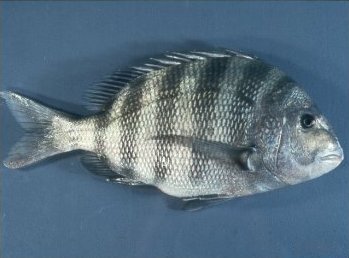 SheepsheadArchosargus probatocephalus
Compare
Questions and answers
What is the scientific name of the Cape Stumpnose?
The scientific name of the Cape Stumpnose is Rhabdosargus holubi. Written with its author, the full name is Rhabdosargus holubi (Steindachner, 1881).
Which family does the Cape Stumpnose belong to?
Rhabdosargus holubi belongs to the family Sparidae, in the order Perciformes and the class Teleostei.
Where is the Cape Stumpnose found?
Checklists and occurrence records place Rhabdosargus holubi in 2 countries: South Africa and Mozambique.
What is the conservation status of the Cape Stumpnose?
The IUCN Red List category recorded for Rhabdosargus holubi is Least Concern (LC).
Sources
Passages the profile rests on
- The species has a shiny silver body with a gold line extending from head to tail. Source passage: “It is a shiny silver fish with a gold line from head to tail.” — English Wikipedia
- The dorsal fin has 11 spines. Source passage: “The dorsal fin has 11 spines.” — English Wikipedia
- The mouth contains between six and eight incisors. Source passage: “the mouth contains 6 to 8 incisors.” — English Wikipedia
- Juveniles have cusped incisors. Source passage: “The incisors of the juvenile have cusps.” — English Wikipedia
- The species usually reaches approximately 15 cm in length. Source passage: “Rhabdosargus holubi is usually around 15 cm (5.9 in) long” — English Wikipedia
- Specimens measuring 40 cm in length have been recorded. Source passage: “specimens of 40 cm (16 in) have been seen.” — English Wikipedia
- Adults mainly inhabit the ocean, while juveniles develop in estuaries. Source passage: “adults mainly living in the ocean and juveniles developing in estuaries.” — English Wikipedia
- Juveniles inhabit eelgrass beds within estuaries. Source passage: “Within the estuary, the juveniles dwell in eelgrass beds” — English Wikipedia
- The species occurs in the Kowie Estuary. Source passage: “It inhabits estuaries such as the Kowie” — English Wikipedia
- Adults feed on bivalves and crustaceans. Source passage: “The diet of the adult is made up of bivalves and crustaceans.” — English Wikipedia
- Juveniles graze on vegetation. Source passage: “The juvenile grazes on vegetation.” — English Wikipedia
- The eelgrass Zostera capensis is the most commonly consumed plant material. Source passage: “The most commonly consumed plant is the eelgrass Zostera capensis” — English Wikipedia
- The species obtains nutrients from microorganisms attached to aquatic plants rather than digesting the plants themselves. Source passage: “It does not digest the plants, however. It digests the minute life forms stuck to them” — English Wikipedia
- Diatoms can constitute 50% of the dry weight of the material consumed. Source passage: “Diatoms, for example may make up 50% of the dry weight of the matter the fish consumes.” — English Wikipedia
- The species feeds during daylight hours. Source passage: “The fish feeds during the day.” — English Wikipedia
- Juveniles generally spend their first year of life in estuaries. Source passage: “The juveniles migrate into the estuaries and generally spend their first year of life there.” — English Wikipedia
- Juveniles migrate into estuaries. Source passage: “The juveniles migrate into the estuaries” — English Wikipedia
- The species has a moderate vulnerability score of 43 out of 100. Source passage: “Moderate vulnerability (43 of 100).” — fishbase.se
- The species is considered a desirable food fish by some sources. Source passage: “Rhabdosargus holubi is, according to some sources, a desirable food fish” — English Wikipedia
- Some fishermen are reportedly uninterested in the species because of its small size. Source passage: “others report that fishermen are not interested in it because it is too small.” — English Wikipedia
Data
- Catalogue of Life, 2026-10-16 XR cc by
- Global Biodiversity Information Facility CC BY 4.0
- Wikidata CC0
- GeoNames CC BY 4.0
- Wikimedia Commons per image; credit shown with each image
- Within the Catalogue of Life, this name comes from World Register of Marine Species cc by
This species in other databases
- Catalogue of Life 4RW7Z
- Wikidata Q2444668
- iNaturalist 127532
- WoRMS urn:lsid:marinespecies.org:taxname:218625
- ITIS 647977
Page built on 29 November 2026. See how the catalog is made and all sources and licences.
Cite this page
ScientificNames.org. (2026). Rhabdosargus holubi (Cape Stumpnose). Retrieved November 29, 2026, from https://scientificnames.org/species/rhabdosargus-holubi
“Rhabdosargus holubi (Cape Stumpnose).” ScientificNames.org, 2026, scientificnames.org/species/rhabdosargus-holubi. Accessed 29 Nov. 2026.
ScientificNames.org. “Rhabdosargus holubi (Cape Stumpnose).” Accessed November 29, 2026. https://scientificnames.org/species/rhabdosargus-holubi.
@misc{scientificnames_rhabdosargus_holubi_cape_stumpnose,
  author = {{ScientificNames.org}},
  title = {Rhabdosargus holubi (Cape Stumpnose)},
  year = {2026},
  url = {https://scientificnames.org/species/rhabdosargus-holubi},
  note = {Accessed 2026-11-29}
}