Species · Mammals
Acuminate Horseshoe Bat Rhinolophus acuminatus
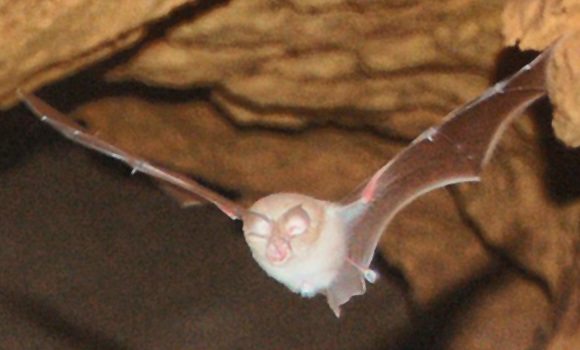
The scientific name of the Acuminate Horseshoe Bat is Rhinolophus acuminatus. It is a species of mammal in the family Rhinolophidae (horseshoe bat), order Chiroptera. The name dates from 1871.
- Scientific name
- Rhinolophus acuminatus Peters, 1871
- Common name
- Acuminate Horseshoe Bat
- Genus
- Rhinolophus
- Family
- Rhinolophidae (Horseshoe Bat)
- Order
- Chiroptera
- Class
- Mammalia
- Red List category
- LC Least Concern
- Recorded in
- 7 countries
- Name status
- accepted in the Catalogue of Life

Overview
The Acuminate Horseshoe Bat is a mammal in the family Rhinolophidae and order Chiroptera. Wilhelm Peters described the species as new in 1871. The species inhabits forests, upper montane forests and urban areas in Cambodia, Indonesia, Laos, Malaysia, Myanmar, Thailand and Vietnam. It is distinguished by its sharply upward-pointing sella and triangular connecting process.
Written 27 November 2026 from the sources listed below. Each statement was checked against the passage it cites; statements that could not be supported were removed.
Appearance
The forearm length ranges from 48 to 50 mm, the tail measures between 21 and 31 mm, and the ears measure 20–21 mm. Adult individuals weigh between 11.5 and 13.5 g.[1][2][3][4]
Male individuals are generally larger than females in Myanmar populations. The species closely resembles Rhinolophus affinis in overall morphology.[5][6]
The species name acuminatus is derived from the Latin word meaning pointed and may refer to the sharply upward-pointing shape of its sella.[7][8]
Habitat
The Acuminate Horseshoe Bat inhabits forests and urban areas. It also occurs in upper montane forest habitats.[9][10]
The species occurs in Cambodia, Indonesia, Laos, Malaysia, Myanmar, Thailand and Vietnam. A confirmed occurrence was documented in Gunung Mulu National Park in Sarawak, Malaysian Borneo, and the Melilas locality record in Brunei represents a new country record.[11][12][13]
The species has been recorded at elevations reaching 3,943 m above sea level.[14]
Behaviour
During daylight hours, the species roosts in sheltered locations such as caves and the undersides of palm leaves. It has been observed roosting in small colonies.[15][16]
In Myanmar, observed colonies have contained approximately 100 individuals, while aggregations in Vietnam have reached 500 bats. In Malaysia, the species has been documented roosting alone or in pairs.[17][18][19]
Conservation
The species was classified as Least Concern in its 2019 IUCN assessment. Its known range includes protected areas.[20][21]
Human disturbance of caves is identified as a local threat to the species.[22]
Similar species
The Acuminate Horseshoe Bat closely resembles Rhinolophus affinis in overall morphology. Its connecting process is triangular, whereas that of Rhinolophus affinis is rounded.[6][23]
The species is larger than other members of the pusillus morphological group. Despite sharing this morphological group, it belongs to a different evolutionary lineage from Rhinolophus pusillus.[24][25]
Classification of the Acuminate Horseshoe Bat
| Kingdom | Animalia |
|---|---|
| Phylum | Chordata |
| Subphylum | Vertebrata |
| Infraphylum | Gnathostomata |
| Parvphylum | Osteichthyes |
| Megaclass | Tetrapoda |
| Class | Mammalia (Mammal) |
| Subclass | Theria |
| Infraclass | Eutheria |
| Order | Chiroptera (Bat) |
| Suborder | Yinpterochiroptera |
| Superfamily | Rhinolophoidea |
| Family | Rhinolophidae (Horseshoe Bat) |
| Genus | Rhinolophus (Horseshoe Bat) |
| Species | Rhinolophus acuminatus Peters, 1871 |
Where the Acuminate Horseshoe Bat is found
Checklists and occurrence records place Rhinolophus acuminatus in 7 countries across Asia. GBIF holds 535 georeferenced records of it.
Countries
Regions and cities with the most records
- Sabah, Malaysia 48
- Lampung, Indonesia 30
- Ranau, Malaysia 28
- Surat Thani, Thailand 27
- Champasak Province, Laos 22
- Songkhla, Thailand 22
- Dong Nai, Vietnam 14
- Hat Yai, Thailand 11
- Bogor, Indonesia 10
- Caringin, Indonesia 8
- Cicurug, Indonesia 8
- Kelantan, Malaysia 7
- Pelabuhanratu, Indonesia 7
- Kampung Jeli, Malaysia 6
- Sarawak, Malaysia 6
- Chumphon, Thailand 4
- Chumphon, Thailand 4
- Phước Hòa, Vietnam 4
- Narathiwat, Thailand 3
Range as the checklists state it
Southern Asia
A number beside a place is its count of GBIF occurrence records. A place without a number comes from a checklist alone. Records show where a species has been observed or collected, which can include escapes and vagrants.
Common names
English
- Acuminate Horseshoe Bat
- Accuminate Horseshoe Bat
Names in 9 other languages
- Czech
- vrápenec špičatý
- Finnish
- indonesianherkko
- German
- Spitze Hufeisennase
- Indonesian
- Prok-bruk Loncos
- Japanese
- トガリキクガシラコウモリ
- Malay
- Kelawar Ladam Kenarong
- Polish
- Podkowiec szpiczasty
- Russian
- Серый подковонос
- Thai
- ค้างคาวมงกุฎยอดสั้นใหญ่
Subspecies and varieties
- Rhinolophus acuminatus acuminatus (Accuminate Horseshoe Bat) subspecies
- Rhinolophus acuminatus audax (Accuminate Horseshoe Bat) subspecies
- Rhinolophus acuminatus calypso (Accuminate Horseshoe Bat) subspecies
- Rhinolophus acuminatus circe (Accuminate Horseshoe Bat) subspecies
- Rhinolophus acuminatus sumatranus (Sumatra's Accuminate Horseshoe Bat) subspecies
Related species
-
 Greater Horseshoe BatRhinolophus ferrumequinum
-
 Lesser Horseshoe BatRhinolophus hipposideros
-
 Mediterranean Horseshoe BatRhinolophus euryale
-
 Intermediate Horseshoe BatRhinolophus affinis
-
 Blasius's Horseshoe BatRhinolophus blasii
-
 Mehely's Horseshoe BatRhinolophus mehelyi
- Andaman Horseshoe BatRhinolophus cognatus
-
 Least Horseshoe BatRhinolophus pusillus
Compare
Questions and answers
What is the scientific name of the Acuminate Horseshoe Bat?
The scientific name of the Acuminate Horseshoe Bat is Rhinolophus acuminatus. Written with its author, the full name is Rhinolophus acuminatus Peters, 1871.
Which family does the Acuminate Horseshoe Bat belong to?
Rhinolophus acuminatus belongs to the family Rhinolophidae, in the order Chiroptera and the class Mammalia.
Where is the Acuminate Horseshoe Bat found?
Checklists and occurrence records place Rhinolophus acuminatus in 7 countries, including Indonesia, Thailand, Malaysia, Cambodia, Laos and Vietnam.
What is the conservation status of the Acuminate Horseshoe Bat?
The IUCN Red List category recorded for Rhinolophus acuminatus is Least Concern (LC).
What other names does the Acuminate Horseshoe Bat have?
Rhinolophus acuminatus is also known in English as Accuminate Horseshoe Bat.
Where does the horseshoe bat live?
The Acuminate Horseshoe Bat inhabits forests, upper montane forests and urban areas in Cambodia, Indonesia, Laos, Malaysia, Myanmar, Thailand and Vietnam. It has also been recorded in Gunung Mulu National Park in Sarawak, Malaysian Borneo, and at the Melilas locality in Brunei.[9][11][12][13][10]
Sources
Passages the profile rests on
- The forearm length of this bat ranges from 48 to 50 mm. Source passage: “Its forearm length is 48–50 mm (1.9–2.0 in);” — English Wikipedia
- Its tail measures between 21 and 31 mm in length. Source passage: “its tail length is 21–31 mm (0.83–1.22 in);” — English Wikipedia
- Its ears measure 20–21 mm in length. Source passage: “its ear length is 20–21 mm (0.79–0.83 in).” — English Wikipedia
- Adult individuals weigh between 11.5 and 13.5 g. Source passage: “It weighs 11.5–13.5 g (0.41–0.48 oz).” — English Wikipedia
- Male individuals are generally larger than females in Myanmar populations. Source passage: “In Myanmar, males are generally larger than females” — pmc.ncbi.nlm.nih.gov
- The acuminate horseshoe bat closely resembles Rhinolophus affinis in overall morphology. Source passage: “Although it closely resembles R. affinis in overall morphology,” — pmc.ncbi.nlm.nih.gov
- The species name acuminatus is derived from the Latin word meaning pointed. Source passage: “Its species name "acuminatus" is Latin for "pointed."” — English Wikipedia
- The species name may refer to the sharply upward-pointing shape of its sella. Source passage: “The inspiration for this name was perhaps its "sharply upwards pointed sella."” — English Wikipedia
- The species inhabits forests and urban areas. Source passage: “It lives in forests and urban areas.” — English Wikipedia
- The species occurs in upper montane forest habitats. Source passage: “indicating the species' presence in upper montane forest habitats.” — pmc.ncbi.nlm.nih.gov
- The species occurs in Cambodia, Indonesia, Laos, Malaysia, Myanmar, Thailand and Vietnam. Source passage: “including Cambodia, Indonesia, Laos, Malaysia, Myanmar, Thailand, and Vietnam.” — English Wikipedia
- A confirmed occurrence of the species was documented in Gunung Mulu National Park in Sarawak, Malaysian Borneo. Source passage: “We report the first confirmed occurrence of R. acuminatus in Sarawak, specifically within Gunung Mulu National Park,” — pmc.ncbi.nlm.nih.gov
- The Melilas locality record in Brunei represents a new country record for the species. Source passage: “the Brunei record constitutes a new country record for R. acuminatus.” — pmc.ncbi.nlm.nih.gov
- The species has been recorded at elevations reaching 3,943 m above sea level. Source passage: “to a new upper limit of 3,943 m a.s.l.,” — pmc.ncbi.nlm.nih.gov
- During daylight hours, the species roosts in sheltered locations such as caves and the undersides of palm leaves. Source passage: “roosting in sheltered places during the day such as inside caves or on the undersides of palm leaves.” — English Wikipedia
- The species has been observed roosting in small colonies. Source passage: “It roosts in small colonies.” — English Wikipedia
- In Myanmar, observed colonies have contained approximately 100 individuals. Source passage: “Observations from the same region recorded colonies of around 100 individuals,” — pmc.ncbi.nlm.nih.gov
- In Vietnam, aggregations of this species have reached 500 bats. Source passage: “surveys in Vietnam found aggregations of up to 500 bats” — pmc.ncbi.nlm.nih.gov
- In Malaysia, the species has been documented roosting alone or in pairs. Source passage: “studies in Malaysia documented this species roosting solitarily or in pairs” — pmc.ncbi.nlm.nih.gov
- The species was classified as Least Concern in its 2019 IUCN assessment. Source passage: “during which it was categorised as Least Concern.” — pmc.ncbi.nlm.nih.gov
- The species' known range includes protected areas. Source passage: “Its range includes protected areas.” — English Wikipedia
- Human disturbance of caves is identified as a local threat to the species. Source passage: “although cave disturbance by humans is a local threat.” — English Wikipedia
- The connecting process is triangular in the acuminate horseshoe bat and rounded in Rhinolophus affinis. Source passage: “the connecting process, which is triangular in R. acuminatus and rounded in R. affinis” — pmc.ncbi.nlm.nih.gov
- The acuminate horseshoe bat is larger than other members of the pusillus morphological group. Source passage: “Within this group, Rhinolophus acuminatus is notably larger than other members” — pmc.ncbi.nlm.nih.gov
- The acuminate horseshoe bat belongs to a different evolutionary lineage from Rhinolophus pusillus despite sharing its morphological group. Source passage: “Despite being placed in the same morphological group as R. pusillus, phylogenetic evidence indicates that R. acuminatus belongs to a different evolutionary lineage” — pmc.ncbi.nlm.nih.gov
Data
- Catalogue of Life, 2026-10-16 XR cc by
- Global Biodiversity Information Facility CC BY 4.0
- Wikidata CC0
- GeoNames CC BY 4.0
- Wikimedia Commons per image; credit shown with each image
- Within the Catalogue of Life, this name comes from The Integrated Taxonomic Information System cc0
References
- Monatsb. K. Preuss. Akad. Wiss. Berlin vol.1871 p.308 where the name was published
- Dobson, & George Edward. (1878). Chiroptera in the Collection of the British Museum.
- Wilson, Don E., and DeeAnn M. Reeder, eds. (1993). Mammal Species of the World: A Taxonomic and Geographic Reference, 2nd Ed., 3rd Printing.
- Wilson, Don E., and F. Russell Cole. (2000). Common Names of Mammals of the World.
- Simmons, Nancy B. / Wilson, Don E., and DeeAnn M. Reeder, eds. (2005). Order Chiroptera. Mammal Species of the World: A Taxonomic and Geographic Reference, 3rd Ed., Vols. 1 & 2.
- Wilson, D. E., and R. A. Mittermeier, eds. (2019). Handbook of the Mammals of the World. Vol. 9: Bats.
This species in other databases
Page built on 29 November 2026. See how the catalog is made and all sources and licences.
Cite this page
ScientificNames.org. (2026). Rhinolophus acuminatus (Acuminate Horseshoe Bat). Retrieved November 29, 2026, from https://scientificnames.org/species/rhinolophus-acuminatus
“Rhinolophus acuminatus (Acuminate Horseshoe Bat).” ScientificNames.org, 2026, scientificnames.org/species/rhinolophus-acuminatus. Accessed 29 Nov. 2026.
ScientificNames.org. “Rhinolophus acuminatus (Acuminate Horseshoe Bat).” Accessed November 29, 2026. https://scientificnames.org/species/rhinolophus-acuminatus.
@misc{scientificnames_rhinolophus_acuminatus_acuminate_horseshoe_bat,
  author = {{ScientificNames.org}},
  title = {Rhinolophus acuminatus (Acuminate Horseshoe Bat)},
  year = {2026},
  url = {https://scientificnames.org/species/rhinolophus-acuminatus},
  note = {Accessed 2026-11-29}
}