Species · Mammals
Adam's Horseshoe Bat Rhinolophus adami
The scientific name of the Adam's Horseshoe Bat is Rhinolophus adami. It is a species of mammal in the family Rhinolophidae (horseshoe bat), order Chiroptera. The name dates from 1968.
- Scientific name
- Rhinolophus adami Aellen & Brosset, 1968
- Common name
- Adam's Horseshoe Bat
- Genus
- Rhinolophus
- Family
- Rhinolophidae (Horseshoe Bat)
- Order
- Chiroptera
- Class
- Mammalia
- Red List category
- DD Data Deficient
- Recorded in
- 1 country
- Name status
- accepted in the Catalogue of Life
Overview
Rhinolophus adami is endemic to the Republic of the Congo. It is distinguished by a forearm measuring 47–49 mm in length and a nose-leaf measuring 15–16 mm in length and 8.5–9 mm in width.
Written 27 November 2026 from the sources listed below. Each statement was checked against the passage it cites; statements that could not be supported were removed.
Appearance
The forearm measures 47–49 mm in length. The ears measure 25–26 mm in length.[1][2]
The nose-leaf measures 15–16 mm in length and 8.5–9 mm in width.[3]
Habitat
The species uses caves and other subterranean habitats as natural habitats. It has been observed in only one cave in the Kouilou Department of the Republic of the Congo.[4][5]
Behaviour
Adam's Horseshoe Bat is nocturnal. During daylight hours, it roosts in sheltered locations, including caves.[6][7]
Conservation
The species is classified as Data Deficient by the IUCN. As of 2019, it had not been observed after the ten individuals collected for its original description in 1968.[8][9]
Classification of the Adam's Horseshoe Bat
| Kingdom | Animalia |
|---|---|
| Phylum | Chordata |
| Subphylum | Vertebrata |
| Infraphylum | Gnathostomata |
| Parvphylum | Osteichthyes |
| Megaclass | Tetrapoda |
| Class | Mammalia (Mammal) |
| Subclass | Theria |
| Infraclass | Eutheria |
| Order | Chiroptera (Bat) |
| Suborder | Yinpterochiroptera |
| Superfamily | Rhinolophoidea |
| Family | Rhinolophidae (Horseshoe Bat) |
| Genus | Rhinolophus (Horseshoe Bat) |
| Species | Rhinolophus adami Aellen & Brosset, 1968 |
Where the Adam's Horseshoe Bat is found
Checklists and occurrence records place Rhinolophus adami in 1 country across Africa. GBIF holds 15 georeferenced records of it.
Countries
Range as the checklists state it
Africa
A number beside a place is its count of GBIF occurrence records. A place without a number comes from a checklist alone. Records show where a species has been observed or collected, which can include escapes and vagrants.
Common names
English
- Adam's Horseshoe Bat
- Adam's Horseshoe Bat.
Names in 6 other languages
- Czech
- vrápenec Adamův
- Finnish
- kongonherkko
- French
- Rhinolophe du Congo
- German
- Adams Hufeisennase, Kongohufeisennase
- Japanese
- コンゴキクガシラコウモリ
- Polish
- Podkowiec samotny
Related species
-
 Greater Horseshoe BatRhinolophus ferrumequinum
-
 Lesser Horseshoe BatRhinolophus hipposideros
-
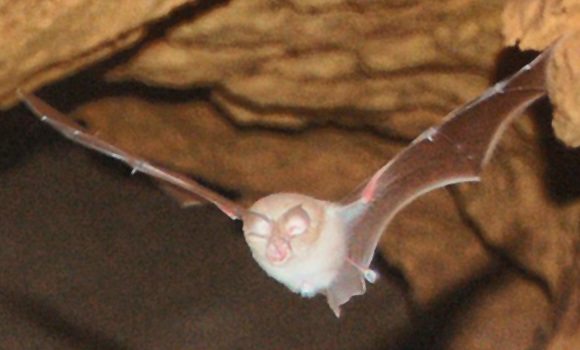 Mediterranean Horseshoe BatRhinolophus euryale
-
 Intermediate Horseshoe BatRhinolophus affinis
-
 Blasius's Horseshoe BatRhinolophus blasii
-
 Mehely's Horseshoe BatRhinolophus mehelyi
- Andaman Horseshoe BatRhinolophus cognatus
-
 Least Horseshoe BatRhinolophus pusillus
Compare
Questions and answers
What is the scientific name of the Adam's Horseshoe Bat?
The scientific name of the Adam's Horseshoe Bat is Rhinolophus adami. Written with its author, the full name is Rhinolophus adami Aellen & Brosset, 1968.
Which family does the Adam's Horseshoe Bat belong to?
Rhinolophus adami belongs to the family Rhinolophidae, in the order Chiroptera and the class Mammalia.
Where is the Adam's Horseshoe Bat found?
Checklists and occurrence records place Rhinolophus adami in 1 country: Republic of the Congo.
What is the conservation status of the Adam's Horseshoe Bat?
The IUCN Red List category recorded for Rhinolophus adami is Data Deficient (DD).
What other names does the Adam's Horseshoe Bat have?
Rhinolophus adami is also known in English as Adam's Horseshoe Bat..
Where are horseshoe bats found?
Adam's Horseshoe Bat is endemic to the Republic of the Congo. It has been observed in only one cave in the Kouilou Department.[10][5]
Where do horseshoe bats live?
Adam's Horseshoe Bat uses caves and other subterranean habitats as natural habitats.[4]
Sources
Passages the profile rests on
- Its forearm measures 47–49 mm in length. Source passage: “Its forearm length is 47–49 mm (1.9–1.9 in).” — English Wikipedia
- Its ears measure 25–26 mm in length. Source passage: “Its ears are relatively long, at 25–26 mm (0.98–1.02 in).” — English Wikipedia
- Its nose-leaf measures 15–16 mm in length and 8.5–9 mm in width. Source passage: “It has a large nose-leaf, at 15–16 mm (0.59–0.63 in) long and 8.5–9 mm (0.33–0.35 in) wide.” — English Wikipedia
- The species uses caves and other subterranean habitats as natural habitats. Source passage: “Its natural habitats are caves and subterranean habitats (other than caves).” — inaturalist.org
- The species has been observed in only one cave in the Kouilou Department of the Republic of the Congo. Source passage: “It has only been observed in a single cave in the Kouilou Department of the Republic of the Congo.” — English Wikipedia
- The species is nocturnal. Source passage: “It is nocturnal, roosting in sheltered places during the day such as caves.” — English Wikipedia
- The species roosts in sheltered locations during daylight hours, including caves. Source passage: “It is nocturnal, roosting in sheltered places during the day such as caves.” — English Wikipedia
- The species is classified as Data Deficient by the IUCN. Source passage: “It is currently evaluated as data deficient by the IUCN.” — English Wikipedia
- The species had not been observed after the ten individuals collected for its original description in 1968, as of 2019. Source passage: “As of 2019, the species had not been observed since the series of ten individuals used to describe the species in 1968.” — English Wikipedia
- Adam's horseshoe bat is endemic to the Republic of the Congo. Source passage: “It is endemic to Republic of the Congo.” — English Wikipedia
Data
- Catalogue of Life, 2026-10-16 XR cc by
- Global Biodiversity Information Facility CC BY 4.0
- Wikidata CC0
- GeoNames CC BY 4.0
- Within the Catalogue of Life, this name comes from The Integrated Taxonomic Information System cc0
References
- Aellen, V., and A. Brosset. (1968). Chiroptères du sud du Congo (Brazzaville). Revue Suisse de Zoologie, Vol. 75, No. 14. where the name was published
- Wilson, Don E., and DeeAnn M. Reeder, eds. (1993). Mammal Species of the World: A Taxonomic and Geographic Reference, 2nd Ed., 3rd Printing.
- Wilson, Don E., and F. Russell Cole. (2000). Common Names of Mammals of the World.
- Simmons, Nancy B. / Wilson, Don E., and DeeAnn M. Reeder, eds. (2005). Order Chiroptera. Mammal Species of the World: A Taxonomic and Geographic Reference, 3rd Ed., Vols. 1 & 2.
- Wilson, D. E., and R. A. Mittermeier, eds. (2019). Handbook of the Mammals of the World. Vol. 9: Bats.
This species in other databases
Page built on 28 November 2026. See how the catalog is made and all sources and licences.
Cite this page
ScientificNames.org. (2026). Rhinolophus adami (Adam's Horseshoe Bat). Retrieved November 28, 2026, from https://scientificnames.org/species/rhinolophus-adami
“Rhinolophus adami (Adam's Horseshoe Bat).” ScientificNames.org, 2026, scientificnames.org/species/rhinolophus-adami. Accessed 28 Nov. 2026.
ScientificNames.org. “Rhinolophus adami (Adam's Horseshoe Bat).” Accessed November 28, 2026. https://scientificnames.org/species/rhinolophus-adami.
@misc{scientificnames_rhinolophus_adami_adams_horseshoe_bat,
  author = {{ScientificNames.org}},
  title = {Rhinolophus adami (Adam's Horseshoe Bat)},
  year = {2026},
  url = {https://scientificnames.org/species/rhinolophus-adami},
  note = {Accessed 2026-11-28}
}