Species · Mammals
Cape Horseshoe Bat Rhinolophus capensis
The scientific name of the Cape Horseshoe Bat is Rhinolophus capensis. It is a species of mammal in the family Rhinolophidae (horseshoe bat), order Chiroptera. The name dates from 1823.
- Scientific name
- Rhinolophus capensis Lichtenstein, 1823
- Common name
- Cape Horseshoe Bat
- Genus
- Rhinolophus
- Family
- Rhinolophidae (Horseshoe Bat)
- Order
- Chiroptera
- Class
- Mammalia
- Red List category
- LC Least Concern
- Recorded in
- 3 countries
- Name status
- accepted in the Catalogue of Life

Overview
The Cape Horseshoe Bat (Rhinolophus capensis) is a monotypic species with no recognized subspecies. The species is endemic to South Africa and occurs in Cape Province. It is distinguished by a horseshoe-shaped nose-leaf with a projecting spear-shaped lancet above and between the eyes.
Written 27 November 2026 from the sources listed below. Each statement was checked against the passage it cites; statements that could not be supported were removed.
Habitat
The Cape Horseshoe Bat inhabits shrubby coastal environments. It uses coastal caves as daytime roosting sites.[1][2]
Appearance
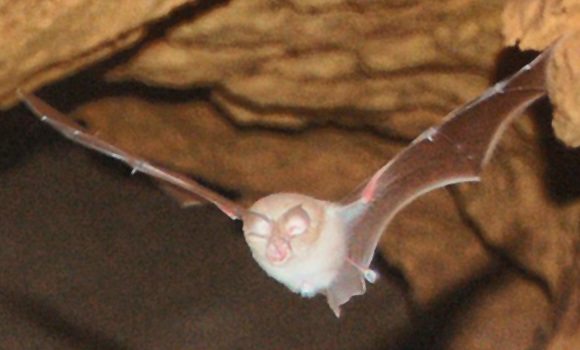
The body fur is dark brown or pale brown over most of its surface, while the underparts are paler and fawn-grey.[3][4]
The ears are large and somewhat rounded, and can move independently of one another.[5][6]
The nose-leaf has a horseshoe shape and does not extend to the upper muzzle. It has a rounded, sparsely haired process on its upper mid-surface and a projecting spear-shaped lancet above and between the eyes.[7][8][9]
Head-and-body length ranges from 5.8 to 6.2 centimetres, and the tail measures between 2.4 and 3.2 centimetres. Adult body mass ranges from 10 to 16 grams.[10][11][12]
Diet
The Cape Horseshoe Bat is an ambush hunter that conceals itself among vegetation. It preys mainly on beetles and moths, and beetles constitute a high percentage of its insect diet.[13][14][15][16]
Behaviour
The bats spend the daytime roosting in large colonies. They sometimes share roosting locations with Geoffroy's horseshoe bat and Schreibers' long-fingered bat.[17][18]
The species has low wing loading and a high aspect ratio, characteristics associated with slow but highly manoeuvrable flight. This manoeuvrability enables it to forage effectively within dense vegetation.[19][20]
Echolocation calls last between 28 and 42 milliseconds and have short pauses between pulses. Peak echolocation frequency varies among individuals from 82 to 86 kHz.[21][22][23]
The echolocation call structure enables the bats to locate rapidly moving insects in vegetation-rich cluttered environments.[24]
Reproduction and life cycle
The breeding season occurs from August to September. Male spermatogenesis takes place between October and May, and males store sperm in the epididymis until the breeding season begins.[25][26][27]
Gestation lasts approximately three to four months. Females give birth to a single offspring in November or December, shortly before the rainy season when insects are most abundant.[28][29][30][31]
Young bats are weaned by the end of January. Individuals reach sexual maturity during their second year.[32][33]
Conservation
The species is classified as Least Concern by the IUCN. It is potentially threatened by habitat loss and disturbance of roosting sites.[34][35]
Similar species
The Cape Horseshoe Bat belongs to the Rhinolophus capensis species group alongside the Bushveld, Dent's and Swinny's horseshoe bats.[36]
Classification of the Cape Horseshoe Bat
| Kingdom | Animalia |
|---|---|
| Phylum | Chordata |
| Subphylum | Vertebrata |
| Infraphylum | Gnathostomata |
| Parvphylum | Osteichthyes |
| Megaclass | Tetrapoda |
| Class | Mammalia (Mammal) |
| Subclass | Theria |
| Infraclass | Eutheria |
| Order | Chiroptera (Bat) |
| Suborder | Yinpterochiroptera |
| Superfamily | Rhinolophoidea |
| Family | Rhinolophidae (Horseshoe Bat) |
| Genus | Rhinolophus (Horseshoe Bat) |
| Species | Rhinolophus capensis Lichtenstein, 1823 |
Where the Cape Horseshoe Bat is found
Checklists and occurrence records place Rhinolophus capensis in 3 countries across Africa. GBIF holds 121 georeferenced records of it.
Countries
Regions and cities with the most records
- Western Cape, South Africa 19
- Eastern Cape, South Africa 6
- Gurúè, Mozambique 3
- Knysna, South Africa 3
- Northern Cape, South Africa 3
- Zambezia Province, Mozambique 3
Range as the checklists state it
Africa
A number beside a place is its count of GBIF occurrence records. A place without a number comes from a checklist alone. Records show where a species has been observed or collected, which can include escapes and vagrants.
Common names
English
- Cape Horseshoe Bat
- Southern Africa Horseshoe Bat
Names in 7 other languages
- Czech
- vrápenec jihoafrický
- Finnish
- kapinherkko
- German
- Kap-Hufeisennase
- Japanese
- ケープキクガシラコウモリ
- Polish
- Podkowiec przylądkowy
- Russian
- Южноафриканский подковонос
- Spanish
- Murciélago de Herradura de El Cabo
Synonyms
3 other scientific names have been used for this species and are now treated as synonyms of Rhinolophus capensis.
- Rhinolophus auritus Sundevall, 1860
- Rhinolophus auritus Victorin
- Rhinolophus clivosus Smith
Subspecies and varieties
- Rhinolophus geoffroyii keniensis subspecies
Related species
-
 Greater Horseshoe BatRhinolophus ferrumequinum
-
 Lesser Horseshoe BatRhinolophus hipposideros
-
 Mediterranean Horseshoe BatRhinolophus euryale
-
 Intermediate Horseshoe BatRhinolophus affinis
-
 Blasius's Horseshoe BatRhinolophus blasii
-
 Mehely's Horseshoe BatRhinolophus mehelyi
- Andaman Horseshoe BatRhinolophus cognatus
-
 Least Horseshoe BatRhinolophus pusillus
Compare
Questions and answers
What is the scientific name of the Cape Horseshoe Bat?
The scientific name of the Cape Horseshoe Bat is Rhinolophus capensis. Written with its author, the full name is Rhinolophus capensis Lichtenstein, 1823.
Which family does the Cape Horseshoe Bat belong to?
Rhinolophus capensis belongs to the family Rhinolophidae, in the order Chiroptera and the class Mammalia.
Where is the Cape Horseshoe Bat found?
Checklists and occurrence records place Rhinolophus capensis in 3 countries: South Africa, Namibia and Mozambique.
What is the conservation status of the Cape Horseshoe Bat?
The IUCN Red List category recorded for Rhinolophus capensis is Least Concern (LC).
What other names does the Cape Horseshoe Bat have?
Rhinolophus capensis is also known in English as Southern Africa Horseshoe Bat.
Why are they called horseshoe bats?
The nose-leaf of the Cape Horseshoe Bat has a horseshoe shape and does not extend to the upper muzzle.[7]
What does the horseshoe bat eat?
The Cape Horseshoe Bat eats insects, mainly beetles and moths. Beetles constitute a high percentage of its diet.[14][15][16]
Sources
Passages the profile rests on
- The species inhabits shrubby coastal environments. Source passage: “where they inhabit shrubby coastal environments.” — English Wikipedia
- The species uses coastal caves as daytime roosting sites. Source passage: “roosting in large colonies in coastal caves” — English Wikipedia
- The body fur is dark brown or pale brown over most of its surface. Source passage: “The fur is dark or pale brown over most of the body” — English Wikipedia
- The underparts are paler and fawn-grey in colour. Source passage: “with paler, fawn-grey, underparts.” — English Wikipedia
- The ears are large and somewhat rounded. Source passage: “The ears are large and somewhat rounded” — English Wikipedia
- The ears can move independently of one another. Source passage: “are capable of independent movement.” — English Wikipedia
- The nose-leaf has a horseshoe shape and does not extend to the upper muzzle. Source passage: “The nose-leaf is horseshoe-shaped, and does not reach the upper parts of the muzzle.” — English Wikipedia
- The nose-leaf has a rounded, sparsely haired process on its upper mid-surface. Source passage: “A rounded, sparsely-haired, process runs from the upper mid-surface of the nose-leaf” — English Wikipedia
- The nose-leaf bears a projecting spear-shaped lancet above and between the eyes. Source passage: “to a projecting spear-shaped lancet above and between the eyes.” — English Wikipedia
- The head-and-body length ranges from 5.8 to 6.2 centimetres. Source passage: “head-body length of 5.8 to 6.2 centimetres” — English Wikipedia
- The tail measures between 2.4 and 3.2 centimetres long. Source passage: “a tail 2.4 to 3.2 centimetres” — English Wikipedia
- Adult body mass ranges from 10 to 16 grams. Source passage: “They weigh between 10 and 16 grams” — English Wikipedia
- Cape horseshoe bats are ambush hunters that conceal themselves among vegetation. Source passage: “They are ambush hunters, hiding among vegetation” — English Wikipedia
- The species preys mainly on beetles and moths. Source passage: “preying mainly on beetles and moths.” — English Wikipedia
- Insects form the diet of Cape horseshoe bats. Source passage: “Cape horseshoe bats are insectivores” — animaldiversity.org
- Beetles constitute a high percentage of the species' diet. Source passage: “with a high percentage of their diet consisting of beetles.” — animaldiversity.org
- The bats spend the daytime roosting in large colonies. Source passage: “spending the day roosting in large colonies” — English Wikipedia
- The species sometimes shares roosting locations with Geoffroy's horseshoe bat and Schreibers' long-fingered bat. Source passage: “They are often found together with other species of bat, including Geoffroy's horseshoe bat and Schreibers' long-fingered bat.” — English Wikipedia
- The species has low wing loading and a high aspect ratio, characteristics associated with slow but highly manoeuvrable flight. Source passage: “The wings have a low wing loading and a high aspect ratio, indicating that the bat is capable of only slow flight, but is highly manoeuvrable in the air.” — English Wikipedia
- Its manoeuvrability enables it to forage effectively within dense vegetation. Source passage: “This allows it to forage effectively among dense vegetation.” — English Wikipedia
- The echolocation calls last between 28 and 42 milliseconds. Source passage: “lasting from 28 to 42 milliseconds” — English Wikipedia
- The species produces echolocation calls with short pauses between pulses. Source passage: “with only short pauses between pulses.” — English Wikipedia
- Peak echolocation frequency varies among individuals from 82 to 86 kHz. Source passage: “The peak frequency varies between different individuals, ranging from 82 to 86 kHz.” — English Wikipedia
- The echolocation call structure enables the bats to locate rapidly moving insects in vegetation-rich cluttered environments. Source passage: “This type of call enables them to quickly locate rapidly moving insects in cluttered environments with plentiful vegetation.” — English Wikipedia
- The breeding season occurs from August to September. Source passage: “The breeding season lasts from August to September” — English Wikipedia
- Male spermatogenesis takes place between October and May. Source passage: “spermatogenesis in the males occurs between October and May” — English Wikipedia
- Males store sperm in the epididymis until the breeding season begins. Source passage: “with the sperm being stored in the epididymis until the start of the breeding season.” — English Wikipedia
- Gestation lasts approximately three to four months. Source passage: “Gestation lasts three or four months” — English Wikipedia
- Females give birth to a single offspring. Source passage: “the mother gives birth to a single young” — English Wikipedia
- Births occur in November or December. Source passage: “in November or December” — English Wikipedia
- The timing of birth coincides with the period shortly before the rainy season, when insects are most abundant. Source passage: “shortly before the rainy season, when insects are at their most abundant.” — English Wikipedia
- Young bats are weaned by the end of January. Source passage: “The young are weaned by the end of January” — English Wikipedia
- Individuals reach sexual maturity during their second year. Source passage: “and reach sexual maturity in their second year.” — English Wikipedia
- The species is potentially threatened by habitat loss and disturbance of roosting sites. Source passage: “potentially threatened by habitat loss and disturbance of its roosting sites” — English Wikipedia
- The species is classified as Least Concern by the IUCN. Source passage: “to be considered of least concern by the IUCN.” — English Wikipedia
- The Cape horseshoe bat belongs to the Rhinolophus capensis species group alongside the Bushveld, Dent's and Swinny's horseshoe bats. Source passage: “It is a member of the Rhinolophus capensis species group, together with the Bushveld, Dent's and Swinny's horseshoe bats” — English Wikipedia
- The Cape horseshoe bat is endemic to South Africa. Source passage: “It is endemic to South Africa” — English Wikipedia
- The species occurs in Cape Province, South Africa. Source passage: “Cape horseshoe bats are endemic to Cape Province in South Africa” — English Wikipedia
Data
- Catalogue of Life, 2026-10-16 XR cc by
- Global Biodiversity Information Facility CC BY 4.0
- Wikidata CC0
- GeoNames CC BY 4.0
- Wikimedia Commons per image; credit shown with each image
- Within the Catalogue of Life, this name comes from The Integrated Taxonomic Information System cc0
References
- Verz. Doblet. Mus. Univ. Berlin p.4 where the name was published
- Dobson, & George Edward. (1878). Chiroptera in the Collection of the British Museum.
- Wilson, Don E., and DeeAnn M. Reeder, eds. (1993). Mammal Species of the World: A Taxonomic and Geographic Reference, 2nd Ed., 3rd Printing.
- Wilson, Don E., and F. Russell Cole. (2000). Common Names of Mammals of the World.
- Simmons, Nancy B. / Wilson, Don E., and DeeAnn M. Reeder, eds. (2005). Order Chiroptera. Mammal Species of the World: A Taxonomic and Geographic Reference, 3rd Ed., Vols. 1 & 2.
- Wilson, D. E., and R. A. Mittermeier, eds. (2019). Handbook of the Mammals of the World. Vol. 9: Bats.
This species in other databases
Page built on 27 November 2026. See how the catalog is made and all sources and licences.
Cite this page
ScientificNames.org. (2026). Rhinolophus capensis (Cape Horseshoe Bat). Retrieved November 27, 2026, from https://scientificnames.org/species/rhinolophus-capensis
“Rhinolophus capensis (Cape Horseshoe Bat).” ScientificNames.org, 2026, scientificnames.org/species/rhinolophus-capensis. Accessed 27 Nov. 2026.
ScientificNames.org. “Rhinolophus capensis (Cape Horseshoe Bat).” Accessed November 27, 2026. https://scientificnames.org/species/rhinolophus-capensis.
@misc{scientificnames_rhinolophus_capensis_cape_horseshoe_bat,
  author = {{ScientificNames.org}},
  title = {Rhinolophus capensis (Cape Horseshoe Bat)},
  year = {2026},
  url = {https://scientificnames.org/species/rhinolophus-capensis},
  note = {Accessed 2026-11-27}
}