Species · Mammals
Decken's Horseshoe Bat Rhinolophus deckenii
The scientific name of the Decken's Horseshoe Bat is Rhinolophus deckenii. It is a species of mammal in the family Rhinolophidae (horseshoe bat), order Chiroptera. The name dates from 1868.
- Scientific name
- Rhinolophus deckenii Peters, 1868
- Common name
- Decken's Horseshoe Bat
- Genus
- Rhinolophus
- Family
- Rhinolophidae (Horseshoe Bat)
- Order
- Chiroptera
- Class
- Mammalia
- Red List category
- NT Near Threatened
- Recorded in
- 4 countries
- Name status
- accepted in the Catalogue of Life

Overview
The species is documented in Kenya and Tanzania. It has a forearm length of 48 to 56 mm and a nose-leaf horseshoe width of 9 to 11 mm.
Written 27 November 2026 from the sources listed below. Each statement was checked against the passage it cites; statements that could not be supported were removed.
Habitat
Decken's Horseshoe Bat has been recorded in tropical and subtropical moist lowland and montane forests. It is associated with forested land, although its habitat preferences are poorly understood.[1][2]
The species uses caves and other subterranean habitats.[3]
Appearance
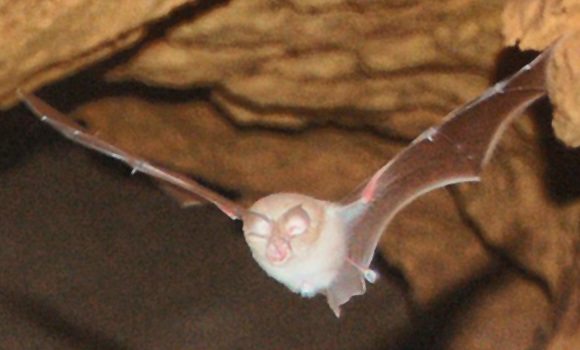
Decken's Horseshoe Bat is considered medium-sized among African horseshoe bats. Its forearm length ranges from 48 to 56 mm, and individuals weigh approximately 15 g.[4][5][6]
The width of its nose-leaf horseshoe ranges from 9 to 11 mm. Its skull has a greatest length exceeding 22 mm.[7][8]
Similar species
Decken's Horseshoe Bat has sometimes been classified as a subspecies of Geoffroy's horseshoe bat (Rhinolophus clivosus).[9]
It can be distinguished from Darling's horseshoe bat by its skull length exceeding 22 mm, compared with less than 21 mm in Darling's horseshoe bat.[10]
Conservation
The species was evaluated as near threatened by the IUCN as of 2008. It is considered close to qualifying for vulnerable conservation status and is likely experiencing a significant population decline.[11][12][13]
Deforestation for agricultural clearing and logging are identified threats to the species.[14]
Classification of the Decken's Horseshoe Bat
| Kingdom | Animalia |
|---|---|
| Phylum | Chordata |
| Subphylum | Vertebrata |
| Infraphylum | Gnathostomata |
| Parvphylum | Osteichthyes |
| Megaclass | Tetrapoda |
| Class | Mammalia (Mammal) |
| Subclass | Theria |
| Infraclass | Eutheria |
| Order | Chiroptera (Bat) |
| Suborder | Yinpterochiroptera |
| Superfamily | Rhinolophoidea |
| Family | Rhinolophidae (Horseshoe Bat) |
| Genus | Rhinolophus (Horseshoe Bat) |
| Species | Rhinolophus deckenii Peters, 1868 |
Where the Decken's Horseshoe Bat is found
Checklists and occurrence records place Rhinolophus deckenii in 4 countries across Africa. GBIF holds 232 georeferenced records of it.
Countries
Regions and cities with the most records
- Kilifi County, Kenya 77
- Watamu, Kenya 68
- Malindi, Kenya 56
- Morogoro, Tanzania 19
- Kilifi, Kenya 9
- Pwani, Tanzania 9
- Chake Chake, Tanzania 8
- Mkoani, Tanzania 8
- Pemba South, Tanzania 8
- Tanga, Tanzania 6
- Kilindoni, Tanzania 5
- Maramba, Tanzania 5
- Zanzibar North, Tanzania 5
- Kidatu, Tanzania 4
- Mossuril, Mozambique 4
- Mozambique, Mozambique 4
- Nampula, Mozambique 4
- Iringa, Tanzania 3
- Nkhotakota, Malawi 3
- Zanzibar, Tanzania 3
Range as the checklists state it
Africa
A number beside a place is its count of GBIF occurrence records. A place without a number comes from a checklist alone. Records show where a species has been observed or collected, which can include escapes and vagrants.
Common names
English
- Decken's Horseshoe Bat
- Decken's Horseshoe Bat.
Names in 8 other languages
- Czech
- vrápenec Deckenův
- Finnish
- tansanianherkko
- French
- Rhinolophe de Decken
- German
- Deckens Hufeisennase
- Italian
- Ferro di cavallo di Decken
- Japanese
- デッケンキクガシラコウモリ
- Polish
- Podkowiec tanzański
- Russian
- Подковонос Декена
Synonyms
One other scientific name has been used for this species and is now treated as a synonym of Rhinolophus deckenii.
- Rhinolophus deckend Peters
Related species
-
 Greater Horseshoe BatRhinolophus ferrumequinum
-
 Lesser Horseshoe BatRhinolophus hipposideros
-
 Mediterranean Horseshoe BatRhinolophus euryale
-
 Intermediate Horseshoe BatRhinolophus affinis
-
 Blasius's Horseshoe BatRhinolophus blasii
-
 Mehely's Horseshoe BatRhinolophus mehelyi
- Andaman Horseshoe BatRhinolophus cognatus
-
 Least Horseshoe BatRhinolophus pusillus
Compare
Questions and answers
What is the scientific name of the Decken's Horseshoe Bat?
The scientific name of the Decken's Horseshoe Bat is Rhinolophus deckenii. Written with its author, the full name is Rhinolophus deckenii Peters, 1868.
Which family does the Decken's Horseshoe Bat belong to?
Rhinolophus deckenii belongs to the family Rhinolophidae, in the order Chiroptera and the class Mammalia.
Where is the Decken's Horseshoe Bat found?
Checklists and occurrence records place Rhinolophus deckenii in 4 countries: Tanzania, Kenya, Malawi and Mozambique.
What is the conservation status of the Decken's Horseshoe Bat?
The IUCN Red List category recorded for Rhinolophus deckenii is Near Threatened (NT).
What other names does the Decken's Horseshoe Bat have?
Rhinolophus deckenii is also known in English as Decken's Horseshoe Bat..
Sources
Passages the profile rests on
- The species has been recorded in tropical and subtropical moist lowland and montane forests. Source passage: “tropical and subtropical moist lowland and montane forest” — English Wikipedia
- The species is associated with forested land, although its habitat preferences are poorly understood. Source passage: “Little is known about its habitat preferences, but it is associated with forested land.” — English Wikipedia
- The species uses caves and other subterranean habitats. Source passage: “caves and other subterranean habitats.” — English Wikipedia
- The species has a forearm length ranging from 48 to 56 mm. Source passage: “It has a forearm length of 48–56 mm (1.9–2.2 in)” — English Wikipedia
- Individuals of this species weigh approximately 15 g. Source passage: “individuals weigh approximately 15 g (0.53 oz).” — English Wikipedia
- The species is considered medium-sized among African horseshoe bats. Source passage: “Decken's horseshoe bat is considered medium-sized for an African horseshoe bat.” — English Wikipedia
- The width of the species' nose-leaf horseshoe ranges from 9 to 11 mm. Source passage: “the width of the "horseshoe" of its nose-leaf, which is between 9–11 mm (0.35–0.43 in).” — English Wikipedia
- The species has a skull whose greatest length exceeds 22 mm. Source passage: “the greatest length of its skull is more than 22 mm (0.87 in)” — English Wikipedia
- The species has sometimes been classified as a subspecies of Geoffroy's horseshoe bat (Rhinolophus clivosus). Source passage: “At times, it has been treated as a subspecies of Geoffroy's horseshoe bat (R. clivosus).” — English Wikipedia
- The species can be distinguished from Darling's horseshoe bat by its skull length exceeding 22 mm, compared with less than 21 mm in Darling's horseshoe bat. Source passage: “the greatest length of its skull is more than 22 mm (0.87 in), while that of Darling's horseshoe bat is less than 21 mm (0.83 in).” — English Wikipedia
- The species was evaluated as near threatened by the IUCN as of 2008. Source passage: “As of 2008, it is evaluated as a near-threatened species by the IUCN.” — English Wikipedia
- The species is likely experiencing a significant population decline. Source passage: “The species is likely experiencing a significant population decline” — English Wikipedia
- The species is considered close to qualifying for vulnerable conservation status. Source passage: “and is close to qualifying for the vulnerable designation.” — English Wikipedia
- Deforestation for agricultural clearing and logging are identified threats to the species. Source passage: “Threats that it faces included habitat destruction due to deforestation for agricultural clearing, as well as logging.” — English Wikipedia
- The species is documented in Kenya and Tanzania. Source passage: “It is found in Kenya and Tanzania.” — English Wikipedia
Data
- Catalogue of Life, 2026-10-16 XR cc by
- Global Biodiversity Information Facility CC BY 4.0
- Wikidata CC0
- GeoNames CC BY 4.0
- Wikimedia Commons per image; credit shown with each image
- Within the Catalogue of Life, this name comes from The Integrated Taxonomic Information System cc0
References
- Monatsb. K. Preuss. Akad. Wiss. Berlin vol.1867 p.705 where the name was published
- Dobson, & George Edward. (1878). Chiroptera in the Collection of the British Museum.
- Wilson, Don E., and DeeAnn M. Reeder, eds. (1993). Mammal Species of the World: A Taxonomic and Geographic Reference, 2nd Ed., 3rd Printing.
- Wilson, Don E., and F. Russell Cole. (2000). Common Names of Mammals of the World.
- Simmons, Nancy B. / Wilson, Don E., and DeeAnn M. Reeder, eds. (2005). Order Chiroptera. Mammal Species of the World: A Taxonomic and Geographic Reference, 3rd Ed., Vols. 1 & 2.
- Wilson, D. E., and R. A. Mittermeier, eds. (2019). Handbook of the Mammals of the World. Vol. 9: Bats.
This species in other databases
Page built on 28 November 2026. See how the catalog is made and all sources and licences.
Cite this page
ScientificNames.org. (2026). Rhinolophus deckenii (Decken's Horseshoe Bat). Retrieved November 28, 2026, from https://scientificnames.org/species/rhinolophus-deckenii
“Rhinolophus deckenii (Decken's Horseshoe Bat).” ScientificNames.org, 2026, scientificnames.org/species/rhinolophus-deckenii. Accessed 28 Nov. 2026.
ScientificNames.org. “Rhinolophus deckenii (Decken's Horseshoe Bat).” Accessed November 28, 2026. https://scientificnames.org/species/rhinolophus-deckenii.
@misc{scientificnames_rhinolophus_deckenii_deckens_horseshoe_bat,
  author = {{ScientificNames.org}},
  title = {Rhinolophus deckenii (Decken's Horseshoe Bat)},
  year = {2026},
  url = {https://scientificnames.org/species/rhinolophus-deckenii},
  note = {Accessed 2026-11-28}
}