Species · Mammals
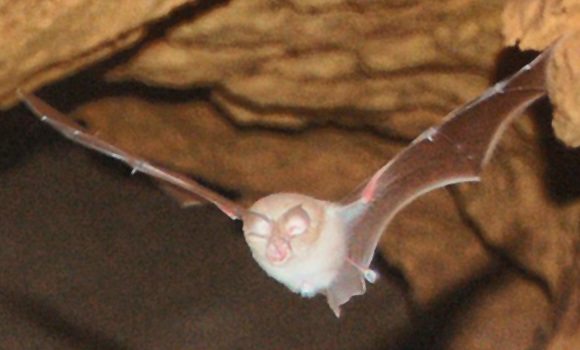
Formosan Woolly Horseshoe Bat Rhinolophus formosae
The scientific name of the Formosan Woolly Horseshoe Bat is Rhinolophus formosae. It is a species of mammal in the family Rhinolophidae (horseshoe bat), order Chiroptera. The name dates from 1939.
- Scientific name
- Rhinolophus formosae Sanborn, 1939
- Common name
- Formosan Woolly Horseshoe Bat
- Genus
- Rhinolophus
- Family
- Rhinolophidae (Horseshoe Bat)
- Order
- Chiroptera
- Class
- Mammalia
- Red List category
- LC Least Concern
- Recorded in
- 1 country
- Name status
- accepted in the Catalogue of Life

Overview
The Formosan Woolly Horseshoe Bat belongs to the trifoliatus species group. The species is endemic to Taiwan and occurs in primary forests at low to middle elevations in central Taiwan. It uses a flycatching foraging strategy and was formerly classified as a subspecies of the woolly horseshoe bat.
Written 27 November 2026 from the sources listed below. Each statement was checked against the passage it cites; statements that could not be supported were removed.
Habitat
The Formosan Woolly Horseshoe Bat is endemic to Taiwan and occurs in primary forests at low to middle elevations in central Taiwan.[1][2]
The species uses caves, buildings, tunnels, and irrigation conduits as roosting locations.[3]
Behaviour
The species uses a flycatching foraging strategy. It maintains broadly similar attack rates throughout the night and reaches its peak residence time at perches around midnight.[4][5][6]
Capture rate and attack efficiency decrease toward midnight and increase again during the hours immediately before dawn. Mean capture, capture rate, and attack efficiency are lower during late summer when volant juveniles join nocturnal activity.[7][8]
During early spring, the species increases perch switching when attack rates are lower. It switches perches less frequently during late spring and the peak summer months, when insect abundance is higher.[9][10]
Scanning across a broad angular range for prey detection and switching perches more frequently increases the species' capture rate. The species can remain at a foraging site longer by slightly reducing its average residence time at each perch.[11][12]
The species' perching and foraging behaviours do not differ significantly between forest settings.[13]
Conservation
The Formosan Woolly Horseshoe Bat is classified as Least Concern on the IUCN Red List. It nearly qualifies as threatened under criterion B1, which concerns extent of occurrence.[14][15]
The population is decreasing in association with deforestation in Taiwan's lowlands. The species occurs in at least one protected area.[16][17]
Similar species
The Formosan Woolly Horseshoe Bat was formerly classified as a subspecies of the woolly horseshoe bat but is now recognized as distinct. It was also formerly considered a subspecies of Rhinolophus luctus but is regarded as apparently distinct.[18][19]
Classification of the Formosan Woolly Horseshoe Bat
| Kingdom | Animalia |
|---|---|
| Phylum | Chordata |
| Subphylum | Vertebrata |
| Infraphylum | Gnathostomata |
| Parvphylum | Osteichthyes |
| Megaclass | Tetrapoda |
| Class | Mammalia (Mammal) |
| Subclass | Theria |
| Infraclass | Eutheria |
| Order | Chiroptera (Bat) |
| Suborder | Yinpterochiroptera |
| Superfamily | Rhinolophoidea |
| Family | Rhinolophidae (Horseshoe Bat) |
| Genus | Rhinolophus (Horseshoe Bat) |
| Species | Rhinolophus formosae Sanborn, 1939 |
Where the Formosan Woolly Horseshoe Bat is found
Checklists and occurrence records place Rhinolophus formosae in 1 country across Asia. GBIF holds 208 georeferenced records of it.
Countries
Regions and cities with the most records
- Taiwan, Taiwan 150
- Xizhi, Taiwan 30
- Neihu, Taiwan 22
- Taipei, Taiwan 21
- New Taipei City, Taiwan 20
- Banqiao, Taiwan 17
- Keelung, Taiwan 17
- Lugu, Taiwan 17
- Taipei, Taiwan 13
- Danshui, Taiwan 12
- Sanzhi, Taiwan 11
- Puli, Taiwan 10
- Shulin, Taiwan 10
- Yilan, Taiwan 9
- Linnei, Taiwan 8
- Zhushan, Taiwan 8
- Tianzhong, Taiwan 7
- Taitung, Taiwan 6
- Douliu, Taiwan 5
- Citong, Taiwan 4
- Hengchun, Taiwan 4
- Caotun, Taiwan 3
- Hualien City, Taiwan 3
- Nantou, Taiwan 3
- Yujing, Taiwan 3
- Zhongxing New Village, Taiwan 3
Range as the checklists state it
Southern Asia
A number beside a place is its count of GBIF occurrence records. A place without a number comes from a checklist alone. Records show where a species has been observed or collected, which can include escapes and vagrants.
Common names
English
- Formosan Woolly Horseshoe Bat
- Formosan Woolly Horseshoe Bat.
Names in 6 other languages
- Chinese
- Taiwan Jutoufu, 台灣大蹄鼻蝠, 臺灣大蹄鼻蝠
- German
- Taiwanesische Wollige Hufeisennase
- Italian
- Ferro di cavallo di Taiwan maggiore, Rinolofo di Taiwan maggiore
- Japanese
- タイワンキクガシラコウモリ
- Korean
- 포르모사양털관박쥐
- Polish
- Podkowiec tajwański
Related species
-
 Greater Horseshoe BatRhinolophus ferrumequinum
-
 Lesser Horseshoe BatRhinolophus hipposideros
-
 Mediterranean Horseshoe BatRhinolophus euryale
-
 Intermediate Horseshoe BatRhinolophus affinis
-
 Blasius's Horseshoe BatRhinolophus blasii
-
 Mehely's Horseshoe BatRhinolophus mehelyi
- Andaman Horseshoe BatRhinolophus cognatus
-
 Least Horseshoe BatRhinolophus pusillus
Compare
Questions and answers
What is the scientific name of the Formosan Woolly Horseshoe Bat?
The scientific name of the Formosan Woolly Horseshoe Bat is Rhinolophus formosae. Written with its author, the full name is Rhinolophus formosae Sanborn, 1939.
Which family does the Formosan Woolly Horseshoe Bat belong to?
Rhinolophus formosae belongs to the family Rhinolophidae, in the order Chiroptera and the class Mammalia.
Where is the Formosan Woolly Horseshoe Bat found?
Checklists and occurrence records place Rhinolophus formosae in 1 country: Taiwan.
What is the conservation status of the Formosan Woolly Horseshoe Bat?
The IUCN Red List category recorded for Rhinolophus formosae is Least Concern (LC).
What other names does the Formosan Woolly Horseshoe Bat have?
Rhinolophus formosae is also known in English as Formosan Woolly Horseshoe Bat..
Where are horseshoe bats found?
The Formosan Woolly Horseshoe Bat is endemic to Taiwan. It occurs in primary forests at low to middle elevations in central Taiwan.[1][2]
Where do horseshoe bats live?
The Formosan Woolly Horseshoe Bat uses caves, buildings, tunnels, and irrigation conduits as roosting locations.[3]
Sources
Passages the profile rests on
- The Formosan woolly horseshoe bat is endemic to Taiwan. Source passage: “It is endemic to Taiwan” — English Wikipedia
- The species occurs in primary forests at low to middle elevations in central Taiwan. Source passage: “occurs in primary forests in low to middle altitudes of central areas of Taiwan.” — English Wikipedia
- The species uses caves, buildings, tunnels, and irrigation conduits as roosting locations. Source passage: “Its roosting locations include caves, buildings, tunnels, and irrigation conduits.” — English Wikipedia
- The species uses a flycatching foraging strategy. Source passage: “The bats maintained flycatching” — pmc.ncbi.nlm.nih.gov
- The bats maintain broadly similar attack rates throughout the night. Source passage: “exhibited largely similar attack rates through the night” — pmc.ncbi.nlm.nih.gov
- The species reaches its peak residence time at perches around midnight. Source passage: “with peak residence time around the midnight” — pmc.ncbi.nlm.nih.gov
- The capture rate and attack efficiency decrease toward midnight and increase again during the hours immediately before dawn. Source passage: “the capture rate and attack efficiency both reduced toward midnight and then increased toward the hours right before dawn.” — pmc.ncbi.nlm.nih.gov
- Mean capture, capture rate, and attack efficiency are lower during late summer when volant juveniles join nocturnal activity. Source passage: “the mean capture, capture rate, and attack efficiency were lower in the late summer when volant juveniles joined the nocturnal activity.” — pmc.ncbi.nlm.nih.gov
- The species increases perch switching at lower attack rates during early spring. Source passage: “The bats increased perch switch at lower attack rates in early spring” — pmc.ncbi.nlm.nih.gov
- The species switches perches less frequently during late spring and the peak summer months when insect abundance is higher. Source passage: “switched less frequently in late spring and prime summer months when insect abundance is higher.” — pmc.ncbi.nlm.nih.gov
- Scanning across a broad angular range for prey detection and switching perches more frequently increases the species' capture rate. Source passage: “By scanning through a broad angular range for prey detection, and switching more frequently among perches, R. formosae foraged with an increased capture rate” — pmc.ncbi.nlm.nih.gov
- The species can remain at a foraging site longer by slightly reducing its average residence time at each perch. Source passage: “were able to remain at the site longer by slightly reducing their mean residence time per perch.” — pmc.ncbi.nlm.nih.gov
- The species' perching and foraging behaviours do not differ significantly between forest settings. Source passage: “The perching-foraging behaviors of the bats did not differ significantly between forest settings” — pmc.ncbi.nlm.nih.gov
- The species is classified as Least Concern on the IUCN Red List. Source passage: “The species is listed as Least concern by the IUCN Red List” — English Wikipedia
- The species nearly qualifies as threatened under criterion B1, which concerns extent of occurrence. Source passage: “it almost qualifies as a threatened species under criteria B1: extent of occurrence for geographic range.” — English Wikipedia
- The population is decreasing in association with deforestation in Taiwan's lowlands. Source passage: “Its population is decreasing due to deforestation in Taiwanese lowlands” — English Wikipedia
- The species occurs in at least one protected area. Source passage: “although it occurs in at least one protected area.” — English Wikipedia
- The Formosan woolly horseshoe bat was formerly classified as a subspecies of the woolly horseshoe bat but is now recognized as distinct. Source passage: “The Formosan woolly horseshoe bat was formerly considered to be a subspecies of the woolly horseshoe bat, but is distinct.” — English Wikipedia
- The species was formerly considered a subspecies of Rhinolophus luctus but is regarded as apparently distinct. Source passage: “Formerly considered a subspecies of luctus, but apparently distinct” — departments.bucknell.edu
Data
- Catalogue of Life, 2026-10-16 XR cc by
- Global Biodiversity Information Facility CC BY 4.0
- Wikidata CC0
- GeoNames CC BY 4.0
- Wikimedia Commons per image; credit shown with each image
- Within the Catalogue of Life, this name comes from The Integrated Taxonomic Information System cc0
References
- Publ. Field. Mus. Nat. Hist., Zool. vol.24 p.41 where the name was published
- Ellerman, J. R., and T. C. S. Morrison-Scott. (1951). Checklist of Palaearctic and Indian Mammals 1758 to 1946.
- Simmons, Nancy B. / Wilson, Don E., and DeeAnn M. Reeder, eds. (2005). Order Chiroptera. Mammal Species of the World: A Taxonomic and Geographic Reference, 3rd Ed., Vols. 1 & 2.
- Wilson, D. E., and R. A. Mittermeier, eds. (2019). Handbook of the Mammals of the World. Vol. 9: Bats.
This species in other databases
Page built on 28 November 2026. See how the catalog is made and all sources and licences.
Cite this page
ScientificNames.org. (2026). Rhinolophus formosae (Formosan Woolly Horseshoe Bat). Retrieved November 28, 2026, from https://scientificnames.org/species/rhinolophus-formosae
“Rhinolophus formosae (Formosan Woolly Horseshoe Bat).” ScientificNames.org, 2026, scientificnames.org/species/rhinolophus-formosae. Accessed 28 Nov. 2026.
ScientificNames.org. “Rhinolophus formosae (Formosan Woolly Horseshoe Bat).” Accessed November 28, 2026. https://scientificnames.org/species/rhinolophus-formosae.
@misc{scientificnames_rhinolophus_formosae_formosan_woolly_horseshoe_bat,
  author = {{ScientificNames.org}},
  title = {Rhinolophus formosae (Formosan Woolly Horseshoe Bat)},
  year = {2026},
  url = {https://scientificnames.org/species/rhinolophus-formosae},
  note = {Accessed 2026-11-28}
}