Species · Mammals
Hills' Horseshoe Bat Rhinolophus hillorum
The scientific name of the Hills' Horseshoe Bat is Rhinolophus hillorum. It is a species of mammal in the family Rhinolophidae (horseshoe bat), order Chiroptera. The name dates from 1989.
- Scientific name
- Rhinolophus hillorum Koopman, 1989
- Common name
- Hills' Horseshoe Bat
- Genus
- Rhinolophus
- Family
- Rhinolophidae (Horseshoe Bat)
- Order
- Chiroptera
- Class
- Mammalia
- Red List category
- VU Vulnerable
- Recorded in
- 2 countries
- Name status
- accepted in the Catalogue of Life
Overview
Rhinolophus hillorum inhabits subtropical and tropical moist lowland and montane forests, caves, and other subterranean habitats. It has a forearm length of 52 to 57 mm and weighs between 16.5 and 25 g.
Written 26 November 2026 from the sources listed below. Each statement was checked against the passage it cites; statements that could not be supported were removed.
Appearance
The forearm length ranges from 52 to 57 mm. Individuals weigh between 16.5 and 25 g.[1][2]
The species has 28 teeth.[3]
Habitat
The species inhabits subtropical and tropical moist lowland and montane forests, caves, and other subterranean habitats.[4]
Conservation
The species was classified as vulnerable by the IUCN as of 2022. Its extent of occurrence is likely below 20,000 km², and it is thought to have a small and declining population.[5][6][7]
Habitat destruction is identified as a reason for its vulnerable classification. Mining, quarrying, deforestation, and hunting are identified as threats.[8][9]
Classification of the Hills' Horseshoe Bat
| Kingdom | Animalia |
|---|---|
| Phylum | Chordata |
| Subphylum | Vertebrata |
| Infraphylum | Gnathostomata |
| Parvphylum | Osteichthyes |
| Megaclass | Tetrapoda |
| Class | Mammalia (Mammal) |
| Subclass | Theria |
| Infraclass | Eutheria |
| Order | Chiroptera (Bat) |
| Suborder | Yinpterochiroptera |
| Superfamily | Rhinolophoidea |
| Family | Rhinolophidae (Horseshoe Bat) |
| Genus | Rhinolophus (Horseshoe Bat) |
| Species | Rhinolophus hillorum Koopman, 1989 |
Where the Hills' Horseshoe Bat is found
Checklists and occurrence records place Rhinolophus hillorum in 2 countries across Africa. GBIF holds 16 georeferenced records of it.
Countries
Range as the checklists state it
Africa
A number beside a place is its count of GBIF occurrence records. A place without a number comes from a checklist alone. Records show where a species has been observed or collected, which can include escapes and vagrants.
Common names
English
- Hills' Horseshoe Bat
- Hill's Horseshoe Bat
- Upland Horseshoe Bat
- Upland Horseshoe Bat.
Names in 4 other languages
- French
- Rhinolophe des collines
- German
- Hochland-Hufeisennase
- Japanese
- アップランドキクガシラコウモリ
- Polish
- Podkowiec wyżynny
Synonyms
One other scientific name has been used for this species and is now treated as a synonym of Rhinolophus hillorum.
- Rhinolophus clivosus hillorum Koopman, 1989
Related species
-
 Greater Horseshoe BatRhinolophus ferrumequinum
-
 Lesser Horseshoe BatRhinolophus hipposideros
-
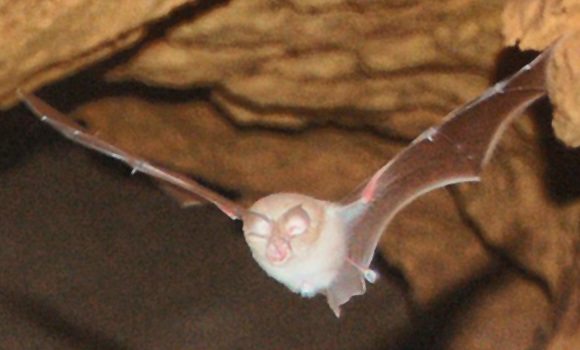 Mediterranean Horseshoe BatRhinolophus euryale
-
 Intermediate Horseshoe BatRhinolophus affinis
-
 Blasius's Horseshoe BatRhinolophus blasii
-
 Mehely's Horseshoe BatRhinolophus mehelyi
- Andaman Horseshoe BatRhinolophus cognatus
-
 Least Horseshoe BatRhinolophus pusillus
Compare
Questions and answers
What is the scientific name of the Hills' Horseshoe Bat?
The scientific name of the Hills' Horseshoe Bat is Rhinolophus hillorum. Written with its author, the full name is Rhinolophus hillorum Koopman, 1989.
Which family does the Hills' Horseshoe Bat belong to?
Rhinolophus hillorum belongs to the family Rhinolophidae, in the order Chiroptera and the class Mammalia.
Where is the Hills' Horseshoe Bat found?
Checklists and occurrence records place Rhinolophus hillorum in 2 countries: Liberia and Cameroon.
What is the conservation status of the Hills' Horseshoe Bat?
The IUCN Red List category recorded for Rhinolophus hillorum is Vulnerable (VU).
What other names does the Hills' Horseshoe Bat have?
Rhinolophus hillorum is also known in English as Hill's Horseshoe Bat, Upland Horseshoe Bat and Upland Horseshoe Bat..
Sources
Passages the profile rests on
- The species has a forearm length ranging from 52 to 57 mm. Source passage: “Hills' horseshoe bat has a forearm length of 52–57 mm (2.0–2.2 in)” — English Wikipedia
- Individuals weigh between 16.5 and 25 g. Source passage: “individuals weigh 16.5–25 g (0.58–0.88 oz).” — English Wikipedia
- The species has 28 teeth. Source passage: “for a total of 28 teeth.” — English Wikipedia
- The species inhabits subtropical and tropical moist lowland and montane forests, caves, and other subterranean habitats. Source passage: “Its natural habitats are subtropical and tropical moist lowland and montane forest, caves and other subterranean habitats.” — English Wikipedia
- The species was classified as vulnerable by the IUCN as of 2022. Source passage: “As of 2022, it is evaluated as vulnerable by the IUCN.” — English Wikipedia
- The species' extent of occurrence is likely below 20,000 km². Source passage: “Its extent of occurrence is likely less than 20,000 km2 (7,700 mi2).” — English Wikipedia
- The species is thought to have a small and declining population. Source passage: “It likely has a small population size which is also declining.” — English Wikipedia
- Habitat destruction is identified as a reason for the species' vulnerable classification. Source passage: “It meets the criteria for this classification because it is experiencing habitat destruction.” — English Wikipedia
- Mining, quarrying, deforestation, and hunting are identified as threats to the species. Source passage: “Specific threats this species faces include mining, quarrying, deforestation, and hunting.” — English Wikipedia
- The species is found in Cameroon, Guinea, Liberia, and Nigeria. Source passage: “It is found in Cameroon, Guinea, Liberia, and Nigeria.” — English Wikipedia
Data
- Catalogue of Life, 2026-10-16 XR cc by
- Global Biodiversity Information Facility CC BY 4.0
- Wikidata CC0
- GeoNames CC BY 4.0
- Within the Catalogue of Life, this name comes from The Integrated Taxonomic Information System cc0
References
- Amer. Mus. Novit. vol.2946 p.4 where the name was published
- Simmons, Nancy B. / Wilson, Don E., and DeeAnn M. Reeder, eds. (2005). Order Chiroptera. Mammal Species of the World: A Taxonomic and Geographic Reference, 3rd Ed., Vols. 1 & 2.
- Wilson, D. E., and R. A. Mittermeier, eds. (2019). Handbook of the Mammals of the World. Vol. 9: Bats.
This species in other databases
Page built on 29 November 2026. See how the catalog is made and all sources and licences.
Cite this page
ScientificNames.org. (2026). Rhinolophus hillorum (Hills' Horseshoe Bat). Retrieved November 29, 2026, from https://scientificnames.org/species/rhinolophus-hillorum
“Rhinolophus hillorum (Hills' Horseshoe Bat).” ScientificNames.org, 2026, scientificnames.org/species/rhinolophus-hillorum. Accessed 29 Nov. 2026.
ScientificNames.org. “Rhinolophus hillorum (Hills' Horseshoe Bat).” Accessed November 29, 2026. https://scientificnames.org/species/rhinolophus-hillorum.
@misc{scientificnames_rhinolophus_hillorum_hills_horseshoe_bat,
  author = {{ScientificNames.org}},
  title = {Rhinolophus hillorum (Hills' Horseshoe Bat)},
  year = {2026},
  url = {https://scientificnames.org/species/rhinolophus-hillorum},
  note = {Accessed 2026-11-29}
}