Species · Mammals
Philippine Forest Horseshoe Bat Rhinolophus inops
The scientific name of the Philippine Forest Horseshoe Bat is Rhinolophus inops. It is a species of mammal in the family Rhinolophidae (horseshoe bat), order Chiroptera. The name dates from 1905.
- Scientific name
- Rhinolophus inops K. Andersen, 1905
- Common name
- Philippine Forest Horseshoe Bat
- Genus
- Rhinolophus
- Family
- Rhinolophidae (Horseshoe Bat)
- Order
- Chiroptera
- Class
- Mammalia
- Red List category
- LC Least Concern
- Recorded in
- 1 country
- Name status
- accepted in the Catalogue of Life
Overview
Rhinolophus inops occurs throughout the Philippines except in the Palawan Region. It has a horseshoe-shaped nasal leaf surrounding its nostrils.
Written 27 November 2026 from the sources listed below. Each statement was checked against the passage it cites; statements that could not be supported were removed.
Appearance
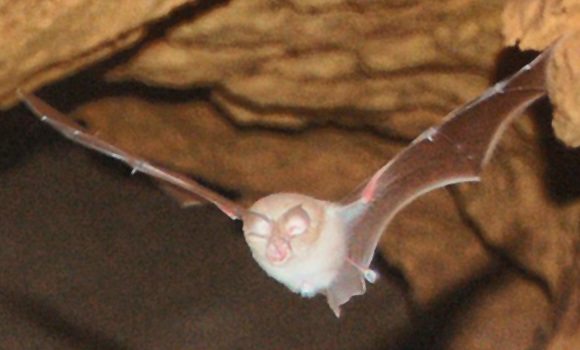
The Philippine Forest Horseshoe Bat has brown fur with rust-colored tints on its back and paler fur underneath. Its nasal leaf is horseshoe-shaped and surrounds its nostrils.[1][2]
It has relatively large ears measuring 22 to 28 mm that lack a tragus. Its small eyes appear partly obstructed by its nasal leaves.[3][4]
Habitat
The Philippine Forest Horseshoe Bat commonly inhabits primary lowland forests and mountainous forests. It is rarely observed in secondary forests.[5][6]
It occurs at elevations ranging from sea level to 2,250 m. Its distribution covers the Philippines except the Palawan Region.[7][8]
The species roosts in caves, hollow trees, and foliage.[9]
Diet
The Philippine Forest Horseshoe Bat feeds on insects and spiders at night. It consumes its prey either on the ground or at its roost.[10][11]
Behaviour
The species generally maintains a regular hunting area and hunts within six metres of the ground in a regular territory. It frequently lands on the ground to eat.[12][13][14]
It flies with a fluttering pattern and generally remains close to the ground. It uses echolocation calls emitted through its nasal passages to navigate and locate prey.[15][16]
While roosting, the species wraps its wings around its body. Horseshoe bats generally roost in groups during the day, with groups ranging from a few individuals to several thousand.[17][18][19]
Reproduction and life cycle
The mating system of the Philippine Forest Horseshoe Bat is unknown. Females give birth to one offspring per reproductive season.[20][21]
The reported typical gestation period for horseshoe bats is seven weeks, and the reported lactation period is one to two months. Female individuals carry and nurse their offspring.[22][23][24]
Conservation
Deforestation has affected lowland populations of the Philippine Forest Horseshoe Bat. Deforestation has not created a major threat because substantial forest remains at higher elevations.[25][26]
Classification of the Philippine Forest Horseshoe Bat
| Kingdom | Animalia |
|---|---|
| Phylum | Chordata |
| Subphylum | Vertebrata |
| Infraphylum | Gnathostomata |
| Parvphylum | Osteichthyes |
| Megaclass | Tetrapoda |
| Class | Mammalia (Mammal) |
| Subclass | Theria |
| Infraclass | Eutheria |
| Order | Chiroptera (Bat) |
| Suborder | Yinpterochiroptera |
| Superfamily | Rhinolophoidea |
| Family | Rhinolophidae (Horseshoe Bat) |
| Genus | Rhinolophus (Horseshoe Bat) |
| Species | Rhinolophus inops K. Andersen, 1905 |
Where the Philippine Forest Horseshoe Bat is found
Checklists and occurrence records place Rhinolophus inops in 1 country across Asia. GBIF holds 376 georeferenced records of it.
Countries
Regions and cities with the most records
- Baggabag B, Philippines 51
- Bambang, Philippines 51
- Bayombong, Philippines 51
- Solano, Philippines 51
- Baybay, Philippines 41
- Polomolok, Philippines 21
- Tupi, Philippines 21
- Lambayong, Philippines 20
- Lucena, Philippines 14
- Tayabas, Philippines 14
- Lucban, Philippines 13
- Majayjay, Philippines 13
- Pagbilao, Philippines 13
- Candelaria, Philippines 12
- Concepcion Ibaba, Philippines 12
- Lilio, Philippines 12
- Malabanban Norte, Philippines 12
- Nagcarlan, Philippines 12
- Sariaya, Philippines 12
- San Pablo, Philippines 10
- Abuyog, Philippines 9
- Alaminos, Philippines 9
- Bay, Philippines 9
- Cabuyao, Philippines 9
- Calabanga, Philippines 9
- Calamba, Philippines 9
- Calauan, Philippines 9
- Del Remedio, Philippines 9
- Goa, Philippines 9
- Los Baños, Philippines 9
- Malvar, Philippines 9
- Mamatid, Philippines 9
- Santo Tomas, Philippines 9
- Tanauan, Philippines 9
- Victoria, Philippines 9
- Magarao, Philippines 8
Range as the checklists state it
Southern Asia
A number beside a place is its count of GBIF occurrence records. A place without a number comes from a checklist alone. Records show where a species has been observed or collected, which can include escapes and vagrants.
Common names
English
- Philippine Forest Horseshoe Bat
- Philippine Forest Horseshoe Bat.
Names in 7 other languages
- Cebuano
- kabyaw
- Czech
- vrápenec mindanajský
- Finnish
- mindanaonherkko
- German
- Mindanao-Hufeisennase, Philippinen-Hufeisennase
- Japanese
- ミンダナオキクガシラコウモリ
- Polish
- Podkowiec mindanajski
- Russian
- Слабый подковонос
Related species
-
 Greater Horseshoe BatRhinolophus ferrumequinum
-
 Lesser Horseshoe BatRhinolophus hipposideros
-
 Mediterranean Horseshoe BatRhinolophus euryale
-
 Intermediate Horseshoe BatRhinolophus affinis
-
 Blasius's Horseshoe BatRhinolophus blasii
-
 Mehely's Horseshoe BatRhinolophus mehelyi
- Andaman Horseshoe BatRhinolophus cognatus
-
 Least Horseshoe BatRhinolophus pusillus
Compare
Questions and answers
What is the scientific name of the Philippine Forest Horseshoe Bat?
The scientific name of the Philippine Forest Horseshoe Bat is Rhinolophus inops. Written with its author, the full name is Rhinolophus inops K. Andersen, 1905.
Which family does the Philippine Forest Horseshoe Bat belong to?
Rhinolophus inops belongs to the family Rhinolophidae, in the order Chiroptera and the class Mammalia.
Where is the Philippine Forest Horseshoe Bat found?
Checklists and occurrence records place Rhinolophus inops in 1 country: Philippines.
What is the conservation status of the Philippine Forest Horseshoe Bat?
The IUCN Red List category recorded for Rhinolophus inops is Least Concern (LC).
What other names does the Philippine Forest Horseshoe Bat have?
Rhinolophus inops is also known in English as Philippine Forest Horseshoe Bat..
Why are they called horseshoe bats?
Members of the family Rhinolophidae are commonly called horseshoe bats. The Philippine Forest Horseshoe Bat has a horseshoe-shaped nasal leaf surrounding its nostrils.[2][27]
Where are horseshoe bats found?
The Philippine Forest Horseshoe Bat occurs throughout the Philippines except in the Palawan Region.[7]
Sources
Passages the profile rests on
- The species has brown fur, with rust-colored tints on its back and paler fur underneath. Source passage: “Philippine forest horseshoe bats are completely brown in color; the dorsal fur has rust colored tints and the ventral fur is paler.” — animaldiversity.org
- The species has a horseshoe-shaped nasal leaf surrounding its nostrils. Source passage: “these bats have a horseshoe shaped nasal leaf expansion that surrounds the nostrils.” — animaldiversity.org
- The species has relatively large ears measuring 22 to 28 mm that lack a tragus. Source passage: “Rhinolophid ears are rather large (22 to 28 mm) and always lack a tragus.” — animaldiversity.org
- The species has small eyes that appear partly obstructed by its nasal leaves. Source passage: “The eyes seem to be obstructed by the nasal leaves and are quite small.” — animaldiversity.org
- The species commonly inhabits primary lowland forests and mountainous forests. Source passage: “Philippine forest horseshoe bats commonly inhabit primary lowland forests and mountainous forests.” — animaldiversity.org
- The species is rarely observed in secondary forests. Source passage: “These bats are rarely seen in secondary forests.” — animaldiversity.org
- The species occurs throughout the Philippines except in the Palawan Region. Source passage: “Philippine forest horseshoe bats ( Rhinolophus inops ) inhabit all of the Philippines except the Palawan Region.” — animaldiversity.org
- The species occurs at elevations ranging from sea level to 2,250 m. Source passage: “It is found from sea-level to 2250 m in elevation.” — animaldiversity.org
- The species roosts in caves, hollow trees, and foliage. Source passage: “Philippine forest horseshoe bats roost in caves, hollow trees and foliage.” — animaldiversity.org
- The species feeds on insects and spiders at night. Source passage: “Horseshoe bats hunt insects and spiders at night” — animaldiversity.org
- The species consumes its prey either on the ground or at its roost. Source passage: “The actual consumption of prey occurs either on the ground or at the roost sight.” — animaldiversity.org
- The species generally maintains a regular hunting area. Source passage: “These bats generally maintain a regular hunting area as well.” — animaldiversity.org
- The species frequently lands on the ground to eat. Source passage: “In order to eat, these bats frequently land on the ground.” — animaldiversity.org
- The species hunts within six metres of the ground in a regular territory. Source passage: “These bats hunt within 6 m of the ground in a regular territory.” — animaldiversity.org
- Horseshoe bats fly with a fluttering pattern and generally remain close to the ground. Source passage: “Rhinolophid bats fly with a fluttering pattern and generally stay close to the ground.” — animaldiversity.org
- The species uses echolocation calls emitted through its nasal passages to navigate and locate prey. Source passage: “Horseshoe bats use echolocation calls that are projected from their nasal passages to navigate and locate prey” — animaldiversity.org
- While roosting, the species wraps its wings around its body. Source passage: “While roosting these bats wrap their wings around the body” — animaldiversity.org
- Horseshoe bats generally roost in groups during the day. Source passage: “horseshoe bats roost mostly during the day in groups” — animaldiversity.org
- The roosting groups of horseshoe bats can range from a few individuals to several thousand. Source passage: “which can vary in size from a few to a few thousand.” — animaldiversity.org
- The mating system of this species is unknown. Source passage: “The mating system for Philippine forest horseshoe bats is unknown.” — animaldiversity.org
- Females give birth to one offspring per reproductive season. Source passage: “Philippine forest horseshoe bats give birth to a single young each season.” — animaldiversity.org
- The reported typical gestation period for horseshoe bats is seven weeks. Source passage: “Horseshoe bat typically have a 7 week gestation period” — animaldiversity.org
- The reported lactation period for horseshoe bats is one to two months. Source passage: “followed by 1 to 2 months of lactation.” — animaldiversity.org
- Female individuals carry and nurse their offspring. Source passage: “female horseshoe bats must carry and nurse their young” — animaldiversity.org
- Deforestation has affected lowland populations of the species. Source passage: “Deforestation has affected the lowland populations of this species” — animaldiversity.org
- The source reports that deforestation has not created a major threat because substantial forest remains at higher elevations. Source passage: “but has not created a large threat due to the amount of remaining forest at higher elevations.” — animaldiversity.org
- The species belongs to the family Rhinolophidae, whose members are commonly called horseshoe bats. Source passage: “Rhinolophidae Gray, 1825 – horseshoe bats” — itis.gov
Data
- Catalogue of Life, 2026-10-16 XR cc by
- Global Biodiversity Information Facility CC BY 4.0
- Wikidata CC0
- GeoNames CC BY 4.0
- Within the Catalogue of Life, this name comes from The Integrated Taxonomic Information System cc0
References
- Andersen, & Knud. (1905). On the bats of the Rhinolophus arcuatus Group, with descriptions of five new forms. The Annals and Magazine of Natural History, Including Zoology, Botany, and Geology, 7th Ser., Vol. 16, No. 93. where the name was published
- Wilson, Don E., and DeeAnn M. Reeder, eds. (1993). Mammal Species of the World: A Taxonomic and Geographic Reference, 2nd Ed., 3rd Printing.
- Wilson, Don E., and F. Russell Cole. (2000). Common Names of Mammals of the World.
- Simmons, Nancy B. / Wilson, Don E., and DeeAnn M. Reeder, eds. (2005). Order Chiroptera. Mammal Species of the World: A Taxonomic and Geographic Reference, 3rd Ed., Vols. 1 & 2.
- Wilson, D. E., and R. A. Mittermeier, eds. (2019). Handbook of the Mammals of the World. Vol. 9: Bats.
This species in other databases
Page built on 27 November 2026. See how the catalog is made and all sources and licences.
Cite this page
ScientificNames.org. (2026). Rhinolophus inops (Philippine Forest Horseshoe Bat). Retrieved November 27, 2026, from https://scientificnames.org/species/rhinolophus-inops
“Rhinolophus inops (Philippine Forest Horseshoe Bat).” ScientificNames.org, 2026, scientificnames.org/species/rhinolophus-inops. Accessed 27 Nov. 2026.
ScientificNames.org. “Rhinolophus inops (Philippine Forest Horseshoe Bat).” Accessed November 27, 2026. https://scientificnames.org/species/rhinolophus-inops.
@misc{scientificnames_rhinolophus_inops_philippine_forest_horseshoe_bat,
  author = {{ScientificNames.org}},
  title = {Rhinolophus inops (Philippine Forest Horseshoe Bat)},
  year = {2026},
  url = {https://scientificnames.org/species/rhinolophus-inops},
  note = {Accessed 2026-11-27}
}