Species · Mammals
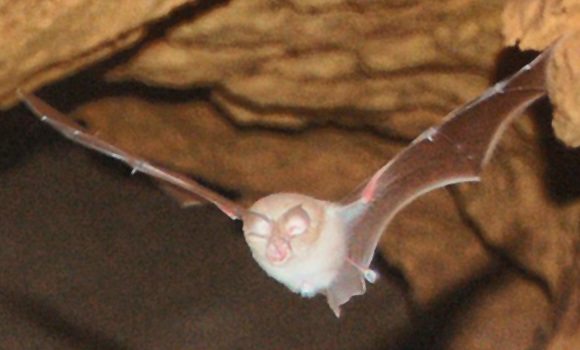
Lander's Horseshoe Bat Rhinolophus landeri
The scientific name of the Lander's Horseshoe Bat is Rhinolophus landeri. It is a species of mammal in the family Rhinolophidae (horseshoe bat), order Chiroptera. The name dates from 1838.
- Scientific name
- Rhinolophus landeri Martin, 1838
- Common name
- Lander's Horseshoe Bat
- Genus
- Rhinolophus
- Family
- Rhinolophidae (Horseshoe Bat)
- Order
- Chiroptera
- Class
- Mammalia
- Red List category
- LC Least Concern
- Recorded in
- 26 countries
- Name status
- accepted in the Catalogue of Life

Overview
Lander's Horseshoe Bat is a medium-sized bat in the family Rhinolophidae. It inhabits savanna environments, dry savanna and caves. It weighs between 5 and 11 g and has a forearm length of between 38 and 41 mm.
Written 27 November 2026 from the sources listed below. Each statement was checked against the passage it cites; statements that could not be supported were removed.
Appearance
Lander's Horseshoe Bat is a medium-sized member of the horseshoe bat family. Its total body length is approximately 75 mm, and its tail measures approximately 23 mm.[1][2][3]
Individuals weigh between 5 and 11 g. The forearm measures between 38 and 41 mm in length.[4][5]
Habitat
Lander's Horseshoe Bat inhabits savanna environments, including dry savanna. Caves are also part of its natural habitat.[6][7][8]
Conservation
The IUCN evaluates Lander's Horseshoe Bat as Least Concern, partly because of its wide geographic range. The species is considered likely to have a large population and unlikely to be undergoing rapid population decline.[9][10][11][12]
Classification of the Lander's Horseshoe Bat
| Kingdom | Animalia |
|---|---|
| Phylum | Chordata |
| Subphylum | Vertebrata |
| Infraphylum | Gnathostomata |
| Parvphylum | Osteichthyes |
| Megaclass | Tetrapoda |
| Class | Mammalia (Mammal) |
| Subclass | Theria |
| Infraclass | Eutheria |
| Order | Chiroptera (Bat) |
| Suborder | Yinpterochiroptera |
| Superfamily | Rhinolophoidea |
| Family | Rhinolophidae (Horseshoe Bat) |
| Genus | Rhinolophus (Horseshoe Bat) |
| Species | Rhinolophus landeri Martin, 1838 |
Where the Lander's Horseshoe Bat is found
Checklists and occurrence records place Rhinolophus landeri in 26 countries across Africa. GBIF holds 744 georeferenced records of it.
Countries
- Benin 5
- Burkina Faso 20
- Cameroon 76
- Central African Republic 7
- Democratic Republic of the Congo 27
- Equatorial Guinea 77
- Ethiopia 32
- Gabon 17
- Gambia 10
- Ghana 51
- Guinea 9
- Ivory Coast 13
- Kenya 92
- Malawi 5
- Mali 3
- Morocco 9
- Mozambique 15
- Namibia 11
- Nigeria 86
- Rwanda 3
- Senegal 57
- Sierra Leone 7
- Sudan 31
- Tanzania 10
- Zambia 28
- Zimbabwe 43
Regions and cities with the most records
- Niger State, Nigeria 66
- Eastern Province, Zambia 23
- Nakuru County, Kenya 18
- Buea, Cameroon 13
- Centre, Cameroon 13
- Limbe, Cameroon 13
- Mutengene, Cameroon 13
- South-West, Cameroon 13
- Tiko, Cameroon 12
- Khomas Region, Namibia 11
- Esim, Ghana 9
- Gilgil, Kenya 8
- Kajiado County, Kenya 8
- Naivasha, Kenya 8
- Kaduna State, Nigeria 7
- Kagoro, Nigeria 7
- Makindu, Kenya 7
- Nakuru, Kenya 7
- South, Cameroon 7
- Yaoundé, Cameroon 7
- Eastern, Ghana 6
- Greater Accra, Ghana 6
- Kafanchan, Nigeria 6
- Ogooué-Maritime, Gabon 6
- Boucle du Mouhoun, Burkina Faso 5
- Chipata, Zambia 5
- Est, Burkina Faso 5
- Mchinji, Malawi 5
- Nouna, Burkina Faso 5
- Taita Taveta, Kenya 5
- Eséka, Cameroon 4
- Kwale County, Kenya 4
- Makueni County, Kenya 4
- Marsabit, Kenya 4
- Marsabit County, Kenya 4
- Natiaboani, Burkina Faso 4
Range as the checklists state it
Africa
A number beside a place is its count of GBIF occurrence records. A place without a number comes from a checklist alone. Records show where a species has been observed or collected, which can include escapes and vagrants.
Common names
English
- Lander's Horseshoe Bat
- Lander's Horseshoe Bat.
Names in 10 other languages
- Afrikaans
- Landers se Saalneusvlermuis
- Czech
- vrápenec Landerův
- Dutch
- Landerhoefijzerneus
- Finnish
- yökkösherkko
- French
- Rhinolophe de Lander
- German
- Landers Hufeisennase
- Japanese
- ランダーキクガシラコウモリ
- Polish
- Podkowiec tropikalny
- Russian
- Подковонос Ландера
- Spanish
- Murciélago de Herradura Africano
Synonyms
One other scientific name has been used for this species and is now treated as a synonym of Rhinolophus landeri.
- Rhinolophus landeri landeri Martin, 1838
Related species
-
 Greater Horseshoe BatRhinolophus ferrumequinum
-
 Lesser Horseshoe BatRhinolophus hipposideros
-
 Mediterranean Horseshoe BatRhinolophus euryale
-
 Intermediate Horseshoe BatRhinolophus affinis
-
 Blasius's Horseshoe BatRhinolophus blasii
-
 Mehely's Horseshoe BatRhinolophus mehelyi
- Andaman Horseshoe BatRhinolophus cognatus
-
 Least Horseshoe BatRhinolophus pusillus
Compare
Questions and answers
What is the scientific name of the Lander's Horseshoe Bat?
The scientific name of the Lander's Horseshoe Bat is Rhinolophus landeri. Written with its author, the full name is Rhinolophus landeri Martin, 1838.
Which family does the Lander's Horseshoe Bat belong to?
Rhinolophus landeri belongs to the family Rhinolophidae, in the order Chiroptera and the class Mammalia.
Where is the Lander's Horseshoe Bat found?
Checklists and occurrence records place Rhinolophus landeri in 26 countries, including Kenya, Nigeria, Equatorial Guinea, Cameroon, Senegal and Ghana.
What is the conservation status of the Lander's Horseshoe Bat?
The IUCN Red List category recorded for Rhinolophus landeri is Least Concern (LC).
What other names does the Lander's Horseshoe Bat have?
Rhinolophus landeri is also known in English as Lander's Horseshoe Bat..
Sources
Passages the profile rests on
- Rhinolophus landeri is a medium-sized member of the horseshoe bat family. Source passage: “It is a medium-sized member of its family.” — English Wikipedia
- The total body length is approximately 75 mm. Source passage: “Total length is approximately 75 mm (3.0 in);” — English Wikipedia
- The tail measures approximately 23 mm in length. Source passage: “tail length is 23 mm (0.91 in)” — English Wikipedia
- Individuals weigh between 5 and 11 g. Source passage: “Individuals weigh 5–11 g (0.18–0.39 oz).” — English Wikipedia
- The forearm measures between 38 and 41 mm in length. Source passage: “forearm length is 38–41 mm (1.5–1.6 in).” — English Wikipedia
- The species inhabits savanna environments. Source passage: “Its natural habitats are savanna and caves.” — English Wikipedia
- The species uses caves as part of its natural habitat. Source passage: “Its natural habitats are savanna and caves.” — English Wikipedia
- Dry savanna is also recorded as a natural habitat of this species. Source passage: “Its natural habitats are dry savanna, ...” — inaturalist.org
- The IUCN evaluates Lander's horseshoe bat as Least Concern. Source passage: “It is currently evaluated as least concern by the IUCN” — English Wikipedia
- The species qualifies for its Least Concern assessment partly because of its wide geographic range. Source passage: “it has a wide geographic range;” — English Wikipedia
- The species is considered likely to have a large population. Source passage: “its population size is likely large;” — English Wikipedia
- The species is considered unlikely to be undergoing rapid population decline. Source passage: “it is unlikely that it is in rapid decline.” — English Wikipedia
- The species has been widely documented across Sub-Saharan Africa. Source passage: “It has been widely documented throughout Sub-Saharan Africa.” — English Wikipedia
- Individuals have been recorded at elevations reaching 2,000 m above sea level on Mount Elgon in Kenya. Source passage: “up to 2,000 m (6,600 ft) above sea level on Kenya's Mount Elgon.” — English Wikipedia
Data
- Catalogue of Life, 2026-10-16 XR cc by
- Global Biodiversity Information Facility CC BY 4.0
- Wikidata CC0
- GeoNames CC BY 4.0
- Wikimedia Commons per image; credit shown with each image
- Within the Catalogue of Life, this name comes from The Integrated Taxonomic Information System cc0
References
- Proc. Zool. Soc. Lond. vol.1837 p.101 where the name was published
- Dobson, & George Edward. (1878). Chiroptera in the Collection of the British Museum.
- Wilson, Don E., and DeeAnn M. Reeder, eds. (1993). Mammal Species of the World: A Taxonomic and Geographic Reference, 2nd Ed., 3rd Printing.
- Wilson, Don E., and F. Russell Cole. (2000). Common Names of Mammals of the World.
- Simmons, Nancy B. / Wilson, Don E., and DeeAnn M. Reeder, eds. (2005). Order Chiroptera. Mammal Species of the World: A Taxonomic and Geographic Reference, 3rd Ed., Vols. 1 & 2.
- Wilson, D. E., and R. A. Mittermeier, eds. (2019). Handbook of the Mammals of the World. Vol. 9: Bats.
This species in other databases
Page built on 27 November 2026. See how the catalog is made and all sources and licences.
Cite this page
ScientificNames.org. (2026). Rhinolophus landeri (Lander's Horseshoe Bat). Retrieved November 27, 2026, from https://scientificnames.org/species/rhinolophus-landeri
“Rhinolophus landeri (Lander's Horseshoe Bat).” ScientificNames.org, 2026, scientificnames.org/species/rhinolophus-landeri. Accessed 27 Nov. 2026.
ScientificNames.org. “Rhinolophus landeri (Lander's Horseshoe Bat).” Accessed November 27, 2026. https://scientificnames.org/species/rhinolophus-landeri.
@misc{scientificnames_rhinolophus_landeri_landers_horseshoe_bat,
  author = {{ScientificNames.org}},
  title = {Rhinolophus landeri (Lander's Horseshoe Bat)},
  year = {2026},
  url = {https://scientificnames.org/species/rhinolophus-landeri},
  note = {Accessed 2026-11-27}
}