Species · Mammals
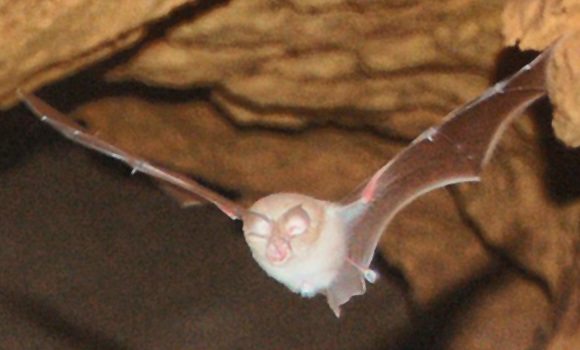
Blyth's Horseshoe Bat Rhinolophus lepidus
The scientific name of the Blyth's Horseshoe Bat is Rhinolophus lepidus. It is a species of mammal in the family Rhinolophidae (horseshoe bat), order Chiroptera. The name dates from 1844.
- Scientific name
- Rhinolophus lepidus Blyth, 1844
- Common name
- Blyth's Horseshoe Bat
- Genus
- Rhinolophus
- Family
- Rhinolophidae (Horseshoe Bat)
- Order
- Chiroptera
- Class
- Mammalia
- Red List category
- LC Least Concern
- Recorded in
- 12 countries
- Name status
- accepted in the Catalogue of Life

Overview
Rhinolophus lepidus occurs across southern Asia, from Afghanistan to Vietnam, and inhabits forests on Tioman Island, Malaysia. It is identified by its pointed, bifid sella.
Written 26 November 2026 from the sources listed below. Each statement was checked against the passage it cites; statements that could not be supported were removed.
Appearance
Blyth's Horseshoe Bat can be identified by its pointed, bifid sella. Its forearm length is approximately 42 mm.[1][2]
Habitat
Blyth's Horseshoe Bat occurs in forests on Tioman Island, Malaysia. It has been recorded at elevations ranging from sea level to 2,338 m.[3][4]
Diet
Blyth's Horseshoe Bat searches for insect prey while flying through cluttered airspace.[5]
Behaviour
Blyth's Horseshoe Bat uses echolocation to navigate and has an echolocation signal frequency of approximately 91 kHz.[6][7]
It flies with a fluttering flight style through cluttered airspace.[8]
On Tioman Island, the population is known to fly and hunt in forests during both daytime and nighttime. It is thought to forage during daylight because resident avian predators are absent from the forest.[9][10]
Classification of the Blyth's Horseshoe Bat
| Kingdom | Animalia |
|---|---|
| Phylum | Chordata |
| Subphylum | Vertebrata |
| Infraphylum | Gnathostomata |
| Parvphylum | Osteichthyes |
| Megaclass | Tetrapoda |
| Class | Mammalia (Mammal) |
| Subclass | Theria |
| Infraclass | Eutheria |
| Order | Chiroptera (Bat) |
| Suborder | Yinpterochiroptera |
| Superfamily | Rhinolophoidea |
| Family | Rhinolophidae (Horseshoe Bat) |
| Genus | Rhinolophus (Horseshoe Bat) |
| Species | Rhinolophus lepidus Blyth, 1844 |
Where the Blyth's Horseshoe Bat is found
Checklists and occurrence records place Rhinolophus lepidus in 12 countries across Asia. GBIF holds 358 georeferenced records of it.
Countries
- Afghanistan 39
- Cambodia 5
- India 121
- Indonesia 3
- Laos 22
- Malaysia 41
- Myanmar 12
- Nepal 3
- Pakistan 31
- Sri Lanka 4
- Thailand 41
- Vietnam 36
Regions and cities with the most records
- Andhra Pradesh, India 33
- Lahore, Pakistan 31
- Model Town, Pakistan 31
- Punjab, Pakistan 31
- Ayer Itam, Malaysia 18
- Balik Pulau, Malaysia 18
- Batu Feringgi, Malaysia 18
- Bayan Lepas, Malaysia 18
- Bukit Gemuroh, Malaysia 18
- Butterworth, Malaysia 18
- George Town, Malaysia 18
- Glugor, Malaysia 18
- Jelutong, Malaysia 18
- Kampung Sungai Ara, Malaysia 18
- Kampung Sungai Glugur, Malaysia 18
- Kampung Teluk Kumbar, Malaysia 18
- Paya Terubong, Malaysia 18
- Perai, Malaysia 18
- Relau, Malaysia 18
- Permatang Kuching, Malaysia 16
- Kampung Teluk Air Tawar, Malaysia 15
- Dong Nai, Vietnam 12
- Bukit Tengah, Malaysia 10
- Kubang Semang, Malaysia 10
- Sungai Dua, Malaysia 10
- Meghalaya, India 9
- Kepala Batas, Malaysia 8
- Kota Kuala Muda, Malaysia 8
- Maharashtra, India 7
- Pahang, Malaysia 7
- Champasak Province, Laos 6
- Bolikhamsai, Laos 5
- Madhya Pradesh, India 5
- Attapu, Laos 4
- Himachal Pradesh, India 4
- Karnataka, India 4
Range as the checklists state it
Europe & Northern Asia (excluding China)
Southern Asia
A number beside a place is its count of GBIF occurrence records. A place without a number comes from a checklist alone. Records show where a species has been observed or collected, which can include escapes and vagrants.
Common names
English
- Blyth's Horseshoe Bat
Names in 8 other languages
- Czech
- vrápenec Blythův
- Finnish
- reviiriherkko
- German
- Blyth-Hufeisennase
- Japanese
- ブライスキクガシラコウモリ
- Kazakh
- Үнді тағатұмсықты жарқанаты
- Polish
- Podkowiec gładki
- Russian
- Индийский подковонос
- Thai
- ค้างคาวมงกุฎจมูกแหลม
Subspecies and varieties
- Rhinolophus lepidus feae (Blyth's Horseshoe Bat.) subspecies
- Rhinolophus lepidus lepidus (Blyth's Horseshoe Bat.) subspecies
- Rhinolophus lepidus monticola (Blyth's Horseshoe Bat.) subspecies
Related species
-
 Greater Horseshoe BatRhinolophus ferrumequinum
-
 Lesser Horseshoe BatRhinolophus hipposideros
-
 Mediterranean Horseshoe BatRhinolophus euryale
-
 Intermediate Horseshoe BatRhinolophus affinis
-
 Blasius's Horseshoe BatRhinolophus blasii
-
 Mehely's Horseshoe BatRhinolophus mehelyi
- Andaman Horseshoe BatRhinolophus cognatus
-
 Least Horseshoe BatRhinolophus pusillus
Compare
Questions and answers
What is the scientific name of the Blyth's Horseshoe Bat?
The scientific name of the Blyth's Horseshoe Bat is Rhinolophus lepidus. Written with its author, the full name is Rhinolophus lepidus Blyth, 1844.
Which family does the Blyth's Horseshoe Bat belong to?
Rhinolophus lepidus belongs to the family Rhinolophidae, in the order Chiroptera and the class Mammalia.
Where is the Blyth's Horseshoe Bat found?
Checklists and occurrence records place Rhinolophus lepidus in 12 countries, including India, Malaysia, Thailand, Afghanistan, Vietnam and Pakistan.
What is the conservation status of the Blyth's Horseshoe Bat?
The IUCN Red List category recorded for Rhinolophus lepidus is Least Concern (LC).
Where are horseshoe bats found?
Blyth's Horseshoe Bat occurs across southern Asia, extending from Afghanistan to Vietnam. It has been documented in Afghanistan, Bangladesh, Cambodia, China, India, Indonesia, Malaysia, Myanmar, Nepal, Pakistan, Thailand, and Vietnam.[11][12]
What do horseshoe bats eat?
Blyth's Horseshoe Bat searches for insect prey while flying through cluttered airspace.[5]
Sources
Passages the profile rests on
- The species can be identified by its pointed, bifid sella. Source passage: “The species can be identified from its pointed, bifid sella.” — English Wikipedia
- Individuals have a forearm length of approximately 42 mm. Source passage: “Individuals have a forearm length of around 42 mm (1.7 in).” — English Wikipedia
- The species occurs in forests on Tioman Island, Malaysia. Source passage: “The Blyth's horseshoe bat population on Tioman Island, Malaysia, is known to fly and hunt in the forest during the day and night.” — English Wikipedia
- The species has been recorded at elevations ranging from sea level to 2,338 m. Source passage: “It is found at a range of elevations from 0–2,338 m (0–7,671 ft) above sea level.” — English Wikipedia
- The species searches for insect prey while flying through cluttered airspace. Source passage: “flying in a fluttering style through cluttered airspace in search of insect prey.” — English Wikipedia
- The species uses echolocation to navigate. Source passage: “It uses echolocation to navigate,” — English Wikipedia
- The species has an echolocation signal frequency of approximately 91 kHz. Source passage: “Its echolocation signal frequency is around 91 kHz.” — English Wikipedia
- The species flies with a fluttering flight style through cluttered airspace. Source passage: “flying in a fluttering style through cluttered airspace” — English Wikipedia
- The population on Tioman Island is known to fly and hunt in forests during both daytime and nighttime. Source passage: “The Blyth's horseshoe bat population on Tioman Island, Malaysia, is known to fly and hunt in the forest during the day and night.” — English Wikipedia
- The species is thought to forage during daylight on Tioman Island because resident avian predators are absent from the forest. Source passage: “It is thought that these bats can forage during the day owing to the absence of resident avian predators in the forest there.” — English Wikipedia
- The species occurs across southern Asia, extending from Afghanistan to Vietnam. Source passage: “It is found across southern Asia from Afghanistan to Vietnam.” — English Wikipedia
- The species has been documented in Afghanistan, Bangladesh, Cambodia, China, India, Indonesia, Malaysia, Myanmar, Nepal, Pakistan, Thailand, and Vietnam. Source passage: “Blyth's horseshoe bat is widely distributed in South and Southeast Asia, and has been documented in the following countries: Afghanistan, Bangladesh, Cambodia, China, India, Indonesia, Malaysia, Myanmar, Nepal, Pakistan, Thailand, and Vietnam.” — English Wikipedia
Data
- Catalogue of Life, 2026-10-16 XR cc by
- Global Biodiversity Information Facility CC BY 4.0
- Wikidata CC0
- GeoNames CC BY 4.0
- Wikimedia Commons per image; credit shown with each image
- Within the Catalogue of Life, this name comes from The Integrated Taxonomic Information System cc0
References
- J. Asiat. Soc. Bengal vol.13 p.486 where the name was published
- Ellerman, J. R., and T. C. S. Morrison-Scott. (1951). Checklist of Palaearctic and Indian Mammals 1758 to 1946.
- Wilson, Don E., and DeeAnn M. Reeder, eds. (1993). Mammal Species of the World: A Taxonomic and Geographic Reference, 2nd Ed., 3rd Printing.
- Wilson, Don E., and F. Russell Cole. (2000). Common Names of Mammals of the World.
- Simmons, Nancy B. / Wilson, Don E., and DeeAnn M. Reeder, eds. (2005). Order Chiroptera. Mammal Species of the World: A Taxonomic and Geographic Reference, 3rd Ed., Vols. 1 & 2.
- Wilson, D. E., and R. A. Mittermeier, eds. (2019). Handbook of the Mammals of the World. Vol. 9: Bats.
This species in other databases
Page built on 27 November 2026. See how the catalog is made and all sources and licences.
Cite this page
ScientificNames.org. (2026). Rhinolophus lepidus (Blyth's Horseshoe Bat). Retrieved November 27, 2026, from https://scientificnames.org/species/rhinolophus-lepidus
“Rhinolophus lepidus (Blyth's Horseshoe Bat).” ScientificNames.org, 2026, scientificnames.org/species/rhinolophus-lepidus. Accessed 27 Nov. 2026.
ScientificNames.org. “Rhinolophus lepidus (Blyth's Horseshoe Bat).” Accessed November 27, 2026. https://scientificnames.org/species/rhinolophus-lepidus.
@misc{scientificnames_rhinolophus_lepidus_blyths_horseshoe_bat,
  author = {{ScientificNames.org}},
  title = {Rhinolophus lepidus (Blyth's Horseshoe Bat)},
  year = {2026},
  url = {https://scientificnames.org/species/rhinolophus-lepidus},
  note = {Accessed 2026-11-27}
}