Species · Mammals
Smaller Horseshoe Bat Rhinolophus megaphyllus
The scientific name of the Smaller Horseshoe Bat is Rhinolophus megaphyllus. It is a species of mammal in the family Rhinolophidae (horseshoe bat), order Chiroptera. The name dates from 1834.
- Scientific name
- Rhinolophus megaphyllus Gray, 1834
- Common name
- Smaller Horseshoe Bat
- Genus
- Rhinolophus
- Family
- Rhinolophidae (Horseshoe Bat)
- Order
- Chiroptera
- Class
- Mammalia
- Red List category
- LC Least Concern
- Recorded in
- 2 countries
- Name status
- accepted in the Catalogue of Life

Overview
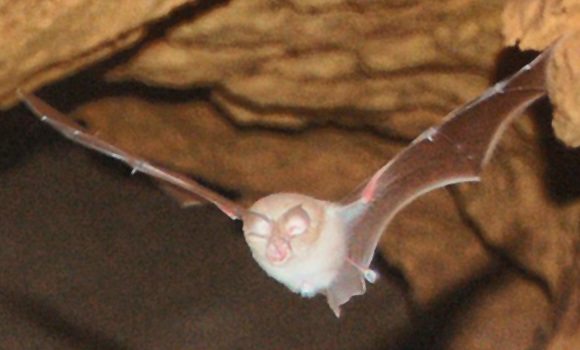
Rhinolophus megaphyllus occurs in Thailand, Malaysia, the Moluccas, New Guinea, the Lesser Sunda Islands and eastern Australia. It has a distinctive pink nose-leaf with grey edging, a horseshoe-shaped lower nose structure and a pointed nasal appendage.
Written 27 November 2026 from the sources listed below. Each statement was checked against the passage it cites; statements that could not be supported were removed.
Appearance
The combined head and body length ranges from 44 to 53 mm, and the forearm measures approximately 44–52 mm. Adults weigh between 7 and 13 grams, and their ears measure between 12 and 21 mm from base to pointed tip.[1][2][3][4]
The species has large, simple ears, tiny eyes and a distinctive nose-leaf. Its dorsal fur is generally grey-brown and darker than its paler underside.[5][6]
Some individuals in Queensland have rufous to orange-coloured fur. Fur coloration in this form varies with age and sex.[7][8]
Habitat
The Smaller Horseshoe Bat inhabits temperate and tropical rainforests, deciduous forests and sclerophyll forests. It also occupies woodlands, coastal scrub and grasslands.[9][10][11]
Its roosting sites include caves, mines, rock outcrops and unoccupied buildings. It selects roosts with high humidity and relatively warm temperatures.[12][13]
Maternity colonies are established exclusively in caves, with maternity roosts located in humid caves.[14][15]
The species occurs in the eastern portion of New Guinea and along the eastern Australian coast from Cape York Peninsula south to Victoria. It occurs at elevations up to 1,600 metres above sea level.[16][17][18]
Diet
The Smaller Horseshoe Bat is insectivorous and consumes moths and other flying insects. Spiders are also included in its diet.[19][20]
Its diet consists predominantly of Lepidoptera and Coleoptera species. Preferred moth prey includes Speiredonia spectans and Speiredonia mutabilis.[21][22]
Behaviour
The species uses constant-frequency echolocation calls between 67 and 71 kHz. It communicates through audible vocalizations and chemical cues.[23][24]
It generally catches prey while flying, using slow, fluttering flight around dense foliage. Individuals can also capture passing prey by flying out from stationary perches.[25][26][27]
The species gleans insects close to surfaces throughout the forest canopy. When roosting, individuals generally hang from cave ceilings rather than cling to walls.[28][29]
Roosting individuals maintain separation from neighbouring bats and may cover their bodies with their wings. Individuals in temperate regions become torpid during winter, while those in tropical regions remain active throughout the year.[30][31][32]
The species is thought to be polygynous.[33]
Reproduction and life cycle
Males begin producing sperm around February and continue through March. Copulation, ovulation and fertilization occur in the latter part of June.[34][35]
Gestation lasts approximately four months, and births take place from late October through November. Young are nursed for approximately two months.[36][37][38]
Male individuals reach sexual maturity between their second and third years. Females generally reach sexual maturity in their third year, sometimes during the latter part of their second year.[39][40]
Pregnant females form maternity colonies containing between 15 and 2,000 individuals. Females care for their offspring until they can fly and obtain food independently.[41][42]
Young reach adult size within a few months of birth.[43]
Conservation
The Smaller Horseshoe Bat is classified as Least Concern on the IUCN Red List. It is not listed under any CITES appendices.[44][45]
Uses
The species can benefit farmers by reducing populations of agricultural insect pests.[46]
Classification of the Smaller Horseshoe Bat
| Kingdom | Animalia |
|---|---|
| Phylum | Chordata |
| Subphylum | Vertebrata |
| Infraphylum | Gnathostomata |
| Parvphylum | Osteichthyes |
| Megaclass | Tetrapoda |
| Class | Mammalia (Mammal) |
| Subclass | Theria |
| Infraclass | Eutheria |
| Order | Chiroptera (Bat) |
| Suborder | Yinpterochiroptera |
| Superfamily | Rhinolophoidea |
| Family | Rhinolophidae (Horseshoe Bat) |
| Genus | Rhinolophus (Horseshoe Bat) |
| Species | Rhinolophus megaphyllus Gray, 1834 |
Where the Smaller Horseshoe Bat is found
Checklists and occurrence records place Rhinolophus megaphyllus in 2 countries across Oceania. GBIF holds 10,498 georeferenced records of it.
Countries
Regions and cities with the most records
- New South Wales, Australia 7,087
- Queensland, Australia 1,859
- Victoria, Australia 731
- Central Coast, Australia 290
- Batemans Bay, Australia 229
- Hornsby, Australia 145
- Port Macquarie, Australia 128
- Cessnock, Australia 112
- Maitland, Australia 92
- Coffs Harbour, Australia 88
- Sydney, Australia 74
- Wollongong, Australia 74
- New Ireland, Papua New Guinea 71
- Parramatta, Australia 61
- Newcastle, Australia 46
- East New Britain Province, Papua New Guinea 45
- Kokopo, Papua New Guinea 43
- Cairns, Australia 35
- Grafton, Australia 32
- Brisbane, Australia 29
- Taree, Australia 20
- Muswellbrook, Australia 16
- Liverpool, Australia 15
- Narangba, Australia 15
- Canberra, Australia 9
- Townsville, Australia 9
- Tuggeranong, Australia 9
- Australian Capital Territory, Australia 8
- Bathurst, Australia 8
- Gold Coast, Australia 7
- Logan City, Australia 6
- Rockhampton, Australia 6
- Caloundra, Australia 5
- Gympie, Australia 4
- Tamworth, Australia 3
- Toowoomba, Australia 3
2 more countries have a few records outside this range
These countries hold a few records of Rhinolophus megaphyllus but lie outside the range the checklists give for it. Such records are often zoo or garden specimens, museum material or vagrants, so the species is not counted as occurring there.
Range as the checklists state it
Australia
A number beside a place is its count of GBIF occurrence records. A place without a number comes from a checklist alone. Records show where a species has been observed or collected, which can include escapes and vagrants.
Common names
English
- Smaller Horseshoe Bat
- Eastern Horseshoe Bat
- Smaller Horseshoe Bat.
Names in 6 other languages
- Czech
- vrápenec australský
- Finnish
- australianherkko
- German
- Östliche Hufeisennase
- Japanese
- ミナミキクガシラコウモリ
- Polish
- Podkowiec wschodni
- Russian
- Австралийский подковонос
Subspecies and varieties
- Rhinolophus megaphyllus fallax (Smaller Horseshoe Bat.) subspecies
- Rhinolophus megaphyllus ignifer (Smaller Horseshoe Bat.) subspecies
- Rhinolophus megaphyllus megaphyllus (Smaller Horseshoe Bat.) subspecies
- Rhinolophus megaphyllus monachus (Smaller Horseshoe Bat.) subspecies
- Rhinolophus megaphyllus vandeuseni (Smaller Horseshoe Bat.) subspecies
- Rhinolophus megaphyllus var. var. β variety
Related species
-
 Greater Horseshoe BatRhinolophus ferrumequinum
-
 Lesser Horseshoe BatRhinolophus hipposideros
-
 Mediterranean Horseshoe BatRhinolophus euryale
-
 Intermediate Horseshoe BatRhinolophus affinis
-
 Blasius's Horseshoe BatRhinolophus blasii
-
 Mehely's Horseshoe BatRhinolophus mehelyi
- Andaman Horseshoe BatRhinolophus cognatus
-
 Least Horseshoe BatRhinolophus pusillus
Compare
Questions and answers
What is the scientific name of the Smaller Horseshoe Bat?
The scientific name of the Smaller Horseshoe Bat is Rhinolophus megaphyllus. Written with its author, the full name is Rhinolophus megaphyllus Gray, 1834.
Which family does the Smaller Horseshoe Bat belong to?
Rhinolophus megaphyllus belongs to the family Rhinolophidae, in the order Chiroptera and the class Mammalia.
Where is the Smaller Horseshoe Bat found?
Checklists and occurrence records place Rhinolophus megaphyllus in 2 countries: Australia and Papua New Guinea.
What is the conservation status of the Smaller Horseshoe Bat?
The IUCN Red List category recorded for Rhinolophus megaphyllus is Least Concern (LC).
What other names does the Smaller Horseshoe Bat have?
Rhinolophus megaphyllus is also known in English as Eastern Horseshoe Bat and Smaller Horseshoe Bat..
What does the horseshoe bat eat?
The Smaller Horseshoe Bat eats moths and other flying insects, as well as spiders. Its diet consists predominantly of Lepidoptera and Coleoptera species, and its preferred moth prey includes Speiredonia spectans and Speiredonia mutabilis.[19][20][21][22]
Where do horseshoe bats live?
The Smaller Horseshoe Bat occurs in Thailand, Malaysia, the Moluccas, New Guinea, the Lesser Sunda Islands and eastern Australia. It inhabits rainforests, deciduous forests, sclerophyll forests, woodlands, coastal scrub and grasslands. It roosts in caves, mines, rock outcrops and unoccupied buildings.[9][10][11][12][47]
Sources
Passages the profile rests on
- The combined head and body length ranges from 44 to 53 mm. Source passage: “combined head and body length of 44–53 millimetres” — English Wikipedia
- The forearm measures approximately 44–52 mm. Source passage: “measurement of the forearm an approximately equal length at 44–52 mm.” — English Wikipedia
- Adults weigh between 7 and 13 grams. Source passage: “The mass is in a range of 7 to 13 grams.” — English Wikipedia
- The ears measure between 12 and 21 mm from their base to their pointed tips. Source passage: “measuring 12–21 millimetres from the base to a finely pointed tip.” — English Wikipedia
- The species has large, simple ears, tiny eyes and a distinctive nose-leaf. Source passage: “They have simple and large ears, measuring 12–21 millimetres from the base to a finely pointed tip. The eyes are tiny and the snout is adorned with a distinctively shaped nose-leaf.” — English Wikipedia
- Its dorsal fur is generally grey-brown and darker than its paler underside. Source passage: “The fur colour is darker above, usually a shade of grey brown that is paler at the ventral side” — English Wikipedia
- Some individuals in Queensland have rufous to orange-coloured fur. Source passage: “the species is recorded in Queensland with rufous to orange coloration across the pelage.” — English Wikipedia
- Fur coloration in the Queensland rufous form varies with age and sex. Source passage: “They are unique from the rest due to their fur, which changes color with age and sex.” — animaldiversity.org
- The species inhabits temperate and tropical rainforests. Source passage: “Smaller horseshoe bats are found in temperate and tropical rainforests” — animaldiversity.org
- Its habitats also include deciduous forests and sclerophyll forests. Source passage: “deciduous forest, sclerophyll forest” — animaldiversity.org
- The species also occupies woodlands, coastal scrub and grasslands. Source passage: “woodlands, coastal scrub, and grasslands.” — animaldiversity.org
- Its roosting sites include caves, mines, rock outcrops and unoccupied buildings. Source passage: “They roost in caves, mines, rock outcrops, and non-occupied buildings.” — animaldiversity.org
- The species selects roosts with high humidity and relatively warm temperatures. Source passage: “Rhinolophus megaphyllus is thought to select roosts based on high humidity and relatively warm temperatures.” — animaldiversity.org
- Maternity colonies are established exclusively in caves. Source passage: “Maternity colonies only occur in caves.” — animaldiversity.org
- Maternity roosts are located in humid caves. Source passage: “with choice roosting being in humid caves.” — animaldiversity.org
- The species is reported from the eastern portion of New Guinea. Source passage: “Accounts suggest that smaller horseshoe bats are found in the eastern portion of New Guinea.” — animaldiversity.org
- In Australia, the species occurs along the eastern coast from Cape York Peninsula south to Victoria. Source passage: “from the tropical regions of Cape York Peninsula along the east coast and inland to the Great Dividing Range as far south as the more temperate climate of Victoria.” — English Wikipedia
- The species occurs at elevations up to 1,600 metres above sea level. Source passage: “They are found at altitudes up to 1600 metres asl.” — English Wikipedia
- The species is insectivorous and consumes moths and other flying insects. Source passage: “They eat moths, other flying insects, and spiders.” — animaldiversity.org
- Spiders are also included in its diet. Source passage: “They eat moths, other flying insects, and spiders.” — animaldiversity.org
- Its preferred moth prey includes Speiredonia spectans and Speiredonia mutabilis. Source passage: “The prey they prefer are moths, specifically Speiredonia spectans and Speiredonia mutabilis .” — animaldiversity.org
- Its diet consists predominantly of Lepidoptera and Coleoptera species. Source passage: “mostly consisting of Lepidoptera and Coleoptera species” — English Wikipedia
- The species uses constant-frequency echolocation calls between 67 and 71 kHz. Source passage: “They use constant frequency calls of 67 to 71 kHz.” — animaldiversity.org
- The species communicates through audible vocalizations and chemical cues. Source passage: “Individuals communicate through audible vocalizations and chemical cues.” — animaldiversity.org
- It generally catches prey while flying. Source passage: “They obtain food primarily while flying.” — animaldiversity.org
- Its flight is slow and fluttering around dense foliage. Source passage: “Their flight patterns are characterized by slow, fluttering flight around dense foliage.” — animaldiversity.org
- Individuals can capture passing prey by flying out from stationary perches. Source passage: “Individuals also capture prey by flying out from a stationary perch to catch passing prey.” — animaldiversity.org
- The species gleans insects close to surfaces throughout the forest canopy. Source passage: “Insects are gleaned close to surfaces at all levels of the forest canopy” — English Wikipedia
- Individuals generally hang from cave ceilings rather than clinging to walls when roosting. Source passage: “Rather than clinging to walls while at their roost, R. megaphyllus hang from the ceiling of caves.” — English Wikipedia
- Roosting individuals maintain separation from neighbouring bats and may cover their bodies with their wings. Source passage: “The individuals roost apart from their neighbours and may cloak their body with the wings.” — English Wikipedia
- Individuals in temperate regions become torpid during winter. Source passage: “Those bats that occupy temperate regions become torpid during winter months and form single roosts.” — animaldiversity.org
- Individuals in tropical regions remain active throughout the year. Source passage: “Tropical areas are occupied year round the bats remain active.” — animaldiversity.org
- The species is thought to be polygynous. Source passage: “Smaller horseshoe bats are thought to be a polygynous species.” — animaldiversity.org
- Males begin producing sperm around February and continue through March. Source passage: “Males produce sperm starting, approximately, in February and continuing through March.” — animaldiversity.org
- Copulation, ovulation and fertilization occur in the latter part of June. Source passage: “In the latter part of June copulation, ovulation, and fertilization occur.” — animaldiversity.org
- Gestation lasts approximately four months. Source passage: “Gestation has a duration of approximately four months.” — animaldiversity.org
- Births take place from late October through November. Source passage: “Births occur from late October through November.” — animaldiversity.org
- Young are nursed for approximately two months. Source passage: “The offspring are nursed for two months.” — animaldiversity.org
- Male individuals reach sexual maturity between their second and third years. Source passage: “Males reach sexual maturity in the second to third year of life” — animaldiversity.org
- Females generally reach sexual maturity in their third year, sometimes during the latter part of their second year. Source passage: “females reach sexual maturity in their third year of life, sometimes the latter part of their second.” — animaldiversity.org
- Pregnant females form maternity colonies containing between 15 and 2,000 individuals. Source passage: “During pregnancy females form maternity colonies that may have as few as fifteen individuals or as many as two thousand.” — animaldiversity.org
- Females care for their offspring until they can fly and obtain food independently. Source passage: “Like other bat species, smaller horseshoe bat females care for their young until they can fly and find food on their own.” — animaldiversity.org
- Young reach adult size within a few months of birth. Source passage: “young are adult sized within a few months of birth.” — animaldiversity.org
- The species is classified as Least Concern on the IUCN Red List. Source passage: “The IUCN Red List has assessed the conservation status of R. megaphyllus as least concern” — English Wikipedia
- The species is not listed under any CITES appendices. Source passage: “This species was not listed under any appendices of CITES.” — animaldiversity.org
- The species can benefit farmers by reducing populations of agricultural insect pests. Source passage: “Their predation on flying insects can impact agricultural pest populations, providing a benefit to farmers.” — animaldiversity.org
- The species occurs in Thailand, Malaysia, the Moluccas, New Guinea, the Lesser Sunda Islands and eastern Australia. Source passage: “Its distribution is throughout Thailand, Malaysia, Moluccas, New Guinea, the Lesser Sunda Islands, and the east coast of Australia.” — animaldiversity.org
Data
- Catalogue of Life, 2026-10-16 XR cc by
- Global Biodiversity Information Facility CC BY 4.0
- Wikidata CC0
- GeoNames CC BY 4.0
- Wikimedia Commons per image; credit shown with each image
- Within the Catalogue of Life, this name comes from The Integrated Taxonomic Information System cc0
References
- Proc. Zool. Soc. Lond. vol.1834 p.52 where the name was published
- Dobson, & George Edward. (1878). Chiroptera in the Collection of the British Museum.
- Wilson, Don E., and DeeAnn M. Reeder, eds. (1993). Mammal Species of the World: A Taxonomic and Geographic Reference, 2nd Ed., 3rd Printing.
- Wilson, Don E., and F. Russell Cole. (2000). Common Names of Mammals of the World.
- Simmons, Nancy B. / Wilson, Don E., and DeeAnn M. Reeder, eds. (2005). Order Chiroptera. Mammal Species of the World: A Taxonomic and Geographic Reference, 3rd Ed., Vols. 1 & 2.
- Wilson, D. E., and R. A. Mittermeier, eds. (2019). Handbook of the Mammals of the World. Vol. 9: Bats.
This species in other databases
Page built on 27 November 2026. See how the catalog is made and all sources and licences.
Cite this page
ScientificNames.org. (2026). Rhinolophus megaphyllus (Smaller Horseshoe Bat). Retrieved November 27, 2026, from https://scientificnames.org/species/rhinolophus-megaphyllus
“Rhinolophus megaphyllus (Smaller Horseshoe Bat).” ScientificNames.org, 2026, scientificnames.org/species/rhinolophus-megaphyllus. Accessed 27 Nov. 2026.
ScientificNames.org. “Rhinolophus megaphyllus (Smaller Horseshoe Bat).” Accessed November 27, 2026. https://scientificnames.org/species/rhinolophus-megaphyllus.
@misc{scientificnames_rhinolophus_megaphyllus_smaller_horseshoe_bat,
  author = {{ScientificNames.org}},
  title = {Rhinolophus megaphyllus (Smaller Horseshoe Bat)},
  year = {2026},
  url = {https://scientificnames.org/species/rhinolophus-megaphyllus},
  note = {Accessed 2026-11-27}
}