Species · Mammals
Mozambican Horseshoe Bat Rhinolophus mossambicus
The scientific name of the Mozambican Horseshoe Bat is Rhinolophus mossambicus. It is a species of mammal in the family Rhinolophidae (horseshoe bat), order Chiroptera. The name dates from 2012.
- Scientific name
- Rhinolophus mossambicus Taylor, Stoffberg, Monadjem, Schoeman, Bayliss & Cotterill, 2012
- Common name
- Mozambican Horseshoe Bat
- Genus
- Rhinolophus
- Family
- Rhinolophidae (Horseshoe Bat)
- Order
- Chiroptera
- Class
- Mammalia
- Red List category
- LC Least Concern
- Recorded in
- 2 countries
- Name status
- accepted in the Catalogue of Life

Overview
Rhinolophus mossambicus occurs in Mozambique and Zimbabwe. It was described as new to science in 2012 after being separated from the Hildebrandt's horseshoe bat species complex.
Written 27 November 2026 from the sources listed below. Each statement was checked against the passage it cites; statements that could not be supported were removed.
Habitat
The Mozambican Horseshoe Bat is associated with savanna habitats. It has been recorded at elevations between 60 and 1,000 metres above sea level.[1][2]
The holotype specimen was collected at Niassa Reserve in Mozambique in July 2006.[3]
Appearance
The species has a forearm length of 60–65 mm.[4]
Behaviour
The Mozambican Horseshoe Bat echolocates at a peak frequency of 35–38 kHz.[5]
Conservation
The species was evaluated as least concern by the IUCN as of 2017. Its population trend is projected to be decreasing.[6][7]
Hunting for bushmeat and disturbance of roosts caused by guano mining are identified as threats to the species.[8][9]
Similar species
The Mozambican Horseshoe Bat was separated from the Hildebrandt's horseshoe bat species complex during its description. Smithers's horseshoe bat was described as another species segregated from the same complex at the same time.[10][11]
Classification of the Mozambican Horseshoe Bat
| Kingdom | Animalia |
|---|---|
| Phylum | Chordata |
| Subphylum | Vertebrata |
| Infraphylum | Gnathostomata |
| Parvphylum | Osteichthyes |
| Megaclass | Tetrapoda |
| Class | Mammalia (Mammal) |
| Subclass | Theria |
| Infraclass | Eutheria |
| Order | Chiroptera (Bat) |
| Suborder | Yinpterochiroptera |
| Superfamily | Rhinolophoidea |
| Family | Rhinolophidae (Horseshoe Bat) |
| Genus | Rhinolophus (Horseshoe Bat) |
| Species | Rhinolophus mossambicus Taylor, Stoffberg, Monadjem, Schoeman, Bayliss & Cotterill, 2012 |
Origin of the name. Etymology. The name denotes the country of origin (Mozambique) of the type specimen of this species. Additional sequenced specimens from Mozambique suggest that the species is widely distributed throughout this country. However R. mossambicus was not recorded on montane islands (Mts Mabu and Inago) to which populations of R. mabuensis are restricted.
Where the Mozambican Horseshoe Bat is found
Checklists and occurrence records place Rhinolophus mossambicus in 2 countries across Africa. GBIF holds 23 georeferenced records of it.
Countries
Regions and cities with the most records
Range as the checklists state it
Africa
A number beside a place is its count of GBIF occurrence records. A place without a number comes from a checklist alone. Records show where a species has been observed or collected, which can include escapes and vagrants.
Common names
English
- Mozambican Horseshoe Bat
Names in 2 other languages
- German
- Mosambik-Hufeisennase
- Polish
- Podkowiec mozambicki
Related species
-
 Greater Horseshoe BatRhinolophus ferrumequinum
-
 Lesser Horseshoe BatRhinolophus hipposideros
-
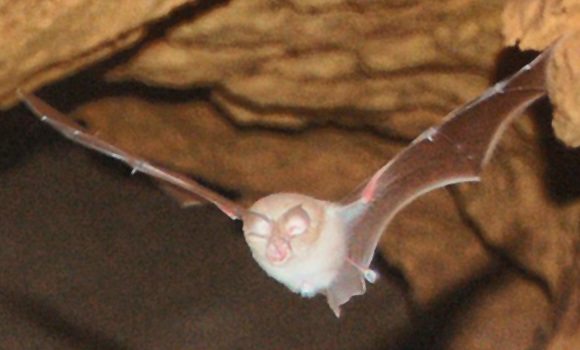 Mediterranean Horseshoe BatRhinolophus euryale
-
 Intermediate Horseshoe BatRhinolophus affinis
-
 Blasius's Horseshoe BatRhinolophus blasii
-
 Mehely's Horseshoe BatRhinolophus mehelyi
- Andaman Horseshoe BatRhinolophus cognatus
-
 Least Horseshoe BatRhinolophus pusillus
Compare
Questions and answers
What is the scientific name of the Mozambican Horseshoe Bat?
The scientific name of the Mozambican Horseshoe Bat is Rhinolophus mossambicus. Written with its author, the full name is Rhinolophus mossambicus Taylor, Stoffberg, Monadjem, Schoeman, Bayliss & Cotterill, 2012.
Which family does the Mozambican Horseshoe Bat belong to?
Rhinolophus mossambicus belongs to the family Rhinolophidae, in the order Chiroptera and the class Mammalia.
Where is the Mozambican Horseshoe Bat found?
Checklists and occurrence records place Rhinolophus mossambicus in 2 countries: Mozambique and Zambia.
What is the conservation status of the Mozambican Horseshoe Bat?
The IUCN Red List category recorded for Rhinolophus mossambicus is Least Concern (LC).
Sources
Passages the profile rests on
- The species is associated with savanna habitats. Source passage: “It is associated with savanna habitats.” — English Wikipedia
- The species has been recorded at elevations between 60 and 1,000 metres above sea level. Source passage: “It has been documented at a range of elevations from 60–1,000 m (200–3,280 ft) above sea level.” — English Wikipedia
- The holotype specimen was collected at Niassa Reserve in Mozambique in July 2006. Source passage: “The holotype had been collected by A. Monadjem in July 2006 at Niassa Reserve in Mozambique.” — English Wikipedia
- The species has a forearm length of 60–65 mm. Source passage: “Its forearm length is 60–65 mm (2.4–2.6 in).” — English Wikipedia
- The species echolocates at a peak frequency of 35–38 kHz. Source passage: “It echolocates at a peak frequency of 35-38 kHz.” — English Wikipedia
- The species was evaluated as least concern by the IUCN as of 2017. Source passage: “As of 2017, it is evaluated as a least-concern species by the IUCN.” — English Wikipedia
- The species' population trend is projected to be decreasing. Source passage: “Its population trend is, however, projected as decreasing” — English Wikipedia
- Hunting for bushmeat is identified as a threat to the species. Source passage: “due to threats, such as hunting for bushmeat” — English Wikipedia
- Disturbance of roosts caused by guano mining is identified as a threat to the species. Source passage: “roost disturbance due to guano mining.” — English Wikipedia
- The species was separated from the Hildebrandt's horseshoe bat species complex during its description. Source passage: “It was segregated from the Hildebrandt's horseshoe bat (R. hildebrandtii) species complex” — English Wikipedia
- Smithers's horseshoe bat was described as another species segregated from the Hildebrandt's horseshoe bat species complex at the same time. Source passage: “at the same time as the Smithers's horseshoe bat, Cohen's horseshoe bat, and Rhinolophus mabuensis.” — English Wikipedia
- The Mozambican horseshoe bat occurs in Mozambique and Zimbabwe. Source passage: “Its range includes the African countries of Mozambique and Zimbabwe.” — English Wikipedia
Data
- Catalogue of Life, 2026-10-16 XR cc by
- Global Biodiversity Information Facility CC BY 4.0
- Wikidata CC0
- GeoNames CC BY 4.0
- Wikimedia Commons per image; credit shown with each image
- Within the Catalogue of Life, this name comes from The Integrated Taxonomic Information System cc0
References
- Taylor, Peter J., Samantha Stoffberg, Ara Monadjem, Martinus Corrie Schoeman, et al. (2012). Four New Bat Species (Rhinolophus hildebrandtii Complex) Reflect Plio-Pleistocene Divergence of Dwarfs and Giants across an Afromontane Archipelago. PLoS ONE, Vol. 7, No. 9, E41744. Link where the name was published
- Wilson, D. E., and R. A. Mittermeier, eds. (2019). Handbook of the Mammals of the World. Vol. 9: Bats.
This species in other databases
Page built on 29 November 2026. See how the catalog is made and all sources and licences.
Cite this page
ScientificNames.org. (2026). Rhinolophus mossambicus (Mozambican Horseshoe Bat). Retrieved November 29, 2026, from https://scientificnames.org/species/rhinolophus-mossambicus
“Rhinolophus mossambicus (Mozambican Horseshoe Bat).” ScientificNames.org, 2026, scientificnames.org/species/rhinolophus-mossambicus. Accessed 29 Nov. 2026.
ScientificNames.org. “Rhinolophus mossambicus (Mozambican Horseshoe Bat).” Accessed November 29, 2026. https://scientificnames.org/species/rhinolophus-mossambicus.
@misc{scientificnames_rhinolophus_mossambicus_mozambican_horseshoe_bat,
  author = {{ScientificNames.org}},
  title = {Rhinolophus mossambicus (Mozambican Horseshoe Bat)},
  year = {2026},
  url = {https://scientificnames.org/species/rhinolophus-mossambicus},
  note = {Accessed 2026-11-29}
}