Species · Mammals
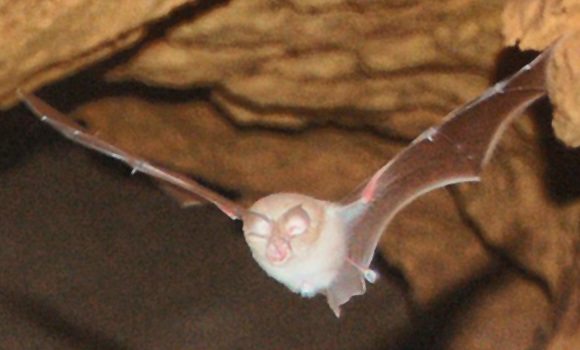
Yaeyama Little Horseshoe Bat Rhinolophus perditus
The scientific name of the Yaeyama Little Horseshoe Bat is Rhinolophus perditus. It is a species of mammal in the family Rhinolophidae (horseshoe bat), order Chiroptera. The name dates from 1918.
- Scientific name
- Rhinolophus perditus K. Andersen, 1918
- Common name
- Yaeyama Little Horseshoe Bat
- Genus
- Rhinolophus
- Family
- Rhinolophidae (Horseshoe Bat)
- Order
- Chiroptera
- Class
- Mammalia
- Red List category
- EN Endangered
- Recorded in
- 1 country
- Name status
- accepted in the Catalogue of Life
Overview
The species is endemic to the Yaeyama Islands of Japan.
Written 27 November 2026 from the sources listed below. Each statement was checked against the passage it cites; statements that could not be supported were removed.
Appearance
It has a shorter tibia than the Okinawa little horseshoe bat.[1]
Diet
The Yaeyama Little Horseshoe Bat feeds on insects, including Lepidoptera such as butterflies and moths, and Hymenoptera such as bees, wasps and ants.[2][3][4]
Behaviour
The species is nocturnal and remains active throughout the year. It is believed to hibernate and frequently awaken to forage.[5][6][7]
It produces echolocation calls with lower constant-frequency values than the Japanese little horseshoe bat and Okinawa little horseshoe bat. It forages mainly in woodland areas.[8][9]
Reproduction and life cycle
Females of the species are monoestrous and give birth to one pup per reproductive event.[10][11]
Conservation
The species is classified as Endangered on the IUCN Red List. Deforestation and habitat loss are principal threats.[12][13]
Destruction of roosting sites and tourist disturbance also threaten the species.[14][15]
Classification of the Yaeyama Little Horseshoe Bat
| Kingdom | Animalia |
|---|---|
| Phylum | Chordata |
| Subphylum | Vertebrata |
| Infraphylum | Gnathostomata |
| Parvphylum | Osteichthyes |
| Megaclass | Tetrapoda |
| Class | Mammalia (Mammal) |
| Subclass | Theria |
| Infraclass | Eutheria |
| Order | Chiroptera (Bat) |
| Suborder | Yinpterochiroptera |
| Superfamily | Rhinolophoidea |
| Family | Rhinolophidae (Horseshoe Bat) |
| Genus | Rhinolophus (Horseshoe Bat) |
| Species | Rhinolophus perditus K. Andersen, 1918 |
Where the Yaeyama Little Horseshoe Bat is found
Checklists and occurrence records place Rhinolophus perditus in 1 country across Asia. GBIF holds 137 georeferenced records of it.
Countries
Range as the checklists state it
Southern Asia
A number beside a place is its count of GBIF occurrence records. A place without a number comes from a checklist alone. Records show where a species has been observed or collected, which can include escapes and vagrants.
Common names
English
- Yaeyama Little Horseshoe Bat
- Yaeyama Horseshoe Bat
Names in 2 other languages
- German
- Yaeyama-Hufeisennase
- Japanese
- Yaeyama Kokikugashira Koumori, ヤエヤマコキクガシラコウモリ
Synonyms
One other scientific name has been used for this species and is now treated as a synonym of Rhinolophus perditus.
- Rhinolophus cornutus perditus K. Andersen, 1918
Subspecies and varieties
- Rhinolophus perditus imaizumii (Imaizumi's Horseshoe Bat) subspecies
- Rhinolophus perditus perditus subspecies
Related species
-
 Greater Horseshoe BatRhinolophus ferrumequinum
-
 Lesser Horseshoe BatRhinolophus hipposideros
-
 Mediterranean Horseshoe BatRhinolophus euryale
-
 Intermediate Horseshoe BatRhinolophus affinis
-
 Blasius's Horseshoe BatRhinolophus blasii
-
 Mehely's Horseshoe BatRhinolophus mehelyi
- Andaman Horseshoe BatRhinolophus cognatus
-
 Least Horseshoe BatRhinolophus pusillus
Compare
Questions and answers
What is the scientific name of the Yaeyama Little Horseshoe Bat?
The scientific name of the Yaeyama Little Horseshoe Bat is Rhinolophus perditus. Written with its author, the full name is Rhinolophus perditus K. Andersen, 1918.
Which family does the Yaeyama Little Horseshoe Bat belong to?
Rhinolophus perditus belongs to the family Rhinolophidae, in the order Chiroptera and the class Mammalia.
Where is the Yaeyama Little Horseshoe Bat found?
Checklists and occurrence records place Rhinolophus perditus in 1 country: Japan.
What is the conservation status of the Yaeyama Little Horseshoe Bat?
The IUCN Red List category recorded for Rhinolophus perditus is Endangered (EN).
What other names does the Yaeyama Little Horseshoe Bat have?
Rhinolophus perditus is also known in English as Yaeyama Horseshoe Bat.
Sources
Passages the profile rests on
- The species has a shorter tibia than the Okinawa little horseshoe bat. Source passage: “shorter tibia than the Okinawa little horseshoe bat.” — English Wikipedia
- The species feeds on insects. Source passage: “The bat's diet consists of insects” — English Wikipedia
- The species eats Lepidoptera, including butterflies and moths. Source passage: “Lepidoptera (butterflies and moths)” — English Wikipedia
- The species eats Hymenoptera, including bees, wasps and ants. Source passage: “Hymenoptera (bees, wasps, ants)” — English Wikipedia
- The species is nocturnal. Source passage: “The Yaeyama little horseshoe bat is nocturnal” — English Wikipedia
- The species remains active throughout the year. Source passage: “though active all year round” — English Wikipedia
- The species is believed to hibernate and frequently awaken to forage. Source passage: “is believed to hibernate but with frequent awakening in order to forage” — English Wikipedia
- The species produces echolocation calls with lower constant-frequency values than the Japanese little horseshoe bat and Okinawa little horseshoe bat. Source passage: “The constant frequency (CF) echolocation values of its calls are also lower than those of these other two species.” — English Wikipedia
- The species forages mainly in woodland areas. Source passage: “for which they forage mainly in areas of woodland.” — English Wikipedia
- Females of the species are monoestrous. Source passage: “Females are monoestrous” — English Wikipedia
- Females give birth to one pup per reproductive event. Source passage: “They give birth to a single pup.” — English Wikipedia
- The species is classified as Endangered on the IUCN Red List. Source passage: “The Yaeyama little horseshoe bat is classed as Endangered on the IUCN Red List.” — English Wikipedia
- Deforestation and habitat loss are principal threats to the species. Source passage: “The principal threats are deforestation and habitat loss” — English Wikipedia
- Destruction of roosting sites threatens the species. Source passage: “destruction of their roosts” — English Wikipedia
- Tourist disturbance is a threat to the species. Source passage: “disturbance by tourists.” — English Wikipedia
Data
- Catalogue of Life, 2026-10-16 XR cc by
- Global Biodiversity Information Facility CC BY 4.0
- Wikidata CC0
- GeoNames CC BY 4.0
- Within the Catalogue of Life, this name comes from The Integrated Taxonomic Information System cc0
References
- Andersen, & Knud. (1918). Diagnoses of new bats of the families Rhinolophidae and Megadermatidae. The Annals and Magazine of Natural History, Including Zoology, Botany, and Geology, 9th Ser., Vol. 2, No. 10. Link where the name was published
- Wilson, D. E., and R. A. Mittermeier, eds. (2019). Handbook of the Mammals of the World. Vol. 9: Bats.
This species in other databases
Page built on 27 November 2026. See how the catalog is made and all sources and licences.
Cite this page
ScientificNames.org. (2026). Rhinolophus perditus (Yaeyama Little Horseshoe Bat). Retrieved November 27, 2026, from https://scientificnames.org/species/rhinolophus-perditus
“Rhinolophus perditus (Yaeyama Little Horseshoe Bat).” ScientificNames.org, 2026, scientificnames.org/species/rhinolophus-perditus. Accessed 27 Nov. 2026.
ScientificNames.org. “Rhinolophus perditus (Yaeyama Little Horseshoe Bat).” Accessed November 27, 2026. https://scientificnames.org/species/rhinolophus-perditus.
@misc{scientificnames_rhinolophus_perditus_yaeyama_little_horseshoe_bat,
  author = {{ScientificNames.org}},
  title = {Rhinolophus perditus (Yaeyama Little Horseshoe Bat)},
  year = {2026},
  url = {https://scientificnames.org/species/rhinolophus-perditus},
  note = {Accessed 2026-11-27}
}