Species · Mammals
Sulawesi Broad-eared Horseshoe Bat Rhinolophus tatar
The scientific name of the Sulawesi Broad-eared Horseshoe Bat is Rhinolophus tatar. It is a species of mammal in the family Rhinolophidae (horseshoe bat), order Chiroptera. The name dates from 1982.
- Scientific name
- Rhinolophus tatar Bergmans & Rozendaal, 1982
- Common name
- Sulawesi Broad-eared Horseshoe Bat
- Genus
- Rhinolophus
- Family
- Rhinolophidae (Horseshoe Bat)
- Order
- Chiroptera
- Class
- Mammalia
- Red List category
- LC Least Concern
- Recorded in
- 1 country
- Name status
- accepted in the Catalogue of Life
Overview
Rhinolophus tatar is endemic to Indonesia and has only been recorded on the island of Sulawesi. It has large, triangular ears and dense, woolly fur.
Written 27 November 2026 from the sources listed below. Each statement was checked against the passage it cites; statements that could not be supported were removed.
Similar species
In 1992, the Sulawesi Broad-eared Horseshoe Bat was treated as synonymous with the broad-eared horseshoe bat, Rhinolophus euryotis. A morphological and genetic analysis published in 2013 concluded that Rhinolophus tatar is distinct from Rhinolophus euryotis.[1][2]
Appearance
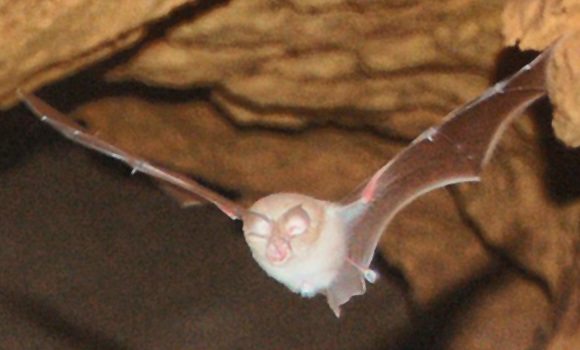
The Sulawesi Broad-eared Horseshoe Bat has large, triangular ears that are longer than they are wide. Its forearm measures between 48.7 and 51.8 mm in length.[3][4]
Its fur is dense and woolly. The hairs on its back have white bases and dark brown tips, while those on its belly have white bases and medium-brown tips.[5][6][7]
Habitat
The species may roost in caves, although tree roosting is considered more likely.[8]
Diet
The Sulawesi Broad-eared Horseshoe Bat is insectivorous.[9]
Behaviour
It obtains prey by gleaning insects from foliage or catching them in flight.[10]
Classification of the Sulawesi Broad-eared Horseshoe Bat
| Kingdom | Animalia |
|---|---|
| Phylum | Chordata |
| Subphylum | Vertebrata |
| Infraphylum | Gnathostomata |
| Parvphylum | Osteichthyes |
| Megaclass | Tetrapoda |
| Class | Mammalia (Mammal) |
| Subclass | Theria |
| Infraclass | Eutheria |
| Order | Chiroptera (Bat) |
| Suborder | Yinpterochiroptera |
| Superfamily | Rhinolophoidea |
| Family | Rhinolophidae (Horseshoe Bat) |
| Genus | Rhinolophus (Horseshoe Bat) |
| Species | Rhinolophus tatar Bergmans & Rozendaal, 1982 |
Where the Sulawesi Broad-eared Horseshoe Bat is found
Checklists and occurrence records place Rhinolophus tatar in 1 country across Asia. GBIF holds 642 georeferenced records of it.
Countries
Range as the checklists state it
Southern Asia
A number beside a place is its count of GBIF occurrence records. A place without a number comes from a checklist alone. Records show where a species has been observed or collected, which can include escapes and vagrants.
Common names
English
- Sulawesi Broad-eared Horseshoe Bat
- Broad-eared Horseshoe Bat
- Tatar Horseshoe Bat
Names in 1 other language
- German
- Tate-Archbold-Hufeisennase
Synonyms
3 other scientific names have been used for this species and are now treated as synonyms of Rhinolophus tatar.
- Rhinolophus euryotis Hill, 1988
- Rhinolophus euryotis tatar Bergmans & Rozendaal, 1982
- Rhinolophus tartar Bergmans & Rozendaal, 1982
Related species
-
 Greater Horseshoe BatRhinolophus ferrumequinum
-
 Lesser Horseshoe BatRhinolophus hipposideros
-
 Mediterranean Horseshoe BatRhinolophus euryale
-
 Intermediate Horseshoe BatRhinolophus affinis
-
 Blasius's Horseshoe BatRhinolophus blasii
-
 Mehely's Horseshoe BatRhinolophus mehelyi
- Andaman Horseshoe BatRhinolophus cognatus
-
 Least Horseshoe BatRhinolophus pusillus
Compare
- Sulawesi Broad-eared Horseshoe Bat vs Greater Horseshoe Bat
- Sulawesi Broad-eared Horseshoe Bat vs Lesser Horseshoe Bat
- Sulawesi Broad-eared Horseshoe Bat vs Mediterranean Horseshoe Bat
- Sulawesi Broad-eared Horseshoe Bat vs Intermediate Horseshoe Bat
- Sulawesi Broad-eared Horseshoe Bat vs Blasius's Horseshoe Bat
Questions and answers
What is the scientific name of the Sulawesi Broad-eared Horseshoe Bat?
The scientific name of the Sulawesi Broad-eared Horseshoe Bat is Rhinolophus tatar. Written with its author, the full name is Rhinolophus tatar Bergmans & Rozendaal, 1982.
Which family does the Sulawesi Broad-eared Horseshoe Bat belong to?
Rhinolophus tatar belongs to the family Rhinolophidae, in the order Chiroptera and the class Mammalia.
Where is the Sulawesi Broad-eared Horseshoe Bat found?
Checklists and occurrence records place Rhinolophus tatar in 1 country: Indonesia.
What is the conservation status of the Sulawesi Broad-eared Horseshoe Bat?
The IUCN Red List category recorded for Rhinolophus tatar is Least Concern (LC).
What other names does the Sulawesi Broad-eared Horseshoe Bat have?
Rhinolophus tatar is also known in English as Broad-eared Horseshoe Bat and Tatar Horseshoe Bat.
Where are horseshoe bats found?
The Sulawesi Broad-eared Horseshoe Bat is endemic to Indonesia and has only been recorded on the island of Sulawesi.[11]
What does the horseshoe bat eat?
The Sulawesi Broad-eared Horseshoe Bat is insectivorous.[9]
Where does the horseshoe bat live?
The species may roost in caves, although tree roosting is considered more likely.[8]
Sources
Passages the profile rests on
- In 1992, the species was treated as synonymous with the broad-eared horseshoe bat, Rhinolophus euryotis. Source passage: “In 1992, Hill published that it was synonymous with the broad-eared horseshoe bat, R. euryotis.” — English Wikipedia
- A morphological and genetic analysis published in 2013 concluded that Rhinolophus tatar is distinct from Rhinolophus euryotis. Source passage: “In 2013, a morphological and genetic analysis concluded that R. tatar was distinct from the broad-eared horseshoe bat.” — English Wikipedia
- Its forearm measures between 48.7 and 51.8 mm in length. Source passage: “R. tatar has a forearm length of 48.7–51.8 mm” — English Wikipedia
- The species has large, triangular ears that are longer than they are wide. Source passage: “It has large, triangular ears that are longer than they are wide.” — English Wikipedia
- Its fur is dense and woolly. Source passage: “Its fur is dense and woolly.” — English Wikipedia
- The hairs on its back have white bases and dark brown tips. Source passage: “on the back, they have white bases and dark brown tips” — English Wikipedia
- The hairs on its belly have white bases and medium-brown tips. Source passage: “while on the belly they have white bases and medium-brown tips.” — English Wikipedia
- The species may roost in caves, although tree roosting is considered more likely. Source passage: “It possibly roosts in caves, though it is more likely that it roosts in trees.” — English Wikipedia
- The species is insectivorous. Source passage: “R. tatar is insectivorous” — English Wikipedia
- It obtains prey by gleaning insects from foliage or catching them in flight. Source passage: “gleaning prey from foliage or hawking them from the air.” — English Wikipedia
- The species is endemic to Indonesia and has only been recorded on the island of Sulawesi. Source passage: “It is endemic to Indonesia, where it has only been found on the island of Sulawesi.” — English Wikipedia
Data
- Catalogue of Life, 2026-10-16 XR cc by
- Global Biodiversity Information Facility CC BY 4.0
- Wikidata CC0
- GeoNames CC BY 4.0
- Within the Catalogue of Life, this name comes from The Integrated Taxonomic Information System cc0
References
- Notes on Rhinolophus Lacepede, 1799 from Sulawesi, Indonesia, with the description of a new species (Mammalia, Microchiroptera). (1982). Contributions to Zoology, 52(2), 169–174. https://doi.org/10.1163/26660644-05202007 Link where the name was published
- Hill, J. E. (1983). Bats (Mammalia: Chiroptera) from Indo-Australia. Bulletin of the British Museum (Natural History), Zoology, Vol. 45, No. 3. Link
- Patrick, Lorelei E., Even S. McCulloch, and Luis Ruedas. (2013). Systematics and biogeography of the arcuate horseshoe bat species complex (Chiroptera, Rhinolophidae). Zoologica Scripta, Vol. 42, No. 6.
- Wilson, D. E., and R. A. Mittermeier, eds. (2019). Handbook of the Mammals of the World. Vol. 9: Bats.
This species in other databases
Page built on 28 November 2026. See how the catalog is made and all sources and licences.
Cite this page
ScientificNames.org. (2026). Rhinolophus tatar (Sulawesi Broad-eared Horseshoe Bat). Retrieved November 28, 2026, from https://scientificnames.org/species/rhinolophus-tatar
“Rhinolophus tatar (Sulawesi Broad-eared Horseshoe Bat).” ScientificNames.org, 2026, scientificnames.org/species/rhinolophus-tatar. Accessed 28 Nov. 2026.
ScientificNames.org. “Rhinolophus tatar (Sulawesi Broad-eared Horseshoe Bat).” Accessed November 28, 2026. https://scientificnames.org/species/rhinolophus-tatar.
@misc{scientificnames_rhinolophus_tatar_sulawesi_broad_eared_horseshoe_bat,
  author = {{ScientificNames.org}},
  title = {Rhinolophus tatar (Sulawesi Broad-eared Horseshoe Bat)},
  year = {2026},
  url = {https://scientificnames.org/species/rhinolophus-tatar},
  note = {Accessed 2026-11-28}
}