Species · Mammals
Willard's Horseshoe Bat Rhinolophus willardi
The scientific name of the Willard's Horseshoe Bat is Rhinolophus willardi. It is a species of mammal in the family Rhinolophidae (horseshoe bat), order Chiroptera. The name dates from 2013.
- Scientific name
- Rhinolophus willardi Kerbis Peterhans & Fahr, 2013
- Common name
- Willard's Horseshoe Bat
- Genus
- Rhinolophus
- Family
- Rhinolophidae (Horseshoe Bat)
- Order
- Chiroptera
- Class
- Mammalia
- Red List category
- EN Endangered
- Recorded in
- 1 country
- Name status
- accepted in the Catalogue of Life
Overview
Willard's Horseshoe Bat is a mammal in the family Rhinolophidae, order Chiroptera, and class Mammalia. It has been recorded in the Misotschi-Kabogo highlands of South Kivu province in the Democratic Republic of the Congo. Its species epithet honours Dr. David Willard for his contribution to bat conservation.
Written 27 November 2026 from the sources listed below. Each statement was checked against the passage it cites; statements that could not be supported were removed.
Appearance
Willard's Horseshoe Bat belongs to the family Rhinolophidae.[1]
Habitat
The holotype was captured near a stream in a deep valley surrounded by dense forest with tall trees and an open understory. The species has been recorded in montane forest at elevations of 1,880 m and 1,950 m.[2][3]
The species probably roosts in caves and mines.[4]
Similar species
Willard's Horseshoe Bat belongs to the Rhinolophus maclaudi species group.[5]
Conservation
Willard's Horseshoe Bat is classified as endangered on the IUCN Red List. It is very poorly documented, and its population size is unknown.[6][7]
Its recorded range is affected by regional conflict, unregulated forest clearing, habitat degradation, and disturbance of roosts. The species is probably affected by hunting of roosting bats in its range.[8][9]
Classification of the Willard's Horseshoe Bat
| Kingdom | Animalia |
|---|---|
| Phylum | Chordata |
| Subphylum | Vertebrata |
| Infraphylum | Gnathostomata |
| Parvphylum | Osteichthyes |
| Megaclass | Tetrapoda |
| Class | Mammalia (Mammal) |
| Subclass | Theria |
| Infraclass | Eutheria |
| Order | Chiroptera (Bat) |
| Suborder | Yinpterochiroptera |
| Superfamily | Rhinolophoidea |
| Family | Rhinolophidae (Horseshoe Bat) |
| Genus | Rhinolophus (Horseshoe Bat) |
| Species | Rhinolophus willardi Kerbis Peterhans & Fahr, 2013 |
Where the Willard's Horseshoe Bat is found
Checklists and occurrence records place Rhinolophus willardi in 1 country across Africa. GBIF holds 9 georeferenced records of it.
Countries
Regions and cities with the most records
Range as the checklists state it
Africa
A number beside a place is its count of GBIF occurrence records. A place without a number comes from a checklist alone. Records show where a species has been observed or collected, which can include escapes and vagrants.
Common names
English
- Willard's Horseshoe Bat
Names in 3 other languages
- French
- Rhinolophe de Willard
- German
- Willards Hufeisennase
- Polish
- Podkowiec ryftowy
Related species
-
 Greater Horseshoe BatRhinolophus ferrumequinum
-
 Lesser Horseshoe BatRhinolophus hipposideros
-
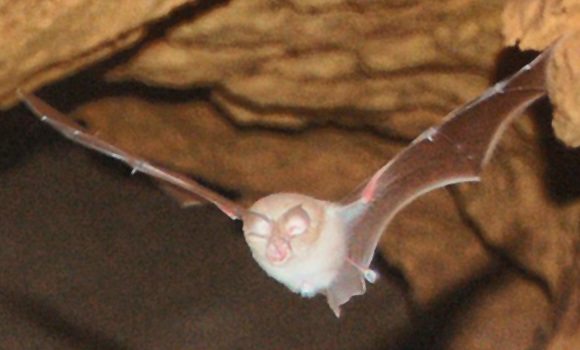 Mediterranean Horseshoe BatRhinolophus euryale
-
 Intermediate Horseshoe BatRhinolophus affinis
-
 Blasius's Horseshoe BatRhinolophus blasii
-
 Mehely's Horseshoe BatRhinolophus mehelyi
- Andaman Horseshoe BatRhinolophus cognatus
-
 Least Horseshoe BatRhinolophus pusillus
Compare
Questions and answers
What is the scientific name of the Willard's Horseshoe Bat?
The scientific name of the Willard's Horseshoe Bat is Rhinolophus willardi. Written with its author, the full name is Rhinolophus willardi Kerbis Peterhans & Fahr, 2013.
Which family does the Willard's Horseshoe Bat belong to?
Rhinolophus willardi belongs to the family Rhinolophidae, in the order Chiroptera and the class Mammalia.
Where is the Willard's Horseshoe Bat found?
Checklists and occurrence records place Rhinolophus willardi in 1 country: Democratic Republic of the Congo.
What is the conservation status of the Willard's Horseshoe Bat?
The IUCN Red List category recorded for Rhinolophus willardi is Endangered (EN).
Sources
Passages the profile rests on
- Willard's horseshoe bat belongs to the family Rhinolophidae. Source passage: “Willard's horseshoe bat (Rhinolophus willardi) is a newly described species of bat in the family Rhinolophidae.” — English Wikipedia
- The holotype was captured near a stream in a deep valley surrounded by dense forest with tall trees and an open understory. Source passage: “The holotype was captured near a stream in a deep valley. The surrounding forest is dense and composed of tall trees about 40–50 m tall and had an open understory.” — English Wikipedia
- The species has been recorded in montane forest at elevations of 1,880 m and 1,950 m. Source passage: “The specimens were captured at elevations of 1,880 m and 1,950 m in montane forest.” — English Wikipedia
- The species probably roosts in caves and mines. Source passage: “It probably roosts in caves and mines.” — English Wikipedia
- The species belongs to the Rhinolophus maclaudi species group. Source passage: “It is part of the Rhinolophus maclaudi species group.” — English Wikipedia
- The species is classified as endangered on the IUCN Red List. Source passage: “It is listed as endangered by the IUCN Red List.” — English Wikipedia
- The species is very poorly documented, and its population size is unknown. Source passage: “The species is very poorly documented and no information exists on its population.” — English Wikipedia
- The species' recorded range is affected by regional conflict, unregulated forest clearing, habitat degradation, and disturbance of roosts. Source passage: “However, the area it has been recorded in is unstable due to regional conflict and is affected by unregulated forest clearing, habitat degradation, and roost disturbance.” — English Wikipedia
- The species is probably affected by hunting of roosting bats in its range. Source passage: “The species is also probably affected by hunting of roosting bats, which is a common regional practice in its range.” — English Wikipedia
- The species has been recorded at only two capture sites in the Misotschi-Kabogo highlands of South Kivu province in the Democratic Republic of the Congo. Source passage: “The species has only been recorded from two capture sites in the Misotschi-Kabogo highlands in the South Kivu province off the shore of Lake Tanganyika in the Democratic Republic of the Congo.” — English Wikipedia
Data
- Catalogue of Life, 2026-10-16 XR cc by
- Global Biodiversity Information Facility CC BY 4.0
- Wikidata CC0
- GeoNames CC BY 4.0
- Within the Catalogue of Life, this name comes from The Integrated Taxonomic Information System cc0
References
- Kerbis Peterhans, Julian C., Jakob Fahr, Michael H. Huhndorf, Prince Kaleme, et al. (2013). Bats (Chiroptera) from the Albertine Rift, eastern Democratic Republic of Congo, with the description of two new species of the Rhinolophus maclaudi group. Bonn Zoological Bulletin, Vol. 62, No. 2. where the name was published
- Wilson, D. E., and R. A. Mittermeier, eds. (2019). Handbook of the Mammals of the World. Vol. 9: Bats.
This species in other databases
Page built on 28 November 2026. See how the catalog is made and all sources and licences.
Cite this page
ScientificNames.org. (2026). Rhinolophus willardi (Willard's Horseshoe Bat). Retrieved November 28, 2026, from https://scientificnames.org/species/rhinolophus-willardi
“Rhinolophus willardi (Willard's Horseshoe Bat).” ScientificNames.org, 2026, scientificnames.org/species/rhinolophus-willardi. Accessed 28 Nov. 2026.
ScientificNames.org. “Rhinolophus willardi (Willard's Horseshoe Bat).” Accessed November 28, 2026. https://scientificnames.org/species/rhinolophus-willardi.
@misc{scientificnames_rhinolophus_willardi_willards_horseshoe_bat,
  author = {{ScientificNames.org}},
  title = {Rhinolophus willardi (Willard's Horseshoe Bat)},
  year = {2026},
  url = {https://scientificnames.org/species/rhinolophus-willardi},
  note = {Accessed 2026-11-28}
}